Table of contents
Google Ads runs nine campaign types, and each one buys a different kind of attention. Picking the wrong type is the single most expensive setup mistake in a paid search account.
Key Takeaways
- 9 campaign types exist in the Google Ads interface: Search, Performance Max, Shopping, Display, Video, Demand Gen, App, Local Services and Smart.
- $294.69 billion in advertising revenue reached Google in 2025 (Statista), which is why every surface it owns eventually becomes an ad placement.
- Just under 90% of global search referrals still come through Google, so Search campaigns remain the demand-capture default.
- 1 conversion action should drive the whole account before you open a second campaign type.
- 30 conversions in 30 days per campaign is the practical floor before Target CPA or Target ROAS bidding behaves predictably.
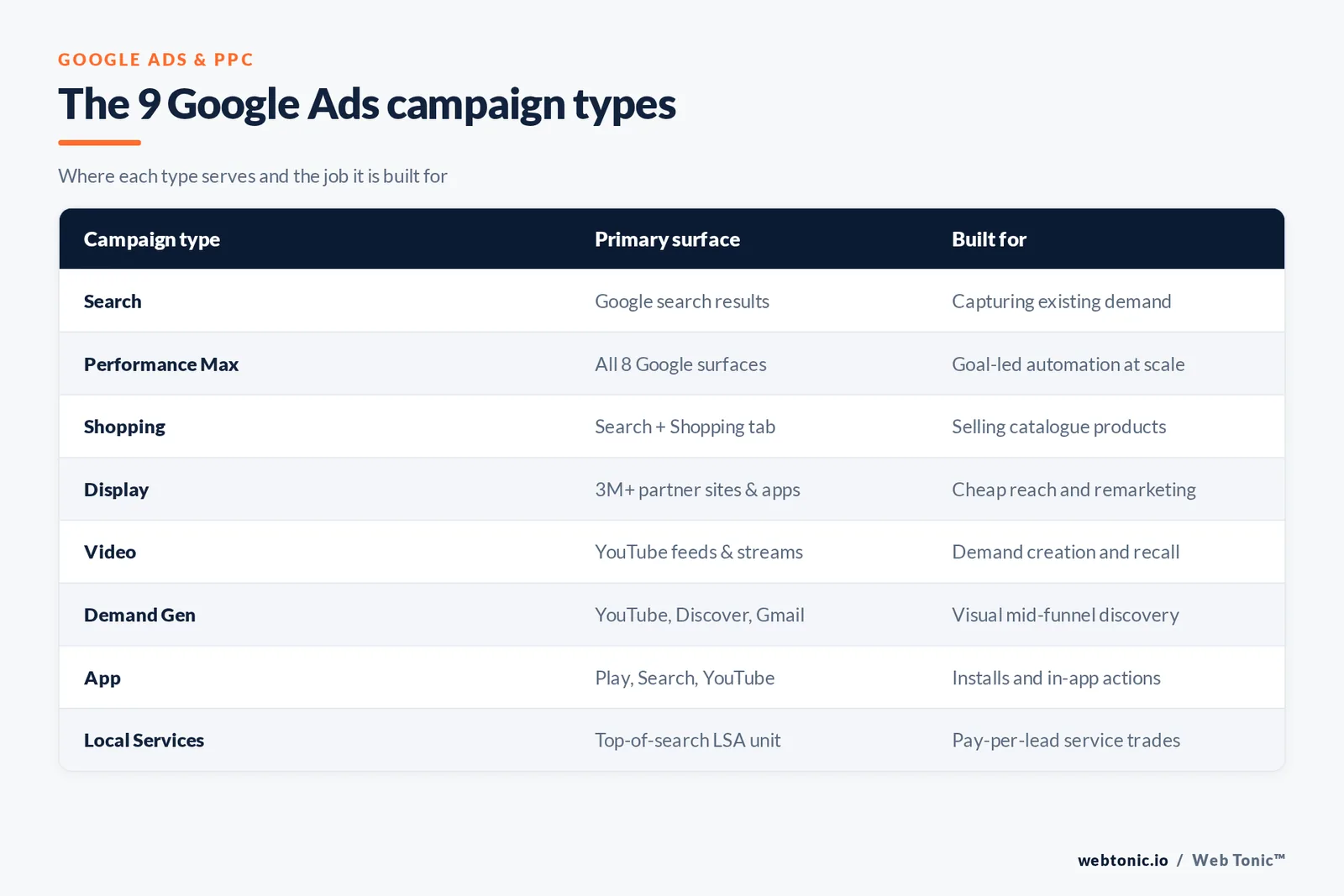
The nine Google Ads campaign types, side by side
Google's own onboarding flow asks for a goal first and a campaign type second, and its campaign type selection guide is written that way on purpose. The underlying taxonomy is visible in the API, where every campaign carries an advertising channel type value — a useful sanity check when the interface renames things faster than the documentation.
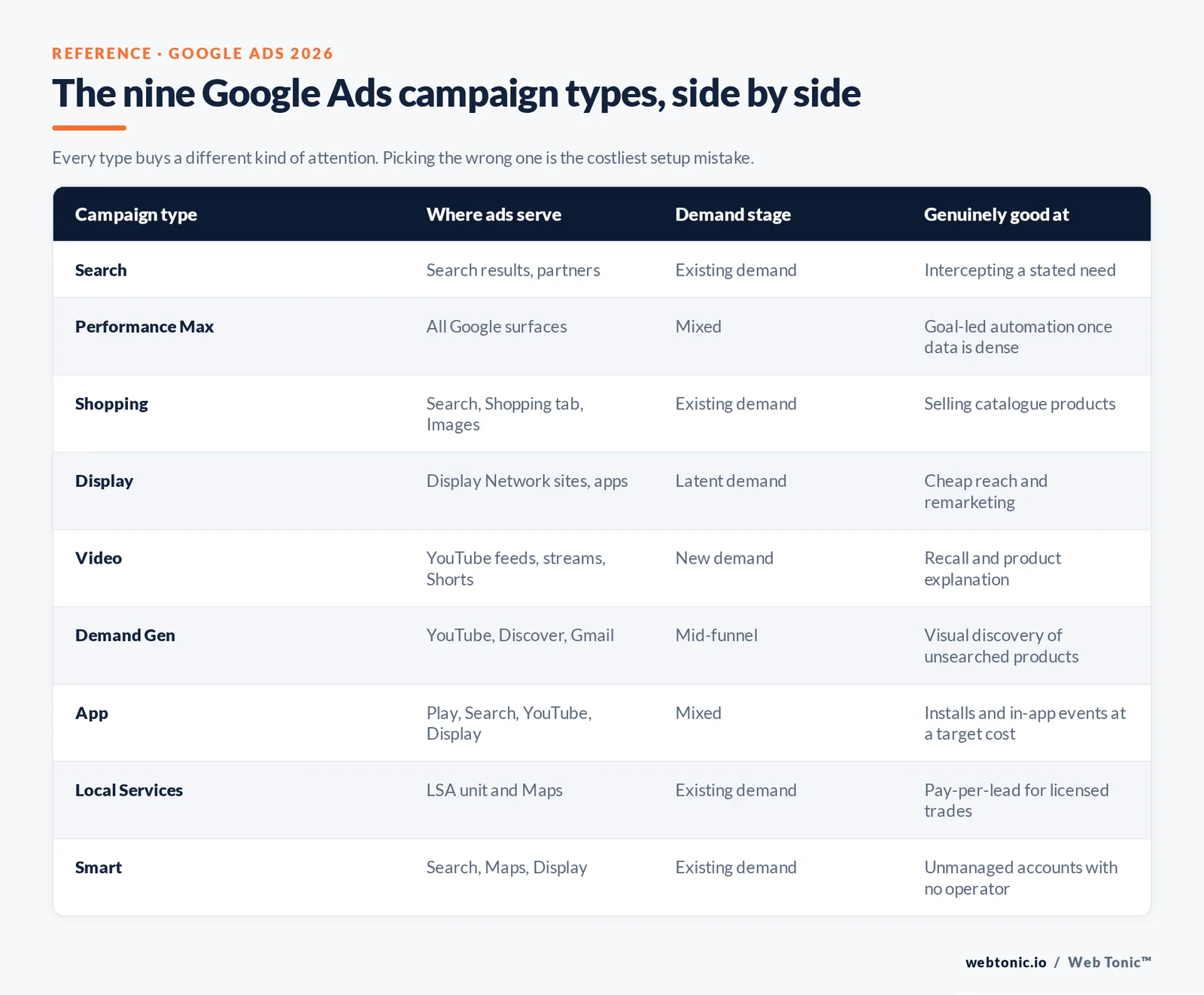
| Campaign type | Where ads serve | Demand stage | What it is genuinely good at |
|---|---|---|---|
| Search | Google search results, search partners | Existing demand | Intercepting a stated need at the moment it is typed |
| Performance Max | All Google surfaces from one campaign | Mixed | Goal-led automation once conversion data is dense |
| Shopping | Search, Shopping tab, Images | Existing demand | Selling catalogue products with price and image up front |
| Display | Google Display Network sites and apps | Latent demand | Cheap incremental reach and remarketing |
| Video | YouTube feeds, streams, Shorts | New demand | Building recall and explaining a product |
| Demand Gen | YouTube, Discover, Gmail | Mid-funnel | Visual discovery for products people do not search for yet |
| App | Play, Search, YouTube, Display | Mixed | Installs and in-app events at a target cost |
| Local Services | Top-of-search LSA unit and Maps | Existing demand | Pay-per-lead for licensed service trades |
| Smart | Search, Maps, Display | Existing demand | Unmanaged accounts with no in-house operator |
Rule 1 — treat these 9 types as 3 jobs. Capture demand (Search, Shopping, Local Services), create demand (Video, Demand Gen, Display), or hand the surface split to automation (Performance Max, App, Smart). Most wasted budget comes from buying a create-demand type while measuring it against a capture-demand cost per acquisition.
Search campaigns: still the anchor of most accounts
Search remains the highest-intent inventory Google sells, and Statcounter's market share tracker explains why: the engine still handles close to nine in ten global search referrals. Responsive search ads assemble headlines and descriptions dynamically, so the operator's job shifts from writing one perfect ad to feeding a strong asset pool and controlling which queries are allowed in.
Rule 2 — 15 headlines and 4 descriptions is the asset ceiling for a responsive search ad, and filling it with near-duplicates is worse than shipping 8 genuinely different angles. Trap 1 — 1 keyword per ad group structures are no longer a universal answer; with broad match and Smart Bidding, 5 to 20 tightly themed keywords per ad group usually gathers signal faster.
| Business model | First campaign type | Second | Why this order |
|---|---|---|---|
| Local service business | Local Services or Search | Performance Max | Lead volume is capped by geography, so intent beats reach |
| Ecommerce (500+ SKUs) | Shopping | Performance Max | Feed quality decides everything before automation helps |
| B2B SaaS | Search | Demand Gen | Small keyword universe, long cycle, needs mid-funnel nurture |
| Mobile app | App | Video | Install events are the only clean optimisation signal |
| New consumer brand | Video | Search - brand | Nobody searches a category term they have never heard |
| Marketplace or aggregator | Search - non-brand | Display remarketing | Wide query surface, high repeat-visit value |
Shopping and Performance Max: the retail pair
Shopping ads pull price, image and title from the Merchant Center feed rather than from ad copy, which makes the feed the real creative asset. Performance Max takes the same feed and spends it across every Google surface at once, optimising to a goal you declare rather than to placements you pick.
Rule 3 — 2 weeks minimum before judging a Performance Max campaign, and closer to 6 weeks if the account records fewer than 30 conversions a month. Trap 2 — 100% of budget in Performance Max hides which surface earned the sale; keep a separate brand Search campaign so you can still read incremental non-brand performance. Google's own product announcements at Marketing Live keep pushing more control back into the type — channel reporting and search term visibility have both improved, but the campaign is still a single bidding entity.
| Decision | Choose Search | Choose Shopping | Choose Performance Max |
|---|---|---|---|
| You sell | Services or lead-gen offers | Physical products with a feed | Products, with 30+ monthly conversions |
| Control needed | Query-level, high | Product-level, medium | Goal-level, low |
| Creative required | Text assets only | Feed images | Text, image, video, feed |
| Time to signal | 7-14 days | 14 days | 4-6 weeks |
| Biggest failure mode | Query waste | Thin or rejected feed data | Brand cannibalisation |

Display, Video and Demand Gen: the create-demand block
The Google Display Network spans millions of sites and apps, which makes it the cheapest reach in the platform and the easiest place to waste money. Video sits on YouTube with a defined set of video ad formats — skippable in-stream, non-skippable, in-feed, bumper and Shorts — and the format choice matters more than the targeting. Demand Gen replaced Discovery campaigns and serves the same visual creative into YouTube feeds, Discover and Gmail.
Rule 4 — 6 seconds is the whole bumper format, so a bumper carrying three messages carries none. Rule 5 — 5 seconds is all you own before a skippable in-stream ad can be dismissed; Think with Google's video research keeps landing on the same conclusion, which is that the opening frame does most of the work. Trap 3 — 0 exclusions on a new Display campaign is how mobile-app placements quietly absorb 40% of a test budget.
| Campaign type | Assets you must have | Minimum viable set | Refresh cadence |
|---|---|---|---|
| Search | Headlines, descriptions, sitelinks | 8 headlines, 3 descriptions | Quarterly |
| Shopping | Compliant product feed | Title, image, price, GTIN | Daily feed sync |
| Performance Max | Text, images, logos, video | 5 images, 1 video, 5 headlines | Every 6-8 weeks |
| Display | Responsive display assets | 3 images, 5 headlines | Every 8 weeks |
| Video | Hosted YouTube videos | 1 hero cut plus 6s bumper | Every 4-6 weeks |
| Demand Gen | Vertical and square creative | 3 image ratios, 1 vertical video | Every 4 weeks |
| App | Store listing plus asset groups | 2 videos, 4 images, 5 lines | Every 6 weeks |
App and Local Services: the two specialist types
App campaigns are built entirely around installs and in-app events; there is no keyword layer to manage, only assets, geography and a target cost. Local Services Ads are stranger still — they sit above the normal ad block, require licence and insurance verification, and bill per lead rather than per click. For plumbers, electricians, lawyers and locksmiths, that billing model changes the maths completely.
Rule 6 — 100% of Local Services spend is charged on contacts, so lead disputing is an operational task, not an optional one. Trap 4 — 1 shared budget across Local Services and Search hides which channel actually produced the booked job; keep the reporting separate and reconcile against your CRM. Our data intelligence work usually starts here, because a lead source that cannot be traced cannot be scaled.
Bidding: the choice that decides whether the type works
Campaign type sets the inventory; bidding sets the economics. The same Search campaign can be a brand-defence exercise on impression share or a strict acquisition engine on Target CPA. Volume is the deciding variable, not ambition.
| Monthly conversions | Sensible bid strategy | Campaign types that fit | What breaks if you overreach |
|---|---|---|---|
| 0-15 | Manual CPC or Maximise Clicks | Search, Display | Smart Bidding never exits learning |
| 15-30 | Maximise Conversions, no target | Search, Shopping | tCPA throttles delivery to near zero |
| 30-100 | Target CPA | Search, Shopping, Demand Gen, App | tROAS misprices low-margin products |
| 100-500 | Target ROAS | Shopping, Performance Max | Over-segmentation splits the signal |
| 500+ | Portfolio tROAS with rules | All types | Manual tinkering undoes the model |
Rule 7 — 7 to 14 days of learning follows any bid strategy or target change, so stacking two changes in one week destroys your ability to attribute the outcome. Rule 8 — 20% maximum movement on a CPA or ROAS target per change keeps the campaign out of a hard reset.
How the types fit together in one account
A functioning account is a portfolio, not a favourite. The split below is a defensible starting point for a lead-generation business with no historical data, and it deliberately holds budget back for testing rather than allocating everything on day one.
| Layer | Share of budget | Campaign type | Primary metric |
|---|---|---|---|
| Brand defence | 10% | Search - brand | Impression share, cost per booked lead |
| Demand capture | 45% | Search - non-brand | Qualified cost per acquisition |
| Automation layer | 20% | Performance Max | Incremental conversions, new customer share |
| Demand creation | 10% | Video or Demand Gen | Assisted conversions, branded search lift |
| Recovery | 5% | Display remarketing | Return-visit conversion rate |
| Reserve | 10% | Whichever type earns it | Marginal cost per acquisition |
Industry-level spending patterns published in the IAB internet advertising revenue report show search and retail media still absorbing the majority of digital budgets, which matches what most accounts discover the hard way: capture converts, creation compounds. If you want the creative side of that split handled properly, that is what our performance creative team exists for, and the strategy layer sits with growth marketing.
What to measure for each campaign type
Every type deserves its own scorecard. Holding a Video campaign to the same last-click cost per acquisition as brand Search is the fastest way to switch off the thing that was feeding the funnel. Set the primary metric before launch, and write down the number that would make you stop.
| Campaign type | Primary metric | Secondary metric | Vanity metric to ignore |
|---|---|---|---|
| Search - brand | Cost per booked lead or order | Impression share, above 85% | Click-through rate |
| Search - non-brand | Qualified cost per acquisition | Search term relevance rate | Average position proxies |
| Shopping | Return on ad spend by product tier | Feed approval rate, target 100% | Total impressions |
| Performance Max | Incremental non-brand conversions | New customer share | Blended campaign ROAS |
| Display | Return-visit conversion rate | Placement quality after exclusions | View-through conversions alone |
| Video | Branded search lift | View rate above 20% | Cost per view in isolation |
| Demand Gen | Cost per qualified action | Creative hold rate by format | Reach |
| App | Cost per in-app event | Day-7 retention | Install count |
| Local Services | Cost per accepted job | Review volume and response time | Raw lead count |
Rule 9 — 30 days of offline conversion imports beats any amount of in-platform optimisation for lead-generation accounts, because the platform will happily buy more of whatever it thinks a conversion is. Trap 5 — 2 conversion actions counted as primary in the same campaign double-counts the same user and inflates every efficiency figure you report upward.
Types Google has retired, and what replaced them
Half the confusion around Google Ads campaign types comes from articles that were accurate three years ago. Several types no longer exist as standalone options, and their settings now live inside other types.
| Retired type | Replaced by | What changed for the operator |
|---|---|---|
| Smart Shopping | Performance Max | Video and text assets became mandatory, not optional |
| Local campaigns | Performance Max with store goals | Store visits now compete for budget with online sales |
| Discovery campaigns | Demand Gen | Added video, Shorts inventory and lookalike segments |
| Expanded text ads | Responsive search ads | Asset pools replaced fixed ad variants in 2022 |
| Universal App campaigns | App campaigns | Same mechanics, new naming and asset reporting |
Rule 10 — 1 annual audit of your campaign type mix is the minimum, because a structure that was correct at launch is rarely correct 12 months and two product retirements later.
Six mistakes that make the wrong type look like a bad platform
| Mistake | What it looks like in the data | Fix |
|---|---|---|
| Judging Video on last-click CPA | $0 revenue, high spend | Measure branded search lift and assisted conversions |
| Launching Performance Max first | All conversions look like brand | Run brand Search separately, compare non-brand only |
| One campaign per product | Every campaign stuck in learning | Consolidate until each has 30+ monthly conversions |
| Display for acquisition | High CTR from apps, no conversions | Exclude app placements, restrict to remarketing |
| Ignoring the feed | Shopping impressions collapse | Fix titles, GTINs and availability at source |
| Untracked phone leads | Great CPA, no pipeline | Import offline conversions from the CRM weekly |

FAQ
How many types of Google Ads campaigns are there?
Nine campaign types are selectable today: Search, Performance Max, Shopping, Display, Video, Demand Gen, App, Local Services and Smart. Google occasionally renames or merges them — Discovery became Demand Gen, and Smart Shopping and standard Local campaigns were folded into Performance Max — so the API channel type list is the most reliable reference when the interface disagrees with older articles.
Which type of Google Ads campaign is best for a small business?
For a local service business, Local Services Ads or a tightly geo-fenced Search campaign nearly always wins first, because both buy stated intent inside a small radius. For a small ecommerce store, Shopping comes first so the feed gets fixed before automation amplifies its flaws. Small businesses should generally run one type well for 60 days before adding a second.
Is Performance Max replacing all other campaign types?
No. Performance Max has absorbed Smart Shopping and legacy Local campaigns, and Google keeps expanding what it can do, but Search, Shopping, Video and Local Services all remain separate types with separate controls. Most mature accounts run Performance Max alongside Search rather than instead of it, precisely so incremental performance stays readable.
What is the difference between Display and Demand Gen?
Display serves responsive text-and-image ads across third-party sites and apps in the Google Display Network, and it is strongest as cheap remarketing. Demand Gen serves richer visual and video creative into Google-owned feeds — YouTube, Discover and Gmail — and is built for mid-funnel discovery. The creative standard for Demand Gen is much closer to social advertising than to classic display banners.
How much budget does each campaign type need?
Work backwards from conversion volume, not from a fixed figure. A campaign needs enough daily budget to produce roughly 30 conversions a month if you want Target CPA or Target ROAS bidding to work, so multiply your current cost per acquisition by 30 to get a realistic monthly floor per campaign. Below that, consolidate campaigns or use volume-based bidding instead.
Sources
Google Ads Help — Choose the right campaign type; About Performance Max campaigns; About Shopping ads; About Display ads and the Google Display Network; About video ad formats. Local Services Help — Getting started with Local Services Ads. Google Ads API reference — AdvertisingChannelType. Google — The Keyword, Google Marketing Live 2025. Think with Google — video marketing strategies. Statista — Google advertising revenue 2001-2025 ($294.69bn in 2025). Statcounter Global Stats — Search Engine Market Share Worldwide. IAB — Internet Advertising Revenue Report, Full Year 2024. All sources accessed August 2026.More paid media breakdowns sit on the Web Tonic blog, or you can talk to our team about which campaign types belong in your account.