Table of contents
U.S. vehicle brand loyalty climbed to a five-year high of 51.4 % in 2025, yet the race for consumer attention has never been fiercer — the global automotive advertising market is now valued at $38.43 billion and projected to reach $69.69 billion by 2032. Below you will find the branding metrics that separate category leaders from also-rans.
Key Takeaways
- Brand loyalty hit 51.4 % in 2025, the highest rate in five years, rising 0.4 percentage points year-over-year (LexisNexis Risk Solutions).
- Toyota leads brand value at $74.2 billion, holding the #6 spot globally while Tesla's brand value fell 35 % (Interbrand 2025).
- Consistent branding increases ad recall by 80 % and makes brands 3.5× more likely to be top-of-mind (Zipdo 2026).
- U.S. local automotive ad spending is forecast at $13.04 billion in 2026, up from $12.61 billion in 2025 (BIA/ProAutoTalk).
- 37 % of consumers say their view of Tesla EVs became less positive over the past six months, underscoring how quickly brand equity can erode (EV Intelligence 2025).
Automotive Branding Benchmarks at a Glance
| Metric | Value | Source / Year |
|---|---|---|
| U.S. brand loyalty rate | 51.4 % | LexisNexis 2025 |
| Brand retention (Reynolds) | 43.9 % | Reynolds & Reynolds 2024 |
| Top brand value (Toyota) | $74.2 B | Interbrand 2025 |
| Global auto ad market | $38.43 B | GII Research 2025 |
| U.S. local auto ad spend | $13.04 B | BIA / ProAutoTalk 2026 |
| Brand consistency → recall lift | +80 % | Zipdo 2026 |
| Avg dealership marketing budget | $631 K /yr | ProAutoTalk 2026 |
| EV brand trust leader | Porsche | EV Intelligence 2025 |
Brand Loyalty Trends Shaping 2026
According to LexisNexis Risk Solutions, U.S. vehicle brand loyalty reached 51.4 % in 2025, a five-year high. Ten brands exceeded that industry average, with Toyota and Subaru consistently topping the retention charts. At the model level, Digital Dealer's 2026 analysis notes one unnamed OEM hit a 74.0 % retention rate — the highest in any category.
Reynolds & Reynolds reports a slightly different retention lens: the nationwide brand retention rate in 2024 was 43.9 %, up 0.2 percentage points from 43.7 % in 2023. The gap between the two studies reflects methodology differences (loyalty = same-brand repurchase vs. retention = same-dealer repurchase), but the trend is the same — incremental year-over-year gains after pandemic-era volatility.
Price sensitivity is reshaping loyalty calculus, however. A July 2026 survey found 31 % of buyers now say price beats brand loyalty in their purchase decision, up from prior years. For brands without a clear value proposition, that shift represents a direct revenue risk. Investing in performance creative that reinforces brand differentiation at every touchpoint is becoming table stakes.
Automotive Brand Value Rankings
| Rank | Brand | Value (USD) | YoY Change |
|---|---|---|---|
| #6 global | Toyota | $74.2 B | +2 % |
| #10 global | Mercedes-Benz | $58.9 B | −10 % |
| #14 global | BMW | $51.1 B | −15 % |
| #25 global | Tesla | $43.1 B | −35 % |
| New top-100 | BYD | $10.2 B | +67 % |
Interbrand's 2025 Best Global Brands report shows Toyota holding steady at $74.2 billion, retaining its position as the world's most valuable automotive brand. Tesla dropped from #12 to #25 with a 35 % decline, while Chinese EV maker BYD cracked the top 100 for the first time at +67 % growth. The lesson: brand value follows product momentum and consumer trust — not just innovation headlines.
Automotive Advertising and Brand Spend
The global automotive advertising market was valued at $38.43 billion in 2025 and is projected to grow at an 8.87 % CAGR to $69.69 billion by 2032. In the U.S. specifically, BIA's 2025 forecast pegged local automotive ad spending at $12.61 billion in 2025 and $13.04 billion in 2026.
At the dealership level, the average U.S. franchised dealer spends roughly $631,000 per year on marketing, with digital channels commanding over 60 % of that budget. SEO and website optimization alone average $103,140 per dealership, while social media ads account for approximately $64,000. Yet automotive TV spending dipped nearly 17 % year-to-date through mid-2026, signaling an accelerating shift toward digital-first brand building.
Regional Branding Variations
Brand preferences vary dramatically by region. Deloitte\'s 2026 Global Automotive Consumer Study found that Japan has the strongest brand retention rates globally, while markets with a high proportion of first-time owners — particularly in Southeast Asia and parts of Latin America — show greater intended brand switching.
In the U.S., Kelley Blue Book\'s Brand Watch study (published by Cox Automotive) ranks Toyota and Lexus at the top of new-vehicle consideration for 2025, outperforming competitors across both mainstream and luxury segments. The study measures brand familiarity, consideration, and perception quality — three pillars that compound over years of consistent marketing investment.
Price sensitivity is creating new dynamics. Nearly one-third (31 %) of car buyers now prioritize price over brand loyalty, a significant shift from pre-pandemic purchasing behavior. For dealerships and aftermarket shops, this means brand identity must be paired with clear value communication — an area where ad creative plays a critical role in translating brand equity into consideration and purchase intent.
Digital vs. Traditional Brand Building
The migration from traditional to digital brand building is accelerating rapidly. ProAutoTalk reports that automotive TV spending dipped nearly 17 % year-to-date through mid-2026, while digital channels now command over 60 % of the average dealership\'s marketing budget. The shift reflects where buyers spend their time: 14 hours and 19 minutes of online research before ever stepping into a showroom.
This transition demands new competencies. OEMs that historically built brands through 30-second TV spots now need performance marketing expertise, social media storytelling, and search visibility. The most effective automotive brands in 2026 run integrated campaigns that connect organic search visibility, paid search campaigns, and social media presence into a coherent brand narrative across every touchpoint in the buyer journey.

Electric Vehicle Brand Perception Shifts
The EV era is rewriting brand hierarchies. According to EV Intelligence's executive dashboard, Porsche, Honda, and BMW are the most trusted brands among consumers, while Tesla ranks lowest in trust among the EV brands tested. Over the past six months, just 9 % of consumers said their view of Tesla EVs became more positive, while 37 % said it became less positive.
Deloitte's 2026 Global Automotive Consumer Study confirms that brand loyalty continues to shift, with strong retention in Japan and greater intended brand switching in markets with many first-time EV owners. For marketers, this means brand-building campaigns must address trust gaps (range anxiety, charging infrastructure, total cost of ownership) alongside traditional performance messaging.
Rebranding and Visual Identity Trends
A wave of OEM rebrands — Nissan, Kia, BMW, Peugeot, Citroën, GM, and Cadillac — has redefined automotive visual identity since 2020. The common thread: flat, digital-first logo designs optimized for screens rather than chrome badges. WDA Automotive notes that successful rebrands preserve core equity while modernizing execution, recommending a perception study before any logo change.
The car logo market report shows the industry has shifted further from static badge design toward a broader branding ecosystem tied to product customization and vehicle presentation. At SEMA Show 2025, aftermarket brands highlighted personalized badge and wrap programs as a growing revenue stream. For JDM-focused retailers and automotive shops, brand identity extends well beyond the logo — it permeates the entire customer experience.
Dealership Brand Consistency Benchmarks
A 2025 AI-powered study by Pied Piper analyzed 540,000+ satellite and street-view images across 18,662 U.S. dealership locations. Chevrolet ranked #1 for visual consistency, followed by Honda, Toyota, Ford, and MINI. At the other end, Alfa Romeo, Fiat, and Tesla scored lowest.
Why does this matter? Zipdo's 2026 brand consistency report found that consistent brand messaging increases ad recall by 80 %, brands with a stable visual identity are 3.5× more likely to be top-of-mind, and inconsistent branding can reduce recognition by 40 %. For multi-location dealerships, Penske Automotive Group achieved a 30 % increase in customer retention and a 25 % boost in new customer acquisition by standardizing brand elements across all stores.
Social Media Branding Performance
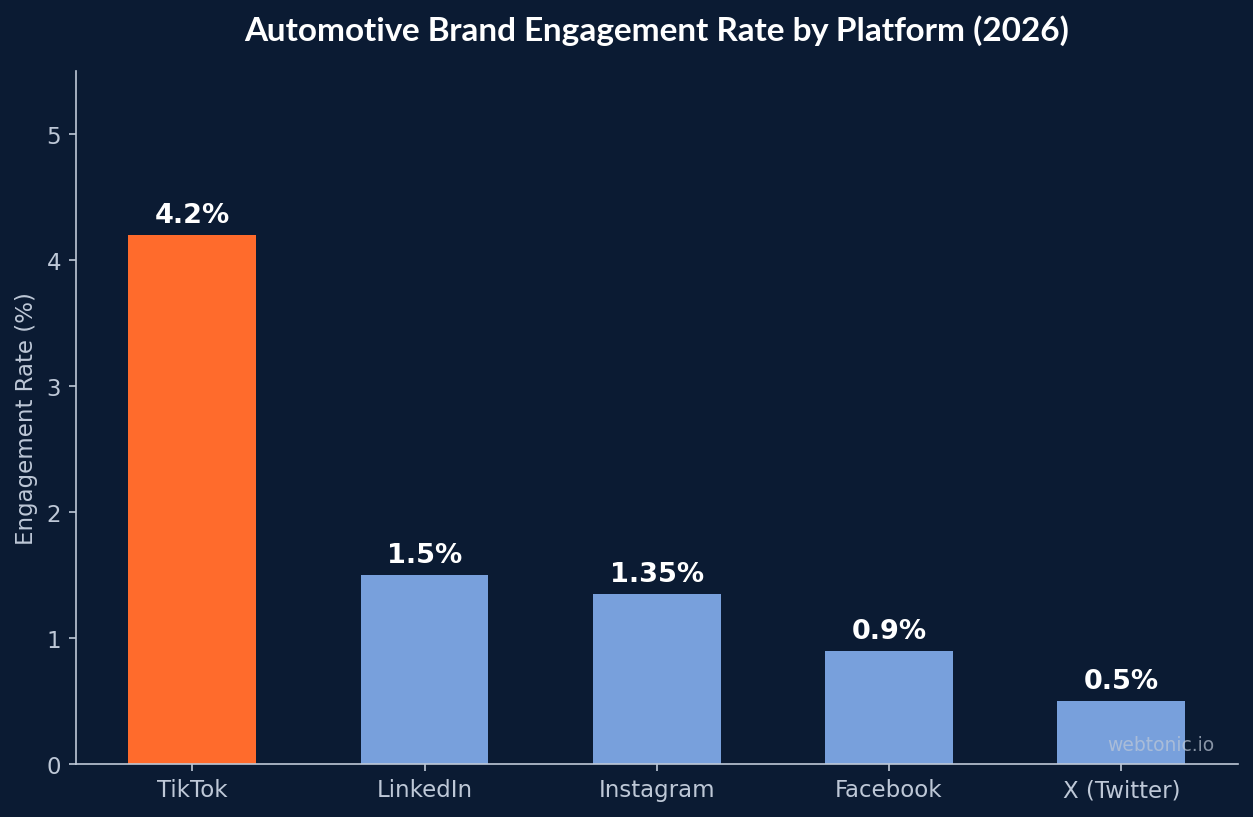
Automotive brands see differentiated engagement by platform. CuFinder's 2026 automotive benchmarks show TikTok engagement at 4.2 %, Instagram at 1.35 %, and LinkedIn at 1.5 % for automotive content. Social media marketing for the industry is best suited to short-form video on TikTok and Reels for consumer-facing brands, while LinkedIn serves B2B segments like fleet sales and aftermarket parts distribution.
Zipdo reports a 3.2 % engagement rate for automotive brands on LinkedIn, with 68 % of B2B automotive marketers using it to target fleet managers. Recommended posting cadences: 3 posts per week on LinkedIn (corporate / B2B), daily on Instagram and TikTok. Brands investing in consistent performance creative across platforms are compounding awareness gains faster than those spreading budgets thinly.
Short-form video is the frontier of automotive brand building. Dealer groups experimenting with TikTok and Instagram Reels report 2–5× higher organic reach compared to static posts. The content formula that works: behind-the-scenes workshop footage, car reveals with cinematic transitions, and customer testimonial clips under 60 seconds. For JDM-focused businesses, build culture and car culture are particularly resonant content themes that drive both engagement and brand affinity.
Automotive Branding Best Practices for 2026
- Audit your visual identity for digital-first consistency — ensure your logo, color palette, and typography render cleanly on mobile screens, social thumbnails, and in-car displays.
- Invest in brand tracking, not just campaign metrics — tools like YouGov BrandIndex or Kelley Blue Book Brand Watch quantify consideration, perception, and purchase intent over time.
- Address EV trust gaps head-on — if you sell or service EVs, create content that tackles range anxiety, charging infrastructure, and total cost of ownership transparently.
- Standardize dealership presentation — the Pied Piper study proves visual consistency drives recall. Implement brand standards checklists for signage, lot layout, and digital listings.
- Double down on short-form video — with TikTok delivering 4.2 % engagement vs. 1.35 % on Instagram, allocate creative resources toward vertical video formats for consumer audiences.
- Connect brand spend to attribution — use data intelligence tools to link upper-funnel brand campaigns to showroom visits and test drives.
Automotive vs. Other Industries: Branding Metrics
| Metric | Automotive | All-Industry Avg | Gap |
|---|---|---|---|
| Brand loyalty rate | 51.4 % | ~40 % | +11.4 pp |
| Avg ad spend / company | $631 K | $410 K | +54 % |
| TikTok engagement | 4.2 % | 3.8 % | +0.4 pp |
| LinkedIn engagement | 1.5 % | 1.2 % | +0.3 pp |
| Brand consistency impact on recall | +80 % | +80 % | Universal |
Frequently Asked Questions
What is the average automotive brand loyalty rate?
U.S. vehicle brand loyalty reached 51.4 % in 2025, the highest rate in five years according to LexisNexis Risk Solutions. Ten automotive brands exceeded this industry average.
Which automotive brand has the highest value?
Toyota leads at $74.2 billion in Interbrand's 2025 Best Global Brands ranking, followed by Mercedes-Benz ($58.9 B) and BMW ($51.1 B). Tesla dropped 35 % to $43.1 B.
How much do dealerships spend on marketing?
The average U.S. franchised dealership spends roughly $631,000 per year on marketing, with over 60 % allocated to digital channels including SEO ($103 K), social ads ($64 K), and paid search.
Does brand consistency really affect sales?
Yes. Research shows consistent branding increases ad recall by 80 % and makes brands 3.5× more likely to be top-of-mind. Penske Automotive saw a 30 % retention increase after standardizing brand elements.
How is EV branding different from traditional auto branding?
EV branding must address unique trust factors — range anxiety, charging availability, and total cost of ownership. Porsche, Honda, and BMW currently lead EV trust rankings, while Tesla saw 37 % of consumers report declining perception.
Sources
LexisNexis Risk Solutions — U.S. Vehicle Brand Loyalty 2025
Digital Dealer — Automotive Brand Loyalty 2026 Winners & Losers
Driving.ca — Interbrand 2025 Automotive Rankings
ProAutoTalk — Automotive Advertising Statistics 2026
GII Research — Automotive Advertising Market 2025–2032
Zipdo — Brand Consistency Statistics 2026
EV Intelligence — EV Brand Perception Dashboard 2025
CuFinder — Automotive Manufacturing Marketing Benchmarks 2026
WDA Automotive — Rebrand Strategy Guide
PW Consulting — Car Logo Market Report