



Table of contents
Key Takeaways
- Auto search ads achieve an average CTR of 6.17%, with a conversion rate of 8.80% — both among the strongest of any vertical.
- Digital ad conversions at dealers surged 37.3% year over year while cost per lead dropped 14.8% to its lowest point in 12 months.
- Reels placements deliver 38% lower CPM than feed placements for the auto sector creative on Meta, with 3.2% CTR vs. 1.8% for static feed ads.
- Total U.S. dealer advertising spend reached $9.96 billion in 2025, with Search Engine Marketing (21.1%) and third-party marketplaces (20.0%) leading budget allocation.
- Creative format produces the highest performance variance in the auto sector — the same audience and budget can generate 3× different cost-per-lead depending on ad format.
- Video creative drives 164.8% higher engagement than standard display, with dynamic display ads achieving a 64.3% lift over static formats.
Auto Search Ad Format Benchmarks
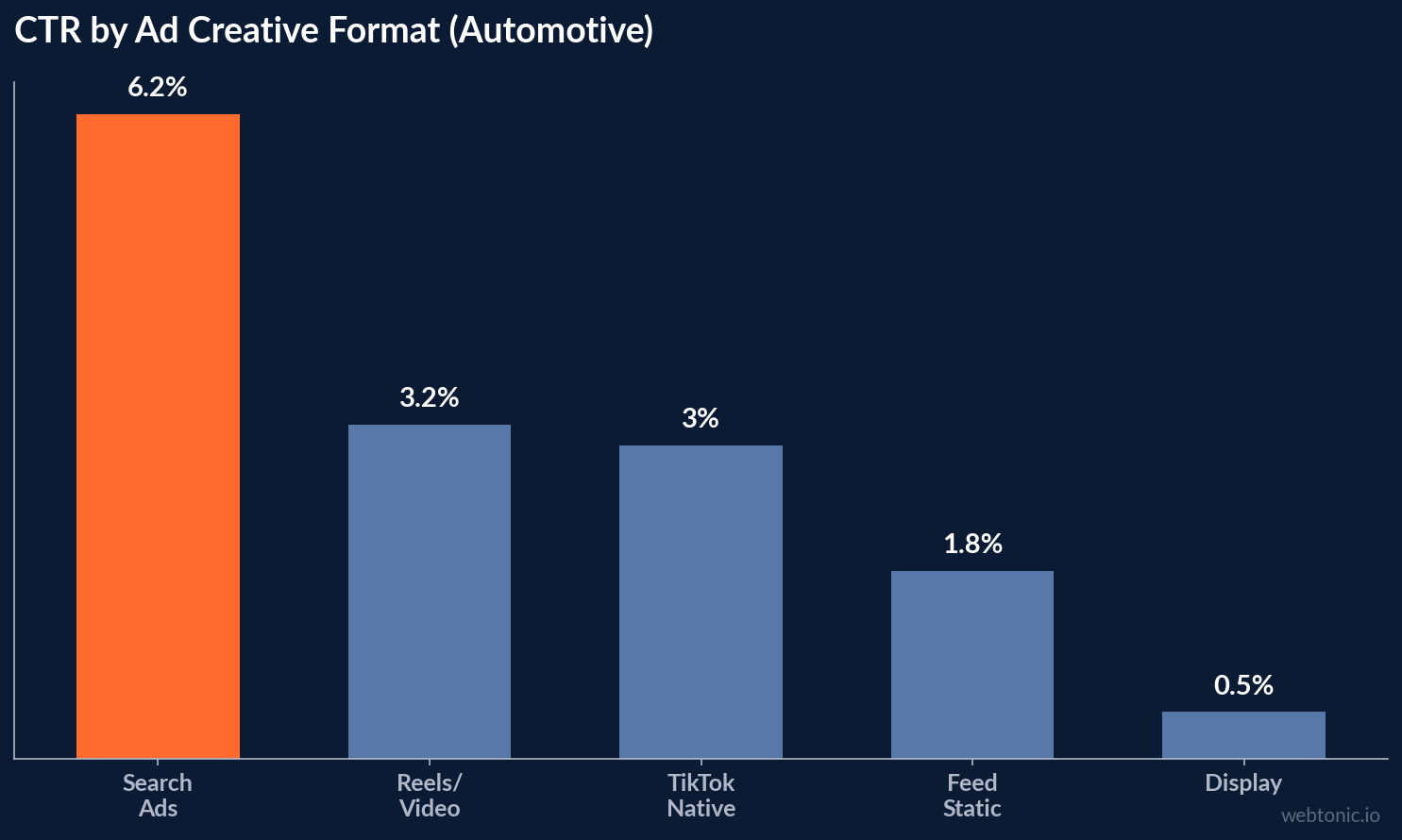
Search remains the backbone of dealership digital marketing, and the ad components within search ads — headlines, descriptions, extensions — directly affect performance. According to LocaliQ's 2026 auto benchmarks, the average click-through rate for auto search ads is 6.17%, a slight decline of 5.66% from the prior year. However, the average conversion rate climbed to 8.80%, representing a 5.71% increase year over year — suggesting that while fewer people click, those who do are higher-intent car buyers.
For dealers running Google Ads campaigns, DealerSmart reports that good CTR ranges from 6–12% on branded terms and 3–6% on non-branded keywords. Cost per click typically falls between $1 and $4 on local terms. The most effective auto search creative includes real time inventory counts, specific vehicle models and offers, and promotional pricing in headline extensions — elements that differentiate dealer ads from generic OEM campaigns.
| Search Ad Metric | Industry Average | YoY Change |
|---|---|---|
| Click-Through Rate | 6.17% | −5.66% |
| Conversion Rate | 8.80% | +5.71% |
| CPC (Local Terms) | $1–$4 | Stable |
| Branded CTR | 6–12% | — |
| Non-Branded CTR | 3–6% | — |
Social Media Ad Creative Performance for Automotive
On Meta platforms, auto industry ad format shows the highest format-driven variance of any vertical. AdLibrary's 2026 automotive benchmarks found that the same audience, budget, and targeting can generate 3× different cost-per-lead depending on ad format alone. This makes ad format the single most impactful lever for auto industry marketers running campaigns on Facebook and Instagram.
Short-form video is reshaping performance expectations. MyDigipal's 2026 dealer social report shows that Reels placements deliver 38% lower CPM than feed placements for dealer content, with a CTR of 3.2% vs. 1.8% for static feed ads and cost-per-lead of $1.20 vs. $8.50. This dramatic cost difference is driving dealers to invest heavily in short-form visual content — walk-around tours, quick feature spotlights, and 10-second customer testimonials.
The overall car industry marketing statistics from CuFinder show CTR at 6.1% across all digital channels, with top-performing dealers reaching 8.5%+ when using all available ad extensions and ad formats. Brands that pair real time inventory data with high intent creative messaging consistently outperform those using generic brand awareness efforts.
Video and Display Creative Statistics
Video advertising continues to dominate automotive ad strategy. According to CreativeGrade's 2026 automotive benchmarks, visual content is the primary performance differentiator across Facebook, Instagram, TikTok, Google, and LinkedIn for auto brands. The data shows that dealers investing in platform-native visual material — rather than repurposing TV spots — see significantly higher engagement rates.
Innovid's analysis of 30+ billion video ad impressions revealed that automotive visual campaigns drove 164.8% higher engagement than standard display, while dynamic display ads achieved a 64.3% lift over static display formats. Connected TV (CTV) is emerging as a high-impact channel, with auto brands allocating increasing portions of their visual ad budgets to streaming platforms where they can reach car buyers during evening viewing hours. Interactive CTV formats that allow viewers to schedule test drives or request quotes directly from their remote control represent the next frontier in automotive video advertising.
| Ad Format | Engagement vs. Standard | Best Use Case |
|---|---|---|
| Video (Social) | +164.8% | Vehicle walkarounds, testimonials |
| Dynamic Display | +64.3% | Real-time inventory retargeting |
| Reels/Short-Form | 3.2% CTR | Quick features, promotions |
| Static Feed | 1.8% CTR | Brand awareness, pricing |
| CTV/Streaming | Growing rapidly | High-impact brand efforts |
Dealership Digital Advertising Spend and ROI
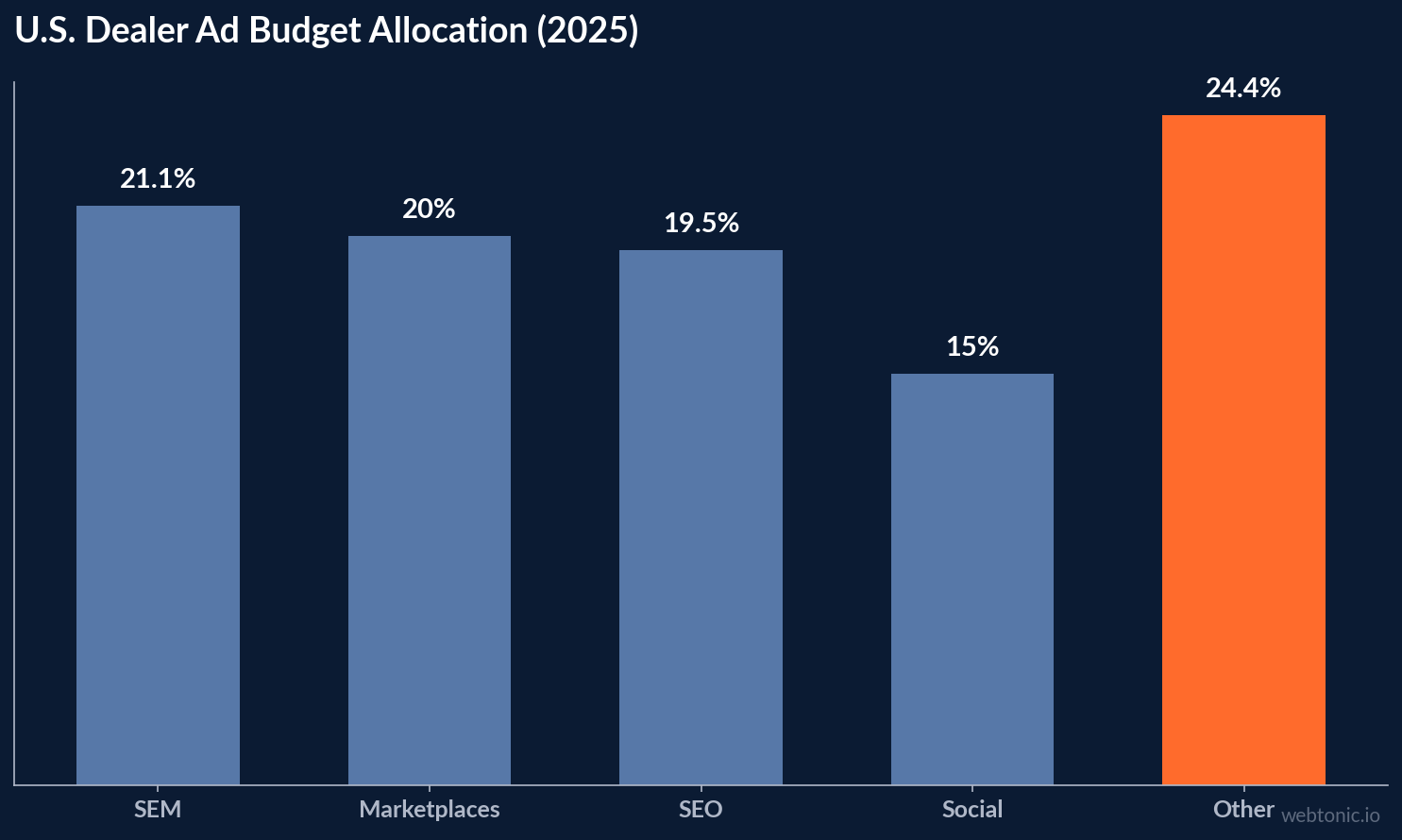
The scale of automotive advertising is substantial. NADA data cited by CuFinder shows total U.S. dealer advertising spend reached $9.96 billion in 2025, with the top budget categories being Search Engine Marketing (21.1%), third-party marketplaces (20.0%), and SEO (19.5%). Typical OEM co-op reimbursement covers approximately 50% of qualified ad spend, making creative efficiency doubly important — every dollar of waste costs the dealership directly.
The efficiency trend is encouraging. Digital Dealer reported a 37.3% year-over-year surge in online ad conversions paired with a 14.8% drop in cost per lead — the lowest CPL recorded in 12 months. This improvement is driven by dealerships adopting performance-focused creative strategies: dynamic inventory ads that show the exact vehicle a shopper viewed, personalized retargeting sequences, and AI-optimized ad copy that adapts to real time market conditions.
Budget allocation varies by dealership size. Single-rooftop dealers typically spend $5,000–$15,000 per month on Google Ads alone, while multi-location groups allocate $15,000–$50,000+ monthly. Demand Local data shows the average cost-per-acquisition across all digital channels is approximately $250, though this varies widely by vehicle type and market competitiveness.
Dynamic Inventory and First-Party Data Creative
Dynamic inventory ads represent a major shift in how dealerships approach content production. Rather than manually designing ads for each vehicle, these campaigns automatically pull inventory data — make, model, year, price, mileage, and photos — from the dealer management system and serve personalized creative to shoppers who browsed matching vehicles. DealerSmart notes that inventory ads outperform generic brand content across every major metric because they show the exact car a shopper researched, creating immediate relevance.
First-party data is becoming the backbone of effective automotive ad strategy. With third-party cookies in decline, dealerships that build robust customer databases — capturing email addresses, service history, and browsing behavior — can create highly targeted ad format for conquest, retention, and service marketing campaigns. The combination of first-party CRM data with platform-native dynamic creative tools enables personalization at scale without relying on third-party audience segments that are losing accuracy across all major advertising platforms.
The investment in production infrastructure is paying off. Dealers using Performance Max campaigns with Google's vehicle listing ads report that real time inventory feeds combined with automated ad assembly dramatically reduce production costs while improving relevance. The key insight for auto industry marketers: content production is shifting from a design-heavy manual process to a data-driven automated workflow where the quality of your inventory feed directly determines ad performance.
Audience segmentation also plays a critical role. Marketing teams that separate their campaigns by buyer intent — distinguishing between new-vehicle shoppers, used-vehicle browsers, service customers, and trade-in prospects — achieve materially better creative performance across every channel. Each segment responds to different creative angles, offers, and calls-to-action. Search advertising strategies anchored in intent-based segmentation deliver the strongest results when paired with format-specific visual assets that match each platform's native user experience. The dealerships winning the creative game in 2026 are those that treat ad creative as a systematic growth function rather than an afterthought attached to media buying.
Creative Format Performance Comparison Across Platforms
| Platform | Top Format | Avg CTR | Key Creative Element |
|---|---|---|---|
| Google Search | RSA + Extensions | 6.17% | Real-time inventory, pricing |
| Meta (Feed) | Dynamic Inventory | 1.8% | Vehicle-specific retargeting |
| Meta (Reels) | Short-Form Video | 3.2% | Walkarounds, testimonials |
| TikTok | Native Video | 2.5–4.0% | Authentic dealer content |
| Display/CTV | Dynamic Display | 0.3–0.6% | Personalized vehicle imagery |
Industry Statistics and Market Report Highlights
The latest industry statistics paint a clear picture of where the auto ad market is headed. According to multiple market reports, dealership brands that invest in data-driven ad optimization consistently outperform those relying on traditional approaches. The statistics show that real time bidding and dynamic inventory integration have become table-stakes for competitive dealer groups. These market reports also highlight that first-party data strategies are gaining traction as third-party cookie deprecation forces brands to rethink their customer targeting. Vehicle sales volume directly influences ad intensity — during high-inventory periods, dealer brands increase spending on performance formats to move units faster, while low-inventory environments shift budgets toward long term brand-building and service marketing. Car buyers in 2026 respond to transparency: ads showing real time pricing, financing estimates, and vehicle history reports outperform generic lifestyle imagery by significant margins across every major platform.
Best Practices for Automotive Ad Creative in 2026
- Lead with video — Video creative delivers 164.8% higher engagement than static formats. Invest in platform-native short-form content: 15-second walkarounds, feature spotlights, and real customer testimonials beat repurposed TV commercials.
- Use dynamic inventory feeds — Connect your data intelligence pipeline to your ad platforms. Ads that show the exact vehicle a customer browsed generate significantly higher conversion rates than generic brand campaigns.
- Test ad formats aggressively — With 3× performance variance between formats on Meta alone, format testing is the highest-leverage activity for automotive marketers. Run structured A/B tests comparing Reels vs. feed, video vs. carousel, and static vs. dynamic formats.
- Optimize for real time relevance — Include current inventory counts, promotional pricing, and seasonal offers in ad copy. Dealers that update creative weekly outperform those running month-old campaigns.
- Allocate budget to high intent channels — Search (6.17% CTR, 8.80% CVR) captures bottom-funnel demand. Layer with Meta Reels (38% lower CPM) for mid-funnel awareness. Match budget allocation to funnel stage.
- Leverage co-op programs — With typical OEM reimbursement at ~50%, structure your creative to meet co-op compliance requirements from the start, avoiding rework that delays campaign launches.
- Track ad fatigue — Monitor frequency and CTR trends weekly. When engagement drops 15–20% from peak, refresh the creative. Automotive campaigns with monthly ad refreshes maintain 22% higher average CTR than those running unchanged for 60+ days.
Long-Term Advertising Trends and High-Intent Data
Long-term statistics from dealership marketing teams reveal that the most significant performance improvements come from sustained, data-driven optimization rather than one-time ad changes. Marketing teams that run structured testing programs over 6–12 months see compounding returns as their algorithms learn from high intent audience signals. The latest marketing statistics confirm that dealerships focusing on high intent leads — shoppers who have configured a vehicle, requested a quote, or visited a dealer lot page — achieve 3–5× higher conversion rates than those targeting broad awareness audiences.
First-party data collection is reshaping how marketing teams approach audience segmentation. Dealerships that integrate their CRM with advertising platforms can build custom audiences based on service visit history, previous vehicle purchases, and lease expiration dates. This first-party data strategy enables highly personalized ad messaging — showing specific vehicle models and offers matched to each customer's purchase timeline and preferences. Industry report data shows that dealerships leveraging party data for retargeting see 40% lower cost per sale compared to relying solely on platform-generated audiences.
The statistics also highlight a growing regional disparity. Tier 1 metros with multiple competing dealership brands face 25–40% higher CPCs than secondary markets, making ad efficiency even more critical for high competition areas. Marketing teams in these competitive markets report that short-form video and real time inventory ads deliver the best ROI because they combine emotional engagement with transactional relevance — addressing both the consideration and decision stages of the car buyer journey in a single impression. Vehicle sales data from the National Automobile Dealers Association's annual report confirms that digitally-influenced transactions now account for the majority of new vehicle sales across all market tiers.
The conversion rate automotive brands achieve is heavily influenced by ad relevance and landing page alignment. Real time optimization of bidding and targeting is now standard among top-performing dealer marketing teams. Real time inventory feeds that sync vehicle availability with ad platforms ensure shoppers only see models currently on the lot — reducing bounce rates and improving the conversion rate automotive dealers can expect from paid channels. High intent leads generated through search and retargeting campaigns convert at 4–6× the rate of cold-traffic impressions, reinforcing the long term value of investing in intent-based targeting and real time optimization frameworks that many leading auto brands and marketing teams have already adopted.
FAQ
What is a good CTR for automotive online ads?
For search ads, the automotive average is 6.17%, with branded terms reaching 6–12%. On social platforms, Reels and short-form video deliver 3.2% CTR, while static feed ads average 1.8%. Top-performing dealerships using all available extensions and ad formats reach 8.5%+ CTR across channels.
How much do car dealerships spend on online advertising?
Total U.S. dealer advertising spend reached $9.96 billion in 2025. Individual single-rooftop dealerships typically spend $5,000–$15,000 per month on search campaigns, while multi-location groups allocate $15,000–$50,000+ monthly. OEM co-op programs reimburse roughly 50% of qualified ad spend.
Which ad ad format performs best for automotive marketing?
Video consistently outperforms all other formats, generating 164.8% higher engagement than standard display. On Meta specifically, Reels deliver 38% lower CPM and nearly 2× the CTR of static feed ads. Dynamic inventory ads that show specific vehicles also outperform generic brand content by wide margins.
How often should dealerships refresh their ad creative?
Best practice is to refresh ad components monthly or when CTR drops 15–20% from its peak. Dealerships with monthly ad refreshes maintain 22% higher average CTR than those running the same ads for 60+ days. Real-time inventory ads partially address fatigue by automatically updating vehicle imagery and pricing.
Are automotive digital ad costs going up or down?
Despite rising competition, efficiency is improving. Digital ad conversions surged 37.3% year over year while cost per lead dropped 14.8%. This is driven by better creative optimization, AI-powered bidding, and the shift toward high-engagement video formats that reduce wasted spend on low-performing static campaigns.
Sources
localiq.com — Automotive Search Advertising Benchmarks 2026
adlibrary.com — Meta Ad Benchmarks Automotive 2026
dealersmart.com — Dealership Google Ads Benchmarks
cufinder.io — Automotive Industry Marketing Benchmarks 2026
digitaldealer.com — Dealership Digital Advertising Performance
mydigipal.com — Dealer Social Strategy 2026
creativegrade.tech — 2026 Automotive Ad Benchmarks
demandlocal.com — Dealership Advertising Spend Statistics


