



Table of contents

Key Takeaways
- Auto sector CPM on Meta ranges from $15–$38 depending on funnel stage, with cold prospecting at $15–$24 and hot VDP retargeting reaching $26–$38 — significantly above the cross-industry average of $11–$14.
- The average cost per lead for automotive Facebook Ads is $39.10, with a typical range of $25–$50 and a conversion rate of 5–7% for lead form submissions.
- Blended ROAS for auto advertisers ranges from 3× to 8× when offline conversion tracking feeds showroom sales data back into Meta — without it, platform-reported ROAS understates true performance dramatically.
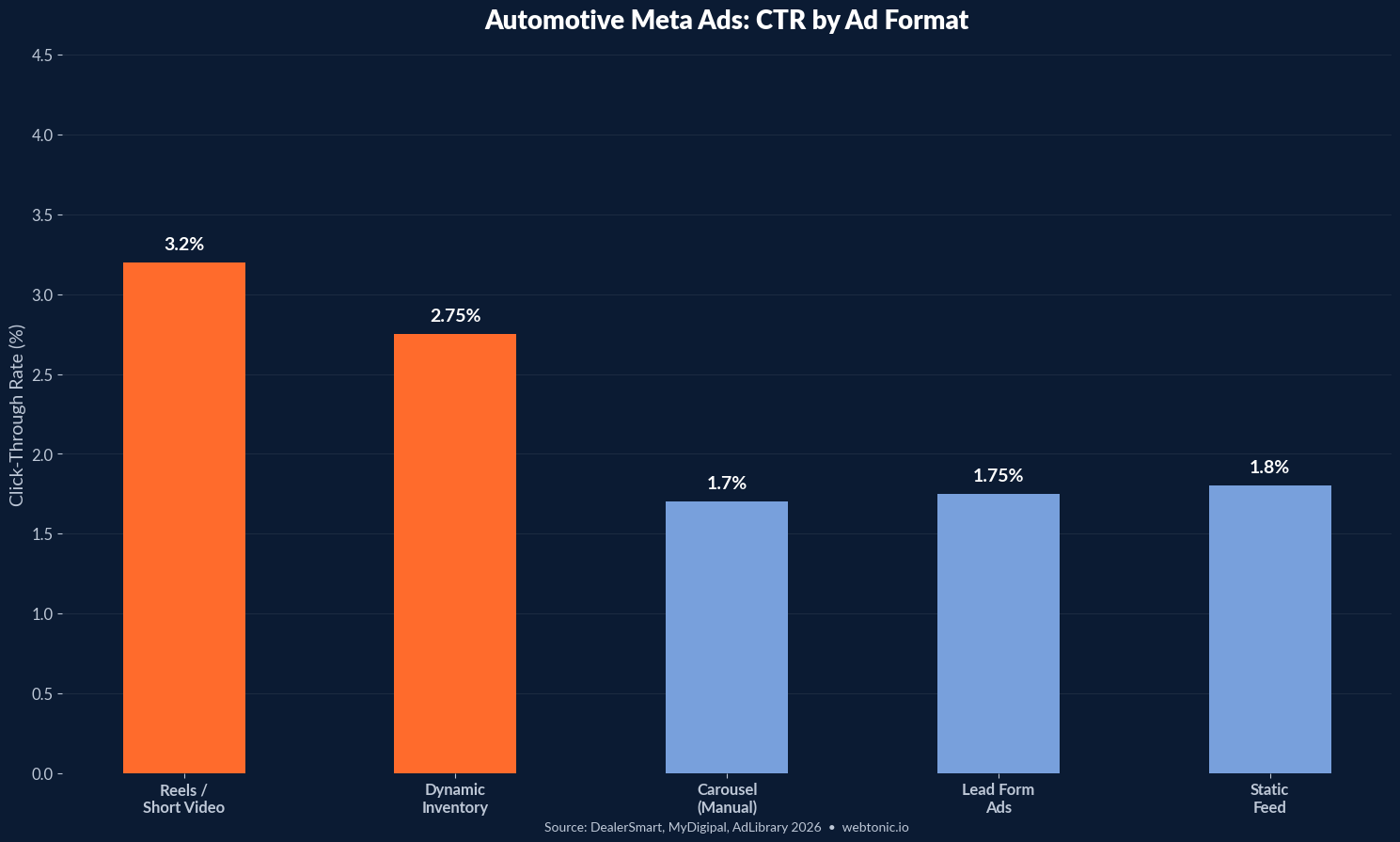
- Reels placements deliver 38% lower CPM than feed placements for dealer content, with CTR of 3.2% vs. 1.8% for static feed ads and cost per lead of $1.20 vs. $8.50.
- Inventory-based dynamic ads outperform generic brand content across every metric because they show the exact vehicle a shopper researched, creating immediate relevance and dramatically higher click-through rates.
- Hot retargeting (7-day VDP visitors) achieves conversion rates of 15–30%, compared to 3–8% for cold prospecting — making retargeting budget the highest-leverage spend in the funnel.
CPM, CPC, and CTR Benchmarks by Funnel Stage
Meta advertising benchmarks for the auto industry vary dramatically by funnel position. AdLibrary's 2026 automotive Meta benchmarks provide the most granular funnel-stage breakdown available. Cold prospecting campaigns — targeting new audiences with no prior dealership interaction — run CPMs of $15–$24, CPC of $0.90–$2.20, and link-click CTR of 0.6–1.4%. Warm retargeting (30-day website visitors) increases CPM to $22–$32 but delivers CTR of 1.4–3.2%. Hot retargeting of 7-day VDP visitors commands the highest CPM ($26–$38) but converts at 15–30% click-to-lead.
The average CPM across all Meta advertisers is roughly $11–$14. If an auto advertiser sees $22 CPM, that cross-industry average makes their numbers look broken — but they are not. Auto is a high-value vertical where Meta charges a premium because the lifetime value of a vehicle sale justifies higher auction prices. CuFinder's 2026 benchmarks confirm a Facebook Ads CPC of $1.15 for the sector overall, reflecting the blended average across funnel stages.
| Metric | Cold Prospecting | Warm Retargeting (30-Day) | Hot Retargeting (7-Day VDP) |
|---|---|---|---|
| CPM | $15–$24 | $22–$32 | $26–$38 |
| CPC | $0.90–$2.20 | $1.40–$3.00 | $1.60–$4.00 |
| CTR (Link Click) | 0.6–1.4% | 1.4–3.2% | 2.0–4.5% |
| CVR (Click to Lead) | 3–8% | 8–18% | 15–30% |
| Cost per Lead | $40–$90 | $20–$55 | $12–$35 |
Cost per Lead and Conversion Rate Benchmarks
LeadSync's 2026 industry-wide CPL data places the average auto sector Facebook Lead Ad cost per lead at $39.10, with a typical range of $25–$50 and a conversion rate of 5–7%. This makes the auto industry the 12th most expensive vertical for Facebook lead generation — more expensive than real estate ($16.61) and education ($28.22) but less expensive than dental ($50–$80) or legal services ($55–$75).
Lead Form Ads are roughly 20–30% cheaper than sending traffic to a landing page because they eliminate the friction of page loading and form filling. However, lead quality from in-platform forms tends to be lower, requiring robust lead scoring and CRM integration to separate serious buyers from casual browsers. Q4 costs are typically 25–30% higher than Q1 due to holiday advertising competition, meaning dealerships that front-load their Meta spend in Q1–Q2 capture lower CPLs while building retargeting audiences for the competitive season.

ROAS and Attribution Challenges in Auto Advertising
Return on ad spend is the most contentious benchmark in auto Meta advertising because attribution is genuinely hard. AdLibrary explains the core problem: a customer researches for 45 days across six touchpoints before walking into a showroom. Meta gets credit for one click. Without offline conversion data feeding back into the platform, platform-reported ROAS measures only the fraction of vehicle sales that close online.
Blended ROAS for auto advertisers ranges from 3× to 8× when offline conversion tracking is properly configured — meaning every dollar spent on Meta returns $3–$8 in attributable revenue. Dealers without offline tracking typically see platform-reported ROAS of 1×–2×, which dramatically understates actual performance and leads to premature budget cuts. The solution involves feeding CRM and DMS sales data back into Meta through the Conversions API, enabling the algorithm to optimize for showroom visits and actual vehicle purchases rather than just form fills. Dealerships that implement full-funnel Meta advertising strategies with proper attribution consistently outperform those optimizing for platform-reported metrics alone.
Creative Format Performance: Reels, Inventory Ads, and Video
Ad format is the single most impactful performance lever for auto industry marketers on Meta. DealerSmart's creative playbook demonstrates that the same audience, budget, and targeting can generate 3× different cost per lead depending on ad format alone. This makes format selection more important than audience refinement for most dealership campaigns.
MyDigipal's 2026 dealer social report quantifies the format gap: Reels placements deliver 38% lower CPM than feed placements with a CTR of 3.2% vs. 1.8% for static feed content and cost per lead of $1.20 vs. $8.50. This dramatic cost difference is driving dealers to invest heavily in short-form video — walk-around tours, quick feature spotlights, and 10-second customer testimonials that feel native to the platform.
Inventory-based dynamic ads represent another high-performance format. Meta reads the dealer's vehicle inventory feed and automatically builds personalized ads using VIN, price, mileage, and photos. When a shopper views SUVs on the dealership website, Facebook dynamic ads retarget them with those specific SUVs and similar models automatically. These ads outperform generic brand content across every metric because they show the exact car a shopper researched — creating immediate relevance that generic creative cannot match. Seasonal campaign overlays (summer SUV savings, year-end clearance) can be layered on top of the dynamic feed without rebuilding the account structure.
| Ad Format | Avg CPM | CTR | Avg CPL |
|---|---|---|---|
| Reels / Short-Form Video | 38% below feed | 3.2% | $1.20 |
| Static Feed (Single Image) | Baseline | 1.8% | $8.50 |
| Dynamic Inventory (Carousel) | Variable | 2.0–3.5% | $15–$35 |
| Lead Form Ads | $18–$35 | 1.0–2.5% | $25–$50 |
| Carousel (Manual) | $16–$28 | 1.2–2.2% | $30–$60 |
Audience Targeting Strategy for Auto Dealers
Sona's comprehensive Meta Ads guide for dealerships outlines the three-audience framework that high-performing dealers use: Core Audiences for geographic reach, Custom Audiences for retargeting and loyalty, and Lookalike Audiences for scaling. Geography and intent are more important than demographics in the auto sector — most buyers will not travel more than 30–50 miles, making local radius targeting and zip code selection more impactful than ultra-granular age splits.
The ideal audience structure separates campaigns by buyer intent: new-vehicle shoppers, used-vehicle browsers, service customers, and trade-in prospects. Each segment responds to different creative formats, offers, and calls-to-action. Over time, dealers refine these segments based on CRM feedback, lead quality, and actual sales performance rather than relying only on platform click metrics. Lookalike audiences built from the dealership's highest-value customers (repeat buyers, service-loyal customers) consistently outperform interest-based targeting for conquest campaigns. Combining performance creative with intent-based audiences produces the strongest results at scale.
Automotive vs. Cross-Industry Facebook Ads Benchmarks
| Metric | Automotive | Cross-Industry Avg | Δ |
|---|---|---|---|
| CPM (Blended) | $18–$35 | $11–$14 | +60–150% |
| CPC | $1.15 | $1.72 | −33% |
| CPL (Lead Ads) | $39.10 | $28–$42 | Within range |
| CVR (Lead Form) | 5–7% | 8–10% | −30% |
| Blended ROAS | 3×–8× | 2×–4× | Higher LTV |
Seasonal Trends and Budget Pacing
Auto sector Meta advertising costs follow predictable seasonal patterns that savvy dealerships exploit for competitive advantage. LeadSync's data confirms that Q4 costs are 25–30% higher than Q1 due to holiday advertising competition across all verticals. For dealerships, this seasonal premium compounds with year-end clearance demand, pushing CPMs to their annual peak in November and December. Conversely, January through March typically offers the lowest auction prices, making it the ideal period for building retargeting audiences and testing new creative formats at reduced cost.
Budget pacing also matters within each month. Weekday campaigns for dealerships tend to outperform weekends on lead quality, while Saturday morning hours produce the highest engagement rates for vehicle walk-around content. Dealers that align their budget distribution with these patterns — heavier weekday spend for lead generation, lighter weekend spend for brand content — achieve 15–20% lower blended CPL than those using even daily distribution. The combination of seasonal awareness with intra-week pacing represents an underutilized optimization lever for most dealers still using flat budget schedules.
Best Practices for Auto Dealer Facebook Campaigns
- Implement offline conversion tracking. Without feeding CRM and DMS sales data back into Meta, platform-reported ROAS dramatically understates true performance. Conversions API integration is essential for accurate attribution and algorithm optimization.
- Prioritize Reels and short-form video. The data is definitive: Reels deliver 38% lower CPM, 78% higher CTR, and 86% lower CPL than static feed content. Invest in 12–20 second vehicle walkarounds, customer testimonials, and feature spotlights.
- Set up dynamic inventory ads. Let Meta's algorithm match vehicle inventory to shopper browsing behavior automatically. Dynamic inventory ads outperform manual creative across every metric by showing the exact car each shopper researched.
- Structure campaigns by funnel stage. Run separate cold prospecting, warm retargeting (30-day), and hot retargeting (7-day VDP) campaigns with different budgets, creative, and bidding strategies. Hot retargeting converts at 15–30% — allocate accordingly.
- Front-load spend in Q1–Q2. Facebook CPLs are 25–30% higher in Q4 due to holiday competition. Building growth-oriented acquisition campaigns earlier in the year captures lower costs while building retargeting pools.
- Use Lead Form Ads strategically. They are 20–30% cheaper than landing page traffic but produce lower-quality leads. Pair with instant CRM integration and automated follow-up to maximize conversion from form submissions.
FAQ
What is the average cost per lead for auto Facebook ads?
According to LeadSync's 2026 data, the average auto sector Facebook Lead Ad CPL is $39.10, with a typical range of $25–$50. AdLibrary's funnel-stage data shows cold prospecting CPL at $40–$90, warm retargeting at $20–$55, and hot VDP retargeting at $12–$35. Lead Form Ads are roughly 20–30% cheaper than sending traffic to an external landing page.
What ROAS should auto dealers expect from Meta ads?
Blended ROAS ranges from 3× to 8× when offline conversion tracking is properly configured. Without feeding showroom sales data back into Meta, platform-reported ROAS typically shows only 1×–2× because vehicle purchases rarely close online. Implementing the Conversions API with CRM integration is essential for accurate ROAS measurement.
Which Facebook ad format works best for car dealerships?
Short-form Reels video delivers the strongest performance metrics: 38% lower CPM, 3.2% CTR vs. 1.8% for static feed, and CPL of $1.20 vs. $8.50. Dynamic inventory ads also perform exceptionally well because they automatically show each shopper the specific vehicles they browsed, creating immediate relevance.
Why is automotive CPM higher than the cross-industry average?
Auto CPM runs $18–$35 versus the cross-industry average of $11–$14 because vehicle sales represent high-lifetime-value transactions. Meta's auction system charges a premium for verticals where the value per conversion is high. Despite higher CPMs, auto CPC is actually 33% below the cross-industry average at $1.15, indicating that auto audiences engage with ads at higher rates.
How should dealerships structure their Facebook ad audiences?
Use a three-audience framework: Core Audiences for geographic reach (30–50 mile radius), Custom Audiences built from CRM data for retargeting and loyalty, and Lookalike Audiences from highest-value customers for conquest. Separate campaigns by intent — new vehicle shoppers, used vehicle browsers, service customers, and trade-in prospects — with tailored budgets and creative for each segment.
Sources
adlibrary.com — Meta ad benchmarks automotive 2026
leadsync.me — Facebook Lead Ads cost per lead benchmarks
dealersmart.com — Meta Ads creative playbook for dealers
mydigipal.com — dealership paid social strategy
sona.com — Meta Ads for car dealerships setup guide
cufinder.io — automotive industry benchmarks


