



Table of contents
Organic search remains the largest traffic source for automotive businesses — and AI-powered discovery is about to reshape the channel completely.
With organic search driving 55–70% of total traffic for well-optimized automotive platforms and the sector achieving a 5.7% organic conversion rate — above the all-industry average of 4.9% — SEO delivers the highest-volume, highest-intent channel available to dealerships and auto parts retailers (Authority Specialist, Ruler Analytics). Yet 92% of dealership websites fail Google's mobile speed requirements, and AI referral traffic to dealer sites grew from near zero to a measurable share in just two years (Overfuel, Wikimotive/NADA). This guide compiles 80+ verified automotive SEO statistics for 2026, spanning organic performance benchmarks, technical SEO gaps, content strategy data, and the emerging AI search landscape.
Key Takeaways
- Organic search accounts for 55–70% of total traffic for automotive classifieds and dealership platforms with strong SEO foundations (Authority Specialist).
- Automotive organic search CTR averages 3.5–4.0%, placing the sector among the top-performing industries for search engagement (Resourcera).
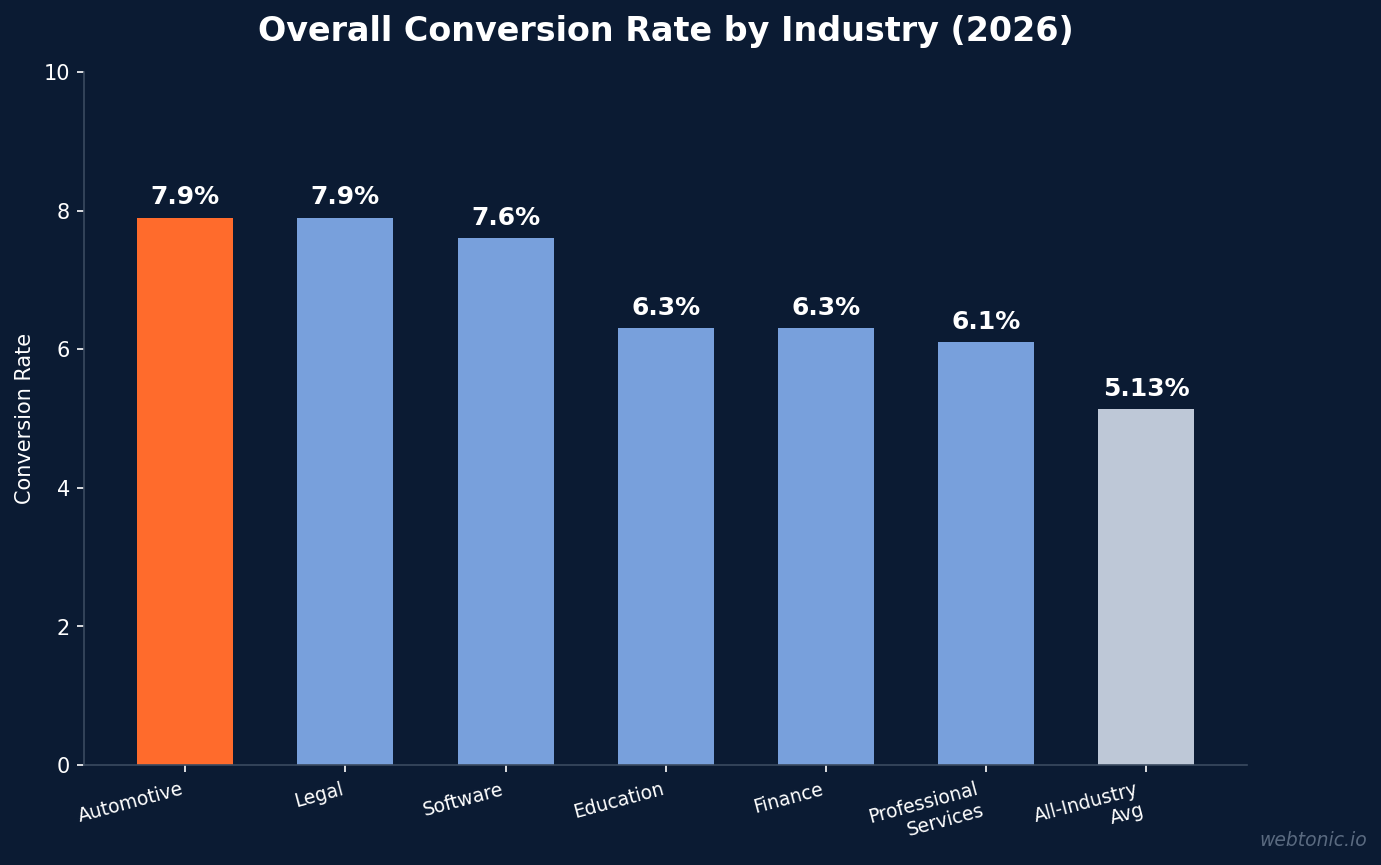
- Automotive conversion rate is 7.9% overall, tied with legal as the highest across 13 tracked industries (Ruler Analytics).
- 92% of dealership domains fail Google's mobile speed requirements — the largest technical SEO gap in the industry (Overfuel).
- AI referral traffic to dealership websites is now measurable and growing — platforms like ChatGPT, Copilot, and Perplexity are emerging as new organic discovery channels (Wikimotive/NADA).
- Auto parts retailers with structured fitment data index 2–3× more catalog pages than those without, making technical indexation a direct revenue variable (Authority Specialist).
| Metric | Automotive Benchmark | All-Industry Average |
|---|---|---|
| Organic traffic share | 55–70% | ~53% |
| Organic search CTR | 3.5–4.0% | 1.51% |
| Overall conversion rate | 7.9% | 5.13% |
| Organic search CVR | 5.7% | 4.9% |
| Mobile speed pass rate | 8% | ~33% |
| Google position #1 CTR | 39.8–43.3% | 39.8–43.3% |
Organic Search Traffic Statistics
Organic search is the dominant acquisition channel for automotive businesses across every subsector — from new-car dealerships to aftermarket parts retailers. The volume and quality of organic traffic consistently outperform paid and direct channels.
- Organic search drives 55–70% of total website traffic for automotive classifieds platforms with strong SEO foundations (Authority Specialist).
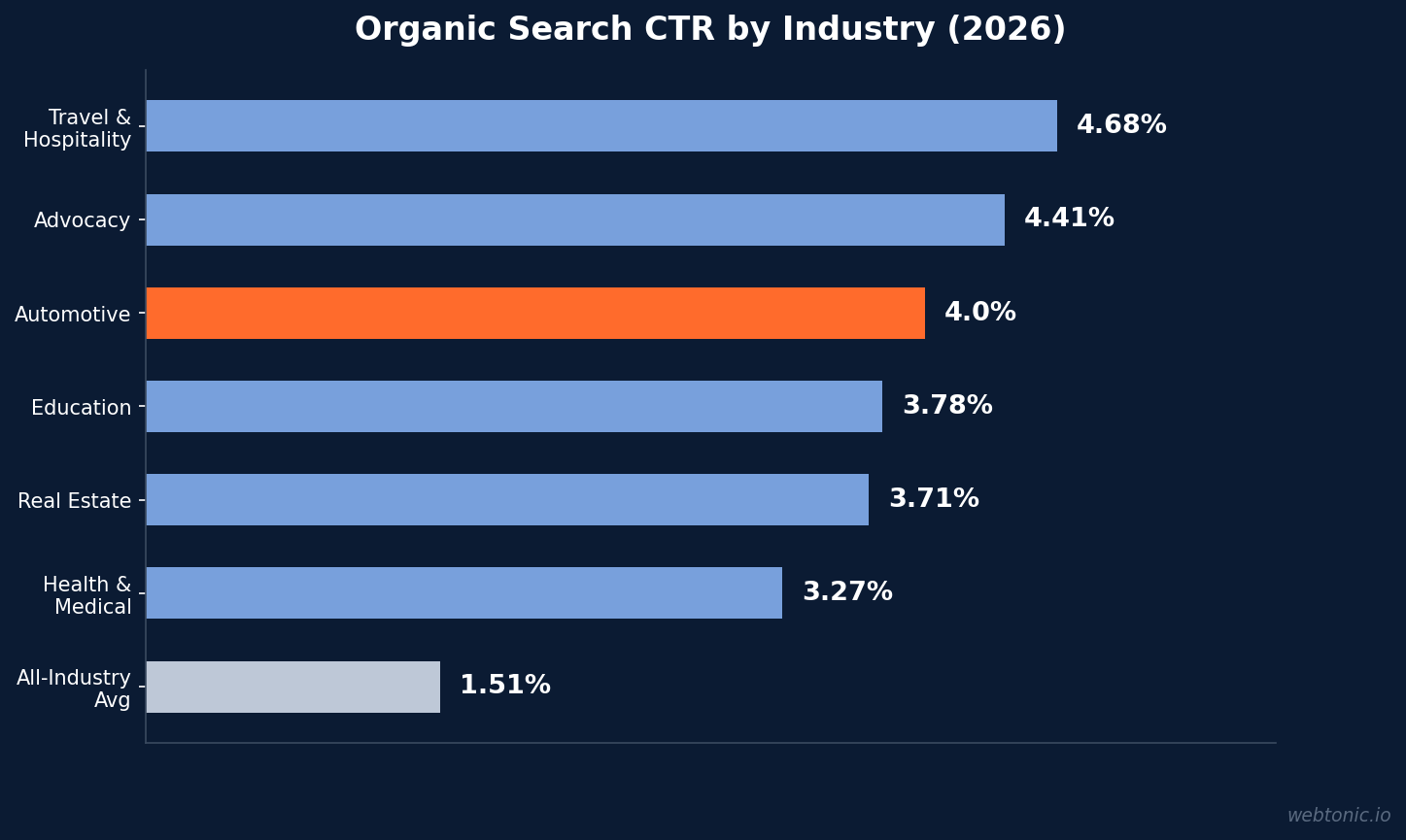
- Automotive organic search CTR averages 3.5% across industries, with some subcategories reaching 4.0% — well above the 1.51% all-industry average (Resourcera).
- Google position #1 captures 39.8–43.3% of all organic clicks, meaning nearly half of searchers choose the very first result (Resourcera).
- Make-model-year landing pages drive the majority of non-branded organic sessions for auto classifieds platforms (Authority Specialist).
- SEO accounts for 40–60% of total e-commerce revenue for established auto parts retailers (Authority Specialist).
Click-Through Rate and Ranking Statistics
CTR varies dramatically by position, industry, and device. For automotive businesses, the combination of high purchase intent and local relevance drives above-average engagement with organic search results.
| Ranking Position / Metric | Organic CTR | Context |
|---|---|---|
| Position #1 (all industries) | 39.8–43.3% | Nearly half of all clicks |
| Automotive search CTR | 3.5–4.0% | Above 1.51% all-industry avg |
| Travel & hospitality CTR | 4.68% | Highest industry CTR |
| Position #1 vs. #10 click ratio | 22× higher | Exponential drop-off |
| Automotive Google Ads CTR | 6.17% | Paid complements organic |
The position-to-CTR curve is exponential: moving from position #10 to #1 generates roughly 22× more clicks (Overfuel). For dealerships ranking in positions 4–10, even a two-position improvement can double their organic traffic. Industries serving immediate or urgent needs — including automotive, consumer services, and dating — consistently generate higher search engagement than sectors with longer consideration cycles like technology or B2B (Resourcera).
Conversion Rate Benchmarks by Channel
Automotive businesses convert at significantly higher rates than most industries, benefiting from the high purchase intent that characterizes vehicle and parts searches. Ruler Analytics' 2026 analysis of 5+ million conversions across 13 industries positions automotive at the top of the leaderboard (Ruler Analytics).
- Automotive overall conversion rate: 7.9% — tied with legal, the highest among all 13 tracked industries (all-industry average: 5.13%).
- Organic search conversion rate: 5.7% — above the 4.9% all-industry organic average.
- Dealership website conversion rate: 1.5% — industry standard, indicating a significant gap between visitor intent and on-site experience (Demand Local).
- Auto parts e-commerce conversion rate: 1.6% — 30% below the 2.3% e-commerce average, with mobile conversion at just 1.1% (WisePIM).
- High-intent fitment queries (year-make-model + part type) convert at significantly higher rates than generic category browsing traffic (Authority Specialist).
Technical SEO and Mobile Optimization Statistics
Technical SEO is the most underinvested area in automotive digital marketing. The gap between industry best practices and actual implementation creates enormous competitive opportunities for dealerships and retailers willing to address the fundamentals.
| Technical SEO Metric | Automotive Benchmark | Opportunity |
|---|---|---|
| Mobile speed failure rate | 92% fail | Pass = ranking advantage |
| Poor speed tier | ~70% | Severe user abandonment |
| Missing AutoDealer schema | 21% | Quick technical fix |
| Catalog indexation (with fitment) | 2–3× more pages indexed | Revenue-driving SEO |
| SKU pages indexed (underperformers) | <40% | Direct revenue loss |
Overfuel's landmark 2026 study analyzed nearly 90,000 organic search results across 250 U.S. markets and found a near-perfect statistical correlation between mobile PageSpeed scores and rankings. Sites ranking #1 are 1.4× more likely to hold a passing speed score than those at position #10 (Overfuel). For auto parts retailers, the indexation challenge is equally critical: platforms with structured fitment data and controlled faceted navigation index 2–3× more catalog pages, and those with fewer than 40% of SKU pages actively indexed consistently underperform on revenue-per-organic-session metrics (Authority Specialist).
AI Search and Emerging Organic Channels
AI-powered search is no longer theoretical for the automotive industry. Wikimotive's NADA-presented study tracked traffic across 150+ dealership websites over two years and provides the first quantified view of how AI discovery channels are reshaping organic visibility (Wikimotive/NADA).
- AI referral traffic to dealership sites is now measurable and growing — ChatGPT, Microsoft Copilot, and Perplexity are emerging as discovery channels alongside traditional search.
- Consumers navigate three distinct search pathways: traditional search engines, AI-powered answers, and social/video discovery — and automotive buyers increasingly use all three.
- 31% of consumers only use businesses rated 4.5+ stars — AI summaries amplify review data, making reputation management even more important for visibility across channels (AutomotiveSEO.org).
- Delante's 2026 AI visibility report for automotive documents how AI-generated search results are reshaping which businesses appear for high-intent queries, with structured data and E-E-A-T signals becoming ranking factors in AI answers (Delante).
Auto Parts SEO Statistics
The auto parts and aftermarket segment has its own distinct SEO dynamics, driven by massive product catalogs, fitment complexity, and the dominance of year-make-model search patterns (Authority Specialist).
- Auto parts retailers with structured fitment data index 2–3× more catalog pages than those relying on generic category structures.
- High-intent fitment queries convert at substantially higher rates than generic category traffic — making search strategy around part-number and year-make-model queries a direct revenue driver.
- Retailers ranking in positions 1–3 for brand-plus-fitment queries capture a disproportionate share of transactional clicks compared to generic category rankings.
- Catalog sites with fewer than 40% of SKU pages indexed consistently underperform on revenue-per-organic-session metrics.
- Long-tail keywords involving specific part numbers or OEM fitment details generate the highest conversion rates in the auto parts vertical.
Local SEO and Google Business Profile Statistics
For dealerships and service centers, local search visibility often outweighs national organic ranking. The combination of Google Business Profile optimization, local review management, and proximity-based search behavior makes local SEO a core pillar of any automotive search strategy.
- 97% of consumers search online for local businesses before visiting in person, with 76% of smartphone searchers visiting a location within 24 hours (Demand Local).
- 70% of local search clicks go to businesses in the Google Map Pack — making local pack optimization the highest-priority SEO task for physical-location businesses.
- 47% of dealerships lack separate Google Business Profiles for service and parts departments, missing dedicated visibility for high-margin revenue centers (SearchLab Digital).
- Only 17% of dealers use all 10 available GBP categories — the remaining 83% leave free ranking signals unclaimed.
Best Practices for Automotive SEO
- Fix mobile PageSpeed immediately — with 92% of dealers failing, passing Google's test provides a disproportionate ranking advantage.
- Implement AutoDealer schema — 21% of dealerships lack this structured data, missing enriched search result eligibility.
- Build make-model-year landing pages — these pages drive the majority of non-branded organic sessions for classifieds and inventory platforms.
- Control faceted navigation and indexation — auto parts sites that manage crawl architecture index 2–3× more revenue-generating pages.
- Optimize for AI search visibility — structured data, E-E-A-T signals, and comprehensive FAQ content increase the odds of appearing in AI-generated answers.
- Prioritize conversion rate optimization — the 1.5% dealership website CVR versus 7.9% overall channel CVR gap indicates massive on-site improvement potential.
- Maintain review velocity — 74% of consumers only trust recent reviews, and AI summaries amplify review sentiment across platforms (BrightLocal).
- Invest in cross-channel SEO-to-paid synergy — organic rankings for high-volume terms reduce reliance on paid search, improving blended CPA.
FAQ
What percentage of dealership traffic comes from organic search?
Well-optimized automotive platforms receive 55–70% of their total website traffic from organic search, according to Authority Specialist's 2026 benchmark study of 29 auto platforms. This share exceeds the all-industry average of approximately 53%. For dealerships specifically, organic search volume depends heavily on technical SEO quality — sites with strong mobile speed scores and structured data capture significantly more organic sessions.
What is the organic search conversion rate for automotive?
The automotive organic search conversion rate is 5.7%, above the 4.9% all-industry average reported by Ruler Analytics across 5+ million tracked conversions. The overall automotive conversion rate (all channels combined) reaches 7.9%, tied with legal as the highest among 13 industries. However, dealership website conversion rates remain at just 1.5%, indicating that many sites fail to capitalize on the high intent of their organic visitors.
How is AI search affecting automotive SEO?
Wikimotive's two-year study of 150+ dealership websites, presented at NADA 2026, shows that AI referral traffic from ChatGPT, Copilot, and Perplexity is now a measurable and growing channel for automotive businesses. While still a small fraction of total traffic compared to Google organic, AI-driven discovery is accelerating. Dealerships that invest in structured data, comprehensive content, and strong E-E-A-T signals are best positioned to appear in AI-generated answers.
Why is mobile speed so critical for automotive SEO?
92% of dealership websites fail Google's mobile speed requirements, with nearly 70% in the "poor" tier. Overfuel's 2026 study of 90,000 search results found a near-perfect correlation between PageSpeed scores and organic rankings — sites at position #1 are 1.4× more likely to pass the speed test than those at position #10. Since position #1 captures 22× the clicks of position #10, mobile speed improvement is the highest-leverage technical SEO investment a dealership can make.
How important is fitment data for auto parts SEO?
Fitment data is the single most important technical SEO factor for auto parts retailers. Platforms with structured fitment data and controlled faceted navigation index 2–3× more catalog pages than those without, directly increasing their organic revenue potential. Catalog sites with fewer than 40% of SKU pages indexed consistently underperform on revenue-per-session metrics. High-intent fitment queries (year-make-model plus part type) convert at substantially higher rates than generic category traffic.
Sources
authorityspecialist.com/industry/automotive/cars-classifieds/seo-statistics
authorityspecialist.com/industry/automotive/auto-parts/seo-statistics
ruleranalytics.com/blog/insight/conversion-rate-by-industry/
overfuel.com/resources/blog/2026-automotive-mobile-pagespeed-study/
Wikimotive NADA Executive Summary (PDF)
resourcera.com/data/seo/ctr-statistics/
delante.co/ai-visibility-report-for-the-automotive-industry-2026/
wisepim.com/ecommerce-industry-insights/automotive-parts
demandlocal.com/blog/local-seo-car-dealerships-statistics/
automotiveseo.org/brightlocals-2026-review-data/
brightlocal.com/research/local-consumer-review-survey/


