



Table of contents
Key Takeaways
- The global automotive social media advertising market reached $8.2 billion in 2025 and is projected to grow to $21.8 billion by 2034 at an 11.4% CAGR, with video ads commanding 38.5% of total ad spend (MarketIntelo).
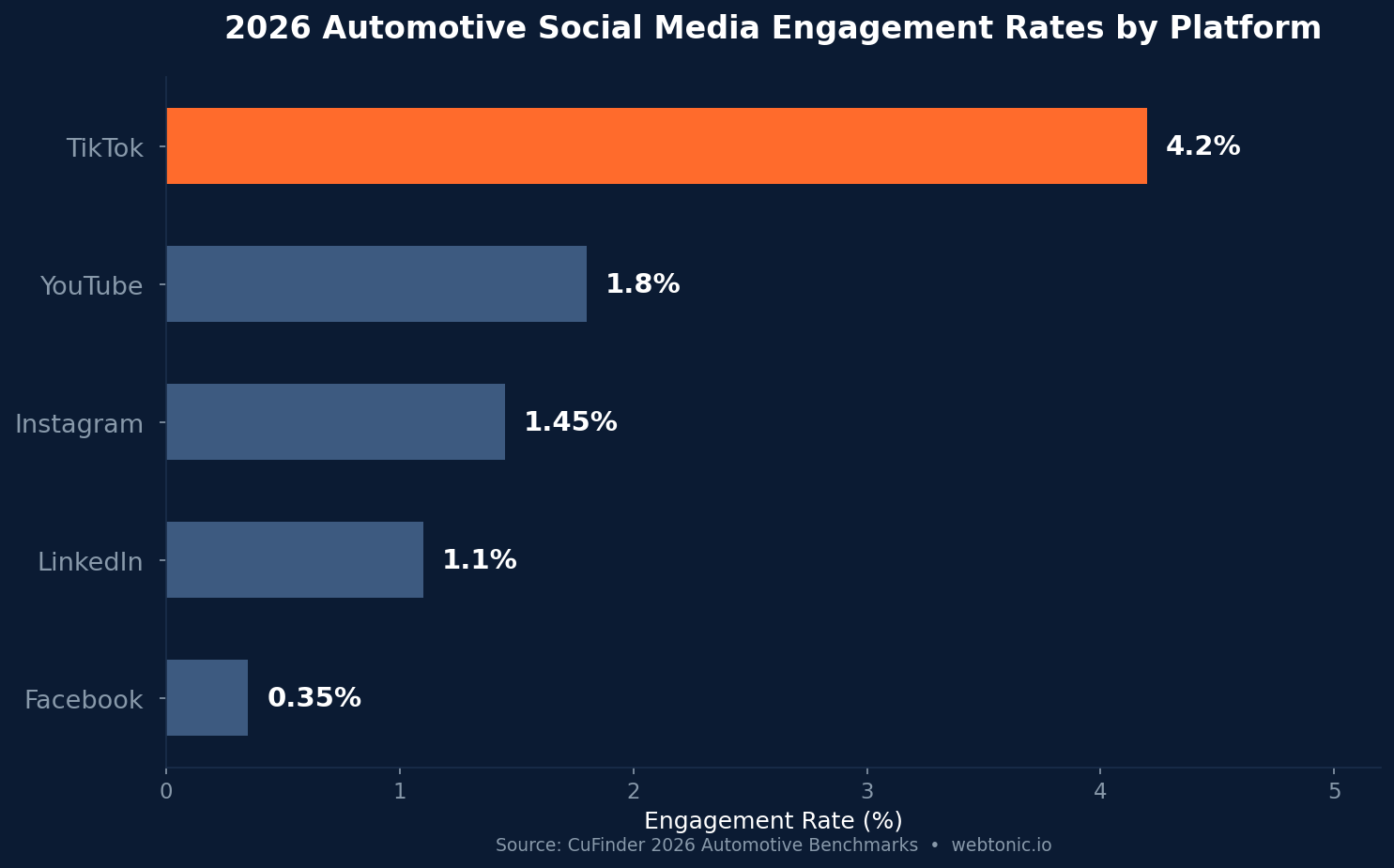
- TikTok delivers a 4.2% engagement rate for auto brands, outperforming Instagram (1.45%) and Facebook (0.35%) by significant margins, while brand follower counts on TikTok surged 200% year over year in 2025 (CuFinder; SocialSellsCars).
- Dealerships running targeted social ads see a 42.3% conversion rate, more than double the 20.1% rate for prospects who were not served ads, according to a study of 600,000+ leads across UK dealers (Motor Trade News).
- User-generated content produces 102.4% higher conversion rates for auto dealerships, with visual UGC achieving a 161.3% conversion lift and delivering 400% ROI ($4 return per $1 invested) (Demand Local).
- Social media now influences 26% of all vehicle purchases, while 37% of U.S. adults use TikTok and 62% of TikTok users rely on the platform for product reviews or recommendations (Demand Local).
| Platform | Engagement Rate | Ad Spend Share | Key Strength |
|---|---|---|---|
| TikTok | 4.2% | 15.8% | Short-form video discovery, 200% follower growth YoY |
| 1.45% | 22.1% | Visual storytelling, 25–45 age demographic | |
| 0.35% | 34.6% | Largest platform share, advanced targeting, 35–65 demographic | |
| 1.1% | 5.2% | B2B fleet and dealer group reach | |
| YouTube | 1.8% | 18.4% | Long-form reviews, walkaround video, 85% U.S. adult reach |
Automotive Social Ad Spend Is Accelerating Toward $21.8 Billion
The automotive sector's investment in social platform advertising is expanding rapidly. Global spending hit $8.2 billion in 2025 and is forecast to reach $9.1 billion in 2026, according to MarketIntelo's 2034 forecast report. By 2034, the market is expected to top $21.8 billion, growing at a compound annual rate of 11.4%.
Video-format ads dominate this budget, capturing 38.5% of total automotive social ad spend. North America leads regionally with a 42.3% revenue share, reflecting the continent's mature dealer network and heavy digital adoption. The shift toward short-form, algorithm-driven content formats is pulling budget away from traditional linear TV and print channels at an accelerating rate.
Facebook commands the single largest platform share at 34.6% of automotive social advertising, generating $2.83 billion in automotive ad revenue in 2025. Instagram follows with 22.1% market share and $1.81 billion in value. Cost-per-lead on Facebook declined 18% year over year in 2025 as platforms refined their optimization algorithms and advertisers improved campaign efficiency.
Platform Engagement Rates and What They Mean for Dealerships
Engagement benchmarks vary dramatically across channels. CuFinder's 2026 automotive benchmarks report a 4.2% engagement rate on TikTok, compared to 1.45% on Instagram and just 0.35% on Facebook. LinkedIn sits at 1.1% for B2B fleet and dealer group content. Car enthusiast culture drives above-average interaction rates across visual platforms, particularly for walkaround footage and behind-the-scenes service-bay content.
However, raw engagement does not tell the full conversion story. Despite lower interaction rates, Facebook accounts for 34.6% of all auto social ad dollars because its conversion infrastructure (pixel-based tracking, Conversions API, and lookalike audiences) still outperforms newer platforms for bottom-funnel measurement. Dealerships should evaluate each channel against both awareness metrics and closed-loop attribution before reallocating budget.
Recommended posting cadences for dealer accounts include 4–5 posts per week on Instagram and Facebook, and 3 posts per week on TikTok and Shorts, according to CuFinder. Consistency matters more than volume: algorithmic relevance rewards regular publishing schedules over sporadic campaign bursts.
TikTok's Rapid Rise as an Automotive Discovery Channel
TikTok has moved from an experimental add-on to a core pillar of dealer social strategies. The 2026 Emplifi Social Media Benchmarks report, analyzed by SocialSellsCars, shows that TikTok brand follower counts rose 200% year over year in 2025. The platform generated twice the median interactions of Instagram and 20 times the median interactions of Facebook.
TikTok delivered a 27.6% median engagement rate in Q4 2025, while Instagram's median engagement dropped from 16.9% (Q1 2024) to 9.7% (Q4 2025). Organic reach on Instagram fell 30–40% across all post formats in 2025, including Reels. For dealerships relying on Instagram's organic feed, this decline makes paid amplification essentially mandatory to maintain visibility.
Demand Local's 2026 TikTok automotive statistics show that 37% of U.S. adults now use TikTok, with 63% of adults under 30 on the platform and 24% using it daily. Among TikTok users, 62% rely on the platform for product reviews or recommendations, and 1 in 2 users have learned something new about vehicles through TikTok content. Short-form video is now a budget priority: 60% of marketers actively use it, 49% rank it as the highest-ROI format, and 30% plan to invest more heavily in it this year (HubSpot, 2026).
Targeted Auto Social Ads Double Conversion Rates
A study of more than 600,000 leads from UK dealerships in the first five months of 2026, conducted by TekCor4 and reported by Motor Trade News, found that prospects exposed to targeted social ads converted at a 42.3% rate. Those who were not served targeted social advertising converted at just 20.1%—a gap that highlights the incremental power of retargeting within the purchase funnel.
This data points to the growing importance of sequential, personalized ad delivery. Dealerships that integrate their CRM with platform pixels can surface vehicle-specific inventory ads to shoppers who have already browsed their site, creating a closed-loop journey from initial research to showroom visit. The retargeting effect is especially strong for high-consideration purchases like vehicles, where buyers average 14 hours of online research before contacting a dealer (Demand Local).
Beyond retargeting, AI-powered CRM integration boosts conversion rates by 42% from online lead to test drive, and dealerships using marketing automation are 2× more likely to achieve higher ROI on their campaigns. These tools help teams prioritize high-intent leads and respond faster, compressing the sales cycle.
| Metric | With Targeted Social Ads | Without Targeted Ads | Lift |
|---|---|---|---|
| Conversion Rate | 42.3% | 20.1% | +110% |
| Time on Dealer Site | 6.5 min | 4.5 min | +44% |
| UGC-Influenced Conversion | 102.4% higher | Baseline | 2× lift |
| Remarketed CPL | Lower by 18% YoY | Standard CPL | −18% |
User-Generated Content Drives 400% ROI for Auto Brands
Authenticity is the currency of social commerce, and user-generated content delivers an outsized return in the automotive vertical. Demand Local's UGC analysis reports that dealerships implementing comprehensive UGC strategies see 102.4% higher conversion rates when shoppers engage with peer-created content. Visual UGC—photos and videos from actual vehicle owners—achieves a 161.3% conversion lift specifically within the automotive category.
The financial case is equally compelling. Bazaarvoice's Forrester study reports a 400% ROI for UGC campaigns, returning $4 for every $1 invested. Each dollar of online revenue influenced by user content generates an additional $3.91 in physical dealership sales, reflecting the offline amplification effect that makes auto retail uniquely suited to UGC strategies.
Additional performance signals underscore UGC's value: visitors spend 90% more time on dealer websites featuring user content, UGC-based ads achieve 4× higher click-through rates, and cost-per-click drops 50% compared to traditional branded creative. Consumers rate user content as 2.4× more authentic than professionally produced brand assets (Stackla research). BMW's UGC efforts illustrate the scale potential: the brand has accumulated 49.2 billion views from user-created content across platforms.
Social Influence on the Vehicle Purchase Journey
The path from first impression to showroom visit increasingly runs through feeds, stories, and short-form video. Cox Automotive's Car Buyer Journey Study found that social channels influence 26% of all vehicle purchases, a share that climbs for younger demographics. Meanwhile, 65% of shoppers want to complete most or all purchase steps online, and 70% say starting the process digitally saves time (Demand Local).
Discovery now lives where culture happens. Mintel's 2026 U.S. Car Purchasing Process report notes that content platforms shape early consideration paths, with algorithm-driven discovery replacing traditional brand-initiated research. Gen Z and millennial buyers, in particular, encounter vehicles through creator-led walkaround videos, comparison Reels, and community discussions well before they ever type a query into a search engine.
This behavioral shift demands a presence strategy that prioritizes top-of-funnel social storytelling. Dealerships that treat their feeds as digital showrooms—featuring real inventory, genuine customer testimonials, and behind-the-scenes service content—capture consideration at the moment attention is most valuable. Internal links to performance creative services and Meta Ads management can help teams build the infrastructure needed to turn social impressions into measurable leads.

Instagram Organic Reach Decline and What Replaces It
Instagram remains a critical automotive platform, but the organic model that carried dealerships through 2020–2024 is no longer viable. SocialSellsCars reports that organic reach on Instagram fell 30–40% across all post formats in 2025, including Reels, carousels, and single images. Video engagement on the platform declined by roughly 18% year over year.
The shift has been algorithmic rather than audience-driven. Likes per reach remained flat and comments stayed minimal, but shares have become the engagement signal that moves content. Dealerships that focus on share-worthy content—price comparisons, feature highlights, and surprising service tips—can still earn organic distribution. Everything else increasingly requires paid amplification.
Despite these headwinds, Instagram's ad platform remains efficient for auto advertisers. The platform's $1.81 billion in automotive ad revenue reflects strong dealer adoption, and its visual-first format aligns naturally with vehicle merchandising. The strategic pivot is clear: use organic content for brand building and community engagement, while dedicating paid budget to reach and conversion goals. Resources on Meta Ads ROI and Facebook Ads pricing can guide dealership budget allocation.
Best Practices for Automotive Social Media Campaigns
- Prioritize short-form video on TikTok and Reels. With 60% of marketers now using short-form video and TikTok delivering 4.2% engagement, dealerships that invest in walkaround clips, customer delivery moments, and service tips will capture disproportionate attention.
- Integrate CRM data with ad platform pixels. The 42.3% vs. 20.1% conversion gap between targeted and untargeted prospects proves that personalized retargeting on social channels directly impacts the bottom line.
- Build a UGC pipeline. Encourage customer testimonials, delivery day photos, and review videos. UGC ads achieve 4× higher CTR at 50% lower CPC, making them the most cost-efficient creative format available.
- Post consistently at platform-recommended cadences. Target 4–5 posts weekly on Instagram/Facebook and 3 posts weekly on TikTok/Shorts to maintain algorithmic relevance.
- Allocate budget toward video ad formats. Video ads command 38.5% of total auto social ad spend because they consistently outperform static formats in both engagement and conversion.
- Track closed-loop attribution. Deploy Facebook Conversions API and TikTok's automotive ad tools to connect social impressions to showroom visits and completed vehicle sales.
- Repurpose organic performers as paid creative. Content that earns shares organically will typically outperform studio-produced ads when amplified with budget behind it.
| Strategy | Expected Impact | Priority Level |
|---|---|---|
| Short-Form Video | 4.2% engagement, highest-ROI format | High |
| CRM-Pixel Integration | +110% conversion lift | High |
| UGC Pipeline | 400% ROI, 4× CTR | Medium-High |
| Consistent Posting | Algorithmic relevance + reach | Medium |
| Video Ad Budget Shift | 38.5% of spend → top performer | Medium |
| Closed-Loop Attribution | Measurable ROAS on social | Medium |
Automotive vs. All-Industry Social Benchmarks
| Metric | Automotive | All-Industry Average | Index |
|---|---|---|---|
| Instagram Engagement Rate | 1.45% | 0.98% | 148 |
| TikTok Engagement Rate | 4.2% | 2.6% | 162 |
| Facebook CPC | $1.15 | $1.72 | 67 |
| Social Share of Buyer Journey | 26% | 18% | 144 |
| UGC Conversion Lift | 161.3% | 102.4% | 157 |
The Car Buyer Journey Across Social Media Platforms
Understanding the car buyer journey in 2026 means mapping how prospects move from awareness to showroom across multiple social media platforms. Data from Cox Automotive's annual Car Buyer Journey Study shows that 95% of vehicle buyers begin their research online, spending an average of 14 hours across digital touchpoints before contacting a dealer. Social channels now intercept this journey earlier than search, with short form video on TikTok and Instagram Reels shaping initial consideration before prospects ever type a query into Google.
The National Automobile Dealers Association (NADA) estimates that the average U.S. dealership spends $672 per new vehicle sold on digital advertising, with social channels consuming a growing share of that budget. In terms of efficiency, dealerships report an average cost per lead (CPL) of $21–$35 on social campaigns, compared to $45–$65 for paid search. The lifetime value (LTV) of a social-acquired customer also trends higher because social touchpoints build brand affinity that drives service retention and repeat purchases.
Automotive social media marketing statistics from MyDigiPal's 2026 dealership strategy analysis confirm that vehicle sales influenced by social advertising grew 18% year over year in the United States and Canada. Dealers in the U.S. market increasingly combine inventory-specific ads with brand storytelling across platforms, while Canadian dealers leverage bilingual content strategies to reach both English- and French-speaking car buyers.
Call Tracking and Attribution for Automotive Social Campaigns
Measuring the true impact of social ads on vehicle sales requires robust call tracking and attribution. Platforms like Invoca report that phone calls driven by automotive digital marketing campaigns convert at 10–15× the rate of web form submissions. Invoca's automotive marketing statistics indicate that 63% of high-value vehicle purchase inquiries still happen over the phone, making call attribution a critical component of any social ROI framework.
Google's offline conversion import feature now supports dealership DMS integration, allowing advertisers to match social ad clicks to completed vehicle sales recorded in their dealer management system. Combined with CRM retargeting on social media platforms, this creates a closed-loop measurement system where every dollar of automotive social ad spend can be traced from impression through to revenue. Dealerships implementing this full-funnel data connection see a 22–30% improvement in reported ROAS compared to those relying on platform-only attribution.
For teams evaluating their digital marketing technology stack, resources on data intelligence services provide guidance on building attribution models that capture the multi-touch reality of the automotive buyer journey.
Automotive Marketing Statistics That Will Shape Strategy in 2026
The automotive marketing statistics landscape will continue to evolve as brands invest in social media marketing to reach car buyers earlier in the consideration cycle. Digital marketing budgets across the automotive industry will increase by 12–15% in 2026, with social media platforms absorbing the largest share of incremental spend. Brands that will succeed are those building always-on content engines rather than campaign-burst models.
Key data points shaping automotive social media strategy include:
- Customer acquisition cost via social is declining. As platform algorithms improve and brands refine their targeting, the average CPL on automotive social media campaigns dropped to $21–$35, making social one of the most efficient channels for dealership lead generation.
- Vehicle sales influenced by digital ads will exceed 40% of total retail volume in 2026. This shift is driven by car buyers who encounter inventory through social feeds before visiting dealer websites.
- Short form video will capture over 50% of automotive social ad impressions. Brands investing in TikTok, Instagram Reels, and YouTube Shorts will dominate awareness metrics, while static-image ads will continue losing impression share.
- Automotive social media marketing now generates measurable ROI. With closed-loop attribution connecting social ad impressions to DMS records, dealerships can prove that social campaigns drive vehicle sales at competitive ROAS levels.
The automotive industry's digital marketing transformation will accelerate as data-driven strategies replace gut-feel spending. Brands that will thrive are combining customer data with creative testing across social media platforms to build scalable acquisition systems. For dealerships, this means investing in both the content (social media marketing creative) and the infrastructure (CRM integration, call tracking, conversion APIs) that connect social impressions to vehicle sales.
Platform-Specific Advertising Benchmarks for Car Brands
| Metric | TikTok | YouTube | ||
|---|---|---|---|---|
| Avg. Automotive CPC | $1.15 | $1.35 | $0.80 | $0.12 CPV |
| Avg. Automotive CPL | $28 | $32 | $24 | $35 |
| Best Content Format | Carousel + video | Reels + stories | Short form video | Walkaround + review |
| Peak Customer Demo | 35–65 | 25–44 | 18–34 | 25–54 |
| Dealership Adoption | 92% | 78% | 31% | 45% |
These automotive marketing statistics reveal clear patterns for car brands and dealership groups looking to optimize their social media marketing budgets. Buyers across every demographic now engage with automotive content on social media platforms, but the channel mix will vary based on whether the brand targets new vehicle buyers, used car buyers, or service customers. Digital marketing data consistently shows that multi-platform strategies outperform single-channel approaches for automotive brands.
Social Media's Role in Automotive Industry Vehicle Sales Growth
Across the automotive industry, social media marketing is no longer a supplementary channel—it is a primary driver of vehicle sales and customer engagement. Automotive marketing statistics from industry associations and digital marketing platforms confirm that brands investing in automotive social media content generation will capture a larger share of the car buyer journey in 2026 and beyond.
The data tells a clear story: car buyers who encounter dealership brands through social media platforms convert faster and with higher satisfaction scores than those acquired through traditional advertising. Digital marketing campaigns that combine short form video, user-generated content, and inventory-specific ads across platforms like Facebook, Instagram, TikTok, and YouTube will generate the strongest ROI for automotive brands in the current market.
For automotive brands and dealership groups exploring how social media marketing statistics translate into actionable strategy, resources on social media ideas for engagement and growth offer proven playbooks aligned with 2026 benchmarks. Dealerships will find that data-backed content calendars, customer-centric storytelling, and platform-specific creative formats deliver consistently stronger vehicle sales results than generic advertising approaches.
Frequently Asked Questions
What is the average engagement rate for automotive brands on social media?
Engagement varies widely by platform. In 2026, automotive brands average a 4.2% engagement rate on TikTok, 1.45% on Instagram, 1.1% on LinkedIn, and 0.35% on Facebook. TikTok's rate is driven by short-form video discovery and car enthusiast culture, while Facebook's lower organic engagement is offset by its superior conversion tracking and ad targeting infrastructure.
How much do car dealerships spend on social media advertising?
The global automotive social advertising market was valued at $8.2 billion in 2025 and is projected to reach $9.1 billion in 2026. Individual dealer budgets vary by rooftop size and market, but industry data shows an increasing share of total ad spend shifting toward social platforms, particularly video-first formats on TikTok, Instagram Reels, and YouTube Shorts.
Does user-generated content actually improve car sales?
Yes. Research shows UGC produces a 102.4% increase in conversion rates and a 400% ROI for automotive dealerships. Visual user content specifically achieves a 161.3% conversion lift in the auto sector. Visitors who interact with ratings and reviews show 108.6% higher conversion rates, and UGC ads deliver 4× higher click-through rates at 50% lower cost-per-click than branded creative.
Which social platform is best for automotive marketing in 2026?
There is no single "best" platform—each serves a different funnel stage. TikTok leads for discovery and top-of-funnel engagement (4.2% rate, 200% follower growth). Facebook remains dominant for conversion-focused campaigns (34.6% of ad spend, strongest attribution tools). Instagram bridges awareness and consideration with visual storytelling, and YouTube excels at long-form research content that influences 80% of new purchasers to take action.
How often should a dealership post on social media?
Industry benchmarks suggest posting 4–5 times per week on Instagram and Facebook and 3 times per week on TikTok and YouTube Shorts. Consistency is more important than volume: maintaining a regular cadence helps the algorithm surface your content to followers and supports steady reach growth over campaign-style bursts.
Sources
marketintelo.com/report/automotive-social-media-advertising-market
cufinder.io/blog/benchmarks/automotive/
socialsellscars.com – 2026 Social Media Benchmarks for Car Dealers
motortradenews.com – Targeted Social Ads Double Conversion Rates
demandlocal.com – User-Generated Content in Automotive Marketing
demandlocal.com – TikTok Automotive Marketing Statistics 2026
demandlocal.com – Lead-to-Sale Conversion Statistics
mydigipal.com – Dealership Paid Social Strategy 2026
adlibrary.com – Meta Ad Benchmarks Automotive 2026


