Table of contents

Short ad text wins on Google Search headlines and shows the widest performance gap of any variable tested; on Meta, short body copy also wins outright, but a second length that works is four to five times longer. This page compares the two platforms on character-count data rather than general copywriting advice.
Key Takeaways
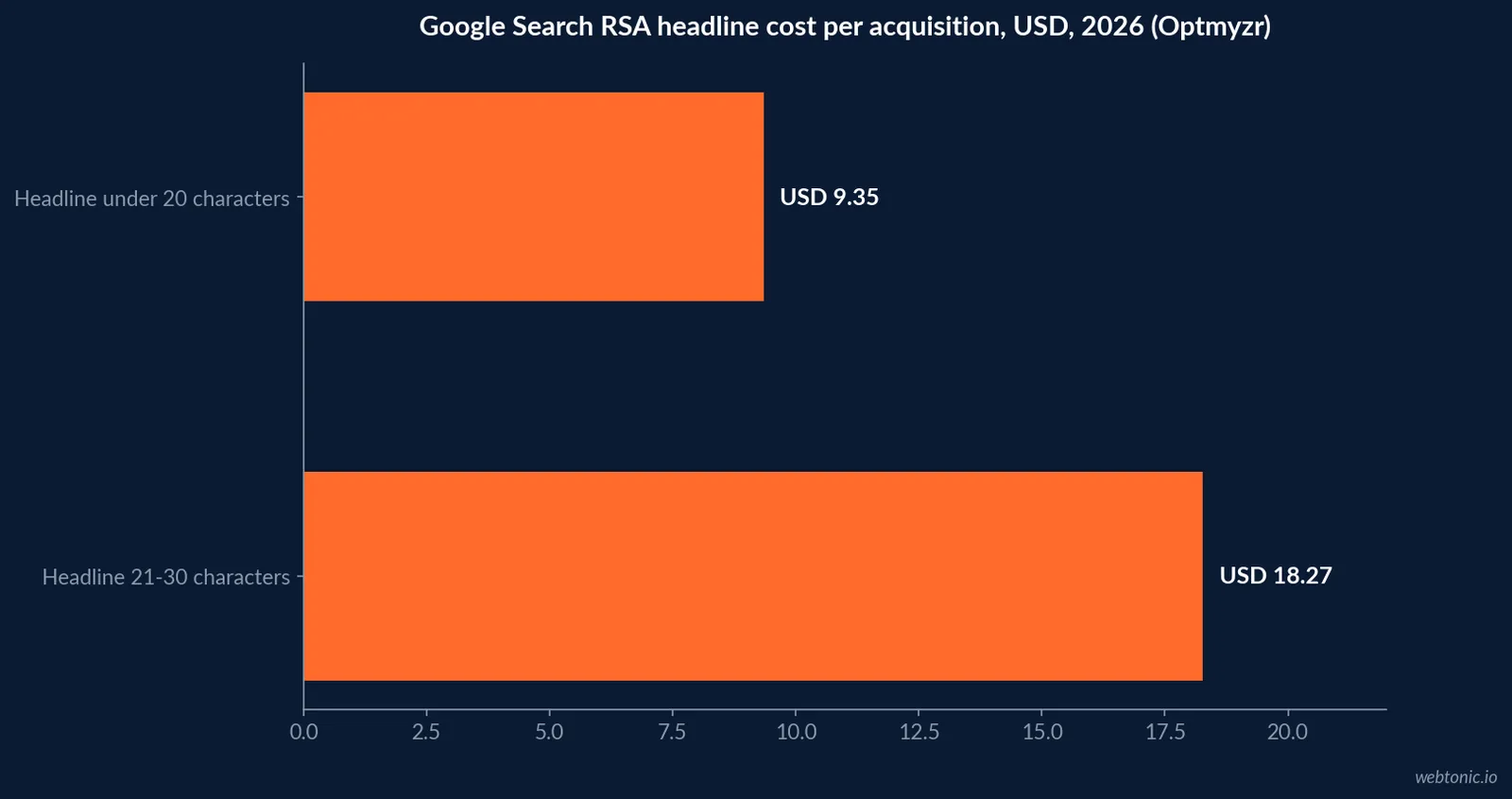
- Headlines under 20 characters post a $9.35 CPA on Google Search.
- That is nearly half the $18.27 CPA of longer headlines.
- Short headlines also post an 11.77% CTR against 10.52% for longer ones.
- Short-headline CVR reaches 10.39% against 8.61%.
- The headline-length correlation with Ad Strength is just 0.056, near zero.
- 61-70 character descriptions deliver the best CTR at 12.33%.
- That bucket also posts a 307.58% ROAS on Google Search.
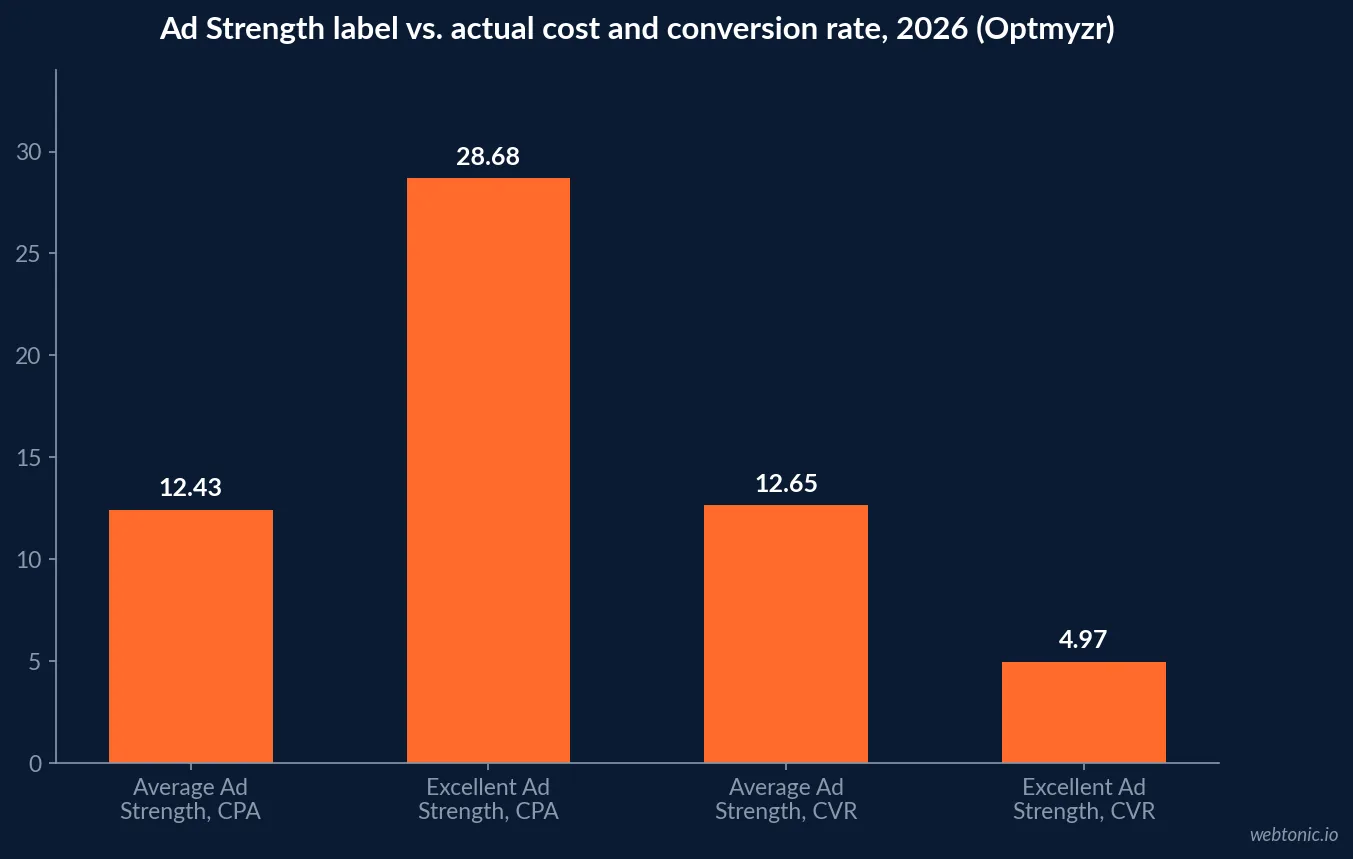
- 'Average' Ad Strength ads post the best CPA at $12.43.
- 'Excellent' Ad Strength ads post the worst CPA at $28.68.
- 'Poor' Ad Strength ads post the best ROAS at 327.65%.
- The study covers roughly 20,000 Google Ads accounts.
- A separate dataset spans 211 million-plus ads across Google and Meta.
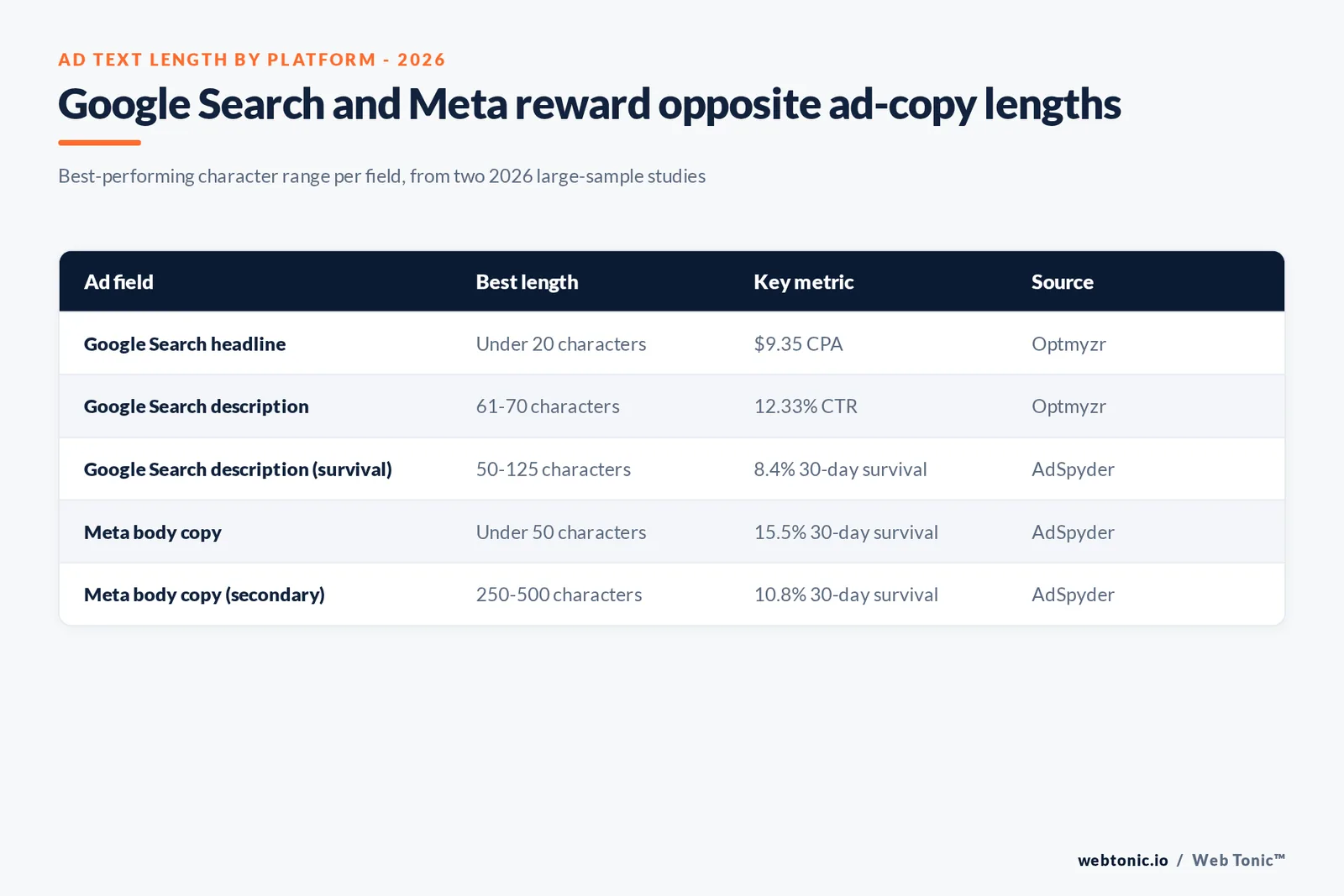
- Google Search's best 30-day survival rate is 8.4% at 50-125 characters.
- Meta's best survival rate is 15.5% under 50 characters.
- Meta's second peak reaches 10.8% at 250-500 characters.
- The 125-250 character range is used by 42.4% of Google ads, yet underperforms.
- Google caps RSA headlines at 30 characters and descriptions at 90.
- Up to 15 headlines and 4 descriptions can populate one responsive search ad.
Why "long versus short" needs a platform split
Ad copy length is not a single variable with one right answer - the two largest 2026 datasets on the question both find the ideal length depends on which platform and which field is being measured. Optmyzr analyzed roughly 20,000 active Google Ads accounts on cost-efficiency metrics; AdSpyder measured copy length against observed ad lifetime across 211 million-plus Google Search and Meta ads. Both point the same direction on Google headlines and split on Meta - which is the useful finding for anyone writing one template for both channels.
Google Search: shorter headlines, mid-length descriptions
Optmyzr's core finding is that headlines under 20 characters deliver a $9.35 CPA - nearly half the $18.27 CPA of longer headlines (21-30 characters) - while also posting a higher CTR (11.77% versus 10.52%) and CVR (10.39% versus 8.61%). The correlation between headline length and Ad Strength in the same dataset was just 0.056, functionally no relationship, even though longer headlines did show a higher share of "Excellent" Ad Strength ratings.
Descriptions behave differently: the 61-70 character bucket delivered the best combination across metrics - 12.33% CTR, 307.58% ROAS, 9.21% CVR, and the most conversions per impression - while very short descriptions (0-50 characters) had the lowest CPA at $9.61 but also the lowest CTR at 8.90%, suggesting they under-communicate the offer even though they are cheap to run.
| Google Search RSA field | Best-performing length | Key metric | Value |
|---|---|---|---|
| Headline | Under 20 characters | CPA | $9.35 |
| Headline (comparison) | 21-30 characters | CPA | $18.27 |
| Description | 61-70 characters | CTR | 12.33% |
| Description | 61-70 characters | ROAS | 307.58% |
| Description (comparison) | 0-50 characters | CTR | 8.90% |
What Ad Strength does and does not tell you
Optmyzr's dataset ties Ad Strength directly to outcomes and the label does not hold up as a performance predictor: "Average" Ad Strength ads produced the best CPA ($12.43), the highest CVR (12.65%), and the most conversions per impression (1.40%) in the study, while "Excellent" ads had the worst CPA ($28.68) and the lowest CVR (4.97%). "Poor" Ad Strength ads delivered the best ROAS of all, at 327.65%, outperforming every higher-rated tier. Optmyzr's own read is that Ad Strength measures asset-coverage completeness - how many unique headlines and descriptions are supplied - not whether the copy itself converts.
Meta: the opposite length wins
AdSpyder's cross-platform dataset - 167.5 million Google Search ads and 43.9 million Meta ads in its historical archive - found Google Search's best 30-day survival rate, 8.4%, sits at 50-125 characters, while Meta's best survival rate, 15.5%, sits at under 50 characters - nearly double Google's best bucket. Meta shows a second, smaller peak at 250-500 characters (10.8%), meaning a very short hook and a long, story-driven post both outperform the mid-length copy most advertisers default to. The most commonly used Google description length, 125-250 characters at 42.4% of ads sampled, is not the best-performing bucket on either platform.
| Platform | Best length bucket | 30-day survival rate | Worst-performing comparison |
|---|---|---|---|
| Google Search | 50-125 characters | 8.4% | 250-500 characters |
| Meta | Under 50 characters | 15.5% | 125-250 characters |
| Meta (secondary peak) | 250-500 characters | 10.8% | n/a |
| Google Search (most common, not best) | 125-250 characters | Used by 42.4% of ads | n/a |
The character limits behind the data
All of this plays out inside fixed platform limits. Google's own documentation caps responsive search ad headlines at 30 characters and descriptions at 90 characters each, with room for up to 15 headlines and 4 descriptions per ad, assembling combinations of up to three headlines and two descriptions per impression. The performance data above shows the winning lengths sit well inside those caps - Google gives an advertiser 30 characters to fill, but the best-performing headlines use fewer than 20 of them.
| RSA asset | Google's character limit | Assets allowed | Best-performing length from data |
|---|---|---|---|
| Headline | 30 characters | Up to 15 | Under 20 characters |
| Description | 90 characters | Up to 4 | 61-70 characters |
| Path field | 15 characters | 2 (path1, path2) | Not covered by this dataset |
Meta's own character limits tell the same story
Meta's Ads Guide, compiled by Ads Uploader's 2026 character-limit reference, recommends 125 characters for primary text, 40 characters for the headline field, and just 25 characters for the description field - and those recommended lengths shrink further by placement: Facebook Feed headlines recommend 27 characters, and Reels Overlay drops to just 10 characters. Text beyond the recommended primary-text length is hidden behind a "See More" link on mobile, which lines up with AdSpyder's finding that Meta's own best-performing bucket, under 50 characters, sits well inside that visible window rather than testing its limits.
Meta allows up to five variations per text field for delivery optimization, the same logic Google applies with its 15-headline, 4-description asset pool - both platforms are built to test length and message inside the account, not to have an advertiser guess the winner in advance.
| Meta ad text field | Meta's recommended length | Tightest placement limit | Source |
|---|---|---|---|
| Primary text | 125 characters | Same across most placements | Meta Ads Guide via Ads Uploader |
| Headline | 40 characters | 10 characters (Reels Overlay) | Meta Ads Guide via Ads Uploader |
| Description | 25 characters | Often absent from Stories/Reels | Meta Ads Guide via Ads Uploader |
When the "long copy wins" rule still applies
The short-copy advantage documented above is specific to ad-unit fields with a truncation point, not a universal rule against long-form persuasion. Creative Direct Marketing Group reports a direct-response test in which Aetna's HealthSpire generated 638% more leads with a long-copy landing page against a short-copy version of the same offer - a format where there is no "See More" truncation and no 30-character cap forcing a decision. The lesson for an ad account is to keep the ad unit itself short, per the data above, and reserve long-form persuasion for the landing page the ad sends traffic to.
Our landing page and CRO analysis treats the ad and the landing page as two different copy-length problems, because the data above shows they are.
| Format | Truncation point | Where long copy tends to win | Where short copy tends to win |
|---|---|---|---|
| Google Search RSA headline | 30 characters (hard cap) | Rarely | Under 20 characters |
| Meta primary text | 125 characters (visible) | 250-500 char. secondary peak | Under 50 characters |
| Landing page body copy | None | High-consideration offers | Simple, low-cost offers |
How to apply the split to a live account
Write Google Search headlines to communicate the offer in under 20 characters rather than filling the 30-character allowance, keep descriptions in the 50-125 character range and test toward 61-70, and stop optimizing to the Ad Strength label directly - optimize to CPA and CVR instead, since the two Optmyzr studies now agree the label and the outcome move independently. On Meta, run a genuinely short hook and a genuinely long story variant in the same test; the mid-length copy in between is where both datasets found the weakest results.
Our performance creative team builds that platform-specific length split into every ad-copy test, and our Facebook Ads ROI analysis covers how copy length interacts with the rest of the creative testing plan. For the broader performance picture, see our conversion rate statistics roundup or talk to our Google Ads team about testing headline length directly in your account.
Frequently Asked Questions
Are shorter headlines always better on Google Ads?
For cost efficiency, yes, according to Optmyzr's analysis of roughly 20,000 Google Ads accounts. Headlines under 20 characters delivered a $9.35 cost per acquisition against $18.27 for longer headlines - nearly half the cost - along with higher CTR (11.77% versus 10.52%) and better conversion rate (10.39% versus 8.61%). Longer headlines, 21 to 30 characters, did correlate with a higher share of 'Excellent' Ad Strength ratings, but Ad Strength itself showed almost no correlation with actual performance in the same dataset.
What is the ideal description length for Google Search ads?
Optmyzr's data puts the sweet spot at 61-70 characters, which produced the highest CTR (12.33%), a strong ROAS (307.58%), solid conversion rate (9.21%), and the most conversions per impression in the study. AdSpyder's separate analysis of 211 million-plus ads found a slightly wider Google Search sweet spot of 50-125 characters, which posted the highest 30-day survival rate at 8.4% - both datasets land on a mid-length description outperforming very short or very long copy.
Does the same rule apply to Meta ad copy?
No - AdSpyder's data found Meta rewards the opposite pattern. Body copy under 50 characters won with a 15.5% 30-day survival rate, nearly double Google's best-performing bucket, with a second, smaller peak at 250-500 characters (10.8%). Google's optimal range is close to Meta's worst-performing length, which is why a single ad-copy template rarely serves both platforms well.
Does a higher Ad Strength score mean better ad text?
No, and this is Optmyzr's headline finding across two consecutive years of study. 'Average' Ad Strength ads produced the best CPA ($12.43) and highest CVR (12.65%) in the 2026 dataset, while 'Excellent' ads had the worst CPA ($28.68) and lowest CVR (4.97%). 'Poor' Ad Strength ads even posted the best ROAS at 327.65%. Ad Strength measures asset-count completeness, not copy quality.
Should ad text length vary by funnel stage?
The character-limit data supports it. Google's own guidance caps responsive search ad headlines at 30 characters and descriptions at 90, but the best-performing zone sits well inside those limits - so cold, high-intent search terms can run the shorter, cheaper headline variants, while retargeting or consideration-stage copy has more room to test the longer, story-driven lengths that show a secondary performance peak on Meta.
Sources
Optmyzr - What actually drives RSA performance
AdSpyder - Ad copy length best practices, 211M+ ads
Google Ads Help - About responsive search ads
Google Ads Help - Best practices for responsive search ads
AdSpyder - B2B Google Ads benchmarks, 2026
Ads Uploader - Meta ad copy specs and character limits, 2026
Creative Direct Marketing Group - Long copy vs. short copy test