



Table of contents
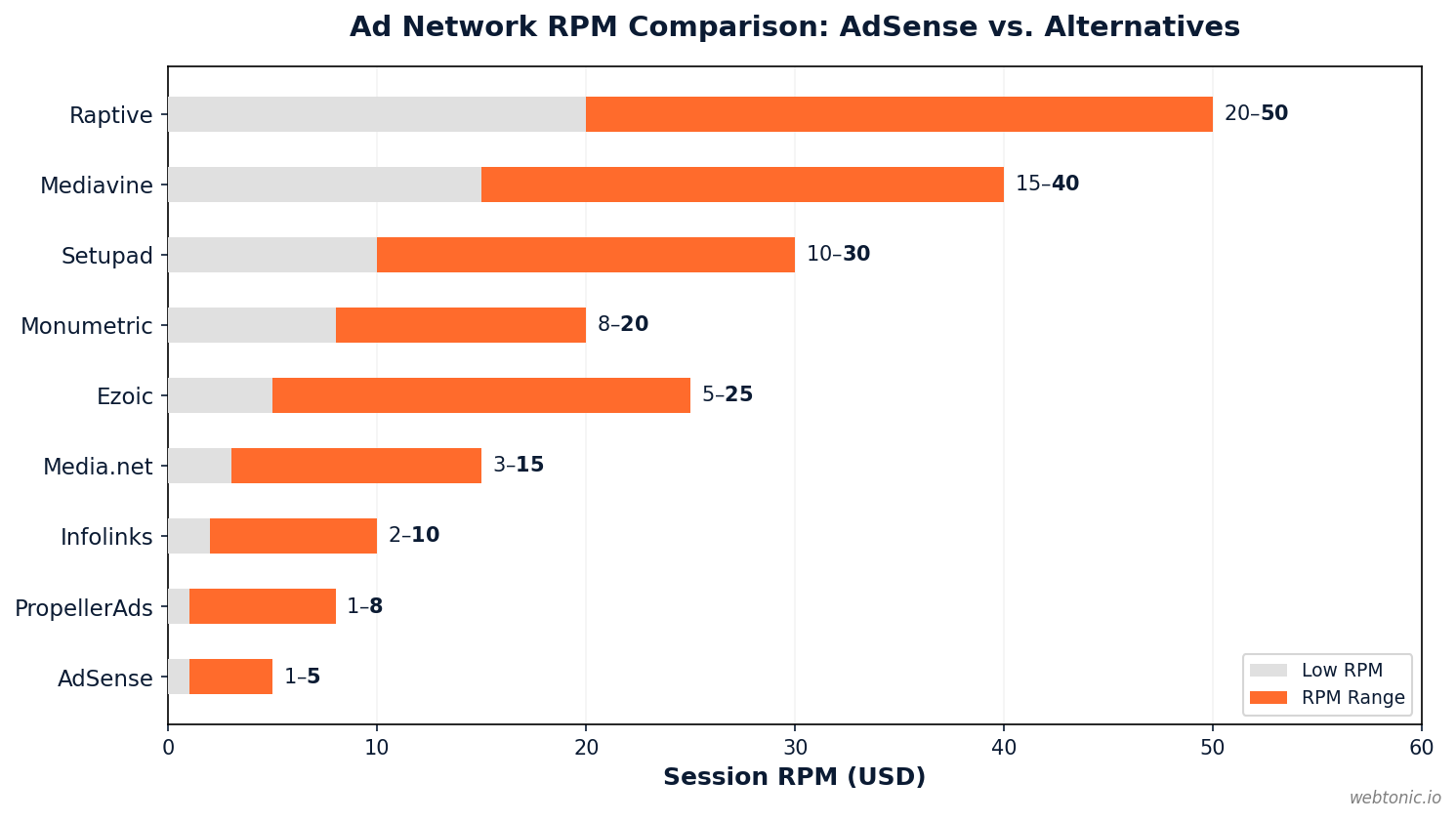
Google AdSense is the default ad network for most publishers, but it is rarely the most profitable one. The best AdSense alternatives — premium alternative ad networks using header bidding — routinely deliver $15–50 session RPM compared to AdSense's typical $1–5 RPM — a difference that can turn a hobby blog into a real revenue source.
Key Takeaways
- Premium ad networks like Mediavine and Raptive pay 5–10× more than Google AdSense for publishers with quality content and tier-one traffic, thanks to header bidding and multiple demand sources.
- The best alternative ad networks for beginners are Ezoic and Media.net — both accept sites with no minimum traffic requirement and offer competitive CPM rates.
- Header bidding is the single biggest revenue driver for publishers in 2026, allowing multiple advertisers to bid simultaneously on each impression instead of relying on a single demand source.
- Revenue depends on niche, geography, and traffic quality — a finance blog with U.S. traffic earns $30–60 RPM, while an entertainment site with global traffic may only reach $3–8 RPM on the same network.
- Switching networks requires a 30-day test — compare net RPM after revenue share and Core Web Vitals impact, not just headline numbers.
Why Publishers Look Beyond Google AdSense
Google AdSense remains the largest advertising network for publishers, but several limitations drive content creators toward alternatives:
- Single demand source — AdSense only runs Google's own ad auction. Alternative networks connect to dozens of demand-side platforms (DSPs), creating more competition for each impression and driving CPM rates higher.
- Low RPM for quality content — Publishers with strong engagement and niche audiences consistently earn 3–10× more revenue from networks that use header bidding compared to AdSense's waterfall model.
- Strict policy enforcement — AdSense account bans are permanent and often unexplained. Many publishers diversify across networks to avoid single-point revenue risk.
- Limited optimization control — Premium ad networks offer dedicated ad ops teams, layout testing, and revenue optimization that AdSense's self-serve model cannot match.
10 Best Alternative Ad Networks Compared
Here is a side-by-side comparison of the best Google AdSense alternatives (also known as the best adsense alternative options) for publishers in 2026, ranked by revenue potential and accessibility:
| Ad Network | Minimum Traffic | RPM Range | Minimum Payout | Best For |
|---|---|---|---|---|
| Mediavine | 50,000 sessions/mo | $15–$40+ | $25 (NET 65) | Lifestyle, food, travel blogs |
| Raptive (AdThrive) | 100,000 PV/mo | $20–$50+ | $25 (NET 45) | Premium content publishers |
| Ezoic | No minimum | $5–$25 | $20 (NET 30) | New and growing publishers |
| Media.net | No minimum | $3–$15 | $100 (NET 30) | Sites with U.S./U.K. traffic |
| Monumetric | 10,000 PV/mo | $8–$20 | $10 (NET 60) | Growing blogs |
| PropellerAds | No minimum | $1–$8 | $5 (NET 7) | Global traffic monetization |
| Amazon Publisher Services | 5,000 unique visitors/day | $4–$15 | $50 (NET 60) | Ecommerce content sites |
| Infolinks | No minimum | $2–$10 | $50 (NET 45) | In-text and native ads |
| Sovrn (formerly VigLink) | No minimum | $3–$12 | $25 (NET 30) | Commerce content publishers |
| Setupad | 100,000 PV/mo | $10–$30 | $100 (NET 60) | European publishers |
Head-to-Head: Media.net vs. Ezoic vs. Mediavine
These three networks represent the best adsense alternatives at different publisher stages. Here is how these best Google AdSense alternatives compare for sites looking to switch from a single-source setup:
- Media.net — Powered by the Yahoo/Bing advertising platform, Media.net is the best adsense alternative for publishers with primarily U.S. and U.K. traffic. The contextual ad technology analyzes page content and serves highly relevant ads without relying on third-party cookies. Media.net, Ezoic, and similar networks work well as alternatives for publishers who want diversified demand.
- Ezoic — The most accessible premium advertising platform with no minimum traffic requirement. Ezoic uses AI to test thousands of ad placement combinations across websites, finding the configuration that maximizes revenue per visitor. The platform connects networks, advertisers, and publishers through an integrated header bidding wrapper.
- Mediavine — The gold standard for lifestyle and content publishers with 50,000+ monthly sessions. Mediavine's full-service approach handles all ad optimization, giving publishers the highest RPM rates among the best networks for publishers in this segment. Video ads integration and high quality ad inventory from premium advertisers make it the top choice for established sites.
The progression path most publishers follow is: Google AdSense → Ezoic or Media.net → Mediavine → Raptive. Each step up requires more traffic but delivers substantially higher revenue. The right choice is the one that match your current traffic level and growth trajectory.
How Header Bidding Increases Ad Revenue
Header bidding is the technology behind most premium alternative ad networks and the primary reason they outperform Google AdSense. In the traditional waterfall model that AdSense uses, ad impressions are offered to one demand source at a time in a fixed priority order. If the first bidder passes, the impression moves to the next — meaning most advertisers never get a chance to bid.
Header bidding changes this by letting all demand sources bid simultaneously. When a page loads, the header bidding wrapper sends the impression to 10–30 demand partners at once. Every advertiser sees every impression, and the highest bid wins. This creates genuine auction pressure that increases CPM rates by 20–50% on average compared to waterfall setups.
Networks like Mediavine, Raptive, and Setupad run header bidding by default. Ezoic uses a proprietary AI-driven system that tests ad placements, sizes, and demand partners to maximize revenue per session. For publishers managing their own ad stack, open-source solutions like Prebid.js provide header bidding without locking into a single network.
Choosing the Right Ad Network: Decision Framework
The best alternative ad network depends on your traffic volume, content niche, audience geography, and technical willingness. Use this framework to find the best networks for publishers at your traffic level:
| Traffic Level | Recommended Networks | Expected RPM | Priority |
|---|---|---|---|
| Under 10K PV/mo | Ezoic, Media.net, Infolinks, PropellerAds | $2–$10 | Focus on content growth; revenue is secondary |
| 10K–50K PV/mo | Ezoic, Monumetric, Media.net | $8–$20 | Test 2–3 networks; optimize ad placement |
| 50K–100K PV/mo | Mediavine, Ezoic Premium | $15–$30 | Apply to premium networks; negotiate terms |
| 100K+ PV/mo | Raptive, Mediavine, Setupad | $20–$50+ | Direct advertiser relationships; header bidding stack |
How Ad Networks Connect Advertisers and Publishers
Understanding how advertising networks function helps publishers choose the best adsense alternatives and negotiate better terms. Every ad network operates as a marketplace connecting two sides:
- Publishers — Website owners who have ad inventory (space on their pages) to sell. Publishers monetize websites by displaying ads from the network's demand pool.
- Advertisers — Brands and businesses that want to reach specific audiences. They bid on ad impressions through demand-side platforms (DSPs) and supply-side platforms (SSPs).
The best networks for publishers aggregate demand from hundreds of advertisers and publishers through a supply side platform (SSP), which connects to multiple demand sources via real time bidding (RTB). When a visitor loads a page, the SSP sends the impression details to all connected DSPs, each advertiser bids based on the audience profile, and the highest bid wins — all within 200 milliseconds.
This programmatic advertising infrastructure is what separates high-quality Google AdSense alternatives from low-tier networks. Networks like Media.net, Ezoic, and Mediavine connect to premium demand through sophisticated supply side platform technology, while smaller networks may rely on a single demand source similar to how Google AdSense operates.
Revenue Models: CPM vs. CPC vs. CPA
Different advertising networks use different payment models — CPM, CPC, and CPA are the three core pricing structures across the industry. Understanding which model fits your content type is essential for maximizing revenue:
- CPM (Cost Per Mille) — You earn revenue for every 1,000 ad impressions, regardless of whether visitors click. Best for high-traffic sites with strong page views. Most premium networks like Mediavine and Raptive primarily use CPM-based pricing.
- CPC (Cost Per Click) — You earn when a visitor clicks an ad. Google AdSense and Media.net use a hybrid model combining CPM and CPC that includes CPC. Best for content with high engagement and intent-driven traffic. Learn more about optimizing ad performance on our blog.
- CPA (Cost Per Action) — You earn when a visitor completes a specific action like a purchase or sign-up. Networks like Sovrn and affiliate-style platforms use CPA. Best for product review and comparison content.
The most profitable publishers in 2026 use a blended approach — the kind of diversified strategy our digital marketing services team recommends — running CPM display ads alongside CPC native ads and CPA affiliate links. This diversification protects revenue when one model underperforms and lets you monetize different traffic segments appropriately.

How to Switch Ad Networks Without Losing Revenue
Switching advertising networks is the highest-leverage move a publisher can make, but doing it poorly can cost weeks of lost revenue. Follow this process:
- Benchmark your current performance — Record 30 days of RPM, total revenue, page speed scores, and Core Web Vitals before making any changes.
- Apply to 2–3 networks simultaneously — Approval can take 1–4 weeks. Having multiple options gives you negotiating leverage and a backup if one rejects your site.
- Run a 30-day A/B test if possible — Some networks like Ezoic allow split testing where a percentage of traffic sees the new ads while the rest stays on your current setup.
- Monitor Core Web Vitals closely — Ad scripts can degrade Largest Contentful Paint (LCP) and Cumulative Layout Shift (CLS), hurting organic search rankings — a risk that growth marketing teams monitor closely. A network that pays higher RPM but tanks your SEO traffic is a net negative.
- Compare net RPM, not gross — Revenue share varies from 10% (Raptive) to 30%+ (some smaller networks). Always calculate what lands in your account after the network takes its cut.
Native Ads vs. Display Ads: Which Format Earns More?
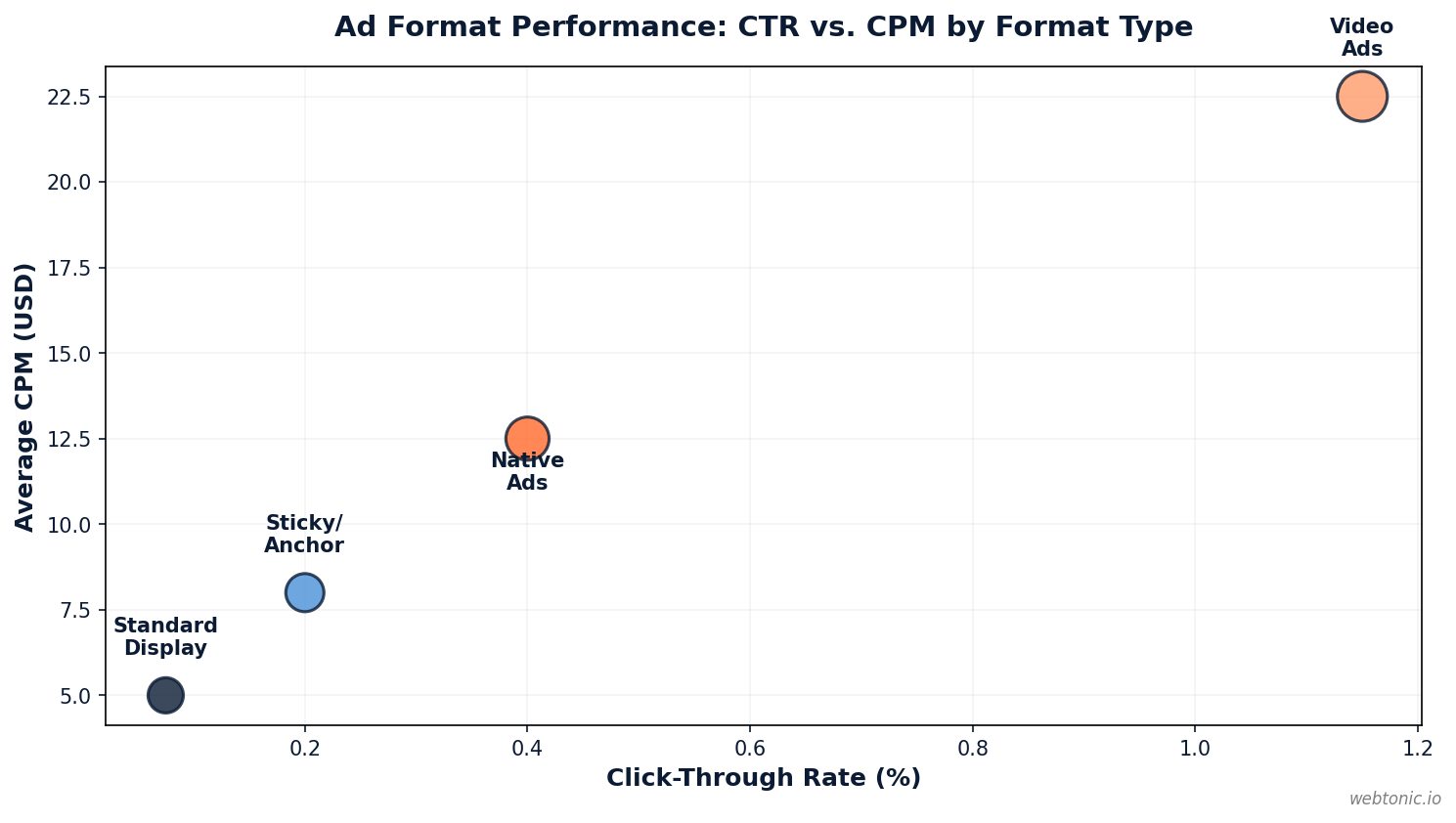
The display advertising landscape in 2026 has shifted significantly toward native ads — ad units that match the look and feel of your content. Here is how the formats compare for publishers:
| Format | Avg. CTR | Avg. CPM | User Experience | Best Networks |
|---|---|---|---|---|
| Standard Display | 0.05–0.10% | $2–$8 | Intrusive; ad-blocker vulnerable | Google AdSense, Ezoic |
| Native Ads | 0.20–0.60% | $5–$20 | Blends with content; higher engagement | Media.net, Infolinks, Taboola |
| Video Ads | 0.50–1.80% | $10–$35 | High impact but can slow pages | Mediavine, Raptive, Connatix |
| Sticky/Anchor | 0.10–0.30% | $4–$12 | Always visible; moderate annoyance | Ezoic, Setupad, AdSense |
Native ads deliver 4–6× higher click-through rates than standard display banners because they feel like editorial content rather than advertising. Networks like Media.net specialize in contextual native ads that match the publisher's content topic, making them a strong Google AdSense alternative — particularly when combined with data intelligence insights — for sites with engaged, reading-focused audiences.
Amazon Publisher Services and Social Media Ad Integration
Amazon Publisher Services (APS) deserves special attention as one of the best Google Ads alternatives for publishers with ecommerce-adjacent content. APS offers both a transparent ad marketplace and header bidding connections through Amazon's Unified Ad Marketplace (UAM). Publishers can run Amazon native shopping ads alongside their primary display network, earning additional revenue from product-level advertising without replacing their existing setup.
Native shopping ads from Amazon match the content topic automatically — a recipe blog shows kitchen tools, a tech review site shows electronics. This contextual relevance drives higher CPM and CPC rates than generic display. Combined with standard display advertising, Amazon native shopping ads can add 10–25% incremental revenue for publishers with the right audience.
Social media platforms also offer advertising network alternatives for publishers who create content across multiple channels. While social media advertising (Facebook Audience Network, Snapchat Publisher Stories) operates differently from website-based networks, publishers who cross-promote content on social media channels often see higher advertising revenue because social traffic tends to have stronger engagement signals that increase CPM rates across all networks.
Ad Network Red Flags: Warning Signs to Watch
Not every alternative ad network is trustworthy. The advertising ecosystem includes networks that inflate revenue projections, delay payments, or serve low-quality ads that damage your site's reputation. Watch for these red flags before signing up:
- Guaranteed RPM promises — No legitimate network can guarantee a specific RPM because ad rates fluctuate based on advertiser demand, seasonality, and market conditions. Networks that promise fixed rates are either misleading or using incentivized traffic schemes.
- Unusually long payment terms — The industry standard is NET 30 to NET 65. If a network requires NET 90+ or has a minimum payout above $200, cash flow becomes a serious concern for smaller publishers.
- No transparency on demand sources — Reputable networks disclose which demand-side platforms and advertisers are bidding on your inventory. If a network cannot explain where the ad revenue comes from, they may be reselling your inventory at a steep markup.
- Mandatory long-term contracts — Most premium networks operate on 30-day rolling agreements. A network requiring a 12-month lock-in is protecting itself, not you. You should always have the freedom to switch if performance disappoints.
- Poor ad quality controls — Networks that serve malware-laden ads, auto-redirect mobile users, or display inappropriate content will drive away your audience and risk Google search penalties. Check advertiser quality across all your websites before committing.
Head-to-Head: Media.net vs. Ezoic vs. Mediavine
These three networks represent the best adsense alternatives at different publisher stages. Here is how these best Google AdSense alternatives compare for sites looking to switch from a single-source setup:
- Media.net — Powered by the Yahoo/Bing advertising platform, Media.net is the best adsense alternative for publishers with primarily U.S. and U.K. traffic. The contextual ad technology analyzes page content and serves highly relevant ads without relying on third-party cookies. Media.net, Ezoic, and similar networks work well as alternatives for publishers who want diversified demand.
- Ezoic — The most accessible premium advertising platform with no minimum traffic requirement. Ezoic uses AI to test thousands of ad placement combinations across websites, finding the configuration that maximizes revenue per visitor. The platform connects networks, advertisers, and publishers through an integrated header bidding wrapper.
- Mediavine — The gold standard for lifestyle and content publishers with 50,000+ monthly sessions. Mediavine's full-service approach handles all ad optimization, giving publishers the highest RPM rates among the best networks for publishers in this segment. Video ads integration and high quality ad inventory from premium advertisers make it the top choice for established sites.
The progression path most publishers follow is: Google AdSense → Ezoic or Media.net → Mediavine → Raptive. Each step up requires more traffic but delivers substantially higher revenue. The right choice is the one that match your current traffic level and growth trajectory.

Related reading
- Ad Blocking Trends: Desktop versus Mobile Usage in 2026
- Long Versus Short Ad Text: 2026 Optimization Benchmarks
- The State of Ad Fatigue Statistics in 2026
- Paid Social services at Web Tonic
FAQ
Which ad network pays the most for publishers?
Raptive (formerly AdThrive) consistently pays the highest RPM for publishers who meet its 100,000 pageview minimum, with rates ranging from $20–$50+ RPM depending on niche and traffic quality. For mid-size publishers, Mediavine delivers $15–$40 RPM with a lower entry threshold of 50,000 sessions. Both networks use header bidding to maximize revenue from multiple demand sources.
Can I use multiple ad networks at the same time?
Yes, but with caveats. Most premium networks like Mediavine and Raptive require exclusivity for display advertising. However, you can typically layer in native ads from Infolinks, affiliate links through Sovrn, and direct sponsorships alongside your primary display network. Running two competing display networks on the same page creates ad conflicts that hurt both performance and user experience.
What is a good RPM for a website?
RPM depends heavily on niche, geography, and traffic quality. For U.S.-focused content: $5–$10 is average, $15–$30 is good, and $30+ is excellent. Finance, insurance, legal, and technology niches command the highest CPM rates because advertisers pay premium prices for those audiences. Entertainment, news, and general-interest content typically falls at the lower end.
Is Google AdSense still worth using in 2026?
Google AdSense remains a viable starting point for new publishers with low traffic volumes because it has no minimum traffic requirement and approvals are fast. However, once a site reaches 10,000+ monthly pageviews, most publishers will earn significantly more revenue by switching to an alternative ad network that uses header bidding technology. The revenue difference typically justifies the switch for any site with consistent traffic growth.
How do I know which ad network is best for my site?
Start by matching your traffic volume to network requirements — there is no point applying to Mediavine with 5,000 monthly sessions. Then consider your audience geography (U.S. and U.K. traffic commands higher CPM rates), content niche (finance and technology pay more than entertainment), and your willingness to manage ads (self-serve networks offer more control while managed networks handle optimization for you). Test for at least 30 days before comparing results.
Sources
SentinelSerp — Best Ad Networks vs AdSense 2026
Clickio — Best Ad Networks for Publishers 2026
Amazon Ads — Header Bidding Guide
Prebid.org — Open Source Header Bidding
Adsmarter — Top 5 AdSense Alternatives 2025
Mediavine Official


