Table of contents

White hat SEO is search engine optimization that improves rankings by following published search engine guidelines — earning links, writing genuinely useful content, and making a website faster and clearer for users — instead of manipulating signals the way black hat SEO does.
Below: the definition, the 9 core white hat SEO techniques, how long each takes to pay off, and where the grey hat line actually sits.
Key Takeaways
- White hat SEO is defined by method, not by results. A tactic is white hat if it would still make sense if search engines vanished tomorrow.
- Google publishes the rules in Search Essentials and its spam policies; anything outside them is black hat regardless of how normal it feels in your industry.
- The four pillars are technical health, quality content, on-page relevance and earned links — in that order of fixability.
- Realistic timeline: 3–6 months for early movement on a maintained site, 6–12 months for competitive commercial terms.
- With Google at roughly 91.27% of worldwide search referrals in June 2026, guideline compliance on one engine effectively governs the whole channel.
- US and Canadian buyers report SEO retainers averaging $2,917 per month, with 78.2% of providers billing on retainer — white hat work is a budget line, not a one-off.
- Grey hat — bought guest posts, link exchanges at scale, thin AI pages — is black hat that has not been enforced yet.
- Users scan rather than read: concise copy tested 58% more usable, scannable copy 47%, and all three revisions combined 124%. White hat on-page work is usability work.
What white hat SEO actually means
White hat SEO is the practice of improving a site's visibility in organic search results using techniques that comply with search engine guidelines and are designed to serve the person doing the searching. The term borrows from old Westerns, but the working definition is narrower and more useful: white hat SEO invests in the thing being ranked, while black hat SEO invests in faking the signal.
The rules are not folklore. Google's Search Essentials set out the technical requirements, spam policies and quality expectations a site must meet to be eligible for ranking at all, and the spam policies name the behaviours that get sites demoted. Everything described as white hat below sits inside those documents.
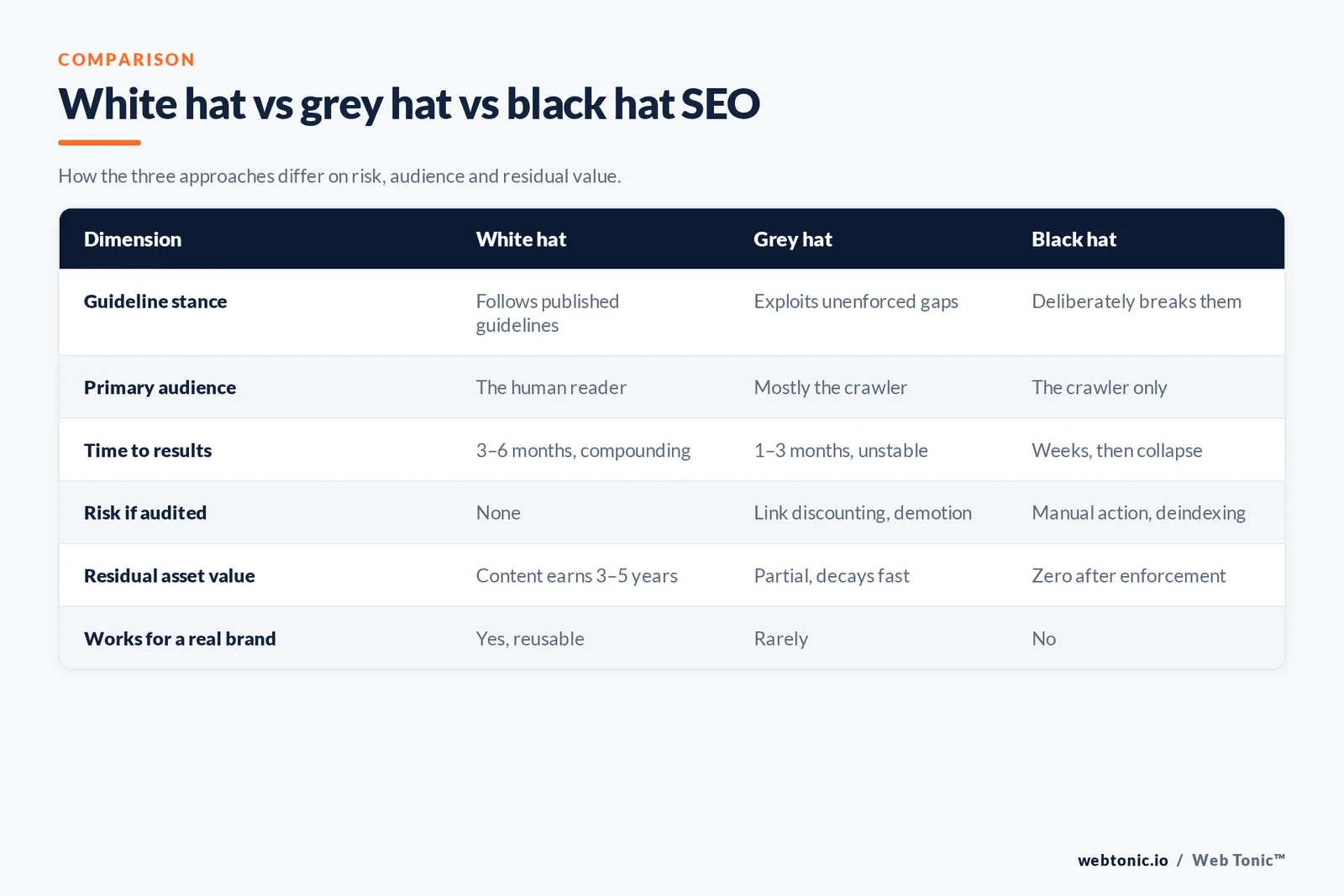
| Dimension | White hat SEO | Grey hat SEO | Black hat SEO |
|---|---|---|---|
| Guideline stance | Follows published guidelines | Exploits unenforced gaps | Deliberately breaks them |
| Primary audience | The human reader | Mostly the crawler | The crawler only |
| Typical time to results | 3–6 months, compounding | 1–3 months, unstable | Weeks, then collapse |
| Risk if audited | None | Link discounting, demotion | Manual action, deindexing |
| Residual asset value | Content keeps earning 3–5 years | Partial, decays fast | Zero after enforcement |
| Works for a real brand | Yes — reusable across channels | Rarely | No |
One test settles almost every argument about whether a tactic is white hat: would you do it if search engines did not exist? A faster checkout, a clearer service page and a genuinely cited original study all pass. A private blog network, a hidden keyword block and a doorway page for every suburb do not. Our companion guide to black hat SEO techniques covers the failure side of that line in detail.
The 9 core white hat SEO techniques
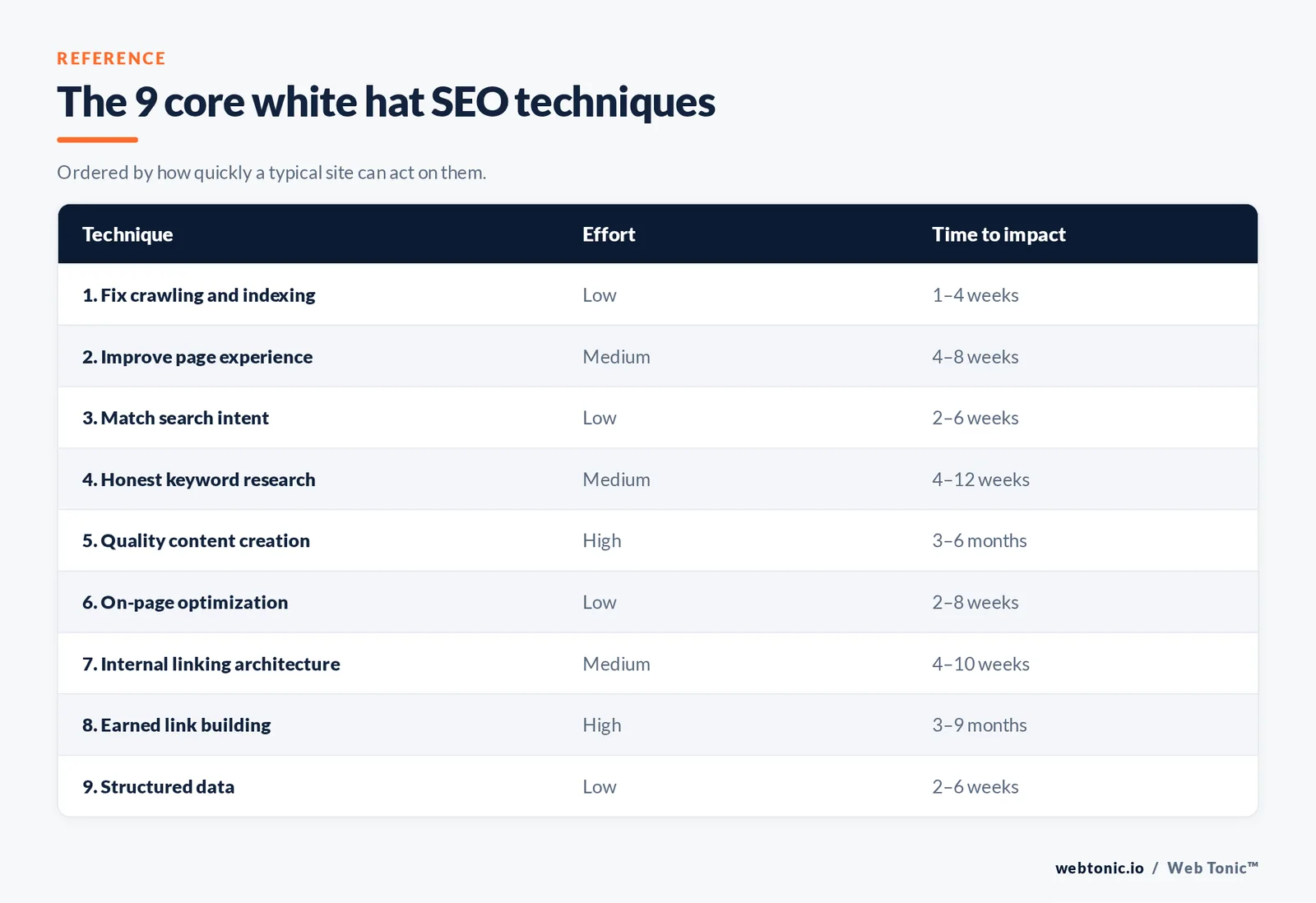
These are the techniques that make up the bulk of legitimate SEO work, ordered by how quickly a typical site can act on them.
| Technique | What it involves | Effort | Typical time to impact |
|---|---|---|---|
| 1. Fix crawling and indexing | Correct robots rules, canonical tags, sitemaps, resolve soft 404s | Low | 1–4 weeks |
| 2. Improve page experience | Core Web Vitals, mobile layout, no intrusive interstitials | Medium | 4–8 weeks |
| 3. Match search intent | Align each page to one query type — informational, commercial, transactional | Low | 2–6 weeks |
| 4. Keyword research done honestly | Topic and entity mapping, no stuffing, one primary term per page | Medium | 4–12 weeks |
| 5. Quality content creation | Original research, first-hand expertise, real examples, maintained pages | High | 3–6 months |
| 6. On-page optimization | Titles, headings, internal links, descriptive image alt text | Low | 2–8 weeks |
| 7. Internal linking architecture | Hub-and-spoke structure, no orphan pages, descriptive anchors | Medium | 4–10 weeks |
| 8. Earned link building | Digital PR, original data, expert contribution, reclaiming broken links | High | 3–9 months |
| 9. Structured data | Markup that matches visible content, per the structured data policies | Low | 2–6 weeks |
Three of these deserve expanding, because they are where white hat SEO practices most often go wrong in execution rather than in intent.
Quality content creation. Google's guidance on creating helpful, reliable content is written as a set of self-assessment questions, not a checklist of word counts. The two that matter most in practice: does the page add original value beyond summarising other results, and would a reader feel the need to search again after reading it? A 900-word page that answers the question completely beats a 3,000-word page that circles it.
On-page optimization. Titles are a recommendation, not a directive — Google rewrites title links when the page's own headings describe the content better. Writing for scanners rather than readers is the higher-leverage move: Nielsen Norman Group's reading research found 79% of users scan pages and only 16% read word by word, with concise, scannable and objective revisions measuring 58%, 47% and 27% more usable respectively.
Earned link building. The only durable version of link building is producing something worth citing and then telling the right people it exists. Ahrefs' work on link building and Semrush's link building guide both land on the same conclusion: campaigns built on original data, tools or unusual access outperform outreach volume, and they do not create a liability you later have to disavow.
White hat SEO by page type
The same principles apply differently depending on what the page is for. This is the mapping we use when auditing a site.
| Page type | Search intent | Highest-leverage white hat work | Common black hat shortcut to avoid |
|---|---|---|---|
| Homepage | Brand and navigational | Clear positioning, fast load, internal links to money pages | Keyword-stuffed footer blocks |
| Service page | Commercial | Scope, pricing signals, proof, one primary keyword | Hidden text with variant keywords |
| Location page | Local commercial | Genuinely local detail, real service area, unique copy | Doorway pages spun per city |
| Blog article | Informational | Original data, tables, expert quotes, maintained updates | Scaled AI content with no added value |
| Product page | Transactional | Unique descriptions, real reviews, valid product markup | Review schema for reviews that do not exist |
| Comparison page | Commercial investigation | Honest criteria table, disclosed affiliations | Paid placement presented as ranking |
| Glossary or definition | Informational | Tight 40–60 word definition, examples, related terms | Scraped encyclopaedia text |
Rule 1 — one page, one job. Most ranking problems we audit are not penalties; they are three pages competing for the same query because nobody decided which one should win. Consolidating them is usually the single largest white hat gain available, and it costs nothing but an afternoon and a set of redirects. Our on-page SEO guide covers the element-level detail.
What white hat SEO costs and how long it takes
Two numbers decide whether a white hat programme survives internal pressure: what it costs, and when it is allowed to start working. Both are knowable.
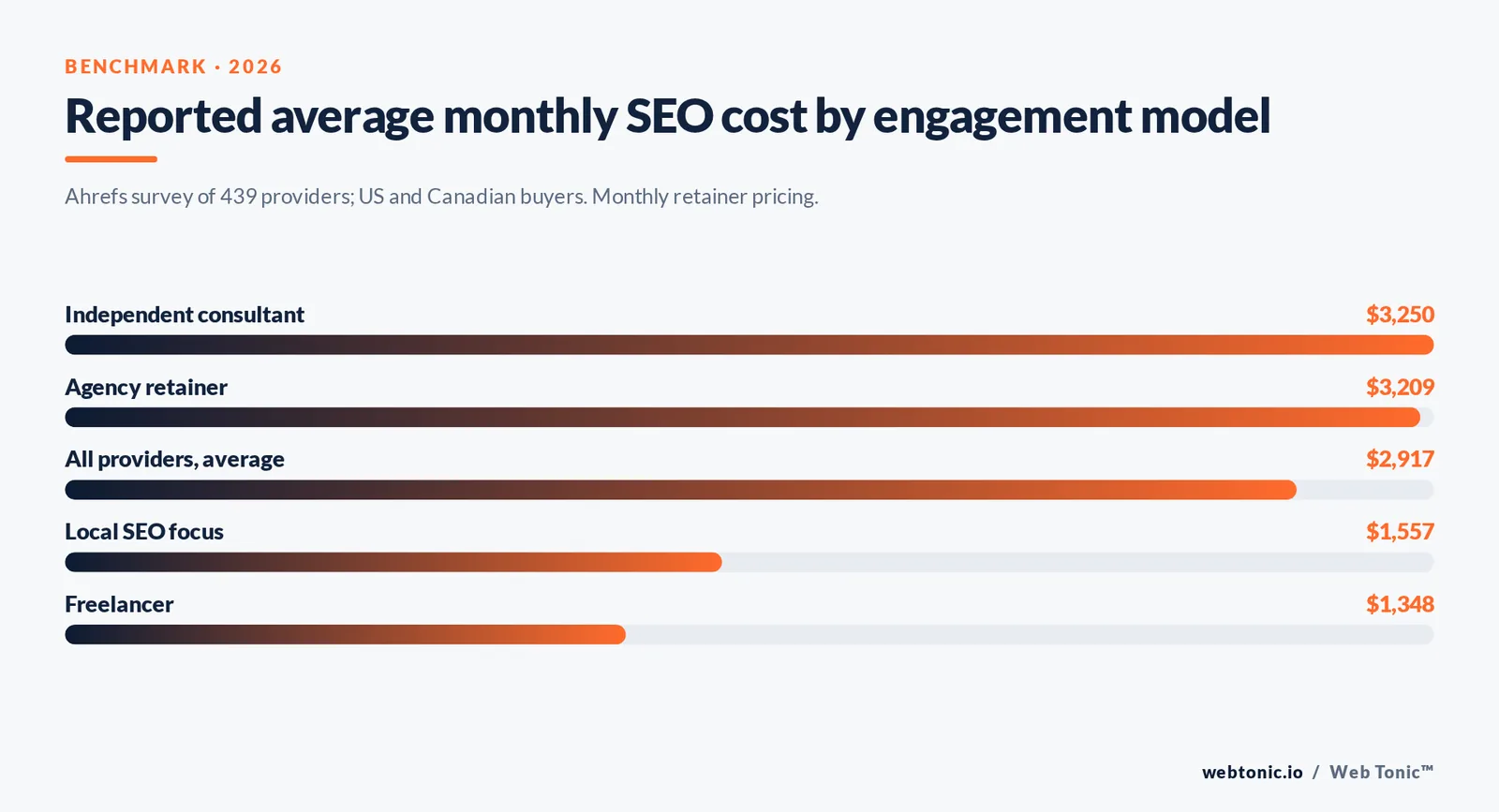
| Engagement model | Reported average monthly cost | Best fit |
|---|---|---|
| Agency retainer | $3,209 | Multi-page sites needing content plus technical plus links |
| Independent consultant | $3,250 | Strategy and diagnosis with an in-house delivery team |
| Freelancer | $1,348 | Single-channel execution on a defined brief |
| Local SEO focus | $1,557 | Service-area businesses with a small page count |
| All providers, average | $2,917 | Benchmark for judging a quote |
| Hourly work | $111 per hour | Audits, one-off fixes, second opinions |
Limit 1: Ahrefs' survey of 439 providers found 78.2% bill on retainer and 68.8% charge $2,000 or less per month, while 79.1% of US and Canadian buyers pay above $1,001 — the market pays for continuity, not for campaigns. Ahrefs' SEO pricing data and Semrush's pricing benchmarks agree within a few hundred dollars.
Limit 2: nothing meaningful happens in the first month. Ahrefs' analysis of how long SEO takes puts most pages that eventually rank in the top 10 at a year or more of age. Plan on 3–6 months for early movement and 6–12 months for competitive commercial terms, and judge quarter one on leading indicators — indexed pages, impressions, average position — not revenue.
Limit 3: the ceiling is the site, not the tactics. A slow, thin, badly structured site with three service pages cannot out-rank a well-maintained competitor with sixty, however clean the link profile is. That is a web development problem before it is an SEO one, and the sequence matters.
How to verify your own SEO is white hat
Inherited tactics are the common failure mode. A site changes hands, an old agency's doorway pages survive a redesign, and nobody notices until a core update. Run this audit before assuming you are clean.
| Check | Where to look | Red flag |
|---|---|---|
| Step 1 — Manual actions | Search Console, Manual actions report | Any named action at all |
| Step 2 — Indexed page count | Search Console, Pages report | Thousands more indexed URLs than you can name |
| Step 3 — Backlink profile | Any link index, sorted by newest | Bursts of unrelated foreign-language or footer links |
| Step 4 — Hidden text | View source, search for display:none and font-size:0 | Keyword blocks users never see |
| Step 5 — Cloaking | URL Inspection live test vs the rendered page | Crawler and user see different content |
| Step 6 — Page experience | PageSpeed Insights, field data | Core Web Vitals failing on mobile |
| Step 7 — Markup honesty | Rich Results Test | Schema describing content not on the page |
| Step 8 — Duplicate templates | Site search for a boilerplate sentence | Near-identical pages per city or keyword |
The tooling is free. Search Console covers steps 1, 2, 5 and 7; PageSpeed Insights and the Core Web Vitals thresholds cover step 6. Where a fix needs judgement rather than a tool, our data intelligence team runs the diagnosis alongside the reporting.
4 traps that look white hat and are not
Trap 1 — "Guest posting is white hat." Contributing genuine expertise to a relevant publication is. Paying a network $80 for a placement on a site that publishes forty unrelated posts a week is a link scheme under the spam policies, whatever the invoice calls it.
Trap 2 — "AI content is banned." It is not. Scaled content abuse is about value, not authorship: mass-producing pages with nothing original in them is the violation. AI-assisted drafting with real expertise, verification and editing is fine — the test is whether the finished page would survive a reader who already knows the subject.
Trap 3 — "Link exchanges are just networking." Reciprocal linking at scale is explicitly a link scheme. A handful of genuine partner links is noise; a spreadsheet of 200 swaps is a pattern, and patterns are what spam systems detect.
Trap 4 — "It ranked, so it worked." Grey hat tactics often do rank, for a while. The cost arrives later, and it lands on the whole domain rather than the page that earned it. Searchengineland's algorithm update library and the Search Central blog are the two places where that bill shows up in public.
A 90-day white hat SEO plan
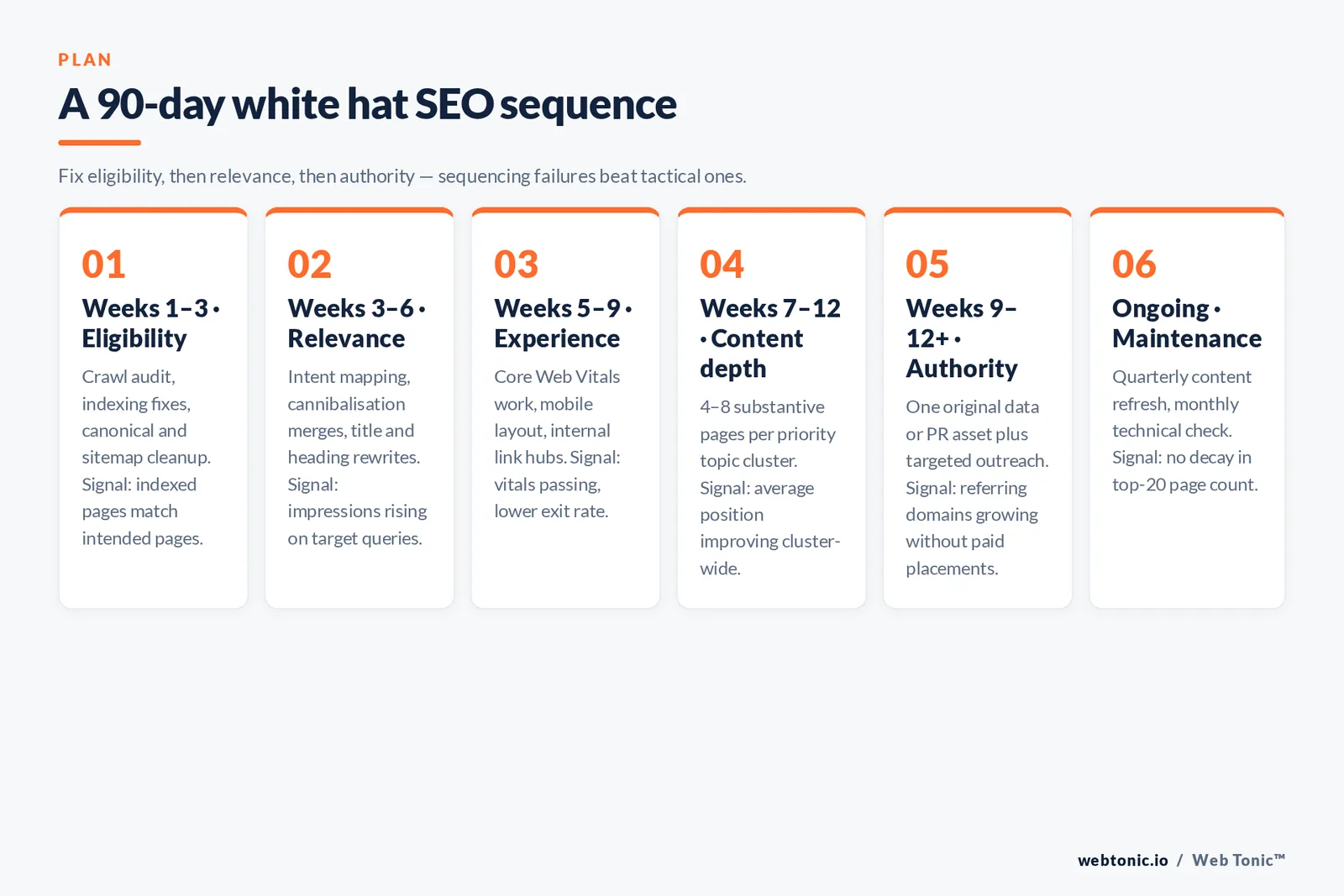
White hat SEO strategies fail from sequencing more often than from tactics. Fix eligibility, then relevance, then authority.
| Phase | Focus | Deliverables | Success signal |
|---|---|---|---|
| Phase 1 — Weeks 1–3 | Eligibility | Crawl audit, indexing fixes, canonical and sitemap cleanup | Indexed pages match intended pages |
| Phase 2 — Weeks 3–6 | Relevance | Intent mapping, cannibalisation merges, title and heading rewrites | Impressions rising on target queries |
| Phase 3 — Weeks 5–9 | Experience | Core Web Vitals work, mobile layout, internal link hubs | Vitals passing, lower exit rate on entry pages |
| Phase 4 — Weeks 7–12 | Content depth | 4–8 substantive pages per priority topic cluster | Average position improving cluster-wide |
| Phase 5 — Weeks 9–12+ | Authority | One original data or PR asset, targeted outreach | Referring domains growing without paid placements |
| Ongoing | Maintenance | Quarterly content refresh, monthly technical check | No decay in top-20 page count |
Two context numbers to keep the plan honest. Google handled roughly 91.27% of worldwide search referrals in June 2026 against Bing's 4.66%, so guideline compliance is not one option among several. And WordPress powers about 41.2% of all websites, which means most white hat technical work is the same short list of platform-level fixes — see our WordPress SEO guide for the specifics. If you want the strategy layer handled with the content and reporting, that is what our growth marketing engagements cover, and you can talk to us about scope.
FAQ
Is white hat SEO still worth it in 2026?
Yes, and more than before. AI-generated answers and AI Overviews reward pages that demonstrate first-hand expertise and original information, which is exactly what white hat content produces. The tactics that suffered most in recent updates were the scaled, low-value ones.
How long does white hat SEO take to work?
Expect early indicators — impressions, indexed pages, average position — within 4 to 8 weeks on a maintained site, meaningful traffic movement in 3 to 6 months, and competitive commercial rankings in 6 to 12 months. Pages that eventually rank in the top 10 are usually a year old or more.
What is the difference between white hat and grey hat SEO?
Grey hat tactics are not named in the spam policies yet, but they work by manipulating signals rather than improving the site — bought guest posts, reciprocal link programmes, expired-domain redirects, thin AI pages at scale. In practice grey hat is black hat with a delay on the invoice.
Can white hat SEO recover a site that used black hat tactics?
Usually, but not on a fixed timeline. Manual actions need the tactic removed and a reconsideration request; algorithmic demotions need the underlying quality problem fixed and then a re-evaluation, which typically arrives with a later core update. Cleanup first, new content second.
Do I need links at all if my content is good?
For low-competition and long-tail queries, often no. For commercial head terms, links remain a differentiator, which is why the honest version — original data, digital PR, expert contribution — is worth budgeting for rather than buying around.
Sources: Google Search Central — Search Essentials, spam policies, helpful content guidance, title links, Search Central blog · Google Search Console · PageSpeed Insights and web.dev Core Web Vitals · Ahrefs — SEO pricing survey (439 providers), link building, how long SEO takes · Semrush — SEO pricing, link building guide · Search Engine Land Google algorithm update library · Nielsen Norman Group, How Users Read on the Web · StatCounter Global Stats, search engine market share, June 2026.