Table of contents
Backlinks have been one of the strongest signals search engines use to rank a website since PageRank first existed, and that hasn't changed in 2026. What's changed is how much scrutiny every link now gets. Google's AI-based spam system, SpamBrain, evaluates link patterns in real time rather than waiting for periodic updates, which means manipulative link building gets caught faster and recovers slower than it used to.
White hat link building is the alternative: earning backlinks through genuine editorial value instead of manufacturing them. It takes longer than buying links or running a private blog network, but it's the only approach that compounds instead of eventually costing a site a manual penalty. This guide covers effective white hat link building strategies for 2026, what they cost, and where the line sits between white hat, grey hat, and black hat tactics.
Key Takeaways
- White hat link building means earning links through genuine editorial value, guest posts, digital PR, broken link building, resource page outreach, rather than buying or manufacturing them.
- Pages with at least one backlink are widely reported as far more likely to reach the top 10 than pages with none, and the #1-ranking page averages 3.8x more backlinks than pages in positions 2 through 10.
- The 2026 market average for a single quality backlink is $508.95 USD, though pricing ranges from $100 to $400 for niche edits up to $750 to $2,000+ for digital PR placements.
- Link building is frequently cited as one of the highest-ROI marketing channels for B2B companies, though poorly targeted campaigns fall well short of the headline figures.
- Black hat tactics (buying links, link farms, PBNs, automated schemes) violate search engine guidelines outright and can trigger a manual penalty that takes 12 to 18 months to recover from.
- Anchor text should stay 60-70% branded and natural (including naked URLs), since that mix mirrors how the web links organically and survives every link-spam detection system Google runs.
What is white hat link building?
White hat link building is the practice of earning backlinks through legitimate methods that comply with search engine guidelines: quality content, genuine outreach, and real editorial relationships. The difference between black hat and white hat link building comes down to intent and disclosure. White hat SEO earns a link because the content or data genuinely deserves it. Black hat SEO manufactures the appearance of that same endorsement through payment or automation.
It sits on one end of a spectrum. Grey hat tactics, aggressive guest post networks, excessive reciprocal linking, over-optimized anchors, are technically within the rules but manipulative enough to carry risk. Black hat tactics, buying links that pass PageRank, link farms, private blog networks, automated link schemes, violate the guidelines outright.
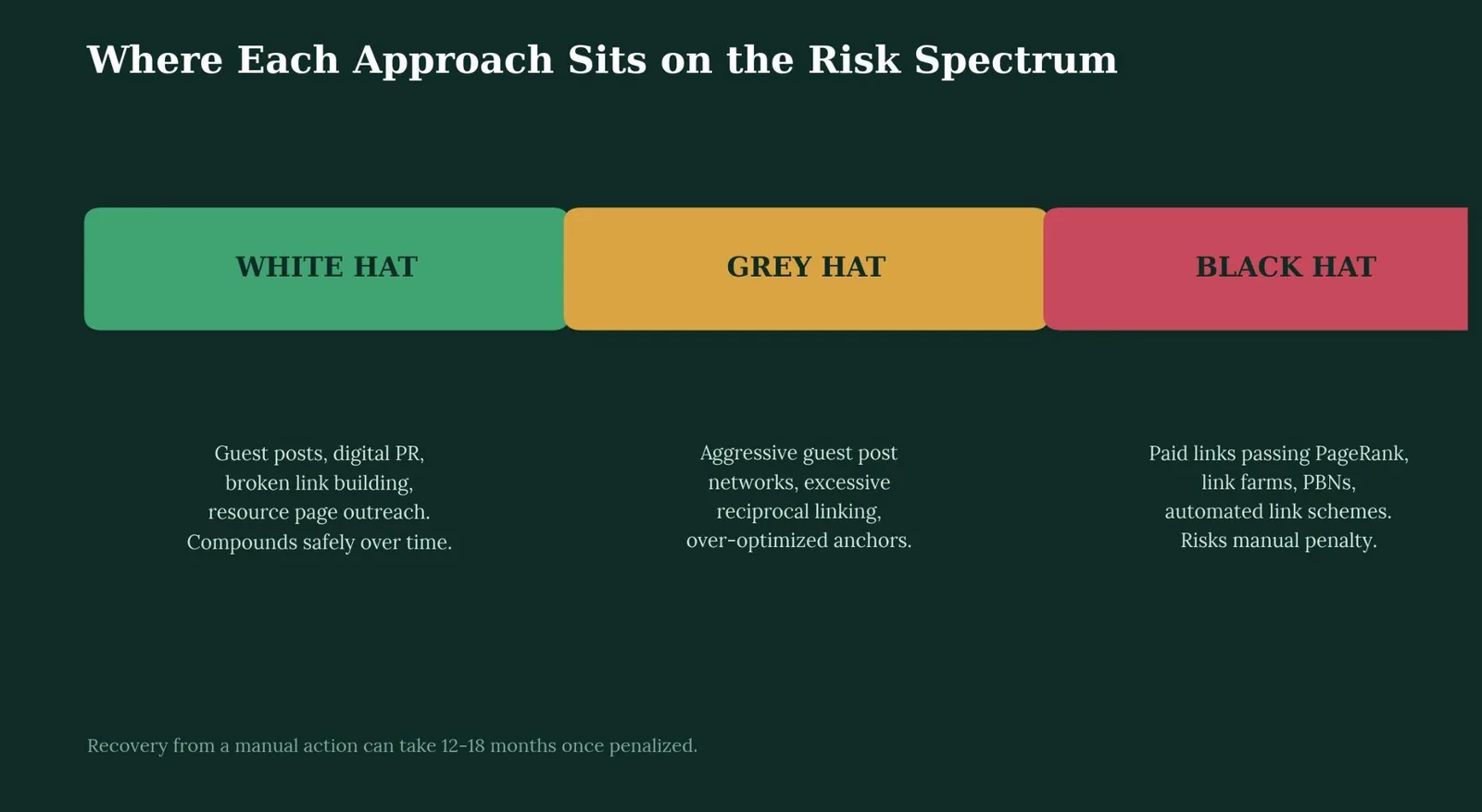
Google's own Search Central spam policies spell this out directly: link schemes distort rankings and can trigger either algorithmic devaluation or a manual action from a human reviewer. A single manipulative link won't sink a website on its own, but a pattern of them will, especially once SpamBrain flags the footprint. Recovery from a manual action commonly requires auditing thousands of backlinks, contacting webmasters for removal, and filing a reconsideration request, a process that typically takes 12 to 18 months.
White hat vs. grey hat vs. black hat link building
| Factor | White hat | Grey hat | Black hat |
|---|---|---|---|
| Examples | Guest posts, digital PR, broken link building, resource pages | Aggressive guest post networks, excessive link exchanges | Paid links, link farms, PBNs, automated schemes |
| Search engine guideline status | Fully compliant | Technically allowed, manipulative in practice | Direct violation |
| Typical outcome | Compounds over months and years | Works until it doesn't | Fast gains, then a likely penalty |
| Recovery if penalized | Not applicable | Possible, but time-consuming | 12-18 months, often with disavow work |
| Best for | Any business building a durable backlink profile | Nobody, really, the risk-adjusted return is poor | No legitimate business should use these |
Why link building still matters in 2026
Google confirms backlinks remain one of the strongest signals behind search engine rankings, and Backlinko's analysis of millions of search results puts a number on it: the #1-ranking page averages 3.8 times more backlinks than pages in positions two through ten. Pages with at least one backlink are also widely reported, including by RankZ's 2026 pricing analysis, as 77% more likely to appear in the top 10 than pages with none, though that particular figure circulates across several 2026 industry reports rather than one clean original study.
Links now do a second job too. Search engines and large language models increasingly draw on the same underlying signals. A 2025 survey of 518 SEO professionals by Editorial.Link found that 73.2% believe backlinks from authoritative editorial sources are a primary factor in whether a brand appears in AI search overviews, including Google's AI Mode, Perplexity, and ChatGPT. A link is simultaneously a ranking vote, a referral channel, and evidence to language models that a brand is worth citing.
Effective white hat link building strategies
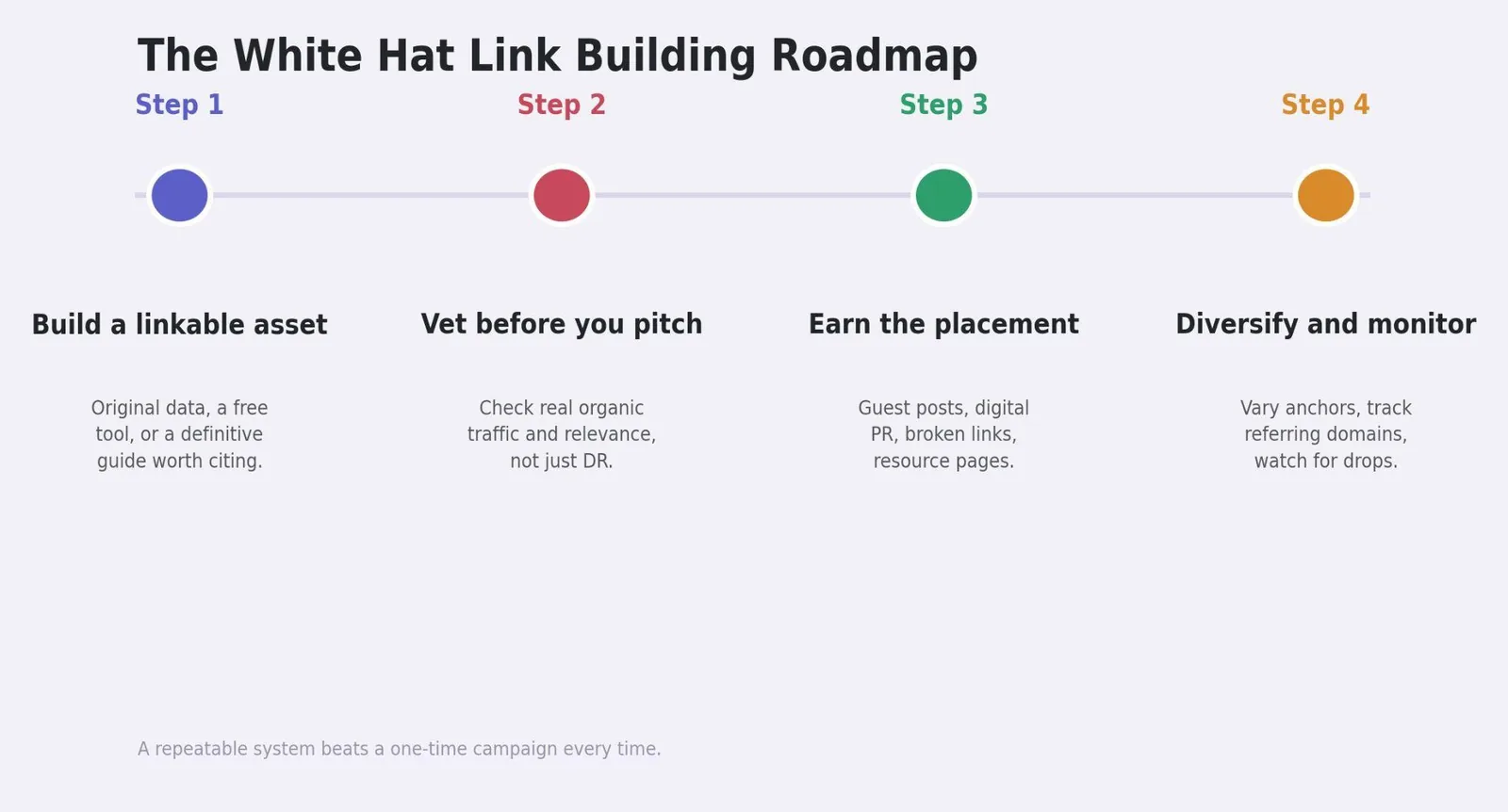
Step 1: Build a linkable asset first
Outreach without something worth linking to is just noise. Original data, a free tool or calculator, a definitive guide, or a proprietary industry study all give journalists, bloggers, and industry websites a real reason to cite you. Much like Apple earns unsolicited press coverage simply by shipping something worth writing about, the strongest digital PR campaigns start with an asset newsworthy enough that outreach becomes a formality. One serious linkable asset built per quarter, promoted consistently, outperforms scattered outreach with nothing anchoring it.
Step 2: Vet every opportunity before you pitch
Domain Rating and Domain Authority are third-party estimates, not quality certificates, and plenty of high-DR websites carry bot-farm traffic. Check real organic traffic, topical relevance, and whether the site has genuine editorial standards (bylined authors, a real rejection rate) before spending outreach time on it.
Try it yourself: the tool below scores a prospective link opportunity across the six checks that matter most before you pitch.
Link building tool
Is this link opportunity worth pursuing?
Check off what's true about the site before you pitch. Your score updates as you go.
0 of 6
Check off items above to see whether this opportunity is worth the outreach time.
Step 3: Earn the placement
Not all link building tactics carry equal risk or reward. Guest posting still works when it serves the publication's audience rather than just the linker's goal. Effective guest posting, per Outsource Link Building's 2026 tactics breakdown, means identifying niche-relevant websites with real organic traffic and editorial guidelines, pitching ideas that serve their readers, and controlling anchor text naturally across placements.
Broken link building rounds out one of the lowest-risk tactics available: scan competitor resource pages for broken links, then offer your page as the replacement. Reactive PR and quote platforms work well too. Journalists (and even Reddit threads or industry forums) often already have people asking questions in your area of expertise, and an unlinked mention today is a possible backlink tomorrow. A single feature in a publication like the New York Times or a strong niche trade outlet can be worth more than a dozen lower-tier placements combined.
Step 4: Diversify tactics and monitor your profile
No single method should make up more than 30-40% of a backlink profile, per BuzzStream's diversification guidance. Anchor text should skew toward branded anchors, naked URLs, and generic phrases like "this guide," a distribution pattern Webin Marketing's 2026 strategies guide recommends explicitly, reserving descriptive partial-match anchors for guest posts and asset outreach. Keeping a backlink profile diverse protects it against future spam updates. Track referring domains over time and watch for sudden drops, which often signal a spam update devaluing a batch of links rather than a technical issue on the site itself.
The link building techniques above aren't new, but execution quality is what separates a safe placement from a risky one, and it's that consistency that earns white hat backlinks able to survive algorithm updates.
What white hat link building costs in 2026
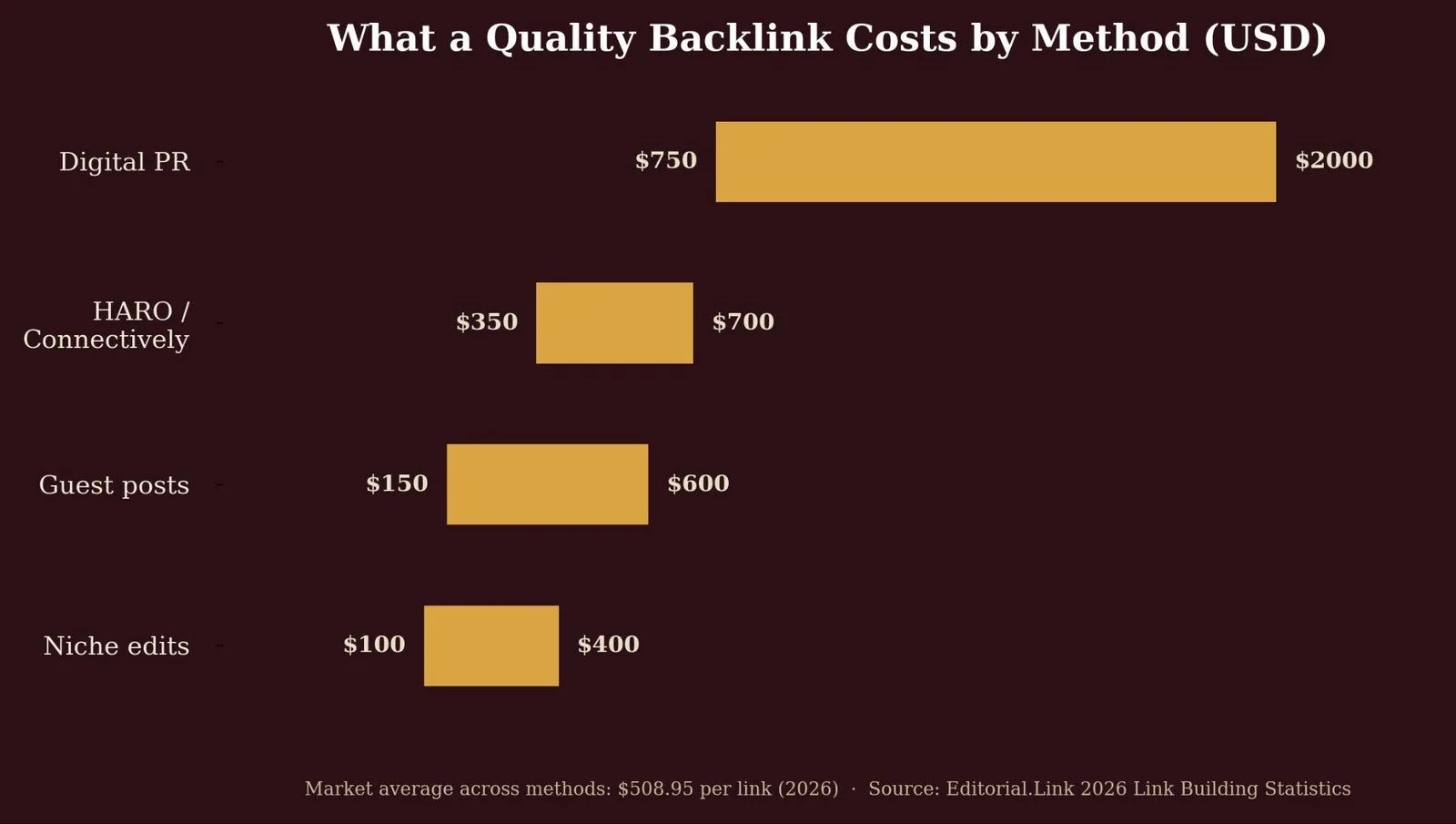
The average price SEO professionals consider acceptable for one high-quality backlink is $508.95 USD, up from roughly $350 in 2022, per Editorial.Link's 2026 link building statistics report. Pricing varies significantly by method: niche edits run $100 to $400, guest posts $150 to $600, HARO or Connectively placements $350 to $700, and digital PR $750 to $2,000+ per link, with full campaign fees reaching $3,000 to $20,000 USD for 10 to 40 placements. Geography affects price too: U.S. and UK placements typically carry a premium over other markets, since publishers there command larger, more trusted audiences.
Monthly retainers follow a similar spread. Startups can begin around $1,500 USD per month, most established businesses spend $3,000 to $10,000 USD per month, and competitive verticals like finance, legal, or gambling frequently exceed $15,000 USD per month. Despite the cost, link building is frequently cited among 2026 industry reports as one of the highest-ROI marketing channels available, with most campaigns showing a noticeable ranking movement within roughly 3 months of a link being acquired.
Common white hat link building mistakes
Prioritizing link quantity over quality wastes budget on placements that don't move rankings or survive the next spam update. The websites ranking at the top of any competitive niche didn't get there through link farms or any black hat tactic; a handful of relevant, editorially earned links consistently outperforms a large volume of low-authority ones.
Ignoring relevance is a close second. A link from a high-DR website outside your industry carries far less weight than a contextually relevant link from a smaller, real publication.
Over-optimized anchor text is a subtler mistake. Repeating the same exact-match commercial phrase across many domains looks unnatural to search engines, even when every individual link was earned legitimately.
And treating link building as a one-time campaign rather than an ongoing system means the compounding effect never has time to build. Websites that publish, promote, and earn links continuously outperform those running a single quarterly push.
Frequently asked questions
What's the difference between black hat and white hat link building?
White hat link building earns links through genuine editorial value, content and relationships a publisher would feature regardless of the link. Black hat link building manufactures the appearance of that same endorsement through payment, automation, or manipulation, and directly violates search engine guidelines.
How much should a business budget for white hat link building?
It depends heavily on industry competitiveness and whether the work is done in-house or outsourced, so an exact number isn't something to take from a general guide. As a planning frame, most businesses spend $3,000 to $10,000 USD per month, with startups starting around $1,500 USD and competitive verticals exceeding $15,000 USD. Get a quote specific to your niche before committing to a budget.
Is guest posting still a legitimate white hat tactic in 2026?
Yes, when done selectively. Guest posting becomes risky at scale, mass-produced posts across guest-post farms or sites that accept every pitch resemble a link scheme, even though a single well-placed, relevant guest post on a website with real editorial standards remains fully legitimate.
What happens if Google catches black hat link building?
Websites can face algorithmic devaluation (the links simply stop passing value) or a manual action, a human reviewer penalty affecting the entire domain. Recovery typically requires auditing the backlink profile, disavowing or removing bad links, and filing a reconsideration request, a process that commonly takes 12 to 18 months.
Do unlinked brand mentions matter if there's no actual link?
Yes, increasingly so. Unlinked brand mentions, on Reddit threads, in industry publications, or elsewhere, correlate strongly with AI search visibility, since language models weigh citation patterns and brand consensus signals independently of whether a hyperlink is present.
How long does it take to see results from white hat link building?
Most sites see a noticeable ranking movement within roughly 3 months of a link being acquired, but meaningful, compounding organic traffic growth typically takes 6 months or more, especially for newer domains without existing authority.
The bottom line on white hat link building
White hat link building rewards patience over shortcuts. Build something worth linking to, vet every opportunity before pitching, diversify tactics instead of leaning on one channel, and give the compounding effect time to work. Black hat and grey hat tactics can move rankings faster in the short term, but the risk-adjusted math rarely favors them once a penalty or algorithmic devaluation enters the picture.
Start with one linkable asset this quarter, an original data point, a free tool, or a genuinely definitive guide, and build outreach around it rather than starting outreach with nothing to offer.
Ready to build your backlink profile the right way?
Vetting opportunities, writing pitches that publishers actually accept, and keeping an anchor text mix diverse enough to survive algorithm updates is a lot to run consistently in-house. Web Tonic's off-site SEO and digital PR team handles link building, digital PR, and domain authority development as part of a full-funnel approach, so backlinks keep compounding without pulling your team away from the rest of the business.
More from Web Tonic: growth marketing services, data & analytics.
Sources: developers.google.com · backlinko.com · rankz.co · editorial.link · outsource-link-building.com · buzzstream.com · webinmarketing.com