Table of contents

Black hat SEO is any set of tactics that tries to manipulate search engine rankings by breaking search engine guidelines — keyword stuffing, cloaking, hidden text, paid link schemes, scraped or auto-generated content — rather than by making a site genuinely more useful to the people who visit it.
Below: the 12 most common tactics, what Google does about them, how to audit your own site, and the white hat alternative to each.
Key Takeaways
- Black hat SEO is defined by intent and guideline breach, not by difficulty. If the tactic exists only to fool search engine crawlers, it is black hat.
- Google publishes the rules in its spam policies, and adds new ones as abuse patterns emerge — scaled content abuse, site reputation abuse and expired domain abuse were all formalised in 2024.
- There are 2 ways a site gets hit: an algorithmic demotion (silent, no notification) or a manual action, which appears in Search Console with a named reason.
- Manual actions require a reconsideration request after cleanup; algorithmic recoveries can take multiple core updates and are never guaranteed.
- With Google at roughly 91% of global search, a penalty on one engine is effectively a penalty on your whole search channel.
- The grey hat middle ground — aggressive link exchanges, thin AI content at scale, expired domains — is simply black hat that has not been enforced yet.
- Every black hat tactic has a legitimate equivalent that produces the same signal honestly, and usually faster than a penalty recovery.
- Audit your own site for inherited tactics before you assume you are clean: hidden text, injected links and stale doorway pages routinely survive redesigns and agency handovers.
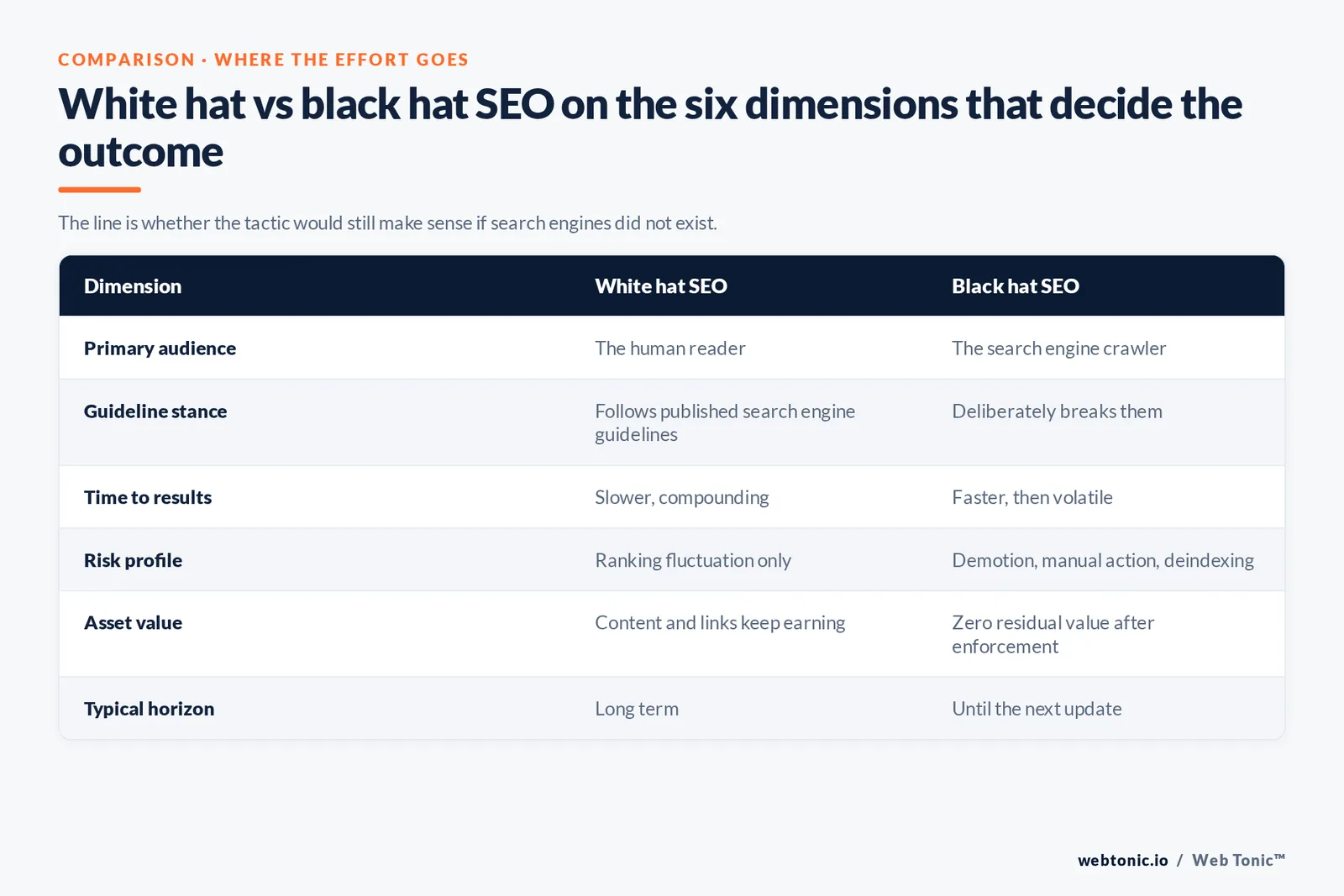
Black hat SEO vs white hat SEO
The two labels describe where the effort goes. White hat SEO invests in the thing being ranked: better content, faster pages, clearer structure, links earned because something is worth citing. Black hat SEO invests in the signal instead — manufacturing the appearance of relevance and authority that a good site would earn.
Google's own framing is useful because it avoids the moralising. Its spam policies define spam as content or behaviour designed to manipulate rankings, and its Search Essentials set out what a site must do to be eligible at all. The line is not "clever versus dull" — it is whether the tactic would still make sense if search engines did not exist.
| Dimension | White hat SEO | Black hat SEO |
|---|---|---|
| Primary audience | The human reader | The search engine crawler |
| Guideline stance | Follows published search engine guidelines | Deliberately breaks them |
| Time to results | Slower, compounding | Faster, then volatile |
| Risk profile | Ranking fluctuation only | Demotion, manual action, deindexing |
| Asset value | Content and links keep earning | Zero residual value after enforcement |
| Typical horizon | Long term | Until the next update |
The economics are the real argument. A white hat page keeps returning traffic for 3–5 years or more; a black hat page returns traffic until enforcement, then returns nothing and takes the rest of the domain with it. That asymmetry is why almost every SEO who has lived through a penalty recovery becomes a white hat pragmatist.
12 black hat SEO techniques (and the honest alternative)
These are the tactics that show up most often in audits. Each maps to a named Google spam policy.
| Tactic | How it works | Risk | White hat alternative |
|---|---|---|---|
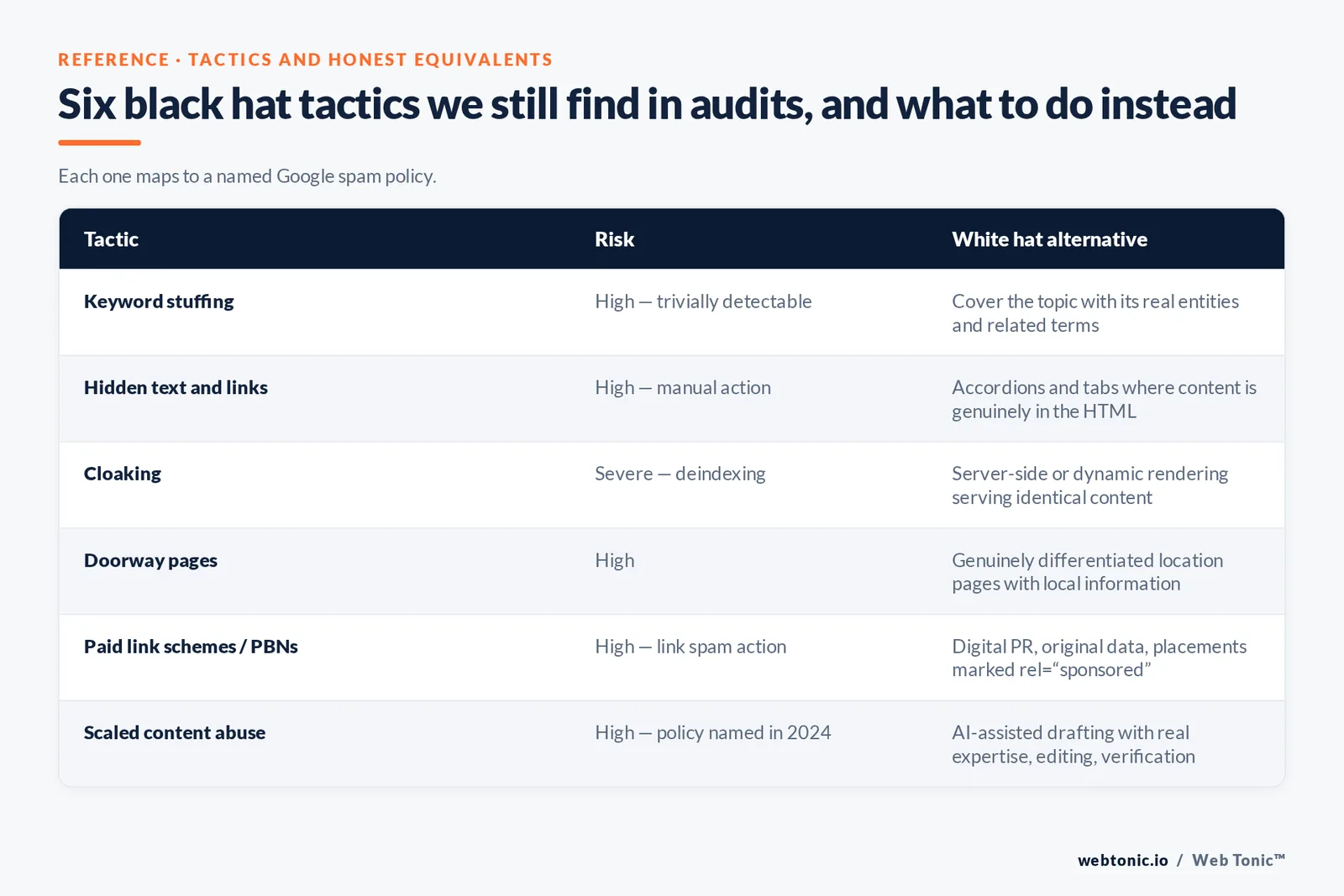
| 1. Keyword stuffing | Repeating target keywords unnaturally in copy, alt text or meta tags | High — trivially detectable | Cover the topic properly with entities and related terms |
| 2. Hidden text and links | White-on-white text, CSS off-screen positioning, zero font size, links behind a single character | High — manual action | Accordions and tabs where content is genuinely in the HTML |
| 3. Cloaking | Serving different content to crawlers than to users, by user agent or IP | Severe — deindexing | Server-side rendering or dynamic rendering that serves identical content |
| 4. Sneaky redirects | Redirecting users to a different page than the one crawled or indexed | Severe | Clean 301s that match user and crawler intent |
| 5. Doorway pages | Hundreds of near-identical pages per city or keyword funnelling to one destination | High | Genuinely differentiated location pages with unique local information |
| 6. Paid link schemes | Buying or exchanging links that pass ranking signals, or private blog networks | High — link spam action | Digital PR, original data, and sponsored placements marked rel="sponsored" |
| 7. Comment and forum spam | Automated links dropped into user-generated content | Medium — also harms the host site | Real community participation; moderate your own UGC |
| 8. Scraped and duplicate content | Republishing other sites' pages with light edits | High | Original reporting, or clear curation with commentary and citation |
| 9. Scaled content abuse | Mass-producing pages, AI or otherwise, with no added value | High — policy named in 2024 | AI-assisted drafting with real expertise, editing and verification |
| 10. Site reputation abuse | Renting subfolders on a trusted domain to third-party spam | High — policy named in 2024 | Editorially owned partner content on your own standards |
| 11. Expired domain abuse | Buying dropped domains purely to repurpose their authority | High | Acquire and genuinely continue a relevant site, redirecting like-for-like |
| 12. Spammy structured data | Marking up reviews, FAQs or products that do not exist on the page | Medium — rich results removed | Markup that matches visible content, per the structured data policies |
Two of these deserve a closer look because they are new enough that plenty of teams still treat them as grey hat. Scaled content abuse is not about whether AI wrote the text — Google's helpful content guidance is explicit that the question is value to the reader, not the production method. And spammy structured data is unusually easy to trip into by accident; the structured data policies require the marked-up content to be visible on the page, which rules out FAQ schema for questions that only exist in the JSON-LD.
What actually happens when you get caught
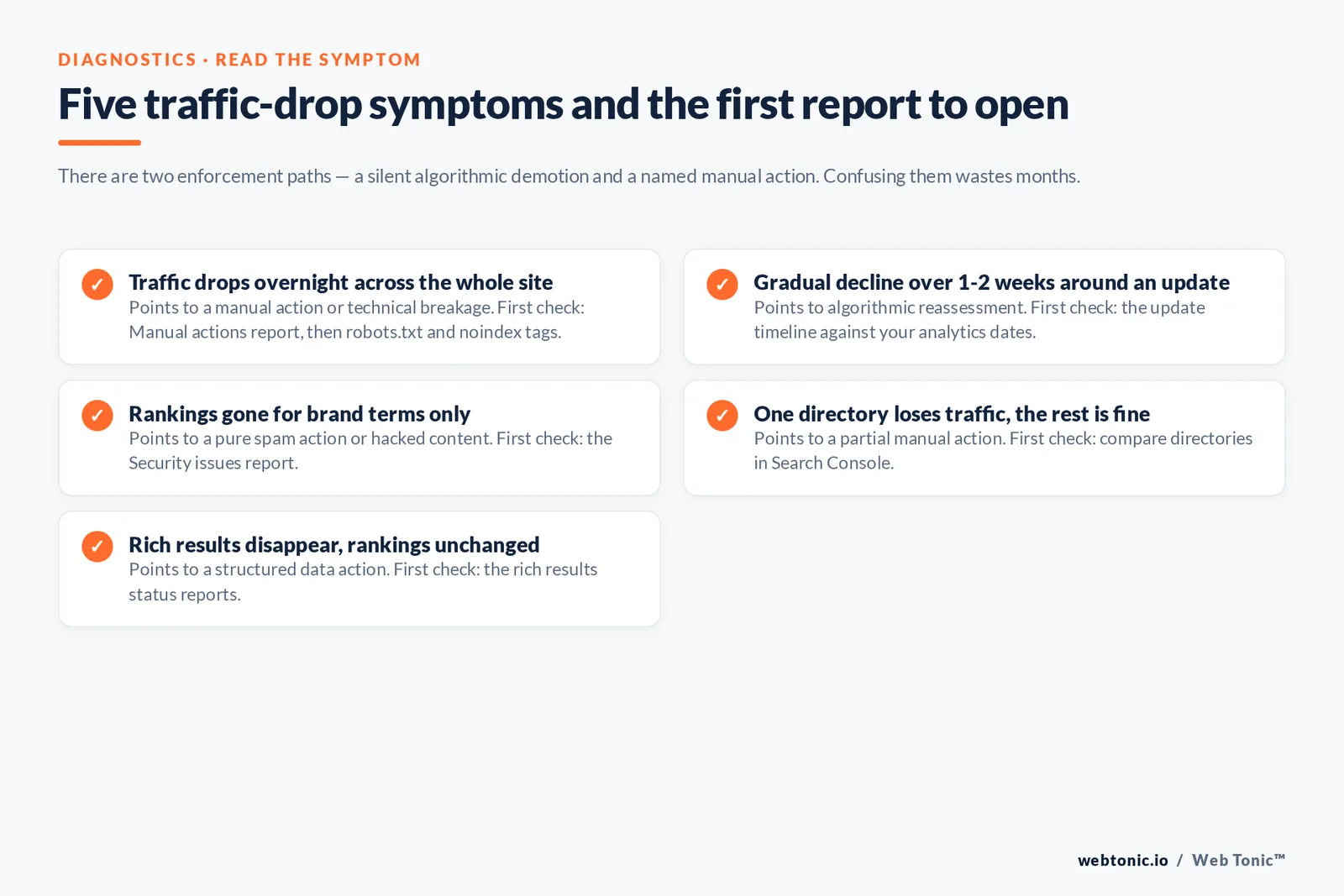
There are exactly 2 enforcement paths, and confusing them wastes months.
Algorithmic demotion. Spam systems and core ranking systems reassess the site continuously. There is no message, no named reason and no appeal — traffic simply falls, often around a core update. Recovery requires fixing the underlying quality problem and then waiting for the systems to re-evaluate, which in practice means the next update cycle or later. Google's Search Central blog and Search Engine Land's update library are the two references worth checking when traffic moves sharply.
Manual action. A human reviewer applies a penalty, and it is named in the Manual actions report in Search Console with a named reason such as "unnatural links to your site", "thin content with little or no added value", "cloaking and sneaky redirects" or "pure spam" — 4 of the most frequently issued. Actions can be site-wide or partial. Clean the issue up, document what you changed, then file a reconsideration request — and expect it to fail if the cleanup is cosmetic.
| Signal | Points to | First check |
|---|---|---|
| Traffic drops overnight across the whole site | Manual action or technical breakage | Manual actions report; robots.txt and noindex tags |
| Gradual decline over 1–2 weeks around an update | Algorithmic reassessment | Update timeline vs your analytics dates |
| Rankings gone for brand terms only | Pure spam action or hacked content | Security issues report |
| One directory loses traffic, the rest is fine | Partial manual action | Compare directories in Search Console |
| Rich results disappear, rankings unchanged | Structured data action | Rich results status reports |
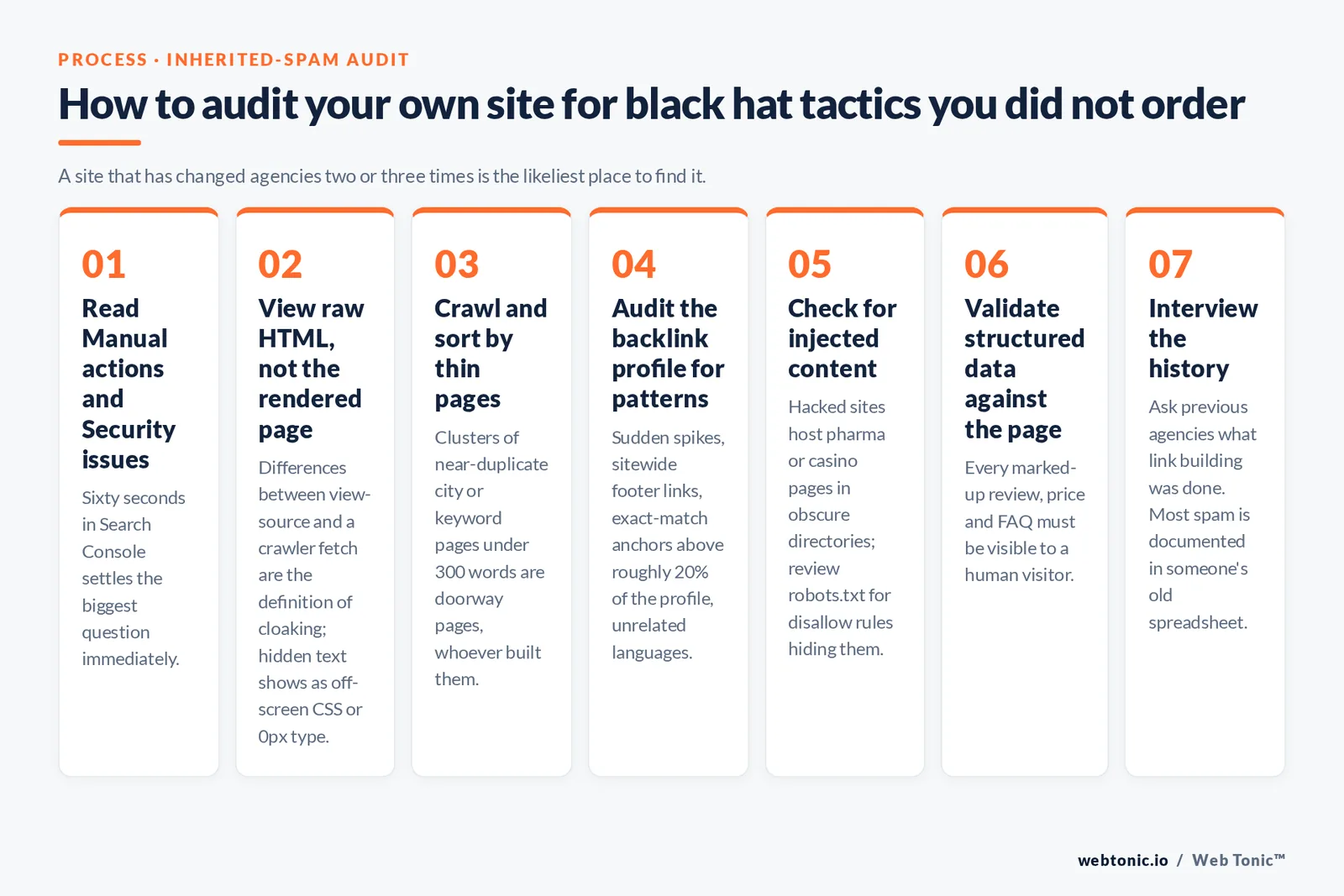
How to audit your own site for black hat tactics
Inherited spam is more common than deliberate spam, and a site that has changed agencies 2 or 3 times is the likeliest place to find it. Run this before you assume a clean bill of health — it is the first pass in every technical audit we run.
- Read the Manual actions and Security issues reports. Takes 60 seconds and settles the biggest question immediately.
- View the raw HTML, not the rendered page. Compare "view source" against what a fetch-as-Google style tool returns. Differences are the definition of cloaking. Hidden text usually shows up as off-screen CSS or 0px font sizes.
- Crawl the whole site and sort by thin pages. Clusters of near-duplicate city or keyword pages with under 300 words and templated copy are doorway pages, whoever built them.
- Audit the backlink profile for patterns. Sudden spikes, footer or sidebar links across unrelated sites, exact-match anchors above roughly 20% of the profile, and links from domains in unrelated languages all point to a link scheme.
- Check for injected content. Hacked sites often host pharma or casino pages in obscure directories. Search your own domain for off-topic terms and review the robots.txt file for suspicious disallow rules hiding them.
- Validate structured data against visible content. Every marked-up review, price and FAQ must appear on the page.
- Interview the history. Ask previous agencies and freelancers directly what link building was done and where. Most spam is documented in someone's old spreadsheet.
SEO tools help but do not decide. Ahrefs and Semrush both maintain useful catalogues of tactics and the signatures they leave behind, and Search Engine Journal tracks enforcement cases as they surface. A crawler flags a symptom; a human decides whether the pattern was manipulative.
Why black hat SEO still exists
Because it sometimes works briefly, and because the incentives of the people selling it are not the incentives of the people buying it. Three patterns explain most of it.
Churn-and-burn economics. If a site is disposable — an affiliate build, a lead-gen shell, a dropshipping store — the operator only needs 3–6 months of rankings before moving to a new domain. There is nothing to protect, so the risk calculation is genuinely different from a real business with a brand.
Misaligned agency incentives. An agency judged on rankings inside a 90-day contract has a rational reason to buy links. The client bears the penalty risk years later. This is why link-building deliverables should be documented, auditable, and owned by the client.
Genuine confusion. Plenty of tactics were mainstream a decade ago — directory submissions, article spinning, exact-match anchor campaigns and reciprocal linking — all normal before 2012 — and outdated blog posts still recommend them. With Google holding roughly 91% of search share according to StatCounter, following advice written for a different era is an expensive way to learn that the rules changed.
Related terms
| Term | Definition |
|---|---|
| White hat SEO | Optimisation that follows search engine guidelines and prioritises the user |
| Grey hat SEO | Tactics not explicitly banned but designed to game signals; usually black hat awaiting enforcement |
| Manual action | A human-applied penalty reported in Search Console, requiring a reconsideration request |
| Cloaking | Showing search engine crawlers different content than human visitors receive |
| Doorway page | A page created only to rank for a query and route visitors elsewhere |
| PBN | Private blog network — a set of sites owned to funnel links to a target domain |
| Keyword stuffing | Overloading a page with target keywords to manipulate relevance signals |
| Negative SEO | Pointing spam links or scraped copies at a competitor to try to trigger a penalty |
| Reconsideration request | The submission asking Google to review a site after a manual action is fixed |
FAQ
What is black hat SEO in simple terms?
Black hat SEO is optimisation aimed at tricking search engines rather than helping people. It includes keyword stuffing, hidden text, cloaking, doorway pages, buying links and publishing scraped or mass-generated content. All of these breach published search engine guidelines, and all of them risk demotion, a manual action or removal from the index entirely.
Can black hat SEO still work in 2026?
Some tactics still produce gains lasting weeks rather than years, which is why disposable sites keep using them. What has changed is the speed and breadth of enforcement: spam systems now operate continuously rather than only at update time, and policies covering scaled content, expired domains and subfolder rental closed the loopholes that made grey hat scaling attractive.
How do I know if my site has a penalty?
Open the Manual actions report in Search Console. If it is empty, you do not have a manual penalty and your decline is either algorithmic or technical. Then compare the drop date against known algorithm update dates, and check the Security issues report for hacked content, which produces very similar symptoms.
How long does it take to recover from a black hat penalty?
Manual actions can be lifted within 7–30 days of a successful reconsideration request, but only if the cleanup is thorough and documented. Algorithmic recoveries are slower and less predictable: expect to wait for one or more update cycles after fixing the underlying content and link problems, and treat full recovery as possible rather than promised.
How do I report black hat SEO by a competitor?
Google accepts spam reports through its search quality reporting forms, with separate paths for paid links, spam and malware. Reports feed algorithm improvements more often than they trigger individual penalties, so treat reporting as low-priority housekeeping rather than a competitive strategy — outranking the site is usually faster.
If you have inherited a site with an unclear history, an audit is cheaper than a recovery. See our services, read more SEO breakdowns on the Web Tonic blog, or get in touch and we will look at it with you.
Sources: Google Search Central (spam policies, Search Essentials, helpful content guidance, structured data policies, robots.txt introduction, Search Central blog) · Google Search Console Help (Manual actions report) · Search Console product page · Search Engine Land algorithm update library · Ahrefs · Semrush · Search Engine Journal · StatCounter Global Stats. Verified against the cited pages in 2026.