Table of contents
Type the same keyword into Google Keyword Planner, Semrush, and Ahrefs, and you'll get three different numbers back. None of them is wrong exactly; they're just measuring the same thing through different lenses. What is search volume, really, and which number should you actually trust when planning content? This guide answers both questions plainly.
Key Takeaways
- Search volume is an estimate of how many times a specific keyword is searched, on average, per month, typically calculated by dividing total searches over the trailing 12 months by 12.
- Google Keyword Planner shows broad ranges like 1K-10K to accounts without active ad spend, while third-party tools like Semrush and Ahrefs use clickstream data and machine learning to produce a single estimated number.
- No search volume tool is definitively correct; they're all independent estimates, and when multiple tools roughly agree, that agreement is a stronger signal than any single number alone.
- Search volume represents total demand, not guaranteed traffic; searchers spread clicks across many results, and a growing share get their answer from an AI Overview or featured snippet without visiting any site.
- AI assistants now generate roughly 45 billion monthly sessions globally, equal to about 56% of traditional search engine volume, though the genuinely search-equivalent share is closer to 28%, still a substantial figure traditional keyword tools can't see at all.
- Search volume should be weighed alongside keyword difficulty, search intent, and CPC, since a high-volume keyword with the wrong intent or unrealistic difficulty isn't actually a good target.
What Is Search Volume?
Search volume is a metric that estimates how many times people type a specific keyword or phrase into a search engine, most commonly Google, over a given period, usually expressed as an average per month. If a keyword shows 10,000 monthly searches, that term is typed into Google roughly ten thousand times a month, though the same person may search it more than once, so the figure isn't the same as ten thousand unique visitors.
A quick terminology note: keyword search and volume search are used almost interchangeably in practice, and search volumes (plural) simply refers to this same data across a list of target keywords rather than one term in isolation. In SEO specifically, higher search volume terms tend to attract more competition, which is exactly why raw volumes alone rarely tell the whole story about whether a keyword is worth pursuing.
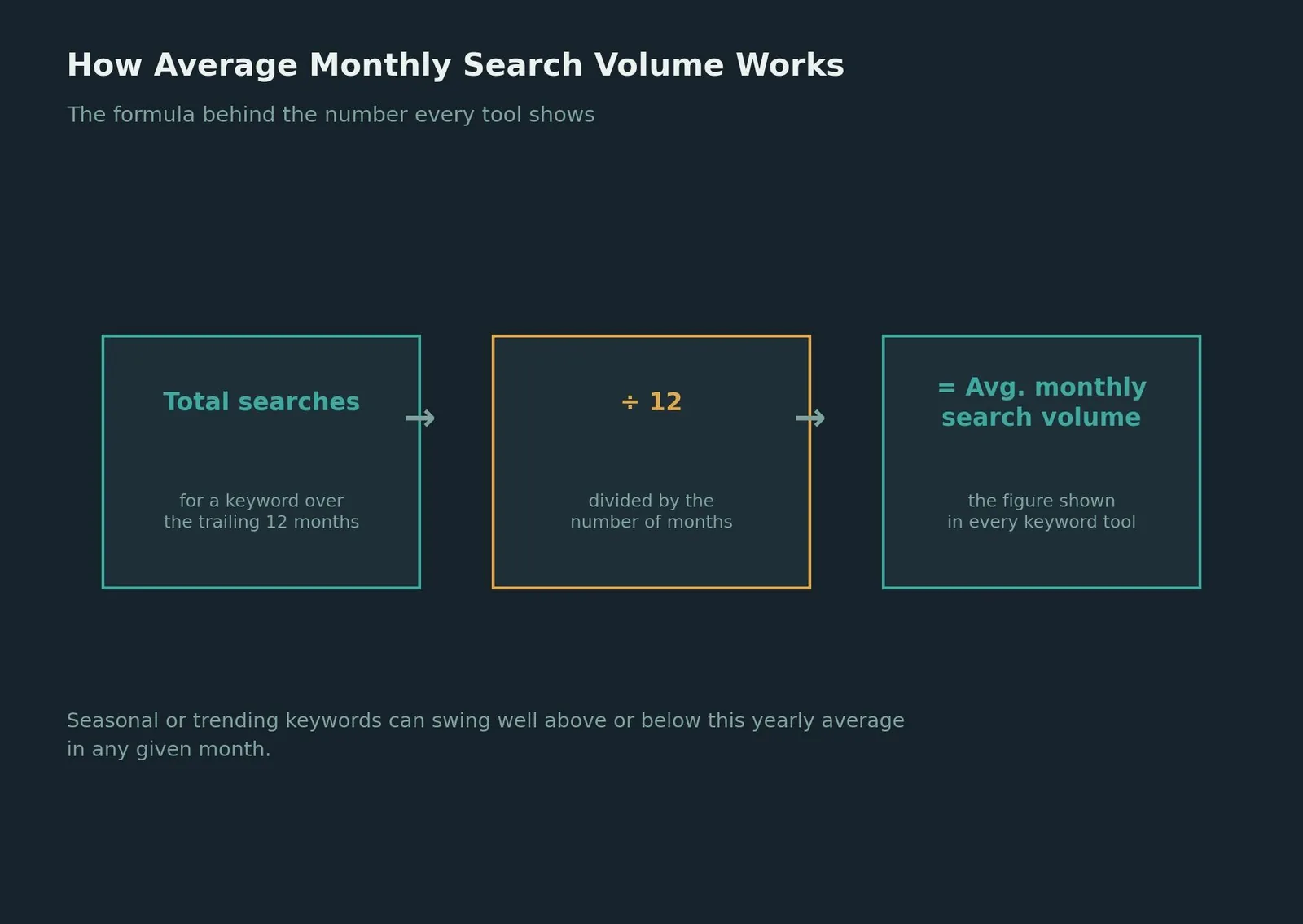
Average monthly search volume is generally calculated by dividing the total number of searches for a keyword over the past 12 months by 12, which smooths out seasonal spikes into a single yearly average. That averaging is exactly why a genuinely seasonal keyword, holiday gift guides, tax deadlines, back-to-school shopping, can show a moderate average volume while actually swinging far higher or lower depending on the month you check.
Google Keyword Planner vs. Third-Party Tools
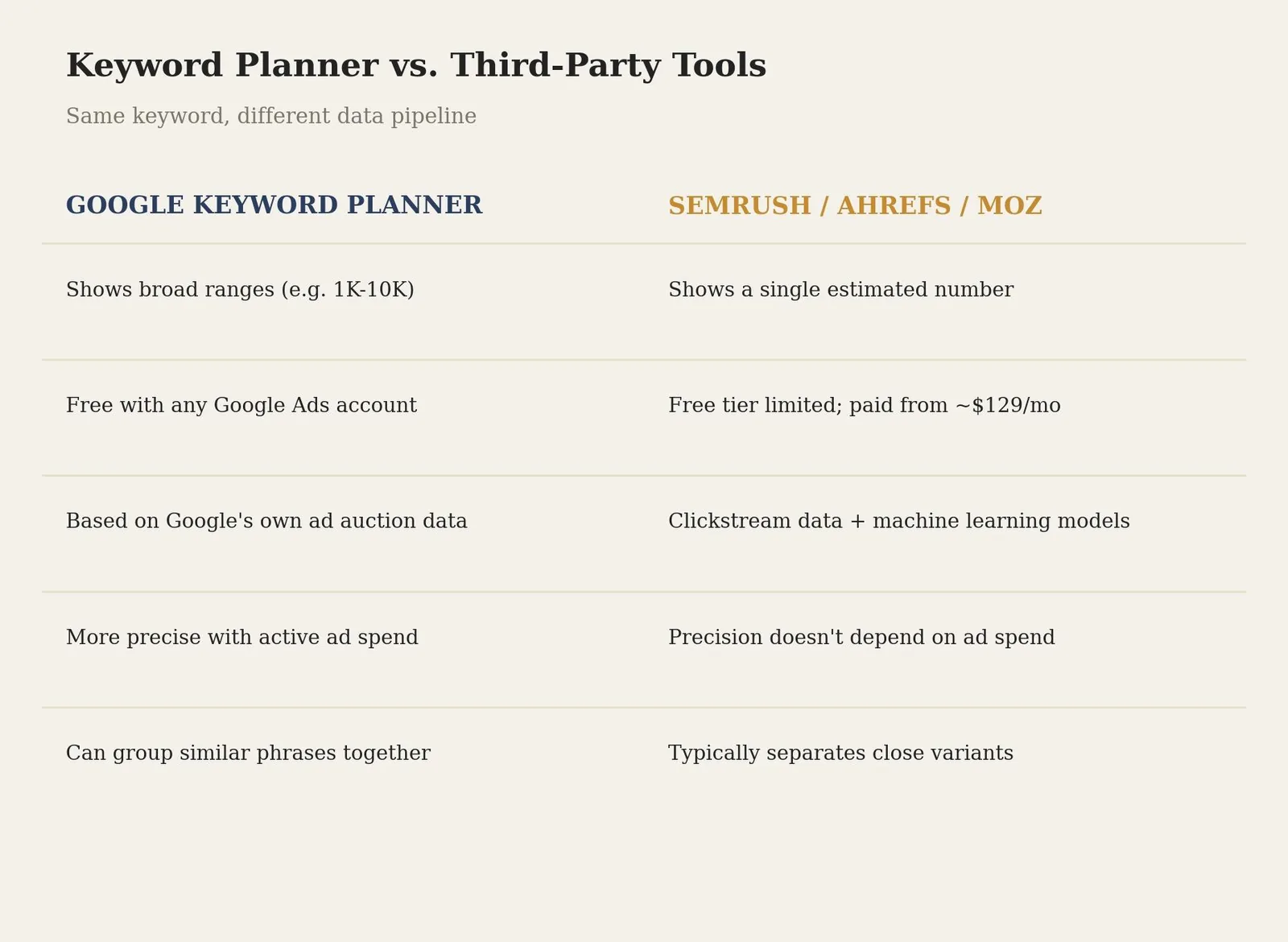
Google Keyword Planner is Google's own free keyword research tool, built primarily for advertisers, and it remains one of the most commonly used sources for search volume data. The catch is that Keyword Planner shows broad ranges, like 1K-10K, rather than exact numbers to accounts without significant active ad spend, which makes it hard to compare keywords precisely or forecast traffic with any confidence.
Third-party tools like Ahrefs, Semrush, and Moz combine clickstream data with Google Ads data and their own machine learning models to produce proprietary volume estimates, typically shown as a single number instead of a range. These estimates frequently disagree with each other and with Google's own numbers, partly because Keyword Planner sometimes aggregates search volume across multiple related phrases rather than isolating the exact keyword you typed in.
Why Search Volume Numbers Never Quite Match
No source is definitively correct, and treating any single figure as a precise measurement is the most common mistake in keyword research. Clickstream-based tools estimate from a sample of real user behavior, and the accuracy of that estimate depends on how large and representative the underlying panel is, which is why smaller, niche keywords tend to show noisier, less consistent numbers across tools than broad, high-volume ones.
A practical cross-referencing approach: pull the volume from two or three tools, and if they land within roughly 20% of each other, treat that as a reasonably confident estimate. When the numbers diverge sharply, that divergence itself is useful information, a signal to dig into why before committing content budget to that keyword.
Search Volume Is Demand, Not Traffic
Search volume tells you how many times a keyword is searched, not how many visitors your specific page will get if it ranks. Searchers spread their clicks across multiple results on the page, and an increasing share of queries get answered directly by a featured snippet or an AI Overview without generating a click to any website at all. Treat search volume as the ceiling on an opportunity, not a traffic guarantee, and always weigh it against how competitive the term is to actually rank for.
Search Volume and AI Search
AI assistants including ChatGPT, Gemini, and Perplexity now generate an estimated 45 billion monthly sessions globally, a figure equal to roughly 56% of traditional search engine volume. That headline number blends in task-completion and creative use alongside search-style queries, though; the genuinely search-equivalent share of AI usage is closer to 28% globally, still a substantial and fast-growing figure that none of that activity shows up in Google Keyword Planner, Semrush, or Ahrefs, since those tools only measure queries typed into traditional search engines. The forward-looking approach layers multiple signals together: Keyword Planner for baseline demand, Google Trends for direction and seasonality, and AI visibility tracking for the discovery channels traditional search volume simply can't see. A keyword with modest Google search volume may be generating meaningful brand exposure if content built around it gets cited consistently in AI-generated answers.
How to Use Search Volume in Keyword Research
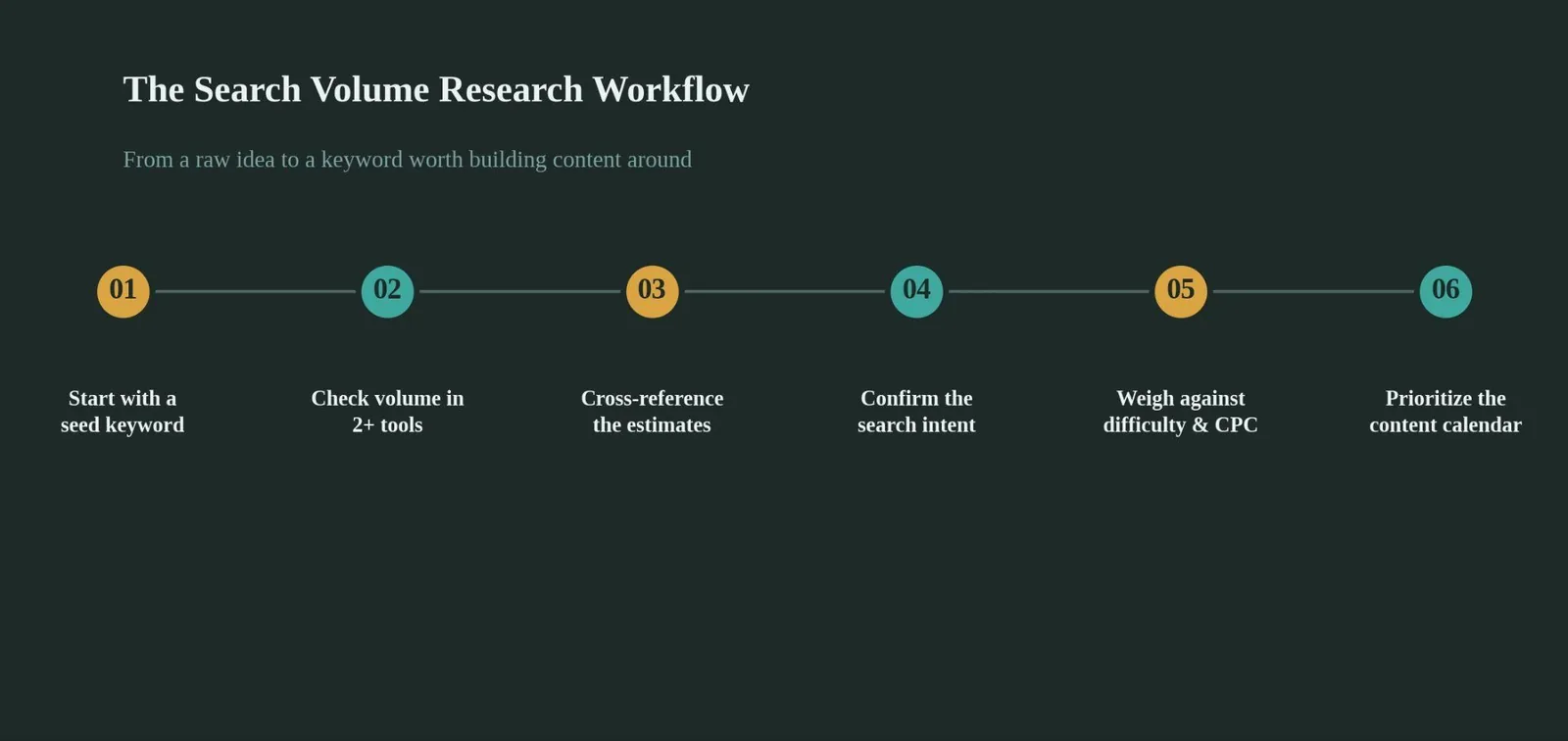
Search volume works best as a comparison tool between keywords within the same source, not as an absolute number to plan a content calendar around in isolation. Pair it with keyword difficulty (how hard the term is to rank for organically) and CPC (cost-per-click, what advertisers pay in Google Ads for that term), since a keyword with strong demand and manageable difficulty is a far better target than raw volume alone would suggest. The real goal is finding target keywords that convert search volume into actual organic traffic, not just impressive numbers on a spreadsheet. That means checking how a term's monthly searches trend over time, not just its current snapshot, before committing content resources to it. Some tools now separate mobile and desktop search volume rather than combining both into one number, which can meaningfully change how a keyword looks depending on the audience and content format you're planning.
Table 1: Search Volume Metrics Compared
| Metric | What it measures | Where to find it |
|---|---|---|
| Search volume | Average monthly searches for a keyword | Google Keyword Planner, Semrush, Ahrefs |
| Keyword difficulty | How hard the keyword is to rank for organically (0-100 scale) | Semrush, Ahrefs, Moz |
| CPC | Average price advertisers pay per click in Google Ads | Google Keyword Planner, Semrush |
| Search intent | What the searcher actually wants (informational, transactional, etc.) | Semrush, Ahrefs, manual SERP analysis |
Search Volume Tools and Costs
Table 2: Keyword Research Tools Compared
| Tool | Search volume display | Cost (USD) |
|---|---|---|
| Google Keyword Planner | Broad ranges (exact figures with active ad spend) | Free with a Google Ads account |
| Semrush | Single estimated number | Free tier (5 checks/day), paid from ~$140/month |
| Ahrefs | Single estimated number | From $129/month (Lite) |
| Google Trends | Relative interest over time, not absolute volume | Free |
Common Mistakes When Using Search Volume
A single tool's number is treated as a precise, guaranteed figure instead of one estimate among several.
High search volume keywords chased without checking whether the difficulty or the search intent actually fits the content being planned.
Seasonality ignored, judging a keyword's potential from a single month's snapshot rather than the trailing 12-month average.
Search volume is assumed to equal traffic, when actual clicks depend heavily on ranking position, SERP features, and how much gets answered directly on the results page.
AI-driven discovery is overlooked entirely, since a meaningful and growing share of queries never generates a measurable search volume figure in any traditional keyword tool.
Search volume tool
What does that Keyword Planner range actually mean?
Select the range Google Keyword Planner showed you, without active ad spend, and see roughly where the real number tends to fall.
Select a range above
Third-party tools tend to land closer to the lower-middle of Google's displayed range far more often than the top.
Frequently Asked Questions
What Is a Good Search Volume for a Keyword?
There's no universal number; it depends on your site's authority, the keyword's difficulty, and how well it matches your content goals. A keyword with modest volume but strong intent match and low difficulty often outperforms a high-volume keyword that's too competitive or poorly matched to what you offer.
Why Do Google Keyword Planner and Semrush Show Different Numbers for the Same Keyword?
They use different data sources and methods: Keyword Planner draws on Google's own ad auction data and often shows ranges, while third-party tools blend clickstream data with proprietary machine learning models to estimate a single number. Neither is definitively correct.
Does High Search Volume Mean I'll Get a Lot of Traffic If I Rank?
Not necessarily. Search volume measures demand, not guaranteed clicks to your specific page. Ranking position, competing SERP features like featured snippets, and a growing share of AI Overview answers all reduce how much of that volume actually converts into a visit.
How Often Is Search Volume Data Updated?
Most tools update monthly to reflect recent search activity, and the average monthly figure itself is typically recalculated using a trailing 12-month window, so it shifts gradually rather than reflecting only the most recent month.
Should I Ignore Search Volume and Focus Only on AI Search Visibility Instead?
No, they're complementary rather than a replacement for each other. Traditional search volume still reflects a large share of real demand; AI visibility tracking fills in the growing portion of discovery that keyword tools can't measure, and a complete strategy accounts for both.
The Bottom Line on Search Volume
Search volume is a genuinely useful estimate of demand, not a precise measurement, and the gap between those two ideas is where most keyword research mistakes happen. Cross-reference more than one source, weigh the number against difficulty and intent, and remember that a growing share of real search activity is happening in places traditional keyword tools simply can't see.
Pick one keyword you're currently targeting, check its volume in two different tools, and see how far apart the numbers land. That gap tells you more about how confidently to plan around that keyword than either number does alone.
Ready to Build a Content Strategy Around Real Demand?
Search volume is only useful when it's weighed against difficulty, intent, and how your site can realistically compete, not treated as a standalone target. Web Tonic's growth marketing team builds keyword strategy around that full picture, so content investment goes toward terms genuinely worth the effort.
More from Web Tonic: growth marketing services, data & analytics.
Sources: semrush.com · almcorp.com · practicalecommerce.com · keywordme.io · searchengineland.com · trysight.ai · howdoiuseai.com