Table of contents

Search marketing statistics for 2026 rarely put paid and organic costs on the same page, even though the budget decision is made query by query, not channel by channel. This page prices both sides from named 2026 studies so the split can be argued with numbers instead of habit.
Key Takeaways
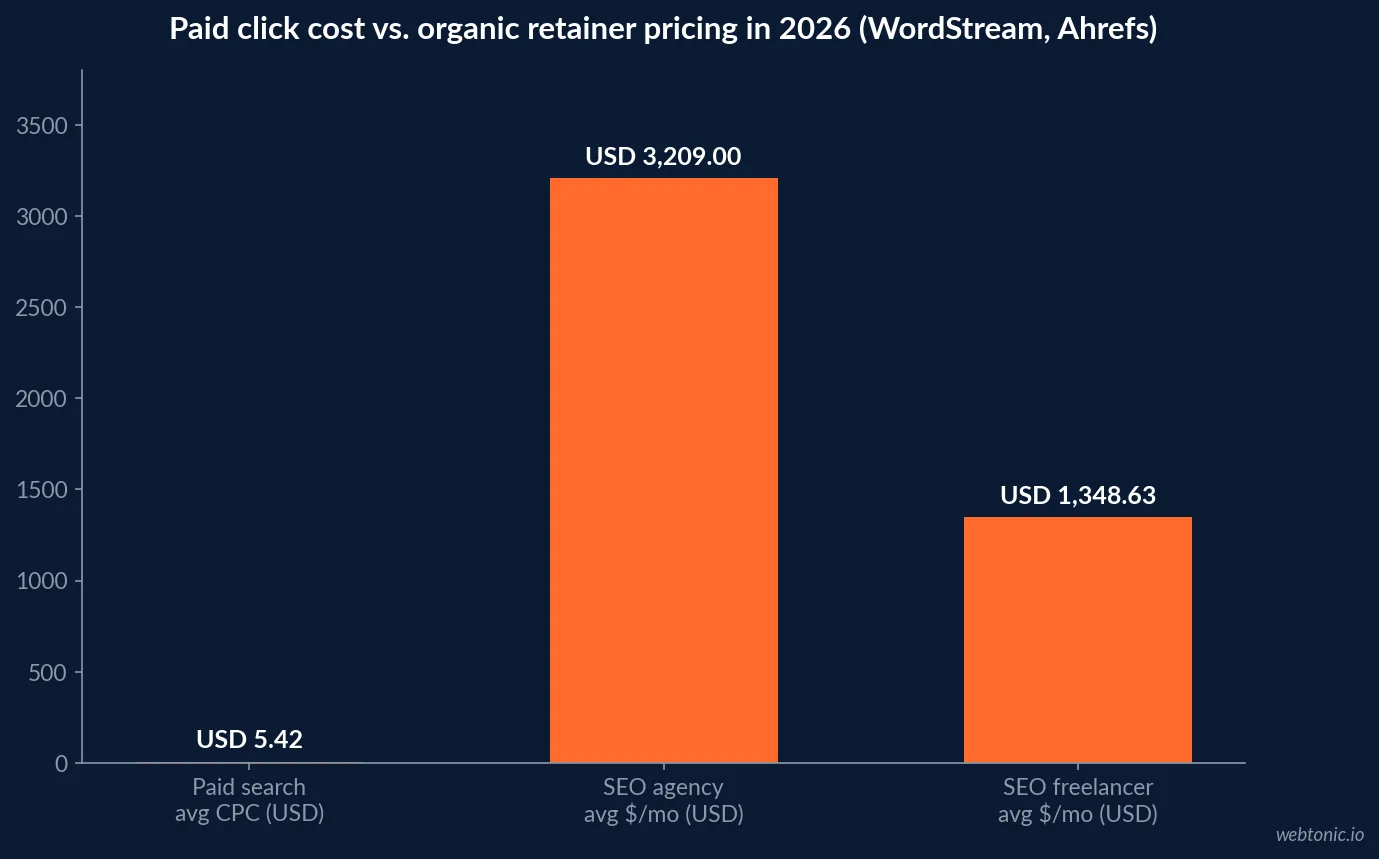
- Average paid search cost per click is USD 5.42 across a 13,000-campaign 2026 panel.
- Average paid search conversion rate is 8.18%, up in 87% of tracked industries.
- Average cost per lead in paid search is USD 66.69.
- Average SEO agency retainer is USD 3,209 a month, from a survey of 439 providers.
- Average SEO freelancer rate is USD 1,348.63 a month, less than half the agency figure.
- 78.2% of SEO providers bill on retainer rather than per project.
- Top organic position earns up to 39.8% of clicks with no AI Overview present.
- An AI Overview cuts that same position's clicks by roughly 58%.
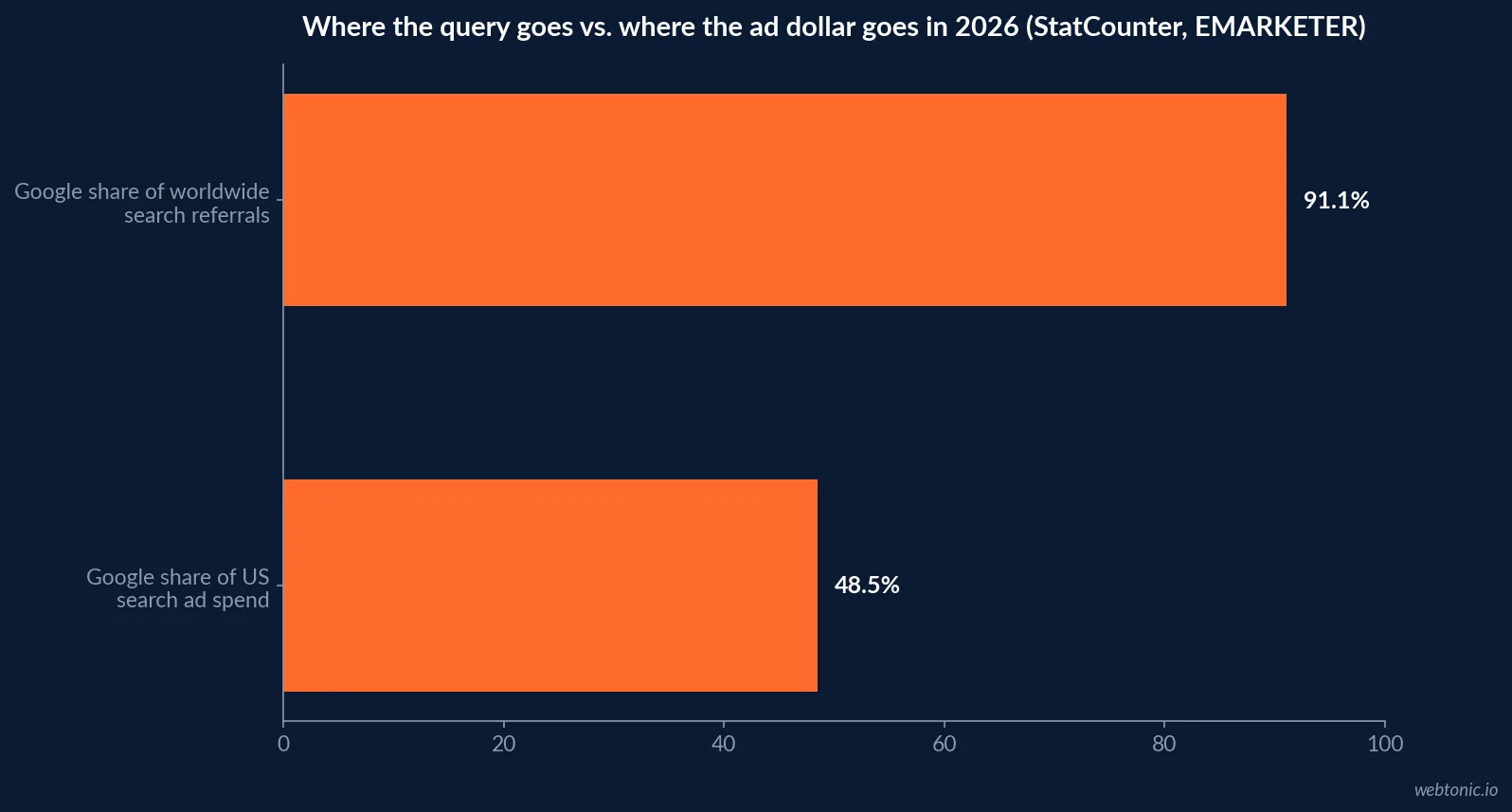
- Google's US search ad-spend share falls to 48.5% in 2026, below half for the first time in 20-plus years.
- Google's worldwide search referral share still sits at 91.1%.
- Google Search & other revenue grew 17% year over year in Q2 2026.
- 79.2% of marketing teams expect a 2026 budget increase.
- 40.6% name SEO adaptation to search changes a top priority.
- 70.2% believe they can adapt strategy to organic search shifts.
- Legal and attorney categories carry the highest paid CPCs in the WordStream panel.
Two budgets, one query
Search engine marketing (paid) and search engine optimization (organic) are usually budgeted by different owners with different KPIs, but they are competing for the same query. A marketer setting next year's search marketing budget needs both cost structures on one page, which is rarely how the two disciplines report their own numbers.
| Channel | 2026 unit cost | What it buys | Source |
|---|---|---|---|
| Paid search (Google/Microsoft Ads) | USD 5.42 avg CPC | An individual click, per auction | WordStream |
| Organic (SEO agency retainer) | USD 3,209/month avg | Ongoing ranking capacity, not a per-click unit | Ahrefs |
| Organic (SEO freelancer) | USD 1,348.63/month avg | Smaller-scope ongoing capacity | Ahrefs |
| Paid search, cost per lead | USD 66.69 avg | A qualified lead, blended across industries | WordStream |
Where the click actually goes when both channels compete
First Page Sage's 2026 CTR meta-analysis puts organic position 1 at up to 39.8% of clicks on a clean results page, against just 2.1% for the first paid ad position in the same clean-page scenario. On paper, that makes organic the cheaper channel per click by a wide margin - until an AI Overview or heavy SERP feature set changes which positions are even visible.
Ahrefs found an AI Overview cuts the top organic position's clickthrough by roughly 58% relative to a matched query without one - a bigger percentage hit than paid ads typically take, since ads frequently render above or beside the overview rather than being replaced by it.
| SERP element (clean page) | 2026 CTR | SERP element (AI Overview present) | Effect |
|---|---|---|---|
| Organic position 1 | 39.8% | Organic position 1 | ~58% relative drop |
| Organic position 2 | 18.7% | Organic position 2 | Also compressed, less studied |
| Paid ad position 1 | 2.1% | Paid ad position 1 | Often preserved above/beside overview |
| Paid ad position 4 | 1.1% | Paid ad position 4 | Less protected than position 1 |
What the market is actually spending, at scale
EMARKETER projects Google's share of US search ad spending falls to 48.5% in 2026, the first time in over two decades it has dropped below half, even as StatCounter shows Google still handling 91.1% of worldwide search referrals. And Alphabet's own Q2 2026 earnings release reports Search & other revenue up 17% year over year to USD 63.27 billion for the quarter - proof that total search ad demand is still growing even as the dollar share shifts toward Amazon and others.
None of that contradicts the organic-click pressure above. Query volume, ad dollars, and click share are three separate numbers, and a 2026 budget has to reconcile all three, not pick the one that fits the narrative already decided on.
The measurement problem that sits underneath the split
Paid search reports a cost per click and a conversion rate inside a dashboard that updates daily. SEO retainers report ranking positions and traffic that move over weeks or months, and increasingly an AI-citation count that has no equivalent daily dashboard at all. Comparing the two channels on a single spreadsheet requires normalizing them to the same time horizon and the same outcome metric - typically cost per qualified lead or cost per acquisition - rather than comparing a CPC to a monthly retainer directly, which is an apples-to-oranges error that shows up in budget decks more often than it should.
Until that normalization is done, any stated search marketing split is really a statement about which team controls the budget conversation, not which channel is actually cheaper per outcome.
| Normalization step | Paid search input | Organic input | Common output metric |
|---|---|---|---|
| Time horizon | Daily/weekly spend and clicks | Monthly retainer, quarterly ranking movement | Trailing 90-day cost per lead |
| Attribution window | Last-click or view-through, platform-reported | First-touch or assisted, GA4 or GSC | Blended, cross-channel model |
| Outcome metric | Cost per click, cost per lead | Cost per ranking position, cost per session | Cost per qualified lead (shared) |
A budget-allocation model that survives contact with these numbers
Segment queries into three buckets before setting the split: high-commercial-intent queries where paid protects the click regardless of AI Overview exposure, informational queries with heavy AI Overview presence where organic increasingly buys a citation rather than a click, and everything else where the cheaper channel per historical CPA should win the marginal dollar. Price each bucket against the tables above rather than defaulting to a fixed 60/40 or 70/30 split carried over from last year.
Our growth marketing team runs this segmentation before recommending a split, and our Google Ads pricing guide breaks the paid side down further by category.
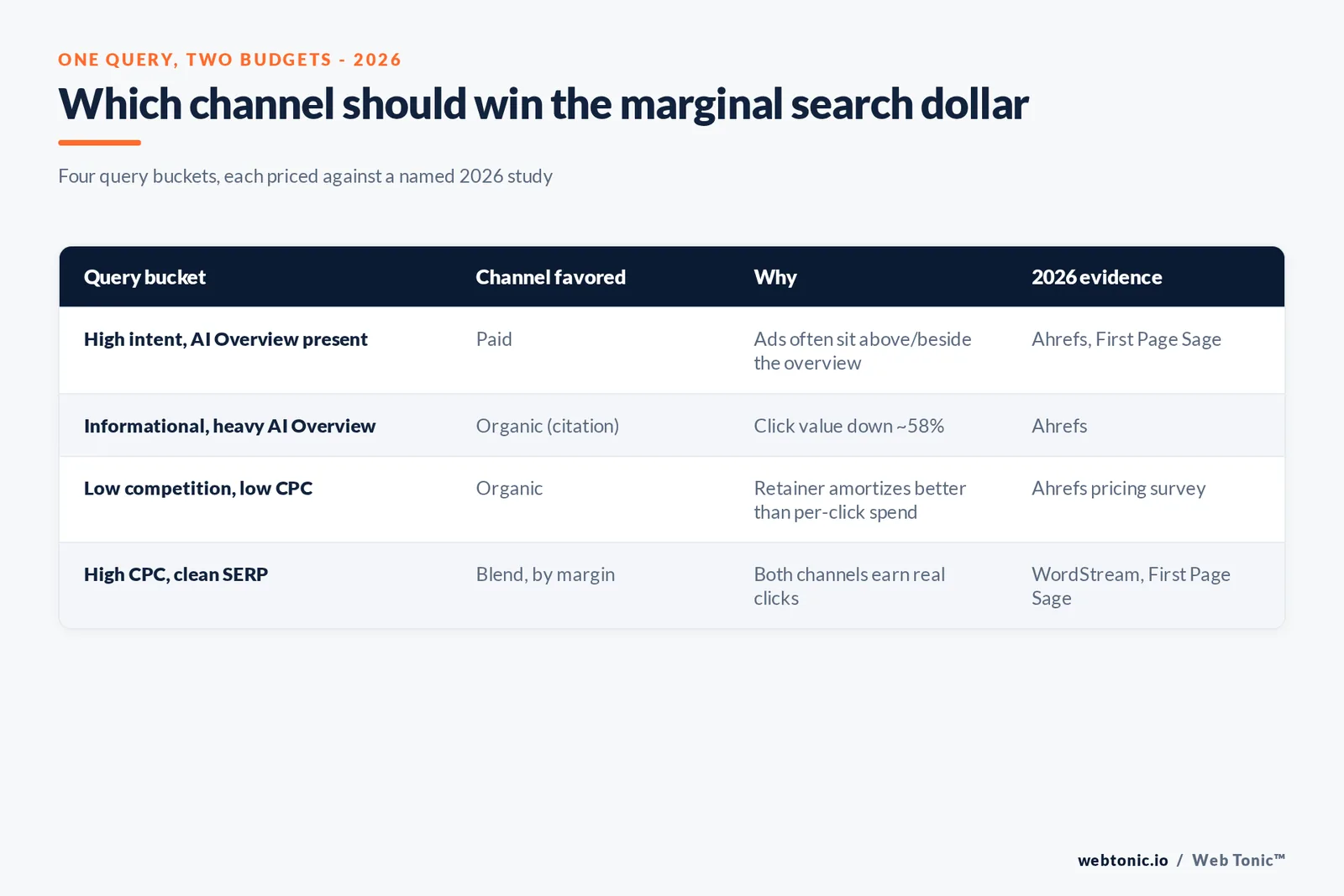
| Query bucket | Channel favored | Why | 2026 evidence |
|---|---|---|---|
| High commercial intent, AI Overview present | Paid | Ads often preserved above/beside overview | Ahrefs, First Page Sage |
| Informational, heavy AI Overview exposure | Organic (for citation, not clicks) | Click value compressed ~58% | Ahrefs |
| Low competition, low CPC | Organic | Retainer cost amortizes better than per-click spend | Ahrefs pricing survey |
| High CPC, high competition, clean SERP | Blend, weighted by margin | Both channels still earn real clicks | WordStream, First Page Sage |
The category spread that makes a single split number meaningless
Both the paid and organic figures above are cross-industry averages, and each hides a wide spread. WordStream's 2026 panel shows Google Ads CPC ranging from roughly USD 2.50 in lower-cost categories like travel and sports to well above USD 8 in attorneys and legal services. Ahrefs' pricing survey shows a similar spread on the organic side: local SEO averages USD 1,557 a month while enterprise-scale programs run into five figures. A search marketing budget split that ignores category is solving the wrong problem at the wrong resolution.
The category, not the channel label, should set the starting range for either line item.
| Category signal | Paid search cost pressure | Organic cost pressure | Net budget read |
|---|---|---|---|
| Legal / attorneys | Highest CPC in the WordStream panel | High competition, longer ranking timelines | Both channels expensive; weigh by close rate |
| Travel | Lower CPC, seasonal swings | Content-heavy, seasonal demand | Paid for peak season, organic for evergreen guides |
| Local services | Moderate CPC | USD 1,557/month average local SEO retainer | Organic often cheaper per lead at scale |
| Finance & insurance | High CPC, high CVR (9.83% CTR panel) | High competition for rankings | Justify premium on both lines |
What marketers say they are doing about it
HubSpot's 2026 State of Marketing survey found 79.2% of teams expecting at least a slight 2026 budget increase, 40.6% naming SEO adaptation to search changes a top priority, and 70.2% believing they can adapt strategy to the shift. That confidence has to translate into the query-level segmentation above, not just a larger version of last year's channel split. Talk to us if you want that segmentation run against your own account, ideally before the retainer or the ad budget for next quarter is already locked in.
Where the budget itself is coming from
The CMO Survey 2026, running its long-standing panel of marketing leaders, is one of the few named studies that tracks marketing budgets as a share of both revenue and total firm spend over time rather than in a single snapshot year. It is a useful outside check on whether a search marketing budget increase is riding a real tide of rising marketing investment or swimming against a flat or shrinking one - the search-specific figures above say nothing about total budget movement on their own.
Pull that panel before finalizing a split, since a flat total marketing budget with a growing search line means the increase is coming out of some other channel's number, not out of new money.
Frequently Asked Questions
Is search marketing paid, organic, or both?
Both, by definition - search engine marketing historically meant paid, and search engine optimization meant organic, but 2026 budget planning increasingly treats them as one query-level decision. A high-CPC, high-competition query might justify paid spend even with a strong organic ranking already in place; a low-CPC, low-volume query rarely justifies bidding at all.
How much does the average paid search click cost in 2026?
WordStream's 2026 panel of over 13,000 campaigns puts the average Google/Microsoft Ads cost per click at USD 5.42, more than double the USD 2.32 recorded in 2016, with an average conversion rate of 8.18% and cost per lead of USD 66.69.
How much does organic search marketing cost by comparison?
Ahrefs' pricing survey of 439 providers puts the average SEO agency retainer at USD 3,209 a month and freelancer rates at USD 1,348.63. Retainer pricing does not map cleanly to per-click paid costs, since SEO buys ongoing capacity rather than individual clicks, but 63% of buyers still spend between USD 500 and 5,000 a month, comparable in scale to a modest paid search budget.
Does AI search change how the two budgets should split?
Yes, and asymmetrically. Ahrefs found AI Overviews cut organic clickthrough on the top position by roughly 58% on affected queries, while paid ads frequently render above or alongside those same overviews, which is why some 2026 guidance shifts weight toward paid for queries where the overview intercepts the informational click but the buyer intent is still high.
What is the single most reliable number to anchor a 2026 search budget on?
Alphabet's own Q2 2026 earnings release, which reported Google Search & other revenue growing 17% year over year to USD 63.27 billion for the quarter. It is the one figure in this space that is a certified financial filing rather than a survey or a forecast, and it confirms that overall demand for search advertising is still expanding even as AI Overviews reshape the organic side.
Sources
WordStream - 2026 Google Ads Benchmarks
Ahrefs - SEO Pricing: How Much Does SEO Cost? 439 People Polled
First Page Sage - Google Click-Through Rates by Ranking Position, 2026
Ahrefs - Update: AI Overviews Reduce Clicks by 58%
EMARKETER - US Search Ad Spending Benchmarks, Q3 2026
StatCounter - Search Engine Market Share Worldwide
Alphabet Inc. - Q2 2026 Earnings Release
HubSpot - 2026 State of Marketing
The CMO Survey - 2026 Highlights and Insights Report