Table of contents
Two keywords can look almost identical and still want completely different things. "Best coffee maker" and "buy coffee maker" both mention the same product, but one wants a comparison and the other wants a checkout page. Search intent types are the framework for telling those two queries apart, and getting it wrong is the single most common reason a technically solid page never ranks. This guide covers the four types, how Google itself defines them, and how to build content that actually matches what a searcher wants.
Key Takeaways
- There are four core search intent types: informational, navigational, commercial, and transactional, each requiring a genuinely different content format to rank.
- Google's own Search Quality Evaluator Guidelines use a parallel framework: Know, Do, Website, and Visit-in-person, which maps closely onto the four SEO categories.
- Informational intent dominates search volume at roughly 53%, followed by navigational at 21%, transactional at 16%, and commercial at just 8.5%, according to Semrush's keyword database.
- SERP analysis, actually searching the keyword and studying what already ranks, is the most reliable way to identify intent, more reliable than guessing from the keyword's wording alone.
- Many keywords carry mixed intent, showing signals for more than one category at once, which is why a single content format won't always be the right answer.
- AI Overviews have shifted measurably toward commercial and transactional queries: informational intent made up 91.3% of AI Overview-triggering searches in January but had dropped to 57.1% by October, per Semrush's own research.
What Are Search Intent Types?
Search intent types are the categories used to describe the underlying goal behind a search query, separate from the literal words typed into the search box. A user, or searcher, doesn't just want a keyword matched; they want a specific kind of answer, a page to visit, a product comparison, or a way to complete a purchase, and Google's ranking systems are built to detect which one applies to any given query.
A quick terminology note, since the labels shift depending on who's talking. Some call this user intent, others say keyword intent or intent keywords. People search the same way regardless of which term gets used. A query is really a stand-in for intent queries that fall into one of four buckets: commercial search, informational search, transactional search, or navigational queries, depending on what the person actually wants. Local search intent deserves its own brief mention here too. A query like "plumber New York" combines a product service need with a location, and Google treats it differently from a generic version of the same search, prioritizing map results and business listings over standard organic pages. Community sites like Reddit increasingly rank well for people search queries too, particularly informational ones where searchers want a real opinion rather than a polished corporate article, which is part of why user-generated content has gained visibility across many query types recently.
In SEO, the four intent types most people use are informational, navigational, commercial, and transactional. Search engines, Google chief among them, build their entire ranking systems around correctly matching users to the right one of these categories. Google's own Search Quality Evaluator Guidelines describe roughly the same territory using different language: Know, Do, Website, and Visit-in-person, and specifically splits Know queries into "Know Simple" (a quick fact) and a deeper "Know" query requiring real research. Both frameworks describe the same underlying user behavior from different angles, one built for search quality raters, one built for content strategy.
The Four Search Intent Types
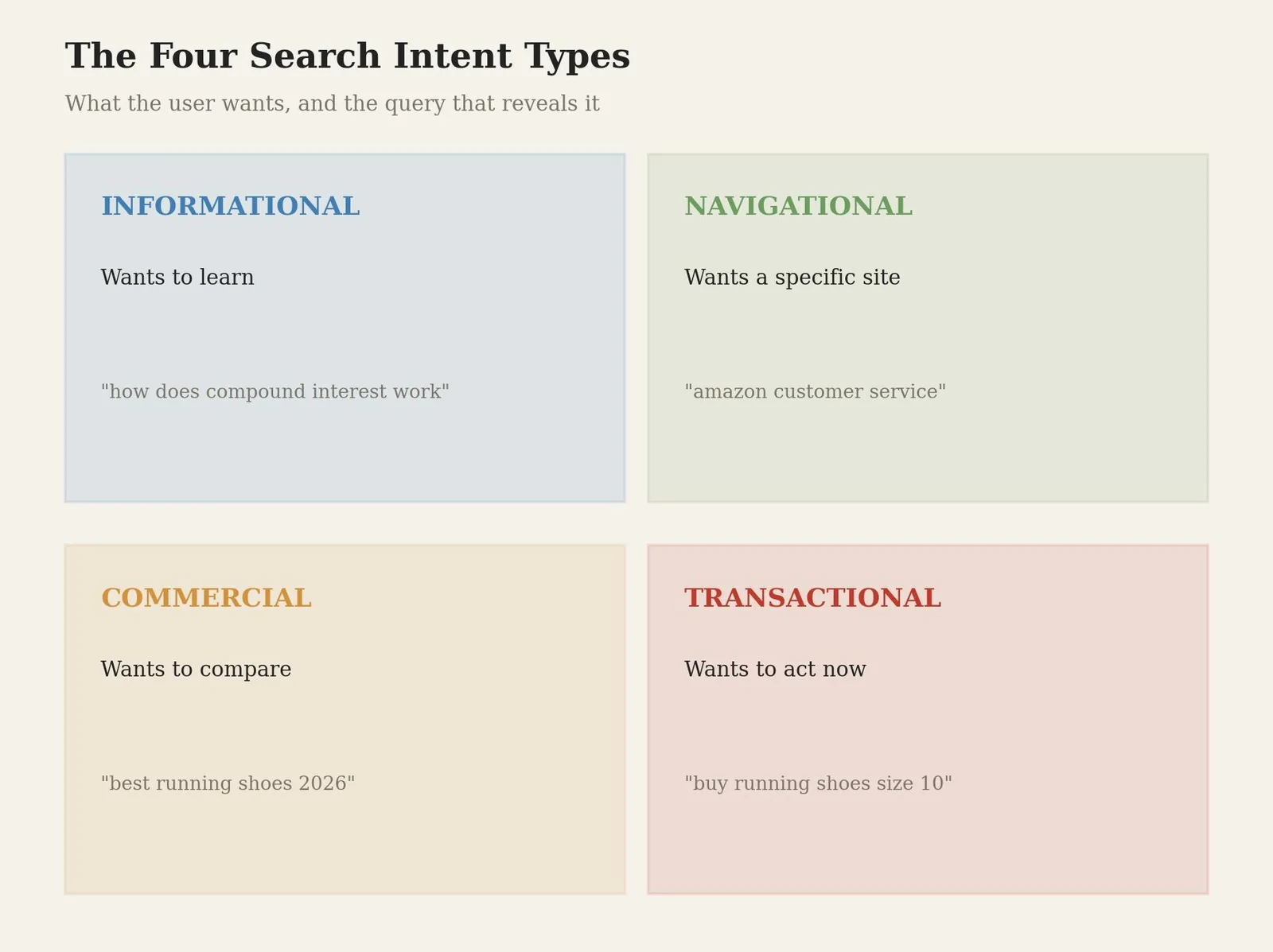
Informational intent means the person wants to learn something, with no immediate plan to buy or visit a specific site. These queries commonly start with "how," "what," "why," or "best way to," and Google typically responds with guides, explainers, or a featured snippet directly pulled from a page that answers the question concisely.
Navigational intent means the searcher already knows exactly where they want to go and is using a search engine to get there rather than typing a URL directly. Someone searching "Amazon customer service" or a specific brand name almost always wants that brand's own page, not a third-party article about it, which is why third-party content rarely displaces the brand itself for its own navigational terms.
Commercial intent, sometimes called commercial investigation, sits between informational and transactional. The searcher has decided they want something in a general category but is still comparing specific options, reading reviews, or narrowing a shortlist. Modifiers like "best," "top," "review," or "vs." are strong signals here.
Transactional intent signals that the person is ready to act right now: buy, subscribe, download, or book. Modifiers like "buy," "price," "discount," or "near me" are the clearest tells, and this is the intent type product pages, pricing pages, and checkout flows are built to serve.
How Google Classifies Intent Internally
Google's own Search Quality Evaluator Guidelines split intent into four categories that search quality raters use to judge whether a page satisfies a query: Know (learn a fact), Do (complete a task or action), Website (reach a specific site), and Visit-in-person (find a local business or place). The Know category further splits into "Know Simple," queries answerable in a single short fact, and a more complex Know query that needs a fuller explanation. These categories are the internal language behind what SEOs describe as informational, transactional, navigational, and local intent, and understanding the overlap helps explain why Google sometimes shows a featured snippet for one query and a full page of links for a nearly identical one.
Search Volume and Intent Distribution
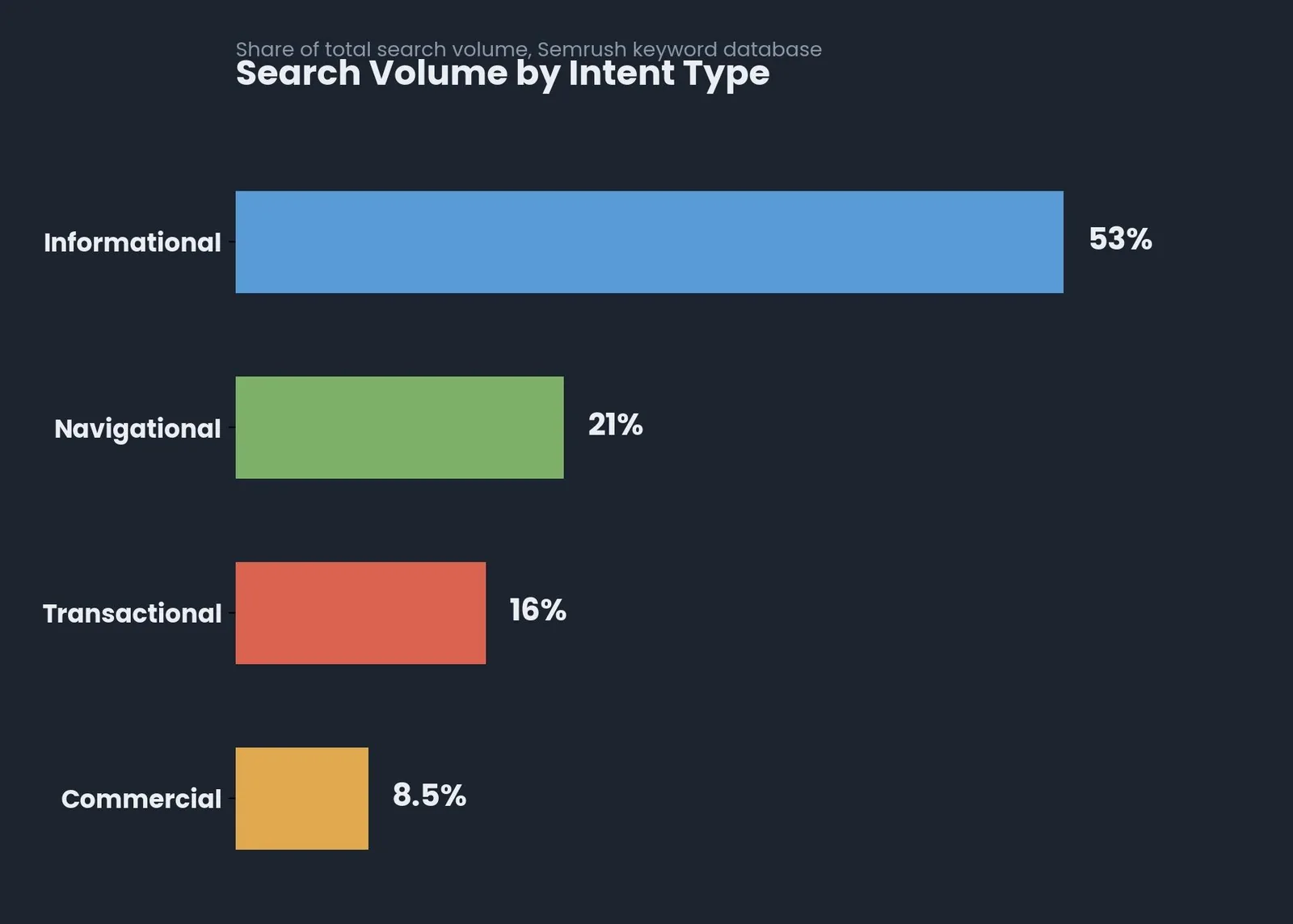
Search intent isn't evenly distributed across query volume. Roughly 53% of total search volume carries informational intent, 21% is navigational, 16% is transactional, and commercial intent makes up only about 8.5%, according to Semrush's own presented keyword data. That gap matters strategically: a site that only targets high-volume informational keywords can build significant traffic while converting almost none of it, since informational content and purchase-ready content rarely live on the same page.
Commercial intent content punches well above its search volume weight in terms of business impact. Semrush's Organic Research data shows commercial-intent keywords driving 72.22% of monthly organic visits to BestBuy.com and 63.89% to Kay.com, a disproportionate return relative to the roughly 8.5% share of total search volume commercial queries represent.
How to Identify Search Intent for Any Keyword
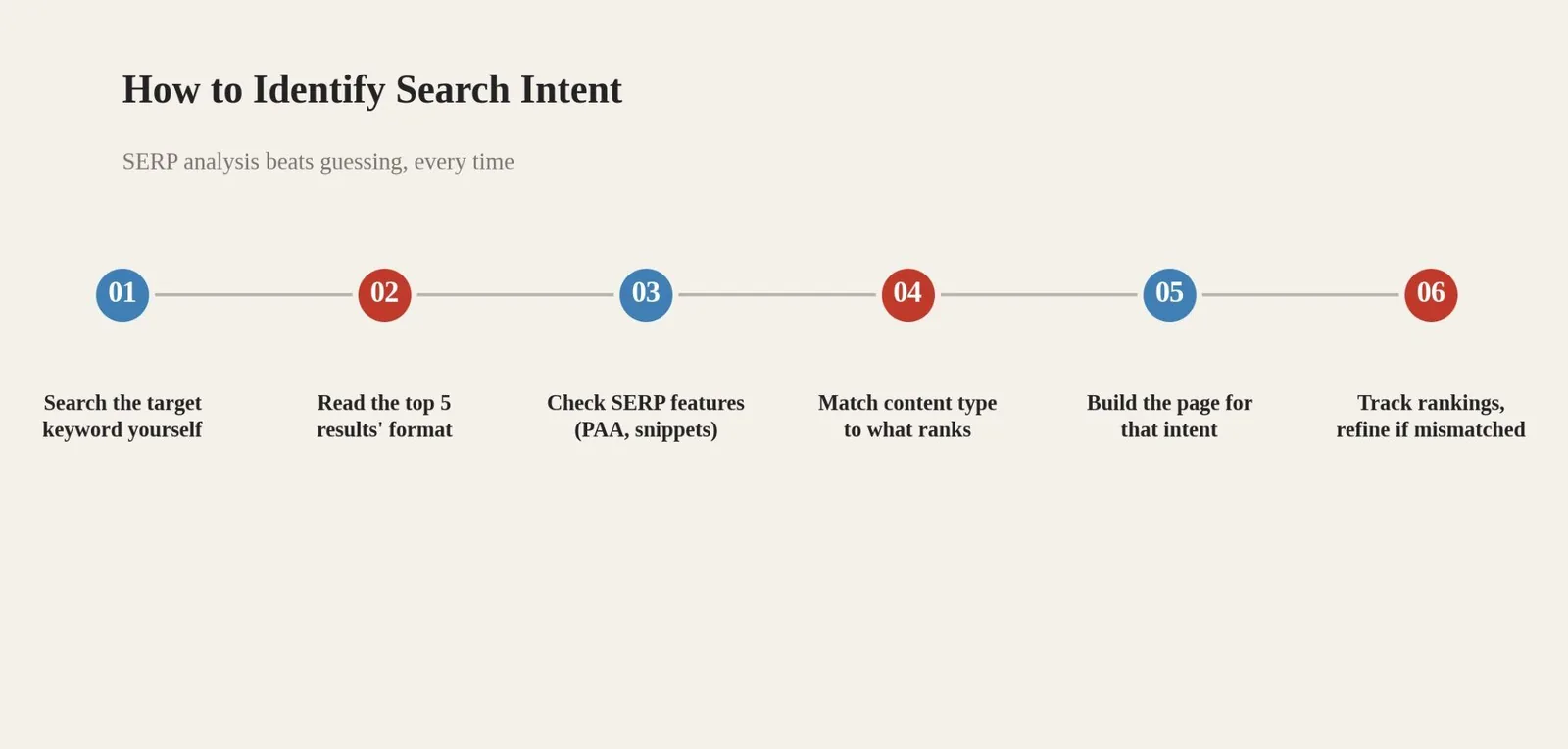
The single most reliable method is SERP analysis: search the target keyword yourself and study what Google already ranks. If the top 5 results are blog posts and guides, the intent is informational. If they're product pages and shopping carousels, it's transactional. Check for People Also Ask (PAA) boxes and featured snippets too; their presence is itself a signal that Google has classified the query as informational, since those SERP features exist specifically to answer a question quickly.
Keyword modifiers offer a faster, if less reliable, first signal for this kind of intent search work. A single intent keyword like "SEO" alone gets classified differently by different SEO tools because it's genuinely ambiguous without more context, which is exactly why modifiers alone shouldn't be the final word. Many real queries also carry mixed intent: "Canon cameras" points toward a specific brand while also implying the searcher might want to make a purchase once they land on the brand's site. When that overlap shows up in a live SERP, plan for it rather than forcing the keyword into a single bucket.
Matching Content to Intent
Each intent type requires a genuinely different content format, depth, and call to action; informational intent needs educational content, and a service page targeting an informational query simply will not rank.
Table 1: Content Format by Search Intent
| Intent type | Content format that works | What to avoid |
|---|---|---|
| Informational | Guides, explainers, FAQs, how-to content | Product pages with no educational context |
| Navigational | A clear, well-optimized brand or homepage | Generic content competing with the brand itself |
| Commercial | Comparison articles, reviews, best-of lists | Pure informational content with no evaluation |
| Transactional | Product pages, pricing pages, low-friction checkout | Long educational content that delays the action |
Search Intent Tools Compared
Table 2: Tools for Identifying Search Intent
| Tool | What it does | Cost (USD) |
|---|---|---|
| Manual SERP analysis | Search the keyword yourself and study the results | Free |
| Semrush Keyword Magic Tool | Auto-labels keywords by intent (I, N, C, T) | From ~$140/month, included in paid plans |
| Google Search Console | Shows which queries actually drive traffic to a page | Free |
| Google Analytics | Reveals whether traffic from a query converts or bounces | Free |
Common Mistakes When Working With Search Intent
A blog post published for a keyword that's actually transactional, then wondering why it never converts or ranks against product pages.
Intent assumed from the keyword's wording alone instead of actually checking what currently ranks in the SERP.
Every keyword is treated as having exactly one intent, when a meaningful share of real queries carry mixed signals.
Only high-volume informational content built, while lower-volume commercial and transactional pages that actually drive revenue get ignored.
SERP features like PAA boxes and featured snippets are overlooked, even though they're direct signals of how Google itself has classified a query.
Search intent tool
What's the intent behind this keyword?
Type a keyword or phrase to get a quick, rule-based read on its likely search intent. Always confirm with real SERP analysis before building a page around it.
Type a keyword above
Enter a phrase and click Check to see a likely intent classification.
Frequently Asked Questions
What Are the Four Main Types of Search Intent?
Informational, navigational, commercial, and transactional. Informational intent means the user wants to learn something, navigational means they want a specific site, commercial means they're comparing options, and transactional means they're ready to act.
How Does Google's Own Framework Differ From the SEO Industry's Four Types?
Google's Search Quality Evaluator Guidelines use Know, Do, Website, and Visit-in-person. They describe largely the same behavior as the SEO industry's four categories, just from the perspective of quality raters judging whether a page satisfies a query rather than marketers planning content.
Can a Single Keyword Have More Than One Search Intent?
Yes. Mixed intent is common; a query like "Canon cameras" can carry both navigational and transactional signals at once, and Google may respond with a blended SERP rather than a single content format.
What's the Best Way to Check a Keyword's Actual Intent?
Search the keyword yourself and study the top-ranking results. The dominant content format, article, product page, comparison list, or brand homepage, reveals what Google has already determined the intent to be, which is more reliable than guessing from the keyword alone.
Does Search Intent Affect Google Analytics or Search Console Data?
Indirectly, yes. Pages that mismatch intent (an informational post targeting a transactional keyword) typically show high bounce rates and low conversions in Analytics, and weak click-through rates in Search Console, both of which are useful signals that a rewrite or format change is needed.
The Bottom Line on Search Intent Types
Search intent types exist because a keyword is only half the story. The same words can hide four different goals, and content that ignores which one applies rarely ranks no matter how well it's written or optimized otherwise. Informational, navigational, commercial, and transactional intent each demand a different format, and Google's own Know/Do/Website/Visit-in-person framework confirms the point: this is built into how search quality itself gets judged, not just a marketing theory layered on top of it.
Pick one underperforming page on your site, search its target keyword in an incognito window, and compare your content format against what's actually ranking. That single check often reveals an intent mismatch that no amount of additional keyword optimization would have fixed.
Ready to Build Content That Actually Matches Intent?
Mapping content to the right search intent touches keyword research, content strategy, and page structure all at once, and getting it wrong wastes the effort spent on both. Web Tonic's growth marketing team builds intent-matched content strategy into every SEO engagement, so pages target the format Google is already rewarding instead of guessing.
More from Web Tonic: growth marketing services, data & analytics.
Sources: semrush.com · jaydeepharia.com · wix.com · niumatrix.com · wpseoai.com · searchengineland.com · w3era.com