Table of contents

Every keyword research session eventually hits the same wall: a great topic idea, decent search volume, and no idea whether the site actually stands a chance of ranking for it. That gap is exactly what keyword difficulty exists to close.
Keyword difficulty (KD) is a metric, usually scored 0 to 100, that estimates how hard it would be to rank on page one of Google for a given keyword, based on signals like the domain authority and number of referring domains pointing to the pages currently occupying the top ranking spots. It's one of the most-cited numbers in SEO, and also one of the most misunderstood, since Ahrefs, Semrush, and Moz each calculate it differently and none of them measure Google's actual ranking algorithm directly. This guide explains what the score really represents, how the major tools calculate it, and how to use the data without over-trusting a single number.
Key Takeaways
- Keyword difficulty estimates how competitive a keyword is to rank for organically, typically as a difficulty score from 0 (easiest) to 100 (hardest).
- Ahrefs calculates KD almost entirely from referring domains to the current top 10, while Semrush and Moz use broader, multi-factor formulas, which is why the same keyword can show wildly different scores across tools.
- At KD 40, Ahrefs estimates roughly 56 referring domains are needed to reach the top 10; at KD 60, that climbs to roughly 249 referring domains.
- Keyword difficulty is not the same as Google Ads competition, which measures advertiser bidding activity, not organic ranking difficulty; a keyword can be commercially "high competition" in Google Keyword Planner while showing a low organic KD score, or the reverse.
- Long tail keywords typically carry a lower difficulty score than broad head terms, making them a practical starting point for newer or lower-authority sites.
- KD is a starting filter, not a final verdict: a high difficulty keyword with strong search volume and commercial intent can still be worth years of sustained effort, especially for an established site.
What is keyword difficulty, exactly?
Keyword difficulty is a composite SEO metric that estimates the level of competition for a specific keyword in organic search, most commonly expressed as a score from 0 to 100. It isn't a single measurement; it's a synthesis of signals about whoever already occupies page one. According to a 2026 keyword difficulty SEO guide from Futuristic Marketing Services, the primary input across nearly every major tool is the strength of the backlink profiles behind the pages currently ranking, since backlinks remain one of the clearest, most measurable proxies for how much authority it takes to compete. As SEO.com's keyword difficulty glossary entry puts it, teams use this difficulty metric to build data-driven strategies rather than guessing which terms are realistically winnable.
Google's own Keyword Planner shows a separate "Low/Medium/High" competition rating, and it's easy to conflate the two. According to Keytomic's guide to keyword difficulty, that figure measures Google Ads advertiser bidding activity, not organic ranking difficulty. A keyword can carry high advertiser competition and a comparatively low organic KD score, or the reverse; the two metrics answer different questions and shouldn't be treated as interchangeable.
How the major tools calculate keyword difficulty
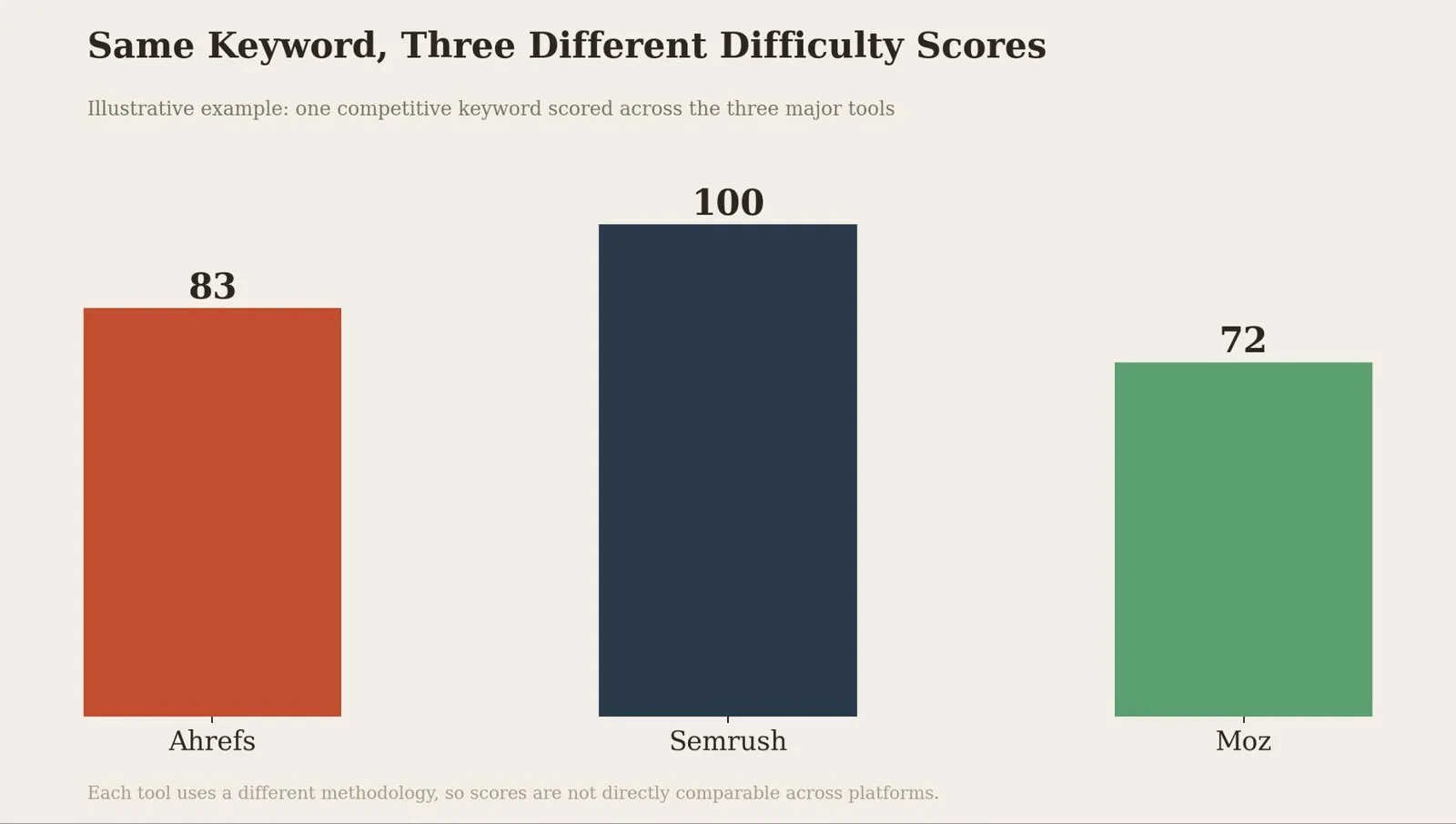
Ask three different search engine optimization tools for the KD of the same keyword and it's common to get three different answers, sometimes wildly different ones. That's not a bug in any one tool; it reflects genuinely different methodologies for how each one chooses to measure keyword difficulty.
Ahrefs takes the narrowest approach. Per Keytomic's breakdown of tool methodologies, Ahrefs' KD is built almost entirely on the number of referring domains pointing to the current top 10 pages, with no direct weighting for content quality, search intent, or SERP features. It's simple and consistent, but blind to context the score doesn't capture.
Semrush uses a considerably broader formula. According to Semrush's own knowledge base, its keyword difficulty score factors in the median number of referring domains, the ratio of dofollow to nofollow links, the median authority score of ranking domains, and the presence of SERP features like featured snippets or local packs that can crowd out organic clicks. Because it accounts for more variables that increase real-world difficulty, Semrush KD scores tend to run higher than Ahrefs' for the same term. Semrush's own product documentation states the formula draws on over 10 parameters across a database the company describes as more than 25 billion keywords, a self-reported figure rather than an independently audited one.
Moz leans on its own Domain Authority and Page Authority metrics. Per Productive Shop's explainer on keyword difficulty, Moz averages the projected authority and click-through rate of all ten first-page results to produce its score, weighting higher-ranked pages more heavily. Moz's scores tend to run more conservatively than Semrush's for highly competitive terms.
A fourth data point rounds this out: Hop AI's hands-on, single-tester comparison of four keyword difficulty tools found that neither Ahrefs nor Ubersuggest consistently matched Moz's scores in manual side-by-side testing, reinforcing that there's no single "correct" keyword difficulty SEO number, only different lenses on the same competitive landscape.
Keyword difficulty tools compared
| Tool | Primary methodology | Tends to score | Best for |
|---|---|---|---|
| Ahrefs | Referring domains to top 10 pages | Lower, single-signal | Fast, consistent backlink-based estimates |
| Semrush | Referring domains, link ratio, authority score, SERP features | Higher, multi-signal | Comprehensive competitive context, including SERP crowding |
| Moz | Domain Authority and Page Authority of top 10 | More conservative | Quick directional read, less reliable for new or small sites |
The keyword difficulty scale, and what each band means
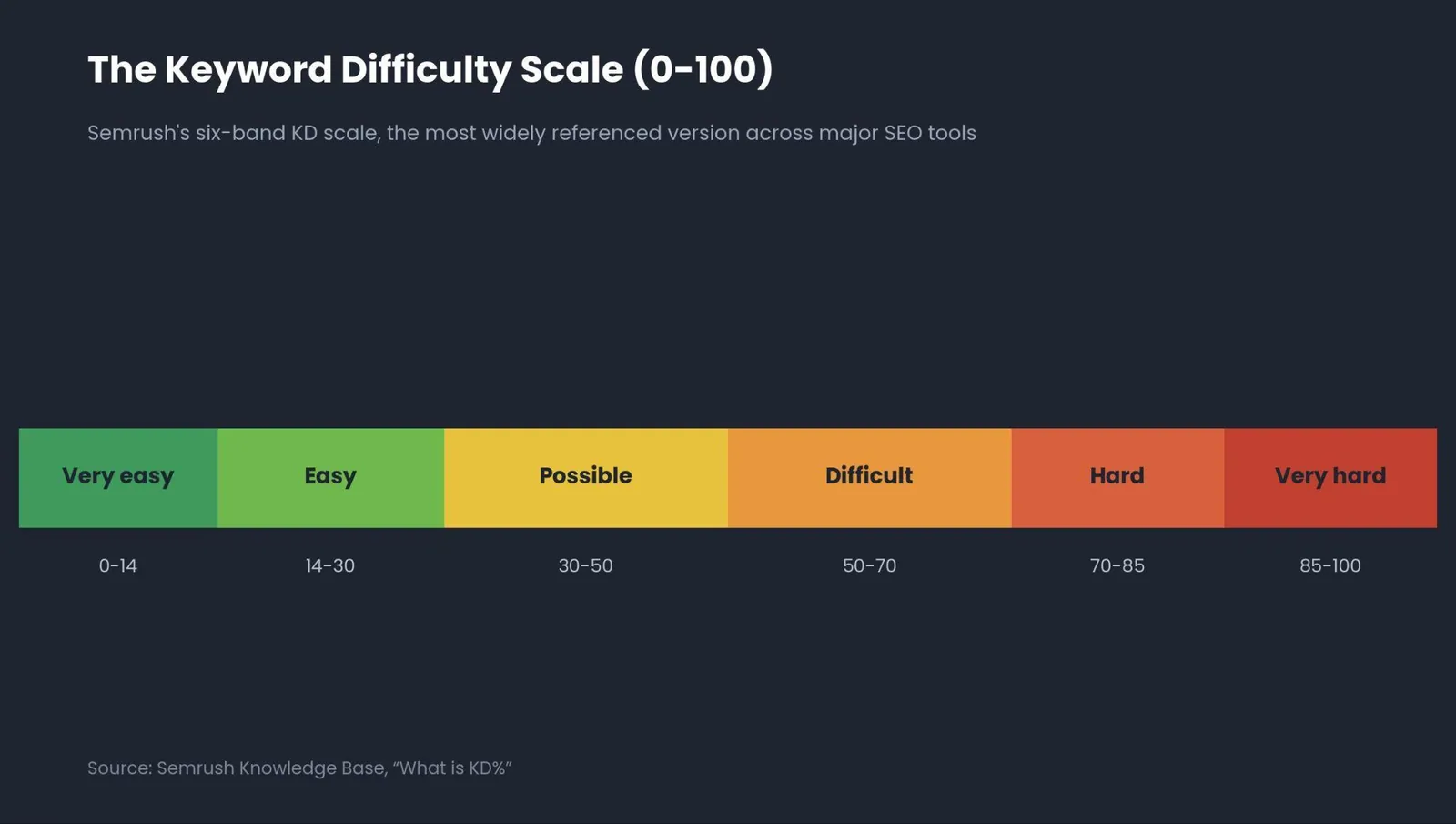
Regardless of which tool produces the number, most practitioners interpret KD in bands rather than treating every point as meaningfully distinct. Semrush's own published scale, one of the most widely referenced versions across the industry, breaks the 0-100 range into six bands: 0-14 is very easy, 14-30 is easy, 30-50 is possible, 50-70 is difficult, 70-85 is hard, and 85-100 is very hard.
A good keyword difficulty target depends entirely on the site's existing authority, not a fixed number that applies everywhere. A brand-new site chasing a KD 60 term is fighting a very different battle than an established domain with hundreds of existing referring domains doing the same thing, and a higher keyword difficulty score simply means more of that authority is required before the term becomes realistic.
What it actually takes to rank at a given KD score
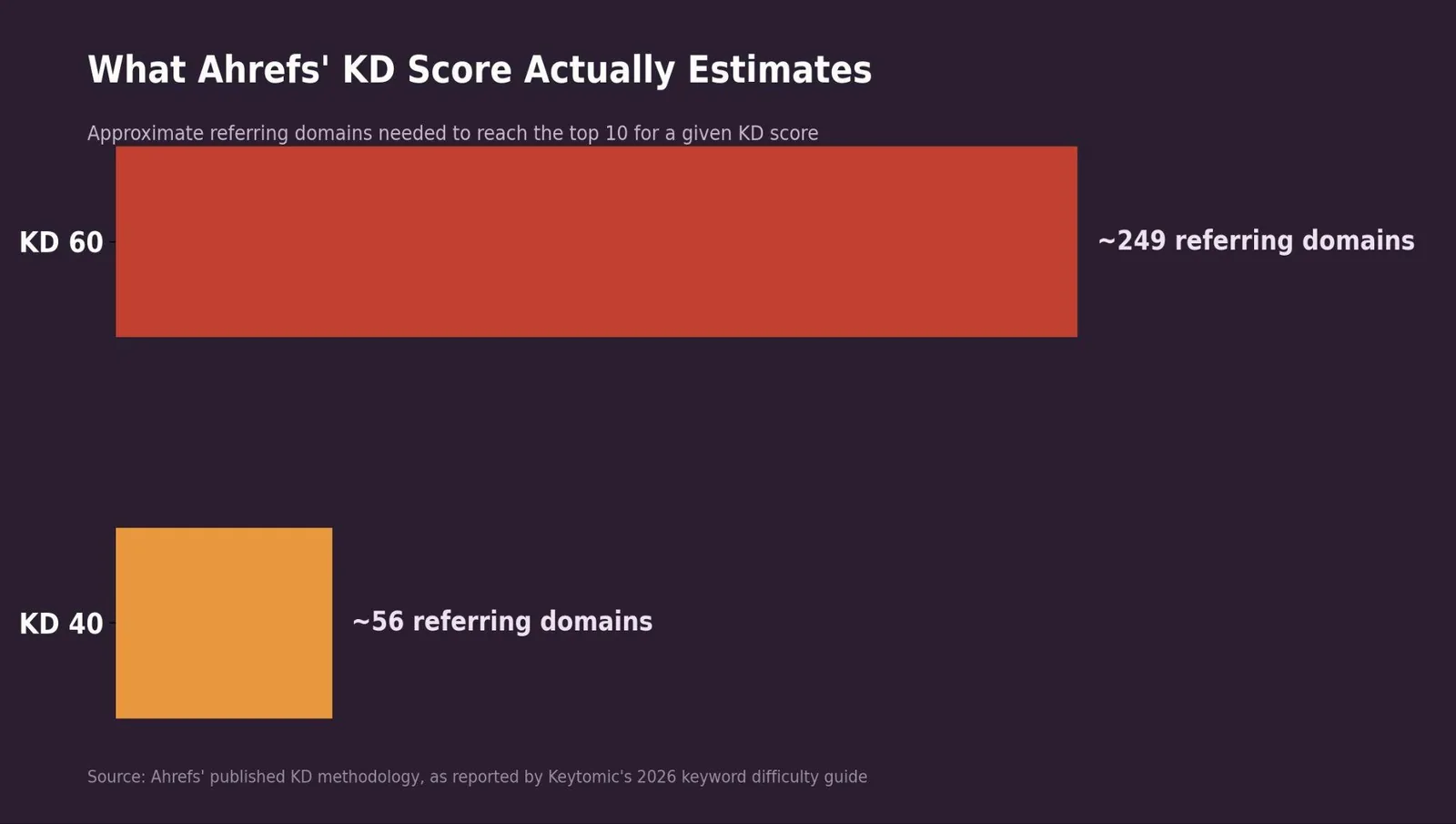
Ahrefs is unusually transparent about translating its score into a concrete number. Per Keytomic's breakdown of Ahrefs' methodology, at KD 40, Ahrefs estimates roughly 56 referring domains are needed to break into the top 10; at KD 60, that estimate climbs to roughly 249 referring domains. Separately, Victorious's guide to keyword difficulty cites a live example: a KD 57 keyword ("Google trends") that reportedly needed around 113 backlinks to outrank existing top content, a second data point suggesting the relationship holds directionally even if exact figures vary by keyword. A 20-point jump in KD can mean a nearly 5x increase in the backlink work required.
How to actually use keyword difficulty in a content strategy
Keyword difficulty tool
What does this KD score actually mean?
Drag the slider to any keyword difficulty score and see what it typically takes to compete.
Possible
Moderate competition. Well-structured, intent-matched content can realistically compete here without a heavy backlink campaign.
Drag the slider in the tool above to any score and see what it typically requires before deciding whether a keyword belongs on this quarter's content calendar.
The most reliable approach treats keyword difficulty as a filter, not a verdict. Start by targeting long tail keywords with lower difficulty scores to build early wins, establish topical relevance, and start generating organic search traffic without a heavy backlink campaign. As the site's authority grows, gradually layer in more competitive terms, always weighing the keyword search volume metric alongside the difficulty score rather than looking at either number in isolation.
For keywords with strong search volume and clear commercial intent but a stubbornly high difficulty score, the calculation changes. A KD 70 term with tens of thousands of monthly searches can be worth a sustained, multi-year investment, especially for a site that can realistically build the referring domains required. For everything else in that range, PPC is often the more efficient near-term channel while organic authority is still being built.
Common keyword difficulty mistakes
Treating one tool's score as an absolute truth is the most common mistake. Since Ahrefs, Semrush, and Moz all calculate keyword difficulty differently, the same keyword can look easy in one tool and hard in another; neither is "wrong," they're measuring different things. Content Gecko's analysis of keyword difficulty in SEO makes the same point: relying exclusively on a single tool's score is a mistake precisely because most third-party databases are too small to capture every niche or real-time SERP volatility.
Chasing high-KD terms before building any authority is a close second. A brand-new site with no existing referring domains rarely competes successfully for a KD 70+ term, regardless of content quality.
Ignoring search intent in favor of the score alone is a subtler mistake. A low-difficulty keyword that doesn't match what the site actually offers won't convert, no matter how easy it is to rank for.
And confusing keyword difficulty with Google Ads competition leads to genuinely bad decisions, since a keyword can be cheap and easy to rank for organically while being expensive to bid on, or the opposite, like many terms dominated by Amazon and other large marketplaces in the paid results.
Frequently asked questions
What is a good keyword difficulty score to target?
There's no universal number. For a brand-new site, targeting keywords in the 0-30 range (very easy to easy) is the most realistic starting point. Established sites with a strong backlink profile can reasonably pursue KD 50-70 terms, and only the most authoritative domains should expect to compete consistently above KD 85.
How is keyword difficulty different from search volume?
They measure completely different things. The search volume metric estimates how many people search a term per month; keyword difficulty estimates how hard it is to rank for it. A keyword can have high volume and low difficulty, or low volume and extremely high difficulty; the two numbers need to be evaluated together, not separately.
Can I check keyword difficulty for free?
Yes, to a limited extent. Ahrefs and Moz both offer free keyword difficulty checkers with a limited number of daily or monthly queries. Google Keyword Planner doesn't provide a KD score at all; it shows advertiser competition instead, which is a different metric entirely.
Does a high keyword difficulty score mean I should avoid the keyword entirely?
Not necessarily. It means the keyword requires more resources, typically backlinks, content depth, and time, before it's realistic. For high-value keywords with strong commercial intent, a high difficulty score can still justify sustained investment, particularly once a site has built enough authority to compete.
How often do keyword difficulty scores change?
For most established keywords, KD is relatively stable, shifting by only a few points per month. A major Google core update or a significant backlink change among top-ranking pages can cause a keyword's score to shift more sharply in a short period.
Where keyword difficulty fits in a real SEO strategy
Keyword difficulty is most useful as an early filter, not the final word on whether a keyword is worth pursuing. Check the score across at least one tool, understand which methodology produced the data, weigh it against search volume and intent, and match the target difficulty to the site's actual authority rather than its ambitions. A realistic content plan built on achievable KD scores compounds; a plan built entirely around aspirational, high-difficulty terms usually just produces months of effort with nothing to show for it.
Before adding a new keyword to next month's content calendar, run it through the interpreter above and ask honestly whether the site currently has anywhere close to the referring domains that score implies.
Building a keyword strategy that matches your site's real authority
Picking the right keywords is only half the work; building the content and backlink profile to actually compete for them is the other half. Web Tonic's SEO and growth marketing team handles keyword research, difficulty analysis, and content execution as one connected process, so target keywords get chosen based on what a site can realistically win, not just what looks appealing on paper.
More from Web Tonic: growth marketing services, data & analytics.
Sources: futuristicmarketingservices.com · seo.com · keytomic.com · semrush.com · productiveshop.com · hoponline.ai · victorious.com · contentgecko.io