Table of contents
A raw keyword list is just a pile of ideas. Some of those ideas mean almost the same thing. Others belong on completely different pages. Without a system for telling them apart, most teams either publish five thin articles competing against each other on the same website, or one bloated page that ranks for nothing well.
Keyword grouping (often called keyword clustering) is that system: sorting a keyword list into logical keyword groups based on meaning, search intent, or shared SERP results, so each of the resulting keyword clusters becomes exactly one piece of content instead of several fighting for the same spot. It matters for SEO content planning and for PPC ad group structure alike, since Google rewards tightly themed groups in both organic and paid search. This guide breaks down the methods, the tools, and what actually changes when grouping is done well.
Key Takeaways
- Keyword grouping sorts a raw keyword list into clusters by meaning, intent, or SERP overlap, turning scattered search terms into a clear content or campaign plan.
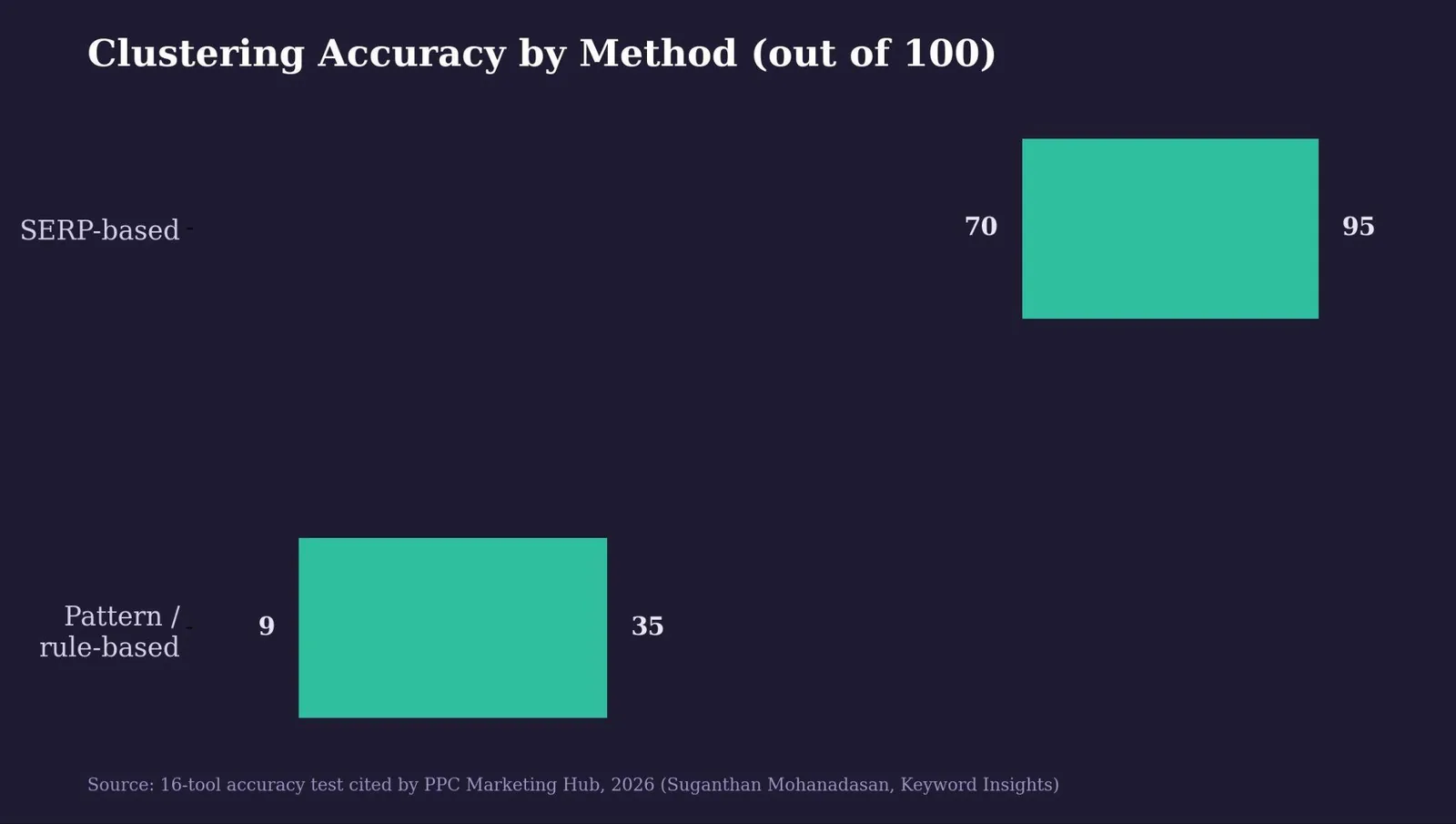
- SERP-based clustering tools score 70 to 95 out of 100 on accuracy, compared to just 9 to 35 out of 100 for pattern-matching or rule-based tools, according to a 2026 test of 16 clustering tools (a vendor-cited figure, worth verifying independently before treating as definitive).
- In Google Ads, one 2026 analysis found that keywords at Quality Score 1-3 can cost up to 400% more per click than the Quality Score 5 baseline, with Quality Score 10 unlocking up to a 50% CPC discount — a single analyst's figures rather than a Google-published benchmark, but directionally consistent with how Quality Score is known to affect Ad Rank.
- The recommended structure for a tightly themed ad group is 5 to 15 closely related keywords; anything broader tends to dilute ad relevance and hurt Quality Score.
- Free tools like Google Keyword Planner and basic spreadsheet logic can get a team started, but paid SERP-based and NLP-based tools scale far better past a few hundred keywords.
- A CSV export is the common handoff format between keyword research, grouping, and content planning tools, regardless of which platform does the clustering.
What is keyword grouping?
Keyword grouping is the process of organizing a keyword tool's raw output into clusters based on how closely related the terms are, whether by wording, meaning, search intent, or the actual search results Google returns for each term. Link-Assistant's guide to keyword clustering tools frames the concept as sitting between keyword research and content production in a typical workflow: research generates the raw ideas, a keyword grouping tool organizes them into logical sets, content mapping turns those sets into article outlines, and content creation produces one piece per group.
Done well, keyword grouping prevents keyword cannibalization, the problem of multiple pages on the same site competing for the same query, and it helps build the kind of topical depth search engines reward. Airefs' 2026 review of keyword grouping software puts it plainly: the strongest tools cluster long tail keywords by checking whether they share the same ranking pages rather than just similar wording, so variations of the same underlying question end up as one article instead of three. Done manually at scale, grouping is slow and error-prone, which is exactly why dedicated grouping tools exist.
The three keyword grouping methods
Not all clustering approaches work the same way, and the differences matter more than most guides admit. Manual or rule-based grouping sorts keywords by shared words or roots, "running shoes" keywords in one bucket, "yoga mats" keywords in another. It's fast and free but crude: it can't tell that "best CRM for small business" and "cheap CRM software" belong together even though they share no words.
Semantic or NLP-based clustering uses natural language processing to group keywords based on meaning and semantic similarity rather than exact wording, catching relationships that pure pattern-matching misses. SERP-based clustering goes a step further and compares the actual ranking URLs Google returns for each keyword. SEOcluster.ai's 2026 comparison of clustering tools puts a number on the threshold: if two keywords share roughly 40% or more of the same top-10 ranking URLs, most SERP-based tools treat them as one topic, because Google already treats them that way.
The accuracy gap between these approaches is significant, though it deserves a caveat. A test of 16 clustering tools, reported by PPC Marketing Hub and attributed to Keyword Insights' Suganthan Mohanadasan, found SERP-based methods scoring 70 to 95 out of 100 on accuracy, compared to just 9 to 35 out of 100 for pattern-matching or rule-based alternatives. That's a single, vendor-adjacent source rather than independently replicated research, so treat the exact numbers as directional.
Keyword grouping methods compared
| Method | How it works | Accuracy | Best for |
|---|---|---|---|
| Manual / rule-based | Groups by shared words or exact-match roots | Low (9-35/100) | Small keyword lists, quick first pass |
| Semantic / NLP-based | Groups by meaning using language models | Medium-high | Mid-size lists, catching synonym relationships |
| SERP-based | Groups by overlapping top-10 ranking URLs | High (70-95/100) | Competitive niches, content planning at scale |
Most experienced practitioners don't pick just one. Loopo's 2026 keyword clustering tools review recommends using SERP-based clustering to create keyword clusters for the core grouping, then applying AI to label intent and generate content briefs on top of that foundation, rather than relying on either method alone.
The keyword grouping workflow
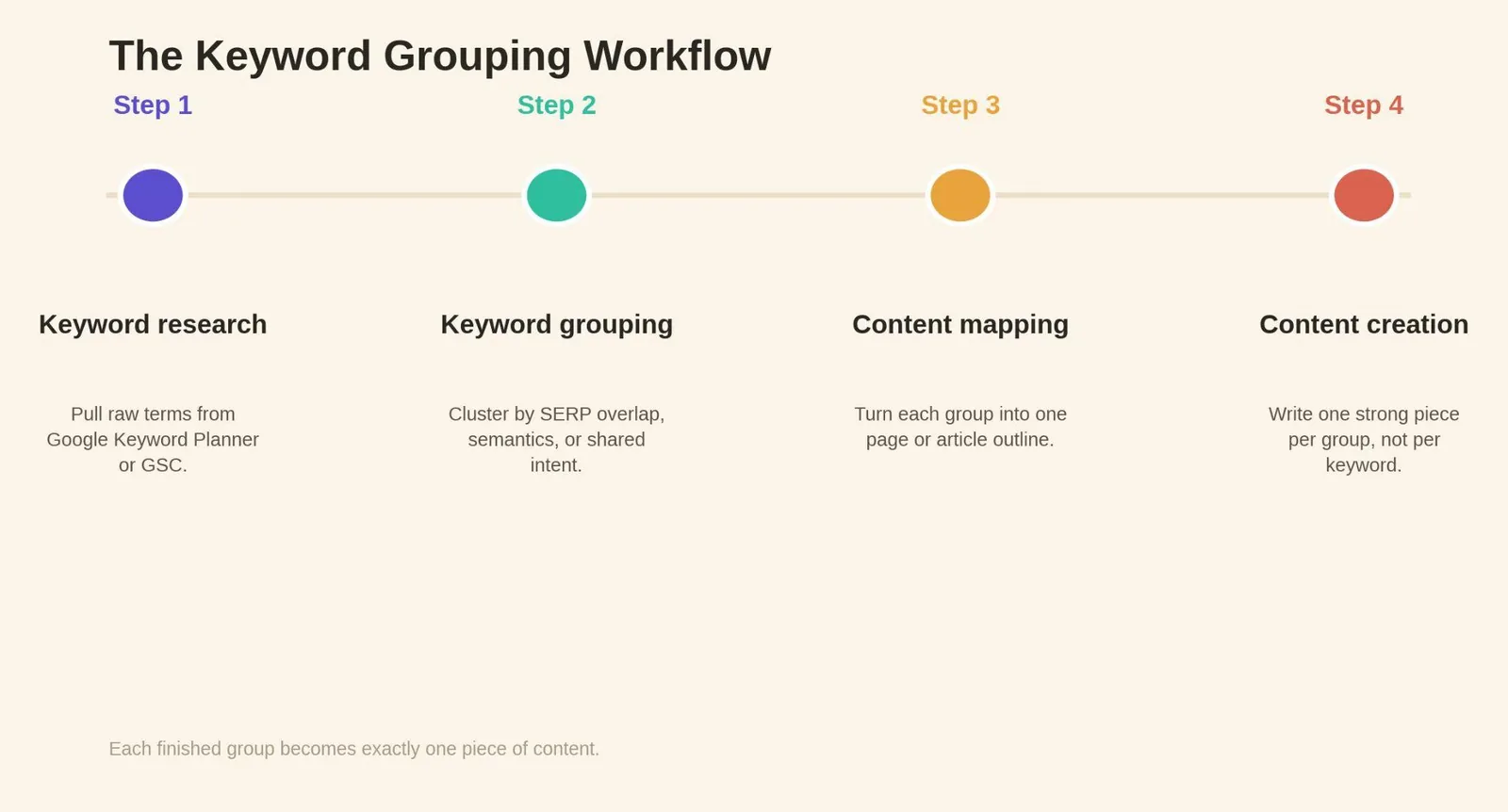
Step 1: Pull raw keyword data
Start with a full list of keyword ideas from Google Keyword Planner, Google Search Console (GSC), or a third-party research tool. Export it as a CSV so it can move cleanly between tools.
Step 2: Group by intent, not just wording
Two keywords can look similar and mean completely different things. "How to cluster keywords" is informational; "keyword clustering agency" is commercial. Grouping by search intent first, then refining by topic, avoids building a single page that tries to serve incompatible searchers at once. Whether the goal is to group keywords for a blog calendar or to create keyword groups for a PPC account, intent should be the first filter applied, not the last.
Step 3: Map each group to one piece of content
Once groups are set, each one becomes exactly one article, landing page, or ad group, never several competing pages, and never one page trying to cover unrelated groups at once. This mapping step is where the actual content strategy takes shape.
Try grouping a real list yourself: the tool below demonstrates simple pattern-based grouping so you can see the concept in action before choosing a dedicated keyword clustering tool.
Keyword grouping demo
Try a simple pattern-based grouper
Paste one keyword per line, then click group. This demo clusters by shared significant words, the same basic logic behind rule-based tools, so you can see the concept in action.
Your groups will appear here.
Note: this is a simplified pattern-matching demo for illustration. Real SEO work should validate clusters against live SERP data, since pattern-matching alone scores far lower on accuracy than SERP-based tools.
Step 4: Build and monitor the content or campaign
Write one strong piece of content per group, or build one tightly themed ad group per group in a PPC campaign. For SEO, track how the finished page performs across every keyword in its group inside Google Search Console, not just the primary target term.
Keyword grouping for PPC: why it moves Quality Score
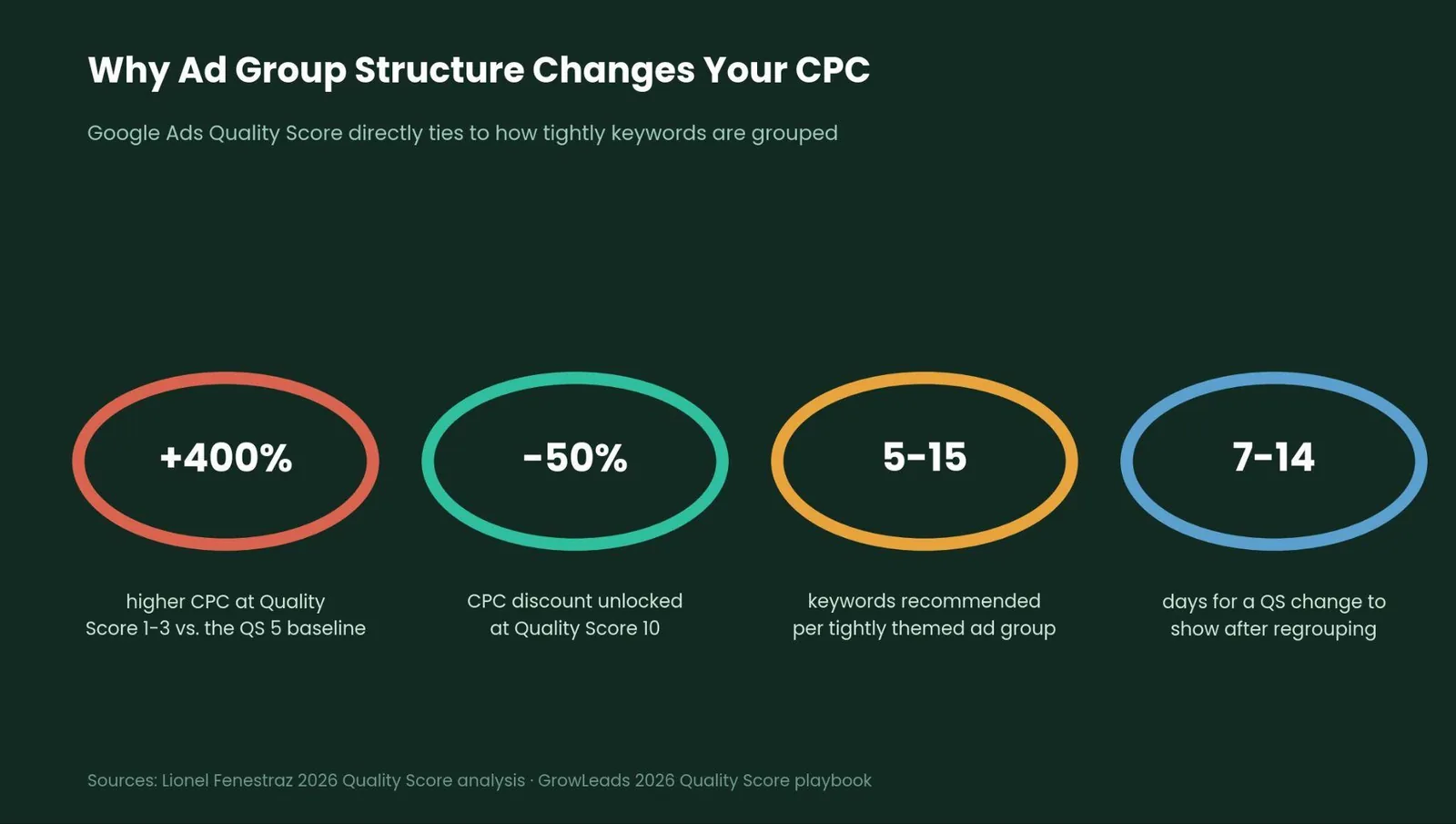
In Google Ads, keyword grouping isn't just a content-planning nicety, it directly determines cost. Google's Quality Score measures how well a keyword, its ad copy, and its landing page match each other, and ad group structure is one of the biggest levers behind it. Lionel Fenestraz's 2026 Quality Score analysis found that a keyword at Quality Score 1-3 can cost up to 400% more per click than the Quality Score 5 baseline, while a Quality Score 10 unlocks up to a 50% CPC discount on the exact same keyword and bid, figures from one analyst's account audits rather than an official Google-published table, but consistent with how Ad Rank is known to weight quality against bid.
Ryze AI's 2026 Google Ads keyword guide notes that the best accounts use tight thematic grouping with 5 to 15 closely related keywords per ad group, since poor organization leads to low Quality Scores, irrelevant ads, and management complexity that scales poorly as an account grows. When a Quality Score needs fixing, the work is usually structural rather than creative, per GrowLeads' 2026 Quality Score playbook: split any ad group with 15 or more loosely related keywords into narrower, single-theme groups, repeat the keyword in the ad headline, and make sure the landing page actually matches the intent behind the group. The same source notes that Quality Score reflects rolling 90-day performance data, so a regrouping change typically shows up in the displayed score within 7 to 14 days, with the full impact measurable after about 30 days, again, one practitioner's stated timeline rather than an official Google figure.
Common keyword grouping mistakes
Grouping by search volume instead of intent is one of the most common mistakes. High-volume and low-volume keywords can share the exact same intent and belong in the same group; volume is a prioritization signal, not a grouping signal.
Relying only on a free keyword grouping approach like basic pattern-matching for a large or competitive keyword list is a close second. It's fast, but the accuracy gap compared to SERP-based methods is wide enough that competitive content plans built this way often need to be reworked later.
Building one page per keyword instead of one page per group is a subtler mistake. It fragments authority across near-duplicate pages and creates exactly the cannibalization problem grouping is supposed to prevent.
And in PPC specifically, leaving broad, mixed-intent ad groups untouched after a Quality Score drop wastes the clearest, most actionable diagnostic Google provides for free.
Frequently asked questions
What's the difference between keyword grouping and keyword clustering?
Nothing substantial. The terms are used interchangeably across the industry; both describe organizing a keyword list into related sets by meaning, intent, or SERP overlap.
Do I need a paid tool, or can I group keywords manually?
Manual grouping works for small lists and is genuinely free. Past a few hundred keywords, or in a competitive niche, paid SERP-based or NLP-based tools save significant time and produce meaningfully more accurate groups, per the accuracy data above.
How does keyword grouping help implement a PPC strategy?
Keyword grouping helps by improving Ad Relevance, one of the three components Google uses to calculate Quality Score alongside Expected CTR and Landing Page Experience. Splitting broad, mixed-intent ad groups into narrower ones is one of the most reliable ways to lift a low Quality Score once you implement keyword grouping properly across an account.
Can Google Keyword Planner do keyword grouping on its own?
Google Keyword Planner is primarily a keyword discovery tool rather than a dedicated grouping tool. It's a solid free starting point for pulling keyword ideas and volume data, but most teams pair it with a separate keyword tool built specifically for clustering once the list needs organizing.
How often should keyword groups be revisited?
For stable niches, an annual review is usually sufficient. Any significant Google algorithm update that reshuffles rankings is worth an immediate re-check, since that often signals a shift in how Google itself is grouping search intents.
The bottom line on keyword grouping
Keyword grouping turns a messy list of search terms into an actual plan. Whether the goal is SEO content or a leaner Google Ads account, the underlying logic is the same: cluster by intent, not just wording, validate against real SERP data when the stakes are high enough, and make sure every group maps to exactly one page or ad group rather than several competing ones.
Pull a keyword list already sitting in a spreadsheet and run it through the grouping demo above. Seeing which terms cluster together, and which ones surprisingly don't, is usually enough to reveal where a content plan or ad account has been quietly fragmented.
Turning a keyword list into a working content plan
Grouping keywords correctly is only useful if it turns into content and campaigns that actually get built. Web Tonic's SEO and growth marketing team handles keyword research, clustering, and content production as one connected process, so a well-grouped keyword list doesn't just sit in a spreadsheet.
More from Web Tonic: growth marketing services, data & analytics.
Sources: link-assistant.com · getairefs.com · seocluster.ai · ppcmarketinghub.com · loopo.org · lionelz.com · get-ryze.ai · growleads.io