Table of contents
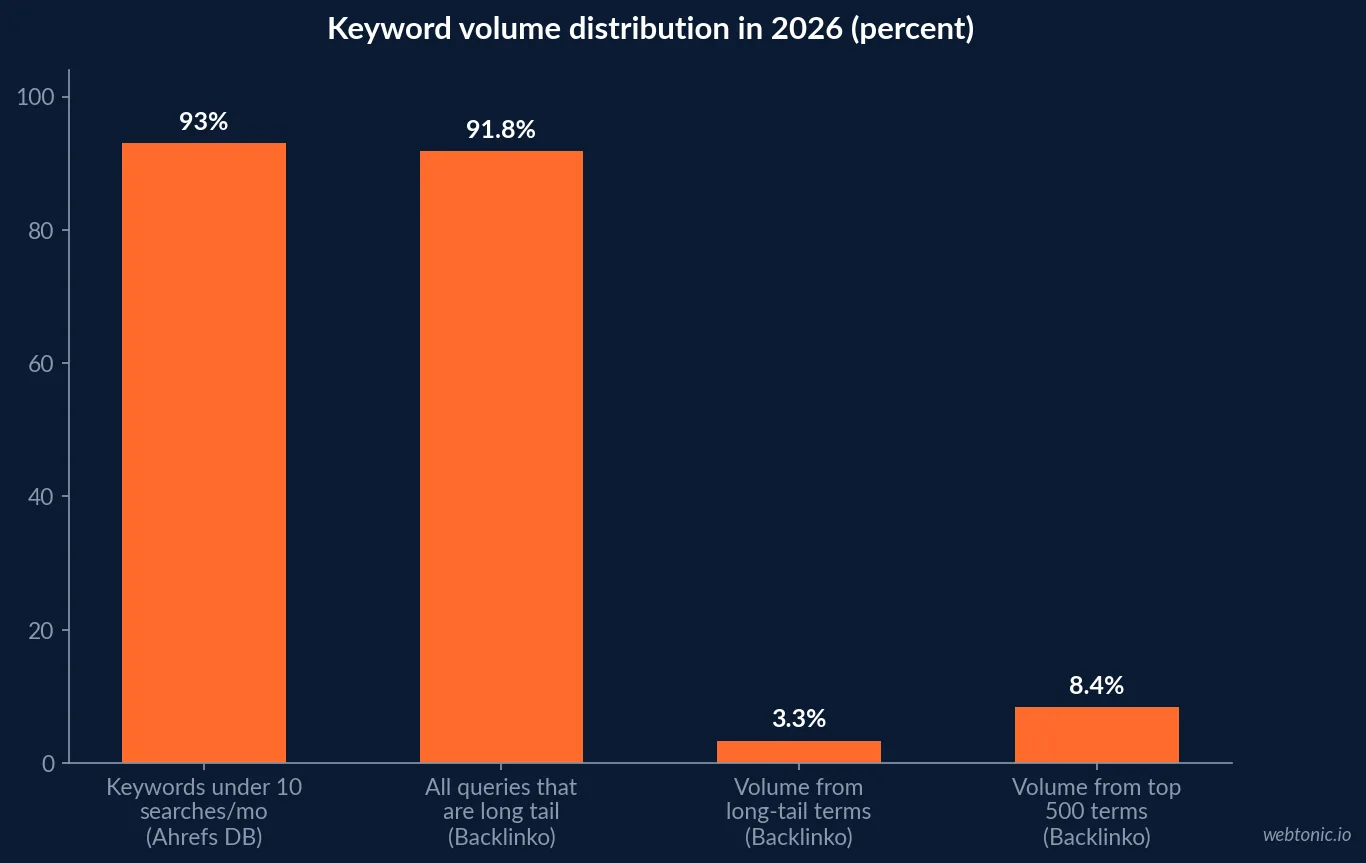
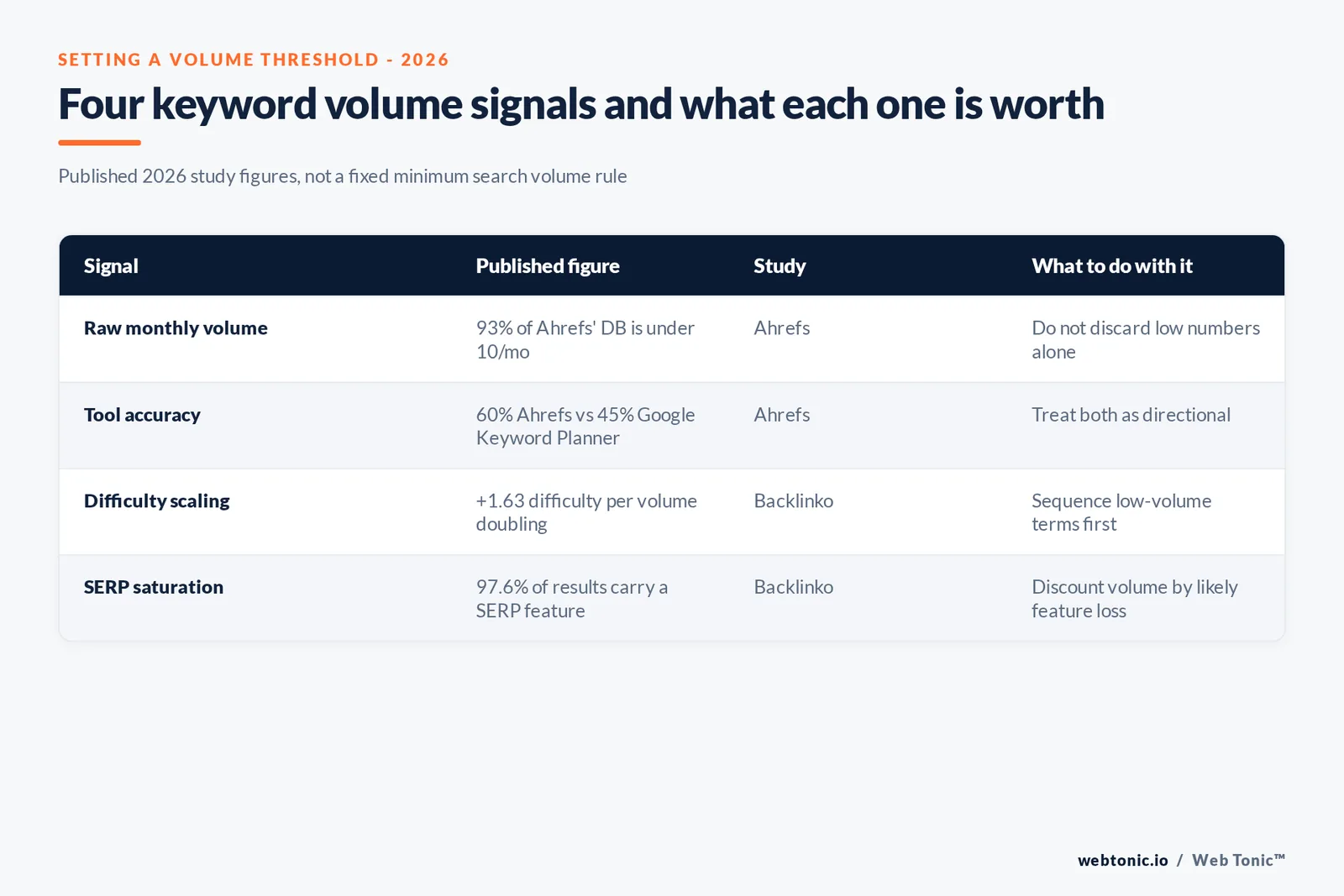
Almost 93% of Ahrefs' entire US keyword database shows fewer than 10 searches a month, and the terms with real volume are the minority, not the rule. This page uses the two largest published keyword-volume studies - Ahrefs' 72,635-keyword comparison against Google Search Console and Backlinko's 306-million-query analysis - to answer how much volume a keyword actually needs before it is worth the time.
Key Takeaways
- Almost 93% of keywords in Ahrefs' US database show under 10 monthly searches.
- 91.8% of all search queries are long tail, per Backlinko's study.
- Those long-tail terms carry only 3.3% of total search volume.
- The top 500 search terms make up 8.4% of all US search volume.
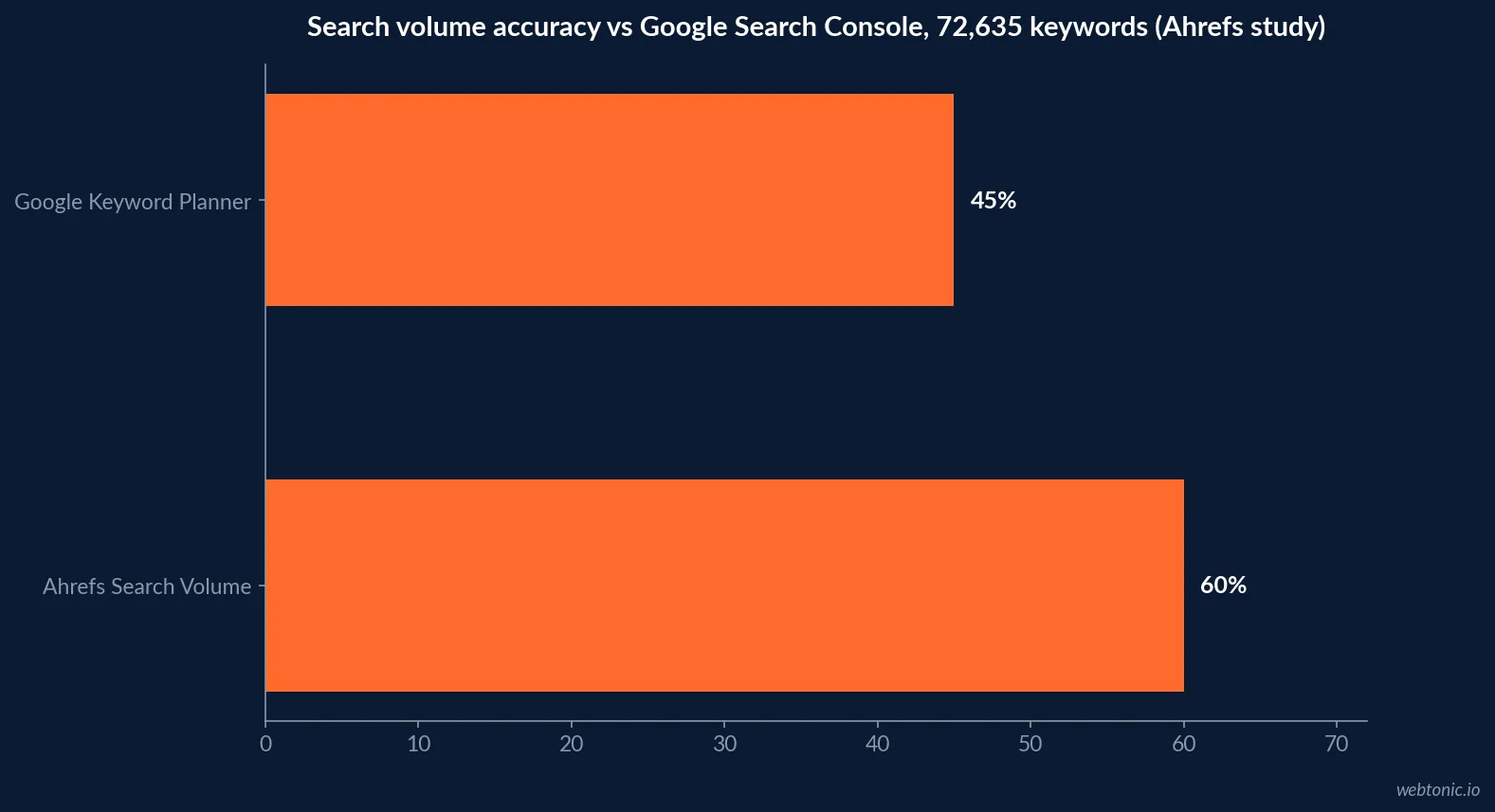
- Ahrefs' volume estimates were roughly accurate for 60% of 72,635 tested keywords.
- Google Keyword Planner matched only 45% over the same sample.
- Roughly 15% of daily Google searches have never been searched before.
- Keyword difficulty rises about 1.63 points every time volume doubles.
- 97.6% of Google results carry at least one SERP feature.
- Only 2.4% of results show no SERP feature at all.
- Semrush Sensor found just 1.16% of first-page results feature-free in March 2026.
- AI Overviews are now among the most common SERP features on informational queries.
- Ahrefs treats search volume as "directionally accurate," never exact.
- Zero-volume labels do not always mean zero real search demand.
What "enough" volume actually looks like in the data
Start with the distribution, not a rule of thumb. Ahrefs reports that keywords with fewer than 10 monthly searches make up almost 93% of its entire US keyword database. Backlinko's analysis of 306 million keywords found 91.8% of all queries are long tail, yet those same long-tail terms carry only 3.3% of total search volume - because search demand concentrates hard at the top: the top 500 most popular terms alone account for 8.4% of all US search volume.
Read together, this says most of the keywords in any niche will show a volume number that looks too small to matter, while a handful of terms carry a disproportionate share of the traffic opportunity. Neither fact should be read alone.
| Distribution fact (published study) | Figure | Study | What it implies |
|---|---|---|---|
| Share of Ahrefs' US database under 10 searches/mo | ~93% | Ahrefs | Most terms look tiny alone |
| Share of all queries that are long tail | 91.8% | Backlinko, 306M keywords | Long tail is the norm |
| Share of total volume from long-tail terms | 3.3% | Backlinko | Volume concentrates elsewhere |
| Share of US volume from the top 500 terms | 8.4% | Backlinko | A few terms carry outsized share |
| Share of daily searches never seen before | ~15% | Google, via Ahrefs | Some demand is unmeasurable |
How accurate the volume number actually is
Before deciding a keyword's volume is "enough," it helps to know how much to trust the number. Ahrefs compared its own Search Volume estimates against real Google Search Console impressions across 72,635 keywords in the 1K-to-10K volume range. Ahrefs matched 60% of cases as roughly accurate; Google Keyword Planner, tested on the same sample, matched only 45%.
Neither tool claims precision. Ahrefs has published a piece stating plainly that there is no such thing as an accurate search volume - the numbers are designed to be directionally useful, telling you which of two keywords has more demand, not the exact count of searches either one gets.
| Tool tested (Ahrefs' 72,635-keyword study) | Roughly accurate vs GSC impressions | Sample | Source |
|---|---|---|---|
| Ahrefs Search Volume | 60% of cases | 72,635 keywords, 1K-10K range | Ahrefs |
| Google Keyword Planner | 45% of cases | Same 72,635-keyword sample | Ahrefs |
Why zero-volume keywords are not always zero-demand keywords
Google itself has stated that roughly 15% of the searches it sees every day have never been searched before - a figure it has repeated consistently since 2013 and reconfirmed as recently as 2025, in the context of AI search. Every keyword tool builds its volume estimate from historical click and impression samples, so a query with no search history cannot be assigned a volume - it shows as zero, or as a dash, even when a real person is about to type it.
That is a measurement gap, not proof the term has no demand. It is also the practical reason a content plan built purely on a tool's reported volume column will systematically miss the newest, often least competitive, share of search demand.
How volume relates to how hard a keyword is to rank for
Backlinko's 306-million-keyword analysis found a close-to-linear relationship on a doubling scale: each time search volume doubles, keyword difficulty rises by about 1.63 points. That is a meaningful, if unsurprising, confirmation - the highest-volume term in a topic cluster is reliably also the hardest one to compete for, because everyone else ran the same volume report and reached the same conclusion.
The practical use of this figure is sequencing, not avoidance. A page targeting a lower-volume, lower-difficulty term inside the same cluster earns the topical relevance that eventually helps the higher-volume, higher-difficulty term rank too.
| Search volume relationship | Published figure | Source | Practical read |
|---|---|---|---|
| Difficulty increase per volume doubling | +1.63 points | Backlinko, 306M keywords | High volume = high competition |
| Share of results with a SERP feature | 97.6% | Backlinko | Rank 1 rarely gets the first click |
| Results with zero SERP features (Mar 2026) | 1.16% | Semrush Sensor via Backlinko | Feature-free SERPs are rare |
| Share of daily queries with no search history | ~15% | Volume tools miss new demand |
Why the SERP itself changes what "enough" volume means
A high volume number matters less when the page has to compete with more than organic results for the click. Backlinko's study found 97.6% of Google results carry at least one SERP feature, and by March 2026 Semrush Sensor data showed only 1.16% of first-page results were feature-free. AI-generated overview panels are now among the most common features on informational queries specifically - the exact query type most keyword research targets.
That means a keyword's raw volume number increasingly overstates the traffic a ranking page will actually receive, because a growing share of that volume is answered on the results page itself before anyone reaches a website.
The volume number also has to survive zero-click search
SparkToro's clickstream research, run on Similarweb's mobile and desktop panel, found that 68.01% of Google searches in the first four months of 2026 ended without a click - up from 60.45% in 2024 and 49% when SparkToro first published this research in 2019. AI Overviews, now present on more than 20% of all searches, are named as the main driver, reducing click-through by nearly 60% when they appear.
A keyword's raw volume number was never a promise of traffic, but the gap between "searched" and "clicked" has widened enough in six years that a volume figure on its own now overstates the realistic traffic opportunity by roughly two to one.
| Zero-click search rate (SparkToro / Similarweb) | Year | Change |
|---|---|---|
| 49% | 2019 | First published figure |
| 60.45% | 2024 | +11.45 points vs 2019 |
| 68.01% | Jan-Apr 2026 | +7.56 points vs 2024 |
| 20%+ | 2026 | Share of searches showing an AI Overview |
A practical volume threshold, stated plainly
None of the studies above set a universal minimum, because none exists in the published data. What they support is a threshold that moves with intent: a handful of monthly searches on a high-intent, low-competition term inside a topic your site already has authority on is frequently worth more than a few hundred searches on a term buried under an AI Overview, a People Also Ask box and two more SERP features.
Our growth marketing team builds topic clusters this way - sequencing lower-volume, high-intent pages first, then targeting the shared high-volume term once the cluster has earned enough topical relevance to compete for it.
Where this connects to paid search planning
The same volume data that shapes organic content planning also sets expectations for paid search budgets on the same terms - a keyword too thin for an organic content plan is often too thin for a profitable Google Ads campaign as well. See our guide to building a Google Ads strategy and our breakdown of what Google Ads costs for how volume and competition interact once money is on the term, not just a content brief.
How to apply this without a keyword tool subscription
Treat every volume number as a rank, not a count. Group keywords by relative volume within a topic, prioritize the lowest-competition high-intent terms first, and expect roughly one in three to five of the numbers a free tool shows you to be meaningfully off from what Search Console will eventually report once the page is live and indexed.
If the goal is a keyword plan matched to what your site can realistically rank for this quarter, talk to us about how our data and analytics practice reconciles tool-reported volume against your own Search Console history.
Frequently Asked Questions
How much search volume does a keyword need to be worth targeting?
There is no fixed floor in the published data, and that is itself the finding. **Almost 93% of Ahrefs' entire US keyword database shows fewer than 10 searches a month**, and Backlinko's 306-million-query study found **91.8% of all queries are long tail**, yet those long-tail terms carry only **3.3% of total search volume**. Most of the demand you can plan around sits in a small share of high-volume terms, but most of the terms themselves show almost no volume at all.
Can I trust the search volume number a keyword tool shows me?
Treat it as directional, not exact. Ahrefs' own comparison against Google Search Console impressions across **72,635 keywords** found its estimates were roughly accurate for **60%** of terms, against **45%** for Google Keyword Planner over the same sample. Both tools are estimates built from sampled click data, and Ahrefs itself has published that there is **no such thing as a fully accurate search volume**, only a directionally useful one.
Why do so many keywords show zero or near-zero volume?
Because most searches are unique. Google has stated that roughly **15% of the queries it sees every day have never been searched before**, and tools that rely on historical click samples cannot assign volume to a query with no history. A zero-volume label in a tool usually means unmeasured, not unsearched - Ahrefs' own testing found some zero-volume keywords still drove real impressions once published.
Does higher search volume mean the keyword is harder to rank for?
Generally, yes, and the relationship is close to linear on a doubling scale. Backlinko's study of 306 million keywords found that **each time search volume doubles, keyword difficulty rises by about 1.63 points**. That means the highest-volume terms in a niche are reliably the most contested ones, which is the practical argument for building topical authority from lower-volume terms first.
Should a content plan chase volume or chase intent?
Chase intent, and let volume set expectations rather than the target itself. With **97.6% of Google results now carrying at least one SERP feature**, per Backlinko, and AI-generated overviews among the most common features on informational queries, a page built for a mid-volume, high-intent term can out-convert one built for a high-volume term buried under three SERP features before the first organic result.
Sources
Ahrefs - Long-tail keywords: what they are and how to get traffic from them
Ahrefs - How accurate is keyword search volume in Ahrefs
Ahrefs - There's no such thing as accurate search volume
Backlinko - We analyzed 306M keywords: what we learned about Google searches
Backlinko - SERP features: what they are and why they matter
SparkToro - In 2026, less than one third of Google searches still send a click
Google - Understanding searches better than ever before
Search Engine Journal - Google revisits the 15% unseen queries statistic