Table of contents

Most content teams still approach SEO one article at a time. Someone finds a promising keyword, writes a post, publishes it, then moves on to the next idea. It works, for a while. Six months later, three different blog posts are all trying to rank for a version of the same search query, none of them are winning, and nobody remembers why the site is organized the way it is.
Keyword mapping is the fix. It turns a scattered list of keywords into a structured content strategy that tells every page on your website exactly what it should rank for, and why. This guide keyword mapping teams can return to every quarter walks through what a keyword map actually is, how to build one from scratch, and how to keep it useful long after launch day.
Key Takeaways
- Keyword mapping is the process of assigning a primary keyword and a cluster of secondary keywords to a single page, so every URL on your site targets one clear search intent instead of competing with your own content.
- A well-maintained keyword map is the single most effective way to avoid keyword cannibalization, the situation where two or more pages fight each other for the same ranking spot.
- One documented case study found that a coordinated keyword mapping process helped a B2B company grow its top-10 Google rankings by 207 percent over a three-year SEO program.
- Every keyword map should sort terms by search intent (informational, commercial, transactional, or navigational) before it sorts them by search volume or keyword difficulty.
- Free tools like Google Sheets, Google Drive, and Google Search Console can build a fully functional keyword map. Paid platforms like Ahrefs (from $29 USD/month) and Semrush (from $139.95 USD/month) add automation and competitive data on top.
- A keyword map is a living document. It should be updated every time you publish new content, refresh an old page, or notice a ranking drop.
What Is Keyword Mapping?
Keyword mapping is an SEO technique that assigns a focus keyword, along with a set of related secondary keywords, to a specific page on your site, then tracks that decision in a shared document. Semrush's definition frames the goal simply: match each keyword with the page and URL best equipped to satisfy the search intent behind it. Some teams call this mapping keyword work; others just call it a keyword map. Same process either way.
Keyword mapping gets confused with keyword research often enough that it's worth separating the two outright. Keyword research answers "what are people searching for?" Keyword mapping answers "which page on my site should own this search term?" You need the first answer before you can give the second one.
A useful way to picture it, borrowed from Bottle Digital PR's framing, is a floor plan. Every room, or page, has a defined purpose, and every hallway, or internal link, guides the visitor exactly where they need to go next. Skip the plan, and visitors and search engine crawlers alike end up wandering.
Why Keyword Mapping Matters
Skipping a keyword map doesn't just cost you tidiness. It shapes how many keywords your site can realistically rank for, how search engines interpret your site structure, and how efficiently your internal linking distributes authority across pages.
The benefits keyword mapping delivers show up in real numbers, not just cleaner spreadsheets. The financial marketing agency Pamann Marketing documented a case involving a B2B specialty insurance provider whose number of top-10 Google positions increased 207 percent after the agency implemented keyword mapping SEO practices as a core part of a three-year program.
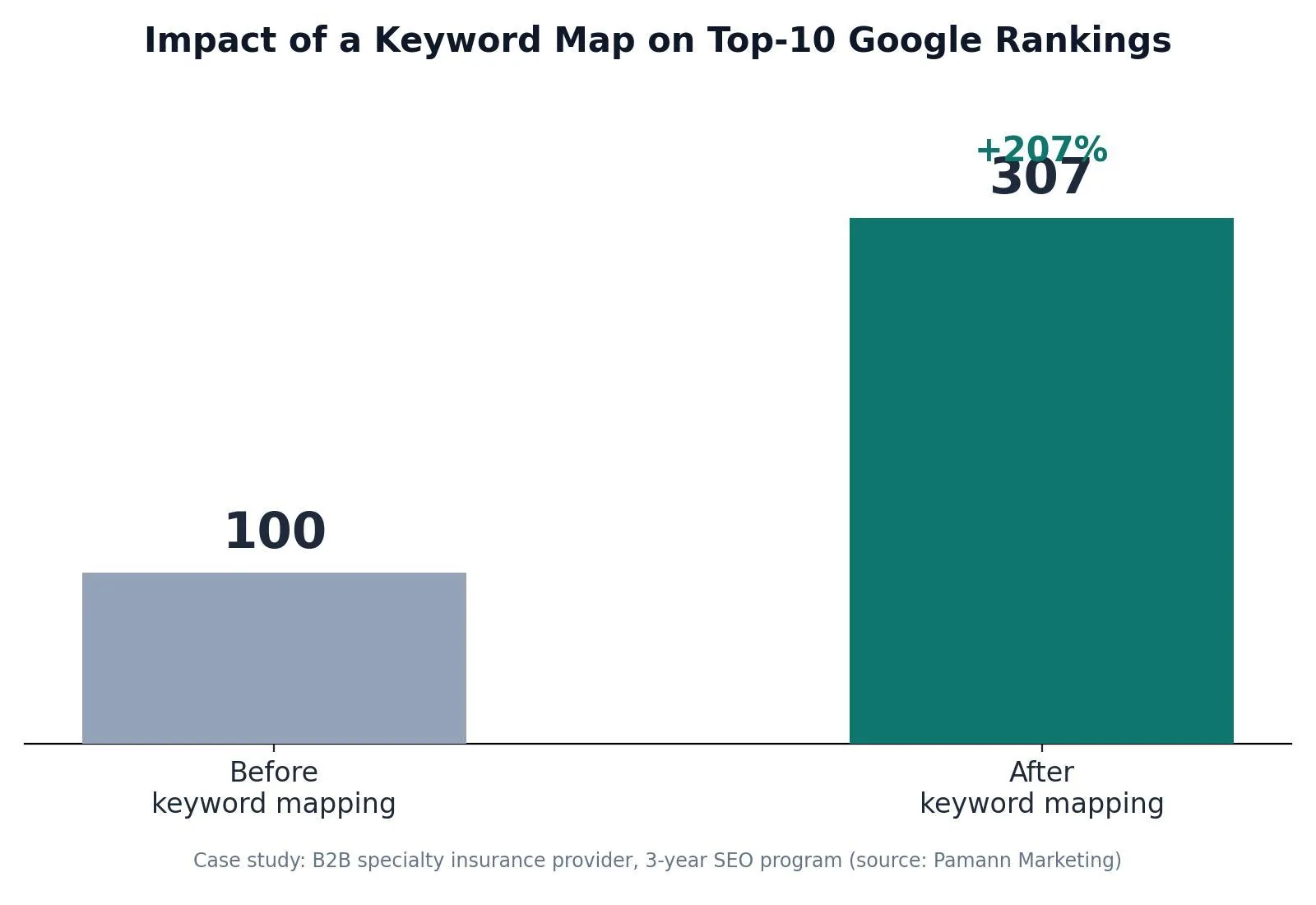
That kind of lift rarely comes from one trick. It comes from removing the internal competition that happens when nobody has assigned clear ownership of a topic to a single page, combined with making sure every page is actually built to answer the query it's trying to rank for.
Search Intent: The Foundation of a Good Keyword Map
Before you sort a single keyword into a spreadsheet column, figure out what the searcher actually wants. This is search intent, and it's the filter that decides whether a keyword belongs on a blog post, a service page, or a pricing page. Running a search intent keyword check on every row before you publish catches most mismatches early.
Four types of intent come up in nearly every framework. Someone typing "what is keyword mapping" wants to learn something, full stop, so that kind of informational intent maps to blog posts and guides. Compare that with someone searching "best keyword mapping tools," who's already decided they need help and is now weighing options: that's commercial investigation, and it belongs on comparison pages and reviews. A search like "SEO agency Montreal" reads differently again. The person is ready to buy or hire right now, which makes it transactional intent, and it belongs on a product or service page, not a blog post. Then there's the searcher who already knows exactly who you are and just wants to find you, typing something like "Web Tonic SEO." That's navigational intent, and it should land on your homepage or the specific branded page they're after.
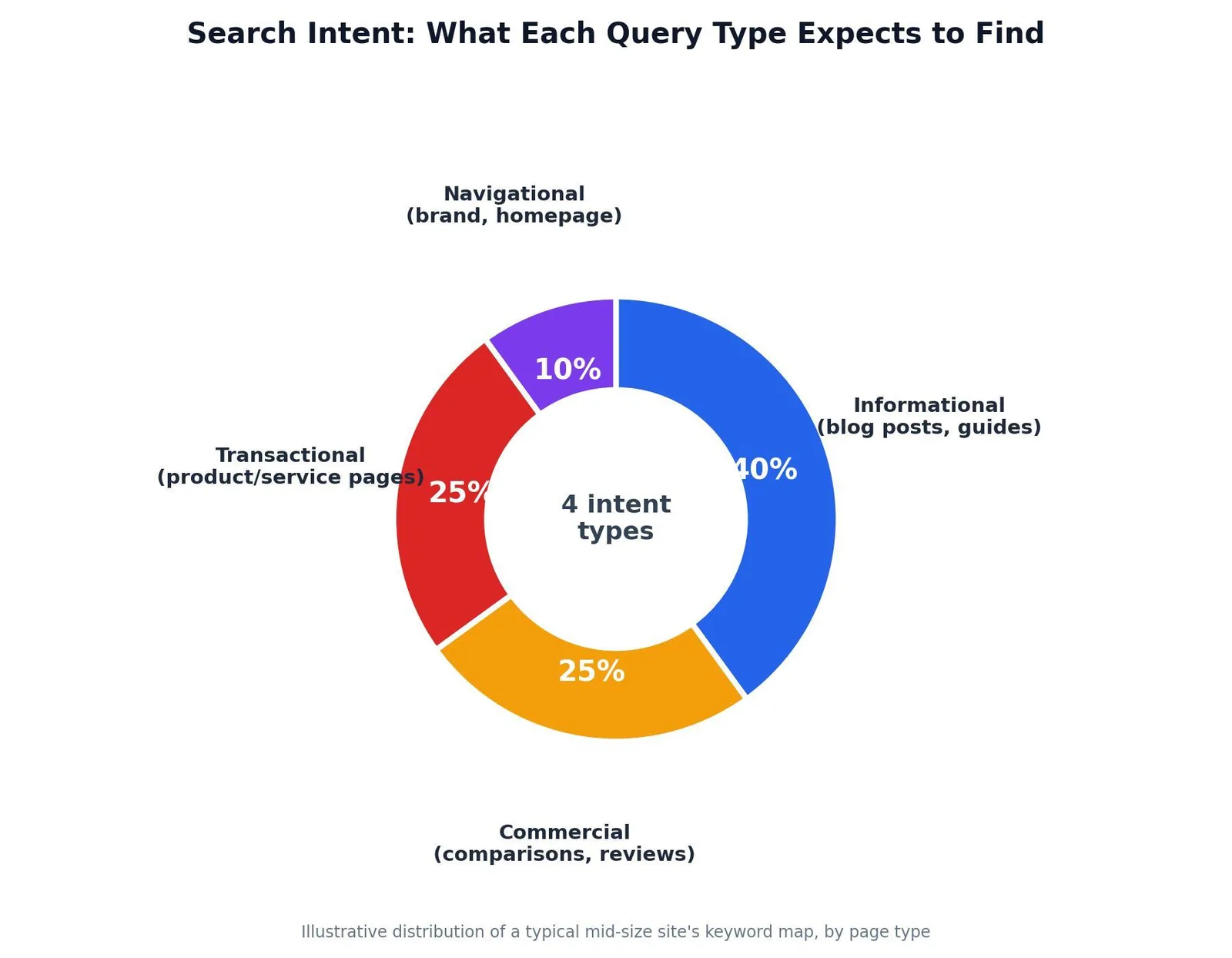
Getting this wrong creates a mismatch that no amount of on-page optimization can fix. As Bottle Digital PR puts it, mapping a transactional keyword to a long educational article is a bit like showing up to the beach in a tuxedo. Technically possible, completely wrong for the moment.
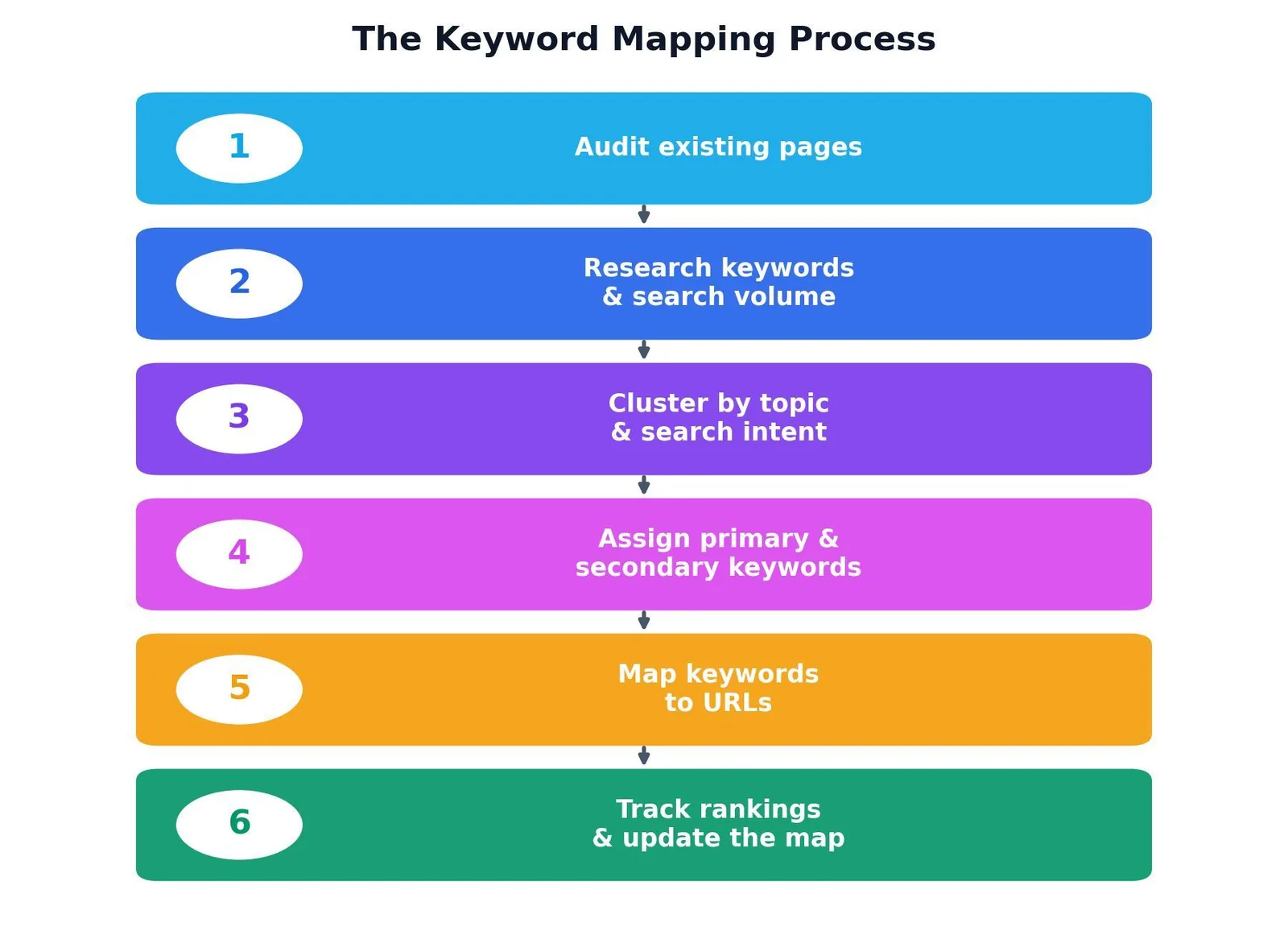
How to Create a Keyword Map: The 6-Step Process
Keyword mapping tool
Which page should this keyword target?
Type your keyword, pick what the searcher is really after, and get a page-type recommendation you can drop straight into your keyword map.
Recommended page type
Step 1: Audit your existing pages
Before assigning a single new keyword, list every page currently live on your site. Note the URL, the current title tag, and, if the page already ranks for something, what that term is. A page that already ranks on page two for a close variant of your target term is often a faster win than starting from zero. This audit becomes the backbone of your keyword map spreadsheet, and it tends to surface internal linking opportunities between pages that were never connected before.
Step 2: Research keywords and search volume
Build out your keyword list using a seed keyword for each core topic, then expand it with tools like Google Keyword Planner, Ahrefs, or Semrush. For each term, pull the search volume keyword data alongside an estimate of keyword difficulty, since both numbers guide the prioritization you'll do later.
Step 3: Cluster keywords by topic and intent
Group your full keyword list into clusters built around a shared topic and a shared search intent. Backlinko's team notes that they use keyword mapping specifically to avoid cannibalization and to keep a strong internal link network across their content library. This is also the best moment to find internal linking opportunities between cluster pages that share a common pillar.
Step 4: Assign primary and secondary keywords
Every cluster needs one primary keyword, the main term the page is built to win, plus a short list of secondary keywords: close variations and related phrases that reinforce the same topic without diluting it.
Step 3: Cluster keywords by topic and intent
Group your full keyword list into clusters built around a shared topic and a shared search intent. Backlinko's team notes that they use keyword mapping specifically to avoid cannibalization and to keep a strong internal link network across their content library. This is also the best moment to find internal linking opportunities between cluster pages that share a common pillar.
Step 4: Assign primary and secondary keywords
Every cluster needs one primary keyword, the main term the page is built to win, plus a short list of secondary keywords: close variations and related phrases that reinforce the same topic without diluting it.
Step 5: Map keywords to URLs
This is the step that gives the exercise its name. Each cluster gets assigned to an existing URL, or flagged as a content gap that needs a new page. Flow Agency's guide recommends a simple spreadsheet with one column for the keyword cluster, one for the primary keyword, one for secondary keywords, and one for the assigned URL.
Step 6: Track rankings and update the map
A keyword map isn't a one-time deliverable. Set a recurring reminder to update keyword map rows on a fixed schedule (quarterly works for most sites), and revisit the sheet the moment you refresh a page, publish new content, or notice a ranking shift.
Keyword Mapping and Site Structure
Finish a keyword map and a site structure falls out of it almost automatically, usually shaped like a pillar-and-cluster model. One comprehensive pillar page owns the broad, high-volume primary keyword, while several supporting cluster pages each target a narrower secondary keyword, all linked back to the pillar and to each other.
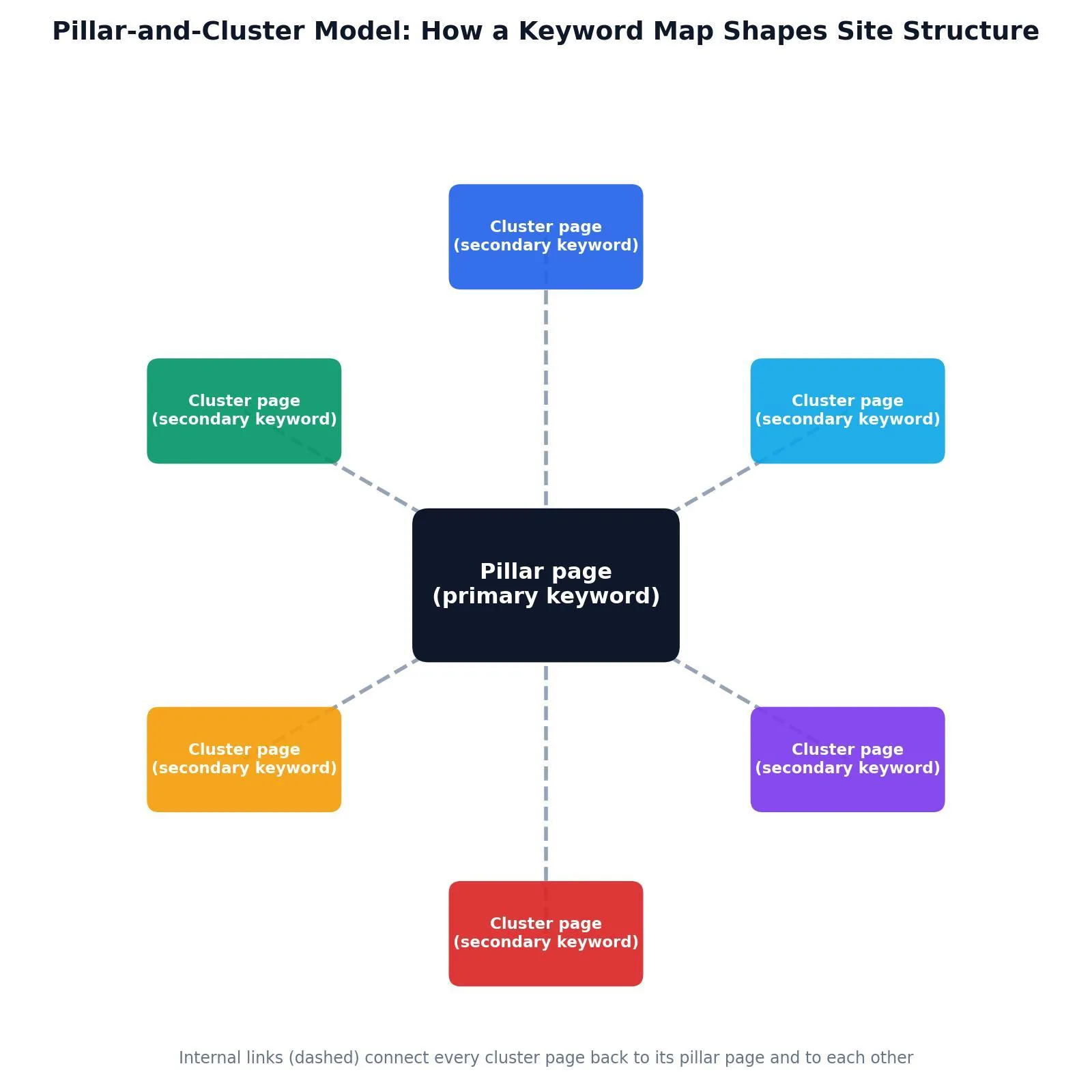
That structure is what makes internal linking genuinely useful instead of arbitrary. Every link between a cluster page and its pillar page tells Google which page is the authority on the broader topic, while giving users a keyword rich anchor to click through on. The American Marketing Association's keyword map framework ties this structure directly to funnel stage, matching awareness-stage content to top-of-funnel pages and decision-stage keywords to bottom-of-funnel pages.
How to Avoid Keyword Cannibalization
Keyword cannibalization happens when two or more pages on the same site target the same keyword, forcing Google to guess which one is actually the best answer. It's one of the most common problems a keyword mapping exercise uncovers, and one of the easiest to fix once it's visible.
Three fixes work in most situations. Start by auditing your existing content against your keyword map to confirm no two pages share a primary keyword. If two pages are close in topic without directly overlapping, sharpen each one with a more specific angle rather than letting them compete. And if two pages are both weak and both chasing the same term, merging them into a single, stronger page usually beats maintaining both.
Building Your Keyword Mapping Template
You don't need specialized software to start. A shared spreadsheet in Google Sheets, stored in Google Drive so your whole team can access and edit it, covers the basics. At minimum, your keyword mapping template should include the target topic or cluster name, the primary keyword and its monthly search volume, the list of secondary keywords, the assigned or planned URL, current page status (live, needs optimization, or to create), and the page's current ranking position, which you can pull directly from Google Search Console.
Tools for Keyword Mapping Compared
| Tool | Best For | Starting Price (USD) | Pros | Cons |
|---|---|---|---|---|
| Google Sheets + Google Drive | Small sites, solo marketers, agencies on a budget | Free | No cost, fully customizable, easy to share with a team | No built-in ranking or volume data, manual updates |
| Google Search Console | Tracking which keywords a page already ranks for | Free | Direct-from-Google ranking and click data, no cost | Historical data limited to 16 months, no keyword research features |
| Ahrefs | Backlink-heavy strategies and keyword difficulty scoring | From $29/month (Starter plan) | Deep keyword and competitor data, fast-updating index | Steep price jump between entry tiers, limited projects on lower plans |
| Semrush | Agencies managing content plans across many client sites | From $139.95/month (Pro plan) | Built-in content templates, historical data on higher tiers | Higher entry price than Ahrefs Starter, add-ons increase cost quickly |
Automating parts of this process saves real time once your site grows past a handful of pages. Semrush notes that its AI-driven keyword tools can streamline mapping at scale, which matters most for teams producing content weekly rather than quarterly.
Common Keyword Mapping Mistakes to Avoid
A keyword map that never gets revisited becomes outdated the moment your site changes, and an outdated map actively misleads whoever's using it next.
Mapping one keyword per page too literally is another common trap. Modern SEO practice favors comprehensive pages that cover a topic with multiple related keyword variations over single-keyword pages stuffed with one phrase.
Chasing search volume while ignoring search intent tends to backfire too. A high-volume keyword that doesn't match what your page actually delivers won't convert, no matter how well it ranks.
And splitting pages and blog posts into separate keyword lists without cross-checking them invites the exact overlap keyword mapping is supposed to prevent. Pamann Marketing recommends keeping high-intent page keywords and lower-intent blog keywords in clearly separated trackers specifically to avoid this.
Frequently Asked Questions
What's the difference between keyword mapping and keyword research?
Keyword research identifies what people are searching for. Keyword mapping decides which page on your website should target each of those terms as part of your broader strategy. Research comes first, mapping comes second.
How often should I update my keyword map?
Most teams review their map quarterly, then update individual rows immediately after publishing new content, refreshing an old page, or noticing a ranking change in Google Search Console.
Can one page target more than one keyword?
Yes, and it should. A page needs one clear primary keyword plus several secondary keywords that reinforce the same topic. What it shouldn't do is compete with another page on your own site for that same primary term.
Do I need paid tools to build a keyword map?
No. Google Sheets paired with Google Search Console covers the essentials for free. Paid tools like Ahrefs or Semrush add speed and competitive data, which becomes more valuable as your site and content library grow.
Ready to Turn Your Site Structure Into a Ranking Advantage?
Building and maintaining a keyword map across dozens or hundreds of pages is exactly the kind of work that stalls without a dedicated process behind it. Web Tonic's growth marketing team handles the technical SEO, on-site structure, and content work this guide walks through as part of a full-funnel approach that also connects it to paid acquisition and attribution, so your internal linking and page targeting stay coordinated instead of drifting apart as your site grows.
More from Web Tonic: growth marketing services, data & analytics.
Sources: semrush.com · wearebottle.com · pamannmarketing.com · backlinko.com · flow-agency.com · ama.org