Table of contents
The platform is Google's own advertising marketplace: you bid for ad placements across Google Search, YouTube, Gmail, Maps, Discover and millions of partner sites, and you normally pay only when someone clicks. It is an auction, not a rate card, so what you pay depends on your competitors and your ad quality.
Key Takeaways
- Google handled 91.27% of worldwide search referrals in June 2026, ahead of Bing at 4.66% — which is why paid search and this one platform are often treated as the same thing.
- Whether your ad appears is decided by Ad Rank, a combination of your bid, ad quality, thresholds, context and expected impact of ad assets — not by budget alone.
- Across 23 industries, the 2026 average search ad costs $5.42 per click, converts at 8.18% and produces a lead for $66.69.
- There are roughly eight campaign types; choosing the wrong one is the most common and most expensive beginner mistake.
- None of it works without conversion tracking in place. Without it you are optimising toward clicks, which nobody buys.
What the platform is — and what it is not
Google Ads (renamed from Google AdWords in 2018) is a self-serve auction platform where advertisers build campaigns, choose targeting and bid for placement across Google's own properties and its partner network. Google's own introductory guide to Google Ads is the canonical starting point. Most confusion comes from mixing it up with the adjacent products in the same account ecosystem.
| Product | What it does | Do you pay? | Relationship to the platform |
|---|---|---|---|
| Google Ads | Buys placements across Google surfaces | Yes, per click or per impression | The marketplace itself |
| Google Analytics | Measures site and app behaviour | Free tier | Linked for conversion and audience data |
| Google Search Console | Reports organic search performance | Free | Separate; organic, not paid |
| Google Business Profile | Manages your local listing and Maps presence | Free | Feeds location assets into campaigns |
| Google Merchant Center | Hosts your product feed | Free | Required for Shopping and retail PMax |
| Google AdSense | Sells space on your own site | You get paid | The publisher side of the same market |
| Google Ads API | Programmatic account management | Free to use | For agencies and large advertisers |
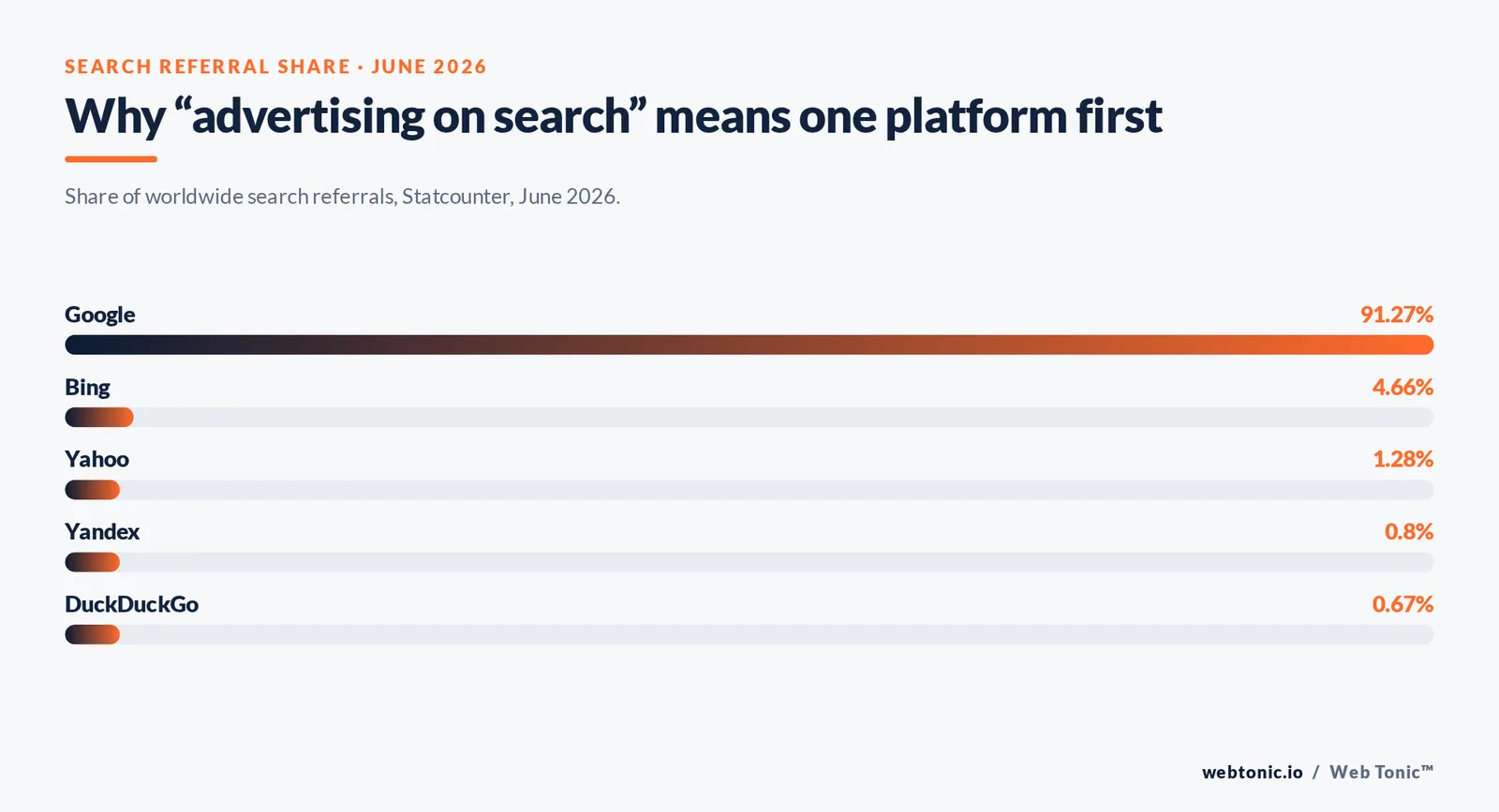
The scale explains the attention. Statcounter's June 2026 data puts Google at 91.27% of search referrals worldwide, with Bing on 4.66%, Yahoo 1.28%, Yandex 0.80% and DuckDuckGo 0.67%. For most businesses, "advertising on search" means Google Ads first and everything else second.
How the auction works, in four steps
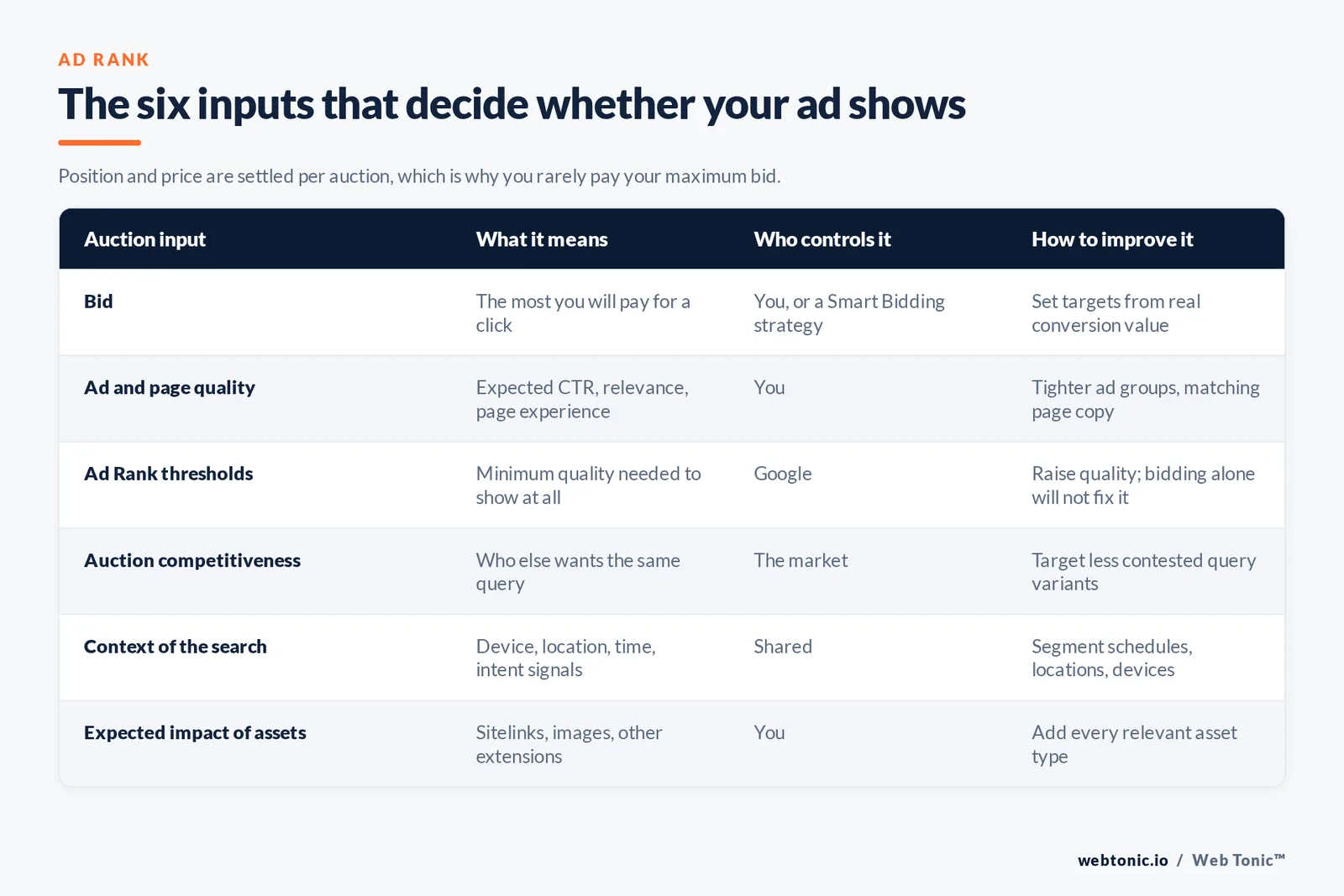
Every time someone searches, Google runs an auction among eligible ads. Step 1: Google identifies which ads match the query and the targeting. Step 2: each ad's Ad Rank is calculated. Step 3: ads below the relevant thresholds are filtered out. Step 4: the remaining ads are ordered, and each advertiser pays the minimum required to hold its position — which is why you rarely pay your maximum bid.
| Auction input | What it means | Who controls it | How to improve it |
|---|---|---|---|
| Bid | The most you will pay for a click | You, or a Smart Bidding strategy | Set targets from real conversion value |
| Ad and landing page quality | Expected CTR, relevance, page experience | You | Tighter ad groups, matching page copy |
| Ad Rank thresholds | Minimum quality to show at all | Raise quality; bidding alone will not fix it | |
| Auction competitiveness | Who else wants the same query | The market | Target less contested query variants |
| Context of the search | Device, location, time, intent signals | Shared | Segment schedules, locations, devices |
| Expected impact of assets | Sitelinks, images, other extensions | You | Add every relevant asset type |
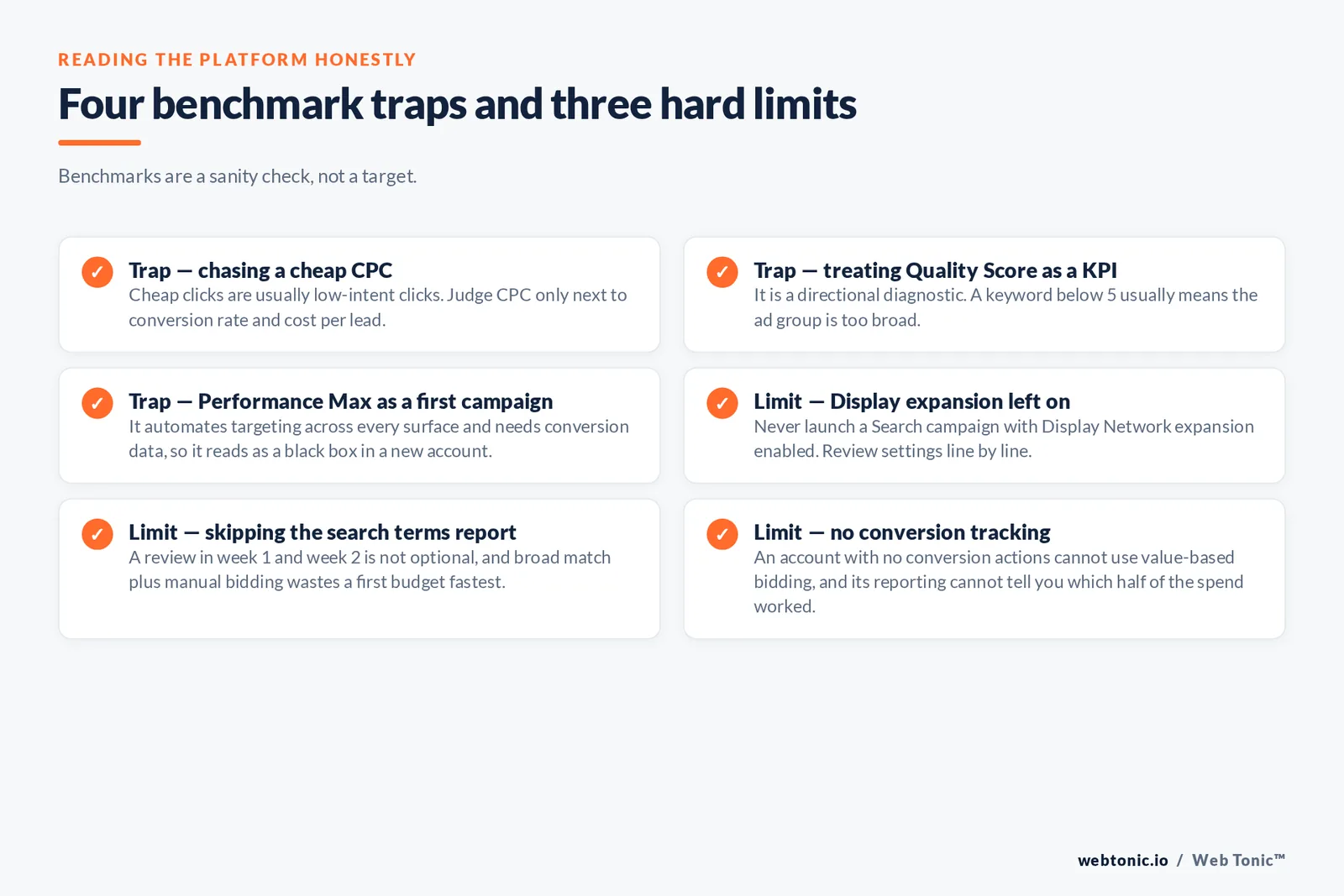
Your diagnostic for the quality side is Quality Score, reported 1 to 10 across three components. Rule 1 — Quality Score is a directional diagnostic, not a KPI. Rule 2 — a keyword with quality below 5 usually signals an ad group that is too broad. Rule 3 — landing page experience is the component advertisers ignore most and the one that is cheapest to fix.
The eight campaign types, and which one to start with
Google groups campaigns by advertising objective, then by campaign type. The type decides where your ads can appear and how much of the targeting Google automates.
| Campaign type | Where the ads appear | Demand it uses | Best first use |
|---|---|---|---|
| Search | Google Search results and search partners | Existing, expressed in queries | Almost every advertiser's first campaign |
| Performance Max | All Google surfaces at once | Existing plus discovered | Retail with a Merchant Center feed |
| Shopping | Shopping tab, Search, partners | Existing product demand | Ecommerce needing product-level control |
| Display | Google Display Network partner sites and apps | Latent; interest-based | Remarketing to past site visitors |
| Video | YouTube and video partners | Latent; audience-based | Awareness with proven creative |
| Demand Gen | YouTube, Discover, Gmail | Latent, visually driven | Consumer brands with strong creative |
| App | Play, Search, YouTube, Display | Install and in-app intent | Mobile app installs and app events |
| Smart or local variants | Search, Maps, Display | Existing local demand | Single-location businesses with no manager |
Two type-level notes worth knowing before you spend anything. Performance Max automates targeting across all channels and needs conversion data to work well, so it is a poor first campaign for a brand-new account. And on Search, your creative is now assembled from assets: responsive search ads mix up to 15 headlines and 4 descriptions into combinations Google tests for you.
Targeting: keywords, audiences and everything in between
Search campaigns are targeted with keywords; the rest are targeted with audiences, placements and signals. On Search, keyword match types decide how loosely Google may interpret your keyword, and getting them wrong is where beginner budgets disappear.
| Targeting control | How wide it reaches | Risk level | When to use it |
|---|---|---|---|
| Exact match keyword | Narrow, same meaning as the term | Low | Your proven, must-win queries |
| Phrase match keyword | Medium, meaning included | Low to medium | Default starting point for new accounts |
| Broad match keyword | Wide, related meanings | High without conversion data | Mature accounts on Smart Bidding |
| Negative keywords | Subtractive | Low | Weekly, from the search terms report |
| Audience segments | Varies by segment | Medium | Display, Video, Demand Gen targeting |
| Location and radius | Geographic | Low | Every campaign, checked on day one |
| Remarketing lists | Past visitors only | Low | Cheapest reliable win in most accounts |
Limit 1: never launch a Search campaign with the Display Network expansion left on — review campaign settings line by line. Limit 2: a search terms review in week 1 and week 2 is not optional. Limit 3: broad match plus manual bidding is the fastest way to waste a first budget.
Bidding: telling Google what a result is worth
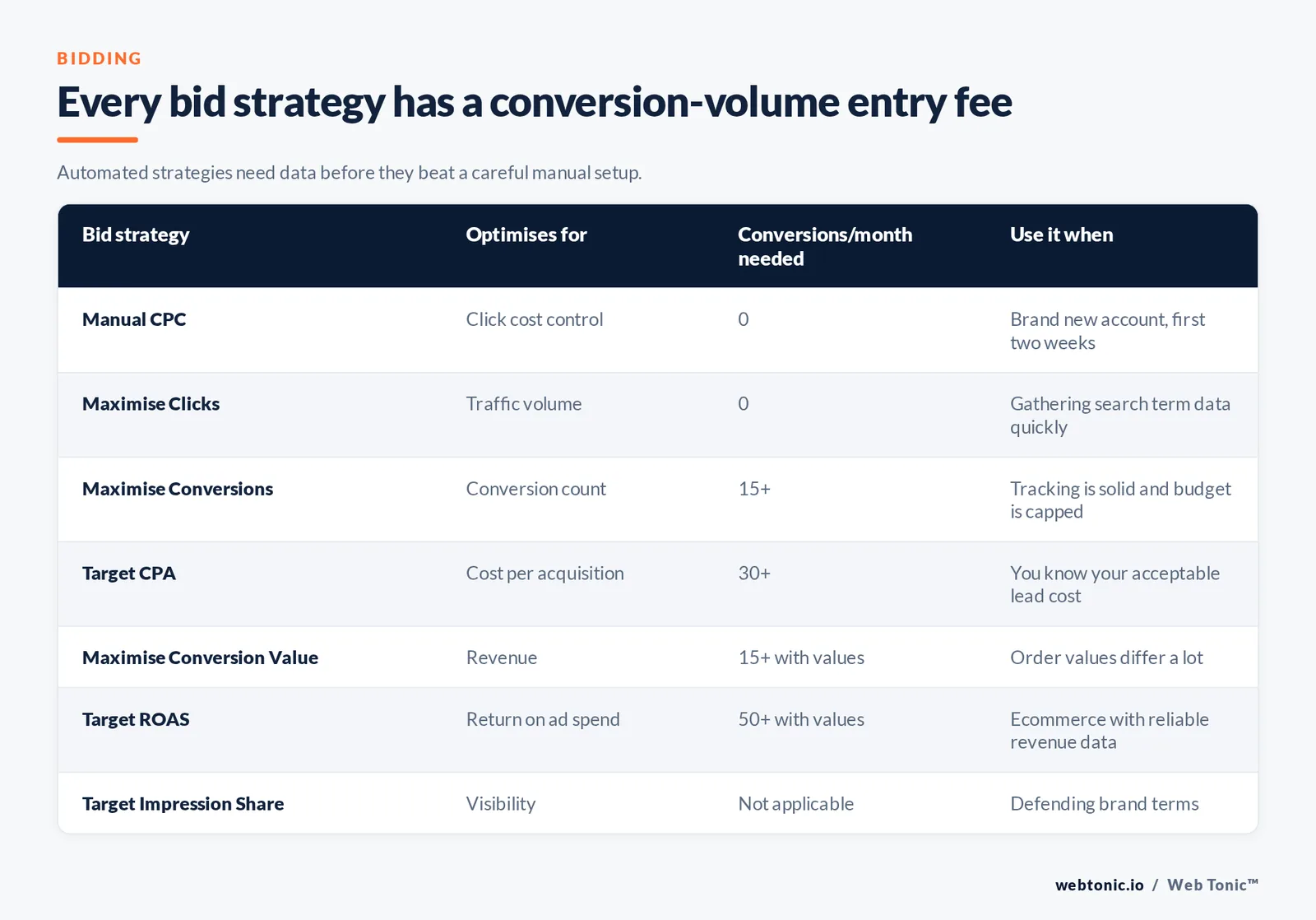
Bidding is where most of the automation now lives. Google's guidance on choosing a bid strategy by goal maps strategies to objectives, but the practical constraint is conversion volume: automated strategies need data before they beat a careful manual setup.
| Bid strategy | Optimises for | Conversions needed monthly | Use it when |
|---|---|---|---|
| Manual CPC | Click cost control | 0 | Brand new account, first two weeks |
| Maximise Clicks | Traffic volume | 0 | Gathering search term data quickly |
| Maximise Conversions | Conversion count | 15+ | Tracking is solid and budget is capped |
| Target CPA | Cost per acquisition | 30+ | You know your acceptable lead cost |
| Maximise Conversion Value | Revenue | 15+ with values | Order values differ a lot |
| Target ROAS | Return on ad spend | 50+ with values | Ecommerce with reliable revenue data |
| Target Impression Share | Visibility | Not applicable | Defending brand terms |
All of this depends on conversion tracking being configured before launch. An account with no conversion actions cannot use value-based bidding at all, and its reporting cannot tell you which half of the spend worked.
What paid search costs in 2026
There is no minimum spend and no fixed price. WordStream by LocaliQ's 2026 search advertising benchmarks, drawn from thousands of Google Ads and Microsoft Ads accounts, give the most usable public reference points: an all-industry average CPC of $5.42, CTR of 6.64%, conversion rate of 8.18% and cost per lead of $66.69.
| Industry | Average CPC | Average CTR | Average CVR | Average CPL |
|---|---|---|---|---|
| All industries | $5.42 | 6.64% | 8.18% | $66.69 |
| Attorneys and legal services | $9.87 | 5.87% | 5.55% | $131.63 |
| Home and home improvement | $8.33 | 6.47% | 8.05% | $90.92 |
| Dentists and dental services | $8.00 | 5.66% | 10.67% | $72.97 |
| Personal services | $7.17 | 7.16% | 12.34% | $54.60 |
| Health and fitness | $6.17 | 5.81% | 6.94% | $67.36 |
| Finance and insurance | $3.39 | 9.83% | 2.64% | $74.44 |
| Real estate | $3.22 | 7.61% | 3.70% | $102.51 |
| Automotive repair and service | $4.35 | 5.56% | 15.51% | $29.96 |
| Restaurants and food | $2.05 | 6.83% | 8.05% | $30.57 |
| Arts and entertainment | $1.63 | 12.75% | 5.91% | $26.84 |
How to read those benchmarks without misleading yourself
Benchmarks are a sanity check, not a target — Google's own search marketing research library is useful for the strategic context behind them. Four traps catch new advertisers every time.
| Trap | Why it misleads | What to do instead |
|---|---|---|
| Trap 1 — Chasing a cheap CPC | Cheap clicks are usually low-intent clicks | Judge CPC only next to CVR and CPL |
| Trap 2 — Treating CTR as a KPI | CTR is a health metric, not a business result | Report conversions, revenue and CPL |
| Trap 3 — Comparing across industries | A $9.87 legal click and a $2.05 food click are different products | Compare against your own trailing 90 days |
| Trap 4 — Ignoring lifetime value | A $131 lead can be excellent or terrible | Set target CPA from margin and close rate |
The arithmetic that actually matters is simple. At the all-industry averages, $1,000 of spend buys about 185 clicks, which produce roughly 15 leads. Whether that is good depends entirely on what a lead is worth to you.
The vocabulary you need in week one
| Term | Definition | Why it matters |
|---|---|---|
| Impression | One display of your ad | Denominator for CTR |
| Click and CPC | A click, and its average cost | What you pay for in most campaigns |
| CTR | Clicks divided by impressions | Relevance signal; benchmark 6.64% |
| Conversion | A tracked valuable action | The only metric bidding can optimise well |
| CPA | Cost per conversion | Compare with margin per sale |
| ROAS | Revenue divided by ad spend | The ecommerce headline number |
| Impression share | Share of available auctions won | Shows headroom for more budget |
| Quality Score | 1–10 keyword-level diagnostic | Flags mismatched ad groups and pages |
| Search terms report | What people actually typed | Source of negatives and new keywords |
Getting started: the first five decisions
Step 1 — define one conversion action worth money and install tracking before launch. Step 2 — choose one campaign type, almost always Search. Step 3 — build a keyword list from real volume in Keyword Planner rather than guesswork. Step 4 — set a daily budget you can sustain for 30 days, not 7. Step 5 — commit to a weekly review cycle. Our step-by-step walkthrough of the setup itself is in the guide to how to run Google Ads.
| Monthly budget | What it realistically buys | What you can learn | Bid strategy to start |
|---|---|---|---|
| Tier 1 — under $500 | Roughly 90 clicks at average CPC | Which queries convert at all | Manual CPC on exact and phrase match |
| Tier 2 — $500 to $1,500 | 90–275 clicks, a handful of leads | Landing page and offer signal | Maximise Clicks, then Maximise Conversions |
| Tier 3 — $1,500 to $5,000 | 275–920 clicks, 20–75 leads | Reliable CPL by service line | Maximise Conversions, then Target CPA |
| Tier 4 — $5,000 to $20,000 | Multi-campaign structure | Channel mix and incremental value | Target CPA or Target ROAS |
| Tier 5 — over $20,000 | Full-funnel presence | Creative and audience testing at scale | Portfolio strategies with experiments |
Who should advertise here, and with what first
| Business type | Start with | Primary conversion | Watch out for |
|---|---|---|---|
| Local service business | Search, tight radius | Phone call and form | Out-of-area clicks; check locations weekly |
| Ecommerce store | Shopping, then Performance Max | Purchase with value | Feed quality decides everything |
| B2B or considered purchase | Search plus remarketing | Qualified enquiry or demo | Long sales cycles distort attribution |
| SaaS | Search on problem and competitor terms | Trial or signup | Trial volume without qualification |
| Mobile app | App campaigns | Install and in-app event | Optimise to events, not installs |
| Consumer brand | Demand Gen and Video | Consideration then purchase | Needs genuinely good creative first |
| Agencies managing accounts | Search plus the API for reporting | Client-defined | Standardise naming before you scale |
Larger advertisers and agencies eventually move reporting and bulk changes into the Google Ads API, and product changes are announced on the Google Ads and commerce blog — worth following, because campaign types and defaults change more often than most guides admit. If you would rather have someone run this for you, look at our performance marketing services or talk to the team.
FAQ
How much does it cost to start?
There is no minimum spend, but a useful learning budget starts around $500 to $1,000 per month. At the 2026 all-industry average CPC of $5.42, $1,000 buys roughly 185 clicks and about 15 leads at an 8.18% conversion rate — enough signal to judge whether the offer and landing page work.
Is paid search the same as SEO?
No. Paid search buys placement in the ad slots and stops the moment you stop paying. SEO earns placement in the organic results and compounds over time. They target the same searches from different directions, and most accounts perform best when the keyword insight from paid search feeds the content plan for SEO.
How long before results appear?
Expect two weeks before the data is meaningful and 60 to 90 days before cost per lead settles. Automated bid strategies need roughly 15 to 50 conversions a month to work properly, so low-volume accounts take longer to stabilise and should start on manual or click-based bidding.
How does Performance Max differ from a Search campaign?
Performance Max is one campaign type inside the platform. It serves across Search, Shopping, YouTube, Display, Gmail, Discover and Maps from a single campaign and automates most targeting, which means it needs existing conversion data to perform. Search campaigns give you far more visible control and are the better starting point.
Do I need a website to advertise?
Practically, yes. Paid clicks have to land somewhere, and landing page experience is part of the quality assessment behind Ad Rank. Call-only and local campaigns can work with a Google Business Profile alone, but conversion tracking and any serious optimisation need a page you control.
Sources: Google Ads Help — introductory guide, Ad Rank, Quality Score, campaign objectives, campaign types, Performance Max, responsive search ads, keyword match types, campaign settings, bid strategy selection, conversion tracking, Keyword Planner; Google Ads API documentation; Google Ads and commerce blog; WordStream by LocaliQ 2026 Search Advertising Benchmarks; Statcounter Global Stats search engine market share, June 2026; Think with Google search marketing strategies; Wikipedia Google Ads.