Table of contents
Google's competitors now fall into three groups: rival search engines, privacy-first indexes, and AI answer engines that never show a results page. Only the third group is changing marketer behaviour.
Key Takeaways
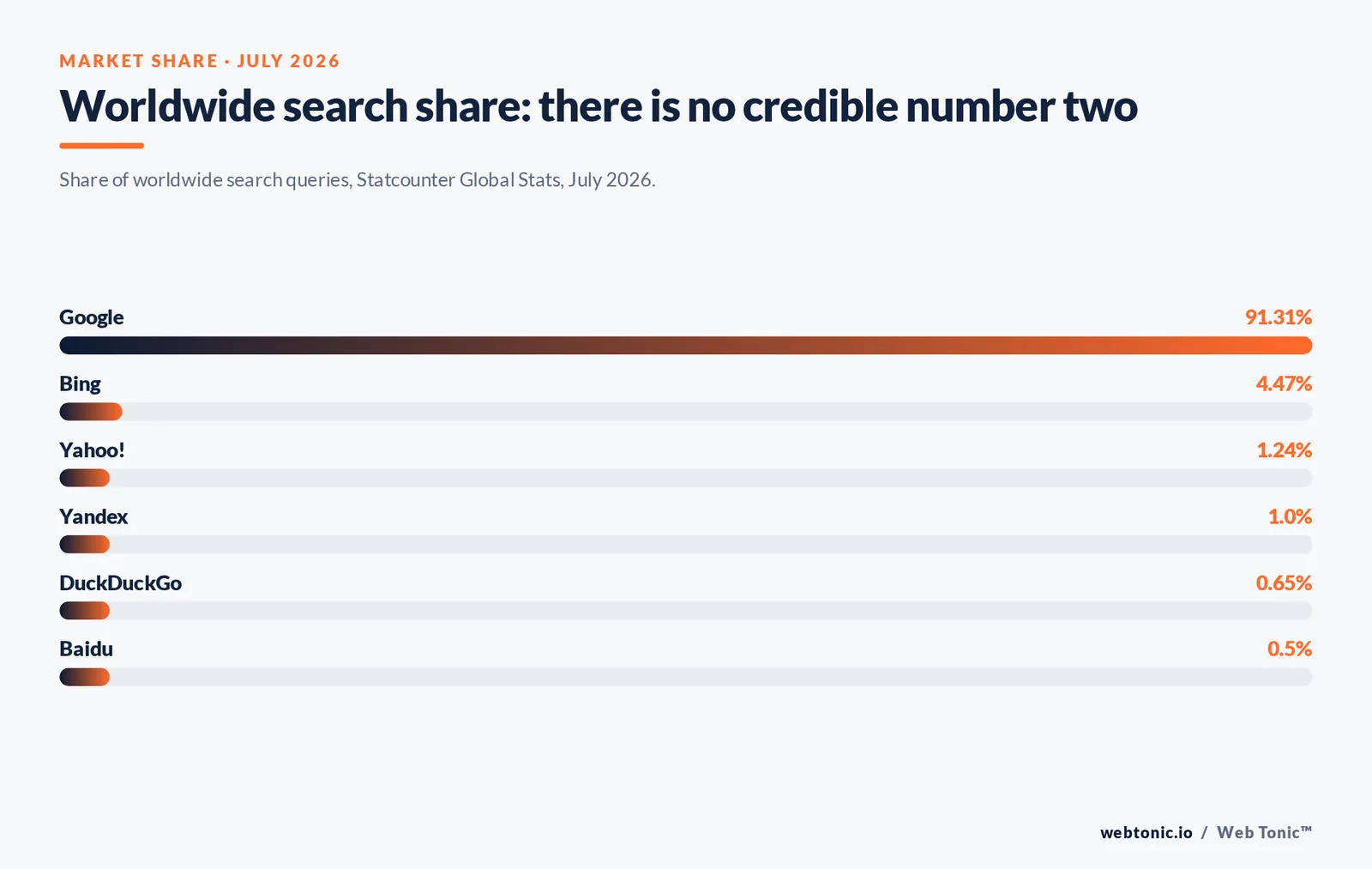
- Google held 91.31% of worldwide search in July 2026, with Bing second at 4.47% and every other engine below 1.3%.
- The United States is Google's weakest large market at 86.6%, where Bing reaches 8.63% and DuckDuckGo 1.58%.
- Chrome carries 68.22% of browser share, which is the real distribution moat — default placement, not algorithm quality.
- Only 2 engines run fully independent large-scale web indexes besides Google: Microsoft Bing and Yandex, plus Brave's independent index and Baidu in China.
- 4 categories of competitor matter to marketers: search engines, AI assistants, in-platform search (social, retail, video), and browsers that control the default.
The competitive picture in one table
Start with measured share rather than narrative. Statcounter's worldwide search engine data for July 2026 shows how concentrated the market remains, and the United States breakdown shows where the concentration is weakest.
| Engine | Worldwide share | US share | Index | Owner |
|---|---|---|---|---|
| 91.31% | 86.6% | Own | Alphabet | |
| Bing | 4.47% | 8.63% | Own | Microsoft |
| Yahoo! | 1.24% | 2.66% | Licensed | Yahoo Inc. |
| Yandex | 1.00% | 0.33% | Own | Yandex |
| DuckDuckGo | 0.65% | 1.58% | Mostly licensed | DuckDuckGo Inc. |
| Baidu | 0.50% | Negligible | Own | Baidu |
| Ecosia | Below 0.2% | 0.12% | Licensed + own | Ecosia |
Two facts hide inside that table. First, the gap between second and third place is roughly 3.2 percentage points worldwide — there is no credible number two challenger, only a distant second. Second, share moves regionally, not globally: the US number sits 4.7 points below the worldwide figure, largely because Windows devices ship with a Microsoft default and Apple's ecosystem routes some queries differently.
Group 1 — Search engines with their own index
Building a web index is the barrier to entry, and almost nobody clears it. Microsoft does: Bing Webmaster Tools is a full crawl-and-index stack with its own submission and diagnostics layer, and it also supplies results to several smaller front-ends. Yandex runs its own crawler and dominates Russian-language search. Baidu holds the Chinese-language market behind the firewall. Brave Search is the notable newer entrant, built on an independent index rather than a licensing deal.
| Engine | Why it exists | Marketer relevance | Action worth taking |
|---|---|---|---|
| Bing | Windows and Edge defaults, enterprise distribution | High in the US, B2B and desktop-heavy audiences | Verify the site in Bing Webmaster Tools and submit a sitemap |
| Yandex | Russian-language market leadership | Only if you serve that market | Localise, or ignore entirely |
| Baidu | Regulated Chinese search market | China-facing brands only | Requires in-market hosting and licensing |
| Brave Search | Independent index bundled with a privacy browser | Small but growing technical audience | Nothing specific — clean crawlability covers it |
| Mojeek and small indexes | Independent crawling on principle | Negligible traffic | Monitor only |
Rule 1 — treat Bing as the only search engine worth separate optimisation work. The effort is small (verification, sitemap, a look at its ranking diagnostics) and it addresses close to 1 in 11 US searches. Everything else in this group either serves a market you already know you are in, or delivers volume too small to justify a workstream.
Group 2 — Privacy-first alternatives
DuckDuckGo, Ecosia, Startpage and Qwant compete on values rather than result quality, and mostly ride licensed results from Bing with their own ranking and privacy layers on top. DuckDuckGo publishes its own traffic figures, and its privacy blog documents the tracker-blocking argument it sells against Google.
For marketers the practical implication is narrow but real: because these engines source from licensed indexes, being indexed and ranked well in Bing usually carries you into them automatically. There is no separate playbook. What does change is measurement — privacy engines strip referrer data more aggressively, so a slice of their traffic will land in your analytics as direct.
| Alternative | Result source | Differentiator | Measurement effect |
|---|---|---|---|
| DuckDuckGo | Mostly Bing plus own crawling | No tracking, instant answers | Referrer often reduced |
| Ecosia | Licensed with own layer | Ad revenue funds tree planting | Standard referrer |
| Startpage | Google results, proxied | Google quality without profiling | Appears as direct or unknown |
| Qwant | Licensed plus own index | European data-protection positioning | Standard referrer |
| Brave Search | Own index | Independence plus browser bundling | Standard referrer |
Worth noting: regulatory pressure is doing more for this group than product marketing ever did. The European Commission's competition enforcement against large digital gatekeepers — including its published decisions on digital markets obligations — has forced choice screens and default-setting changes that hand these engines their only realistic distribution route.
Group 3 — AI answer engines, the competitor that actually changed behaviour
This is the group that matters. ChatGPT, Perplexity, Claude, Copilot and Gemini answer the question instead of listing ten links, and they compete for the research query — the informational middle of the funnel that has historically driven most blog traffic.
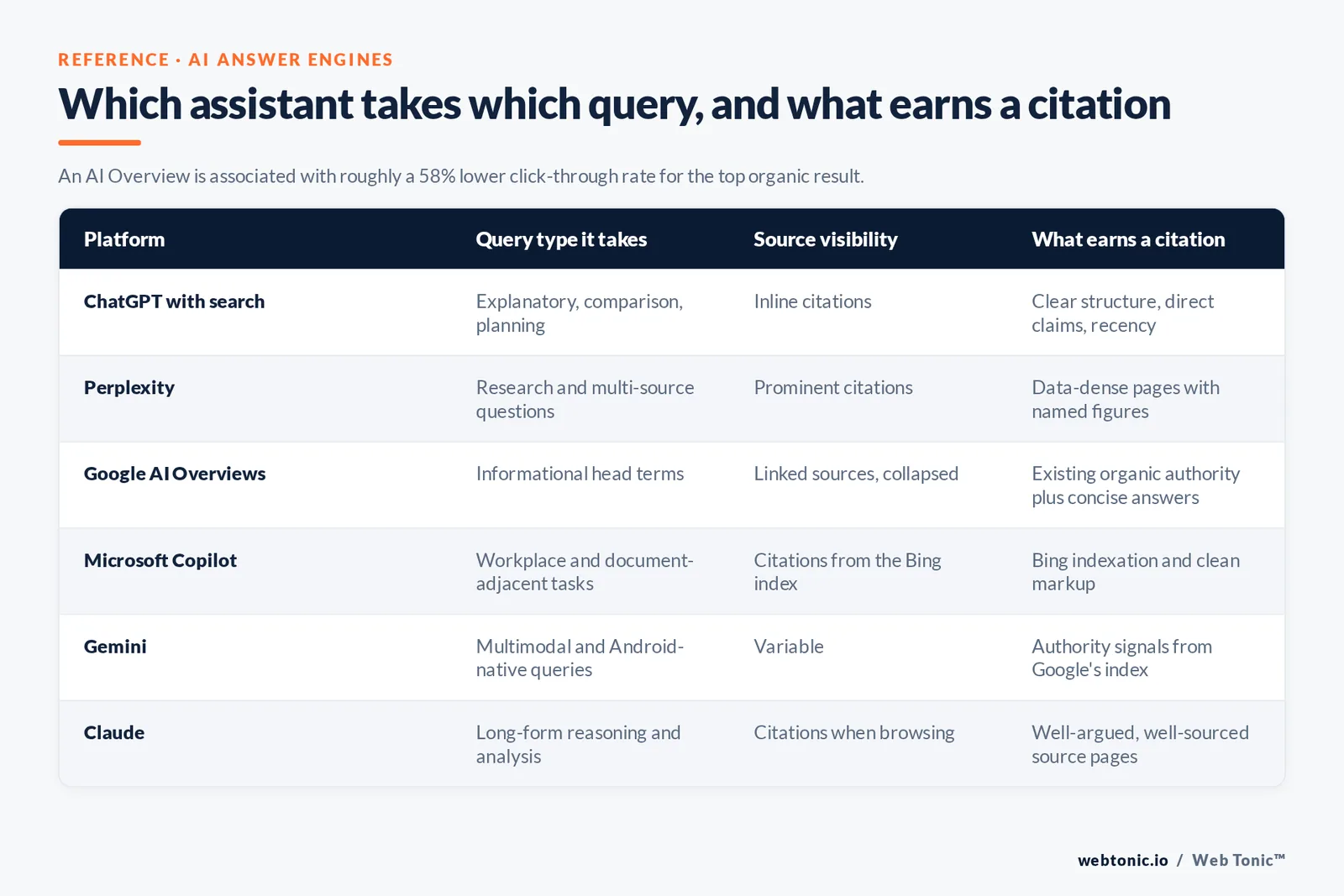
Google's own response tells you how seriously it takes the threat: AI Overviews were rolled out inside the results page itself, converting Google into a partial answer engine rather than ceding the format. The measurable consequence for publishers is a lower click rate on the same ranking position — an AI Overview is associated with roughly a 58% lower click-through rate for the top organic result — while 61.5% of desktop searches already ended without a click before assistants scaled.
| Platform | Query type it takes | Source visibility | What earns a citation |
|---|---|---|---|
| ChatGPT with search | Explanatory, comparison, planning | Inline citations | Clear structure, direct claims, recency |
| Perplexity | Research and multi-source questions | Prominent citations | Data-dense pages with named figures |
| Google AI Overviews | Informational head terms | Linked sources, collapsed | Existing organic authority plus concise answers |
| Microsoft Copilot | Workplace and document-adjacent tasks | Citations from Bing index | Bing indexation and clean markup |
| Gemini | Multimodal and Android-native queries | Variable | Authority signals from Google's index |
| Claude | Long-form reasoning and analysis | Citations when browsing | Well-argued, well-sourced source pages |
Independent analysts have been blunt that assistant referral volume remains a small fraction of search volume even as usage grows — clickstream research from SparkToro has repeatedly argued that Google's query volume is still growing in absolute terms. The realistic reading for 2026: assistants are eating a slice of clicks, not a slice of searches.
Group 4 — Where people search that is not a search engine at all
The most underrated competitor list has no search engines on it. Product discovery increasingly begins inside a platform: a retail app for purchases, a video app for how-to, a social feed for recommendations, a professional network for vendors, a forum for honest opinions.
| Destination | Query it wins | Why it wins | Marketing response |
|---|---|---|---|
| Retail marketplaces | Transactional product search | Price, reviews and checkout in one place | Feed quality and marketplace listings |
| Video platforms | "How to" and demonstration | Motion explains better than text | Short demonstration content, titled for search |
| Short-form social | Discovery and recommendation | Algorithmic feed, low search friction | Creator and UGC programmes |
| Community forums | "Is it any good" and comparison | Perceived peer honesty | Genuine participation, never astroturfing |
| Professional networks | B2B vendor and talent search | Identity and credibility attached | Company page depth and employee content |
| App stores | Software discovery on mobile | Install is the conversion | Store listing optimisation |
| Maps and local | Near-me and opening hours | Location plus reviews plus directions | Complete, reviewed local profiles |
Scale context: DataReportal's 2026 global overview counts 5.66 billion social media user identities and internet users up 294 million (+5.1%) year on year — an audience pool where a large share of commercial discovery never touches a search box. Pew's social media fact sheet gives the equivalent US platform-by-platform picture.
Comparing Google and its competitors on user experience and data
Search engines compete on four things marketers can actually evaluate: the quality of the index, the user experience of the results page, the data each engine hands back to site owners, and the advertising platform behind it. Ranked on those criteria, the list of Google competitors shrinks fast.
| Search engine | Free account for site owners | Data marketers get back | Keyword tool quality | User experience angle |
|---|---|---|---|---|
| Yes — search console and analytics | Query-level clicks, impressions, position | Deepest volume data of any engine | AI answers above traditional results | |
| Bing | Yes — free account in webmaster tools | Query data plus crawl diagnostics | Solid, with real-time trend views | Copilot answers alongside links |
| Yandex | Yes | Query and index data for its market | Strong for Russian-language search | Traditional search engine layout |
| DuckDuckGo | No site-owner console | None — traffic arrives anonymised | No public keyword tool | No tracking, no personalised results |
| Brave Search | No | Minimal | None | Independent index, optional AI summary |
| AI assistants | No | Referral data only, often partial | No query volume data at all | One synthesised answer, few links |
The pattern is unmissable: only 3 engines give site owners usable query data, and the platforms taking share fastest give the least. That is the structural problem AI search creates for marketers — not fewer users, but less visibility into the same users. Where a traditional search engine reports impressions and position, an assistant reports nothing, so measurement moves from ranking data to citation audits and branded-demand trends.
Traditional search engines versus AI answers — what changes for marketers
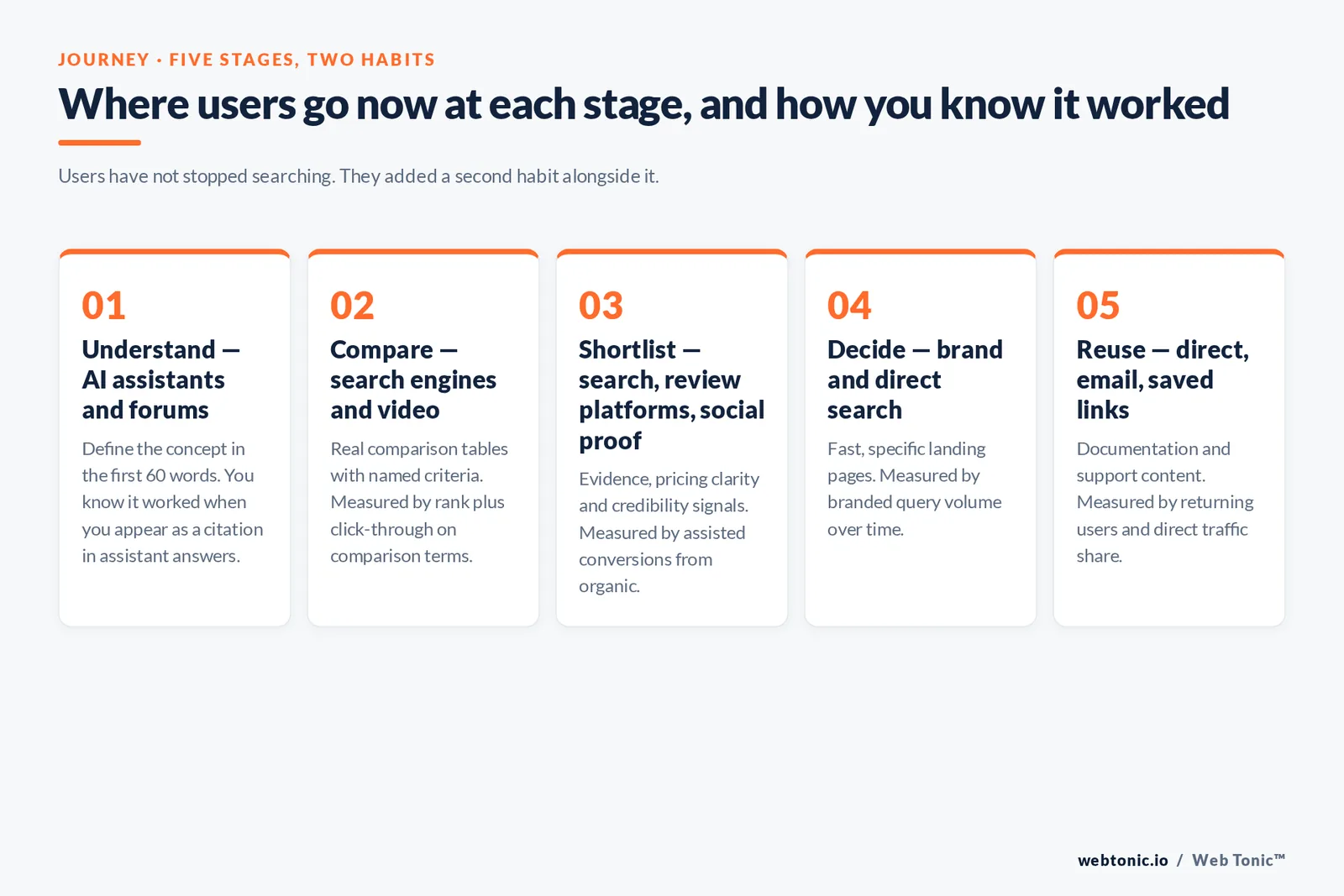
Users have not stopped searching; they have added a second habit. The same person will ask an assistant to explain a category and then use Google to find a supplier, which is why time on each surface is a poor proxy for commercial value.
| Query stage | Where users go now | What the content has to do | How you know it worked |
|---|---|---|---|
| Stage 1 — Understand | AI assistants, forums like Reddit | Define the concept in the first 60 words | Citations in assistant answers |
| Stage 2 — Compare | Search engines and video | Real comparison tables with named criteria | Rank plus click-through on comparison terms |
| Stage 3 — Shortlist | Google, review platforms, social proof | Evidence, pricing clarity, credibility signals | Assisted conversions from organic |
| Stage 4 — Decide | Brand and direct search | Fast, specific landing pages | Branded query volume over time |
| Stage 5 — Reuse | Direct, email, saved links | Documentation and support content | Returning users and direct traffic share |
Two years of this shift produced one durable lesson: pages that win citations are pages that make claims a machine can quote — a figure, a source, a date, a bounded statement. Step 1 — answer in the first 2 sentences. Step 2 — attach a number to every claim. Step 3 — name the source in the text, not only in a footer. Step 4 — keep the page current, because recency is a visible ranking input across every engine and assistant on this list.
Group 5 — Browsers and defaults, the real moat
Google's search share is not primarily an algorithm story. It is a distribution story. Statcounter's July 2026 browser data puts Chrome at 68.22%, Safari at 16.47%, Edge at 5.37% and Firefox at 3.34%. Whoever owns the address bar owns the query.
That is why antitrust remedies focus on default agreements and choice screens rather than on ranking quality, and why Microsoft's search share correlates so tightly with Windows and Edge presence. Fact 1 — the top two browsers carry more than 84% of usage. Fact 2 — both belong to companies that also sell search. Any competitor without a browser or an operating system has to buy attention query by query.
What this means for your marketing plan
Concentration this extreme creates a simple hierarchy of effort. Do not spread work evenly across engines; weight it by reachable audience.
| Priority | Where to spend effort | Share of effort | Why |
|---|---|---|---|
| Priority 1 | Google organic and paid | Roughly 70% | 86.6% of US searches, all AI Overview exposure |
| Priority 2 | Answer-engine visibility (structure, data, citations) | Roughly 15% | Fastest-growing referral source, cheap to earn |
| Priority 3 | Bing verification and Microsoft Ads | Roughly 10% | 8.63% of US search at lower auction pressure |
| Priority 4 | In-platform discovery on your 2 best channels | Roughly 5% | Discovery increasingly starts off-search |
| Priority 5 | Everything else | 0% | Sub-1% engines need no dedicated work |
Practically, priority 2 is the change most teams have not made. Earning an AI citation rewards the same things a good page always needed — a direct answer near the top, named figures with sources, real tables, and a clear entity for the brand. Our own growth marketing work now treats answer-engine citation as a reporting line alongside rankings, and the underlying measurement sits with data intelligence rather than in a social dashboard.
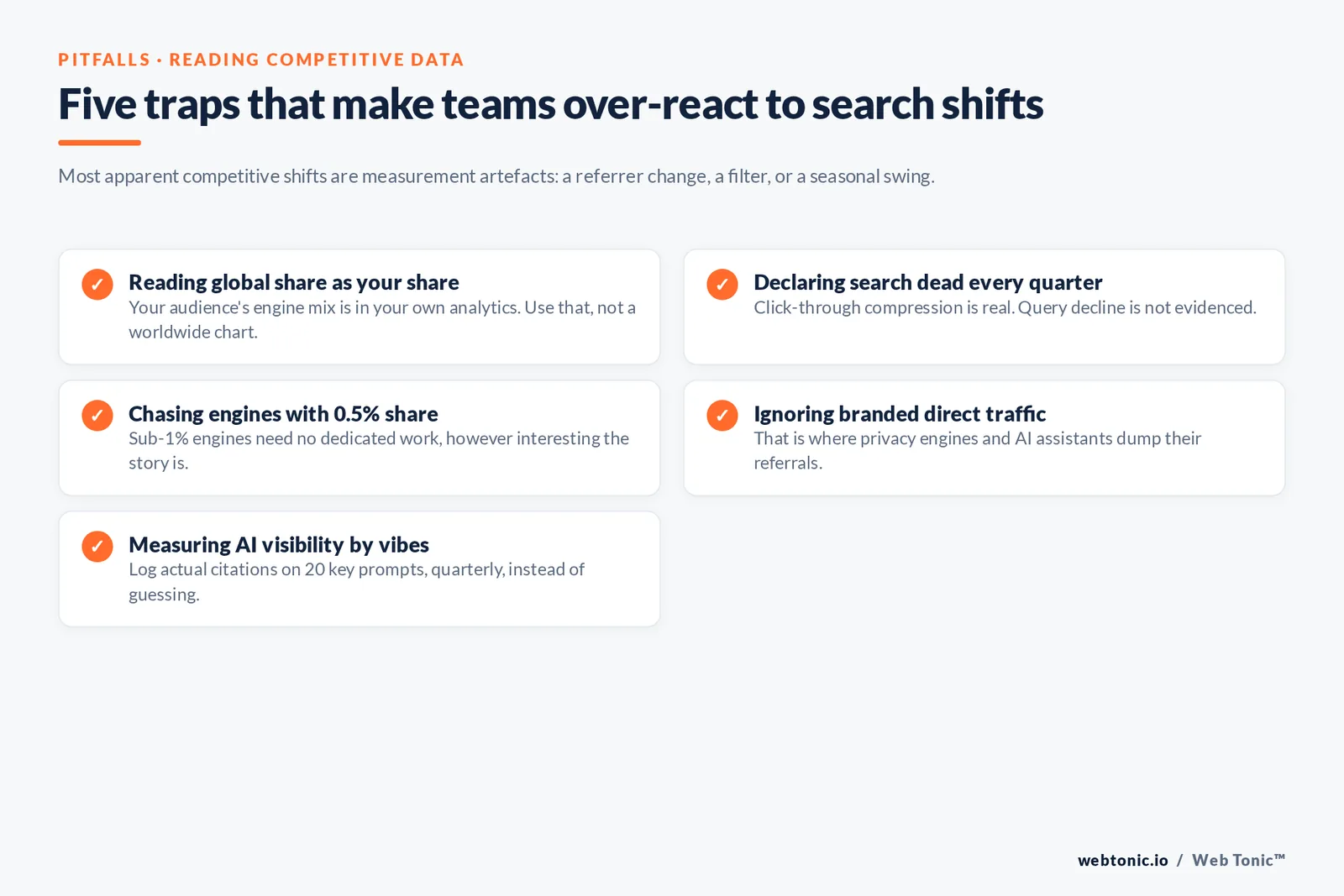
How to track competitive shifts without over-reacting
Trap 1 — reading global share as your share. Your audience's engine mix is in your own analytics; use that, not a worldwide chart. Trap 2 — declaring search dead every quarter. Click-through compression is real; query decline is not evidenced. Trap 3 — chasing engines with 0.5% share because the story is interesting. Trap 4 — ignoring branded direct traffic, which is where privacy engines and assistants dump their referrals. Trap 5 — measuring AI visibility by vibes rather than logging actual citations monthly.
| Signal to monitor | Source | Cadence | Decision it informs |
|---|---|---|---|
| Engine mix in your traffic | Your analytics platform | Monthly | Whether Bing deserves budget |
| Impressions vs clicks by query | Search console data | Monthly | Where AI Overviews are compressing CTR |
| Assistant referrals | Referral reports, filtered | Monthly | Investment in answer-engine content |
| Citation checks on 20 key prompts | Manual or tooled prompt audit | Quarterly | Content gaps to fill |
| Category interest trend | Google Trends | Quarterly | Demand shifts vs ranking losses |
| Search spend forecasts | Industry search marketing forecasts | Annually | Budget planning assumptions |
If a metric in that list moves, check the other five before changing strategy. Most apparent competitive shifts are measurement artefacts: a referrer change, a filter, or a seasonal demand swing. Teams that rebuild their channel strategy on a single month of data usually undo it two months later.
FAQ
Who is Google's biggest competitor?
In measured search share it is Microsoft Bing, at 4.47% worldwide and 8.63% in the United States as of July 2026. In terms of changed user behaviour, the bigger competitor is the set of AI assistants — ChatGPT, Perplexity and Copilot — which absorb research queries that used to produce clicks on results pages.
Is ChatGPT really a competitor to Google?
For a specific query type, yes. Assistants take explanatory, comparison and planning questions that once drove informational traffic. Referral volume from assistants is still small relative to search, so the accurate framing is competition for clicks rather than for total query volume.
What are the best alternative search engines?
Bing if you want an independent index and advertising platform, DuckDuckGo or Startpage for privacy, Brave Search for independence bundled with a browser, Ecosia if you want ad revenue directed to reforestation, and Yandex or Baidu only for their respective language markets.
Should I optimise for Bing separately?
Do the cheap version: verify the site in Bing Webmaster Tools, submit a sitemap, and review its diagnostics twice a year. That covers close to 1 in 11 US searches plus the privacy engines that license Bing results, at almost no incremental content cost.
Will Google lose its search dominance?
Not on current data. Its worldwide share sits above 91%, it owns the leading browser at 68.22% of usage, and it shipped AI Overviews to defend the answer format. The realistic scenario is not collapse but fragmentation of the click: the same query, resolved in more places.
Sources
Statcounter Global Stats — search engine market share worldwide and United States, and browser market share, July 2026 · Bing Webmaster Tools documentation · Brave Search · DuckDuckGo traffic page and Spread Privacy blog · European Commission press corner, digital markets enforcement · Google blog, generative AI in Search · SparkToro clickstream research · DataReportal, Digital 2026 Global Overview Report · Pew Research Center, social media fact sheet · Google Trends · eMarketer search engine marketing insights.