



Table of contents
Fertility clinics operating in competitive metro markets spend $5,000–$20,000 per month on Google Ads, yet the average cost per acquisition sits at just $112 per lead — making paid search one of the most efficient patient acquisition channels for reproductive medicine. Below, we break down the latest performance benchmarks, cost data, and conversion metrics shaping IVF advertising in 2026.
Key Takeaways
- The average Google Ads CPC for fertility clinics is $9.84, nearly double the general healthcare average of $5.64 (Benchmarketing).
- Fertility clinic Google Ads conversion rates average 6.8%, outperforming the broader healthcare search average of 4.2% (Benchmarketing).
- Google Search Ads generate 20% of IVF digital conversions by volume but deliver the highest ARPU patients — those booking 2–3 cycle packages (ICG).
- Top-performing fertility clinics achieve 8.2x ROAS through combined Google Ads and SEO strategies over sustained partnerships (Tandem Medical).
- One OBGYN practice grew new patient bookings by 442% with only a 19% increase in ad spend through campaign restructuring (DeltaV Digital).
Fertility & IVF Google Ads Benchmarks at a Glance
| Metric | Fertility Clinics | General Healthcare | OB-GYN |
|---|---|---|---|
| Average CPC | $9.84 | $5.64 | $6.85 |
| Click-Through Rate | 5.28% | 3.2% | 4.8% |
| Conversion Rate | 6.8% | 4.2% | 5.4% |
| Cost per Acquisition | $112 | $87 | $127 |
| Monthly Budget (Competitive) | $5K–$20K | $2K–$10K | $3K–$8K |
Sources: Benchmarketing 2026, LocaliQ, CuFinder
Cost per Click and Budget Data
The average CPC for fertility-related keywords is $9.84, placing it among the most expensive healthcare subcategories. In major metro areas like New York, Los Angeles, and Miami, CPCs can climb to $15–$25 per click for high-intent terms like "IVF near me" or "fertility specialist." Clinics in these markets typically allocate $10,000–$20,000 monthly to remain competitive, while practices in smaller metros run viable campaigns at $5,000–$8,000 per month (Tandem Medical Marketing).
By comparison, the overall healthcare search advertising CPC averages $5.64, a roughly 6% year-over-year increase according to LocaliQ's 2025 benchmarks. The fertility premium reflects both the high patient lifetime value (single IVF cycles cost $12,000–$25,000+) and intense competition in metro markets where 5–15 clinics bid on the same keywords.
For Indian IVF centers, Google Ads budgets range from ₹2,00,000–₹3,00,000 monthly with a cost per qualified lead of ₹1,120–₹1,600 in Delhi NCR and up to ₹2,500 in saturated tier-1 cities (ICG India).

Conversion Rate and Lead Quality Metrics
Fertility clinics converting at 6.8% on Google Ads outperform the general healthcare benchmark of 4.2%. This higher rate reflects the nature of the search — patients Googling "IVF cost" or "fertility clinic near me" are deep in the decision funnel and ready to book consultations. Treatment-specific landing pages should target 8–12% conversion to free consultation booking; anything below 4% signals structural issues like ad-to-page mismatches or missing online booking options (Tandem Medical).
Lead qualification matters enormously in fertility. Google Search generates 20% of total IVF digital conversions by volume but delivers patients with the highest average revenue per user, typically those booking 2–3 cycle packages. By contrast, Meta Ads drives 45% of conversions by volume but skews toward single-cycle, price-sensitive patients (ICG).
| Channel | Conversion Share | ARPU Profile | Typical CPA |
|---|---|---|---|
| Google Search Ads | 20% | High (2–3 cycle packages) | $112–$200 |
| Meta Ads | 45% | Lower (single cycles) | $74–$150 |
| Organic Search | 35% | Mixed | $0 (content cost) |
Source: ICG 2025 Channel Mix Data
ROAS and ROI Benchmarks
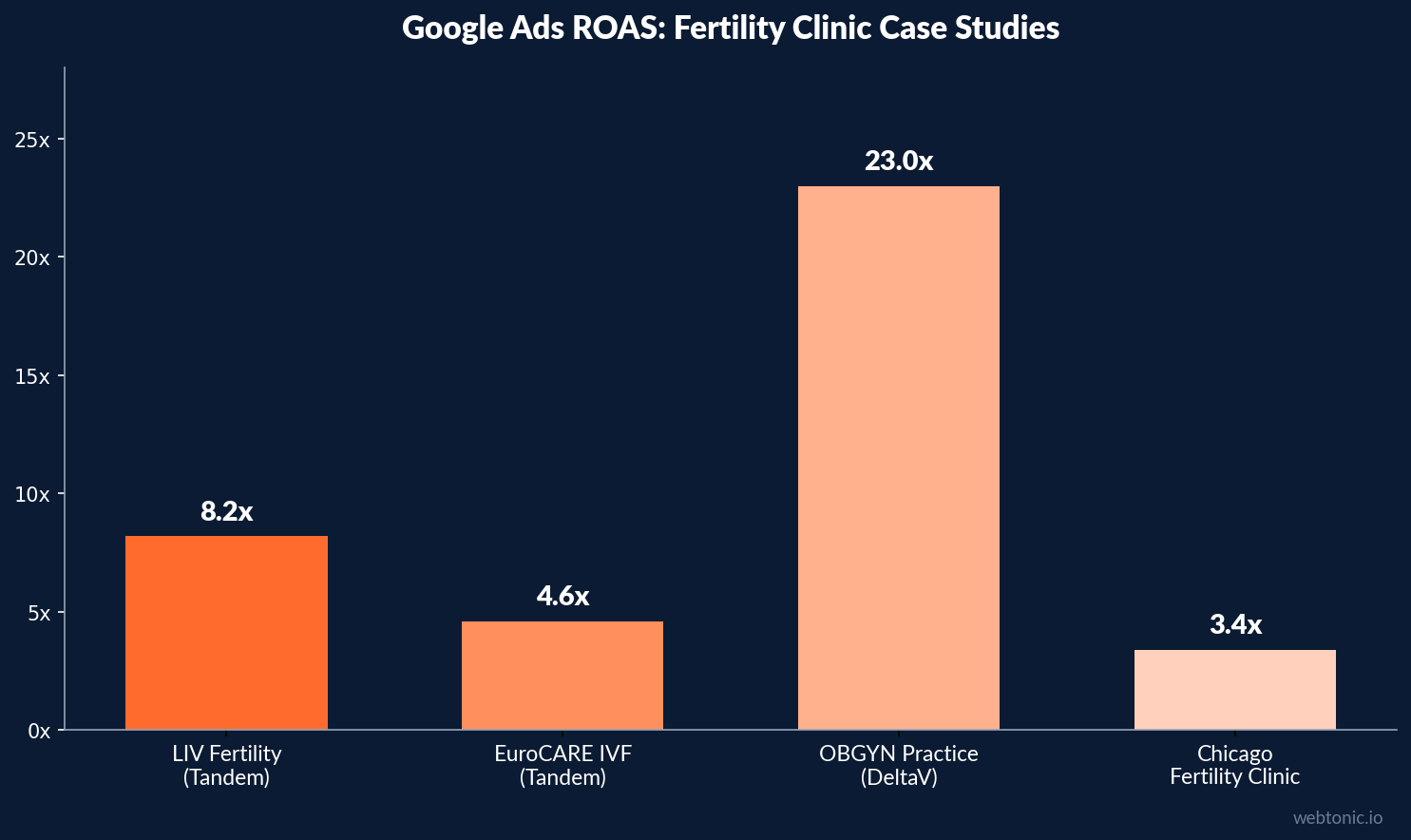
Return on ad spend varies dramatically by clinic maturity and market. LIV Fertility Center achieved 8.2x ROAS across a 2+ year Google Ads and SEO partnership, growing qualified leads by 243% while reducing cost per lead from $285 to $118 (Tandem Medical). EuroCARE IVF sustained 4.6x ROAS across four European markets, building a Scandinavian patient pipeline from zero (Tandem Medical).
FoundryCRO's 2026 healthcare benchmarks place the OB-GYN and fertility segment at a 6.3:1–62.5:1 LTV-to-CAC ratio, reflecting the wide range between single-consultation patients and multi-cycle IVF patients whose lifetime value reaches $5,000–$50,000+ (FoundryCRO).
A DeltaV Digital case study showed that restructuring Google Ads for an OBGYN practice increased new patient bookings from 234 to 1,268 per year — a 442% jump — with only a 19% increase in ad spend ($137,000 to $163,000). That equals a 23x return on the incremental $26,000 invested (DeltaV Digital).
Campaign Performance Case Studies
| Clinic / Agency | Key Result | Campaign Details |
|---|---|---|
| LIV Fertility (Tandem) | 8.2x ROAS, +243% leads | CPL reduced $285 to $118; 35 to 120 leads/month over 2+ years |
| EuroCARE IVF (Tandem) | 4.6x ROAS | Four European markets; Scandinavian pipeline from zero |
| Chicago Fertility Clinic | +240% conversions | 148% CVR improvement within six months |
| OBGYN Practice (DeltaV) | 442% more bookings | 234 to 1,268 annual bookings; 19% more spend = 23x return |
| ReproMed IVF (Utopiads) | 1,425 total leads | 4.26% CVR; avg CPA of 59.81 EUR; 12.35% CTR |
| IVF Clinic (AdToRise) | +57% conversions | +110% phone calls; CPC decreased by 36% |
Budget Allocation and Spend Recommendations
Medical Marketing Firm recommends fertility clinics allocate $2,000–$6,000 per month for Google Ads as part of a broader $8,000–$20,000 total marketing budget. The recommended PPC-to-total ratio is approximately 25–40% of total marketing spend (MMF).
Tandem Medical Marketing provides more specific budgeting for competitive markets: NYC, LA, SF, Miami, Chicago, and Dallas require $10,000–$20,000 monthly Google Ads budgets for meaningful visibility, while mid-sized markets can start at $5,000–$8,000. Agency management fees typically run $1,250/month or 12% of ad spend, whichever is greater (Tandem Medical).
Fertility Google Ads vs Other Healthcare Specialties
| Specialty | Avg CPC | CPA Range | LTV-to-CAC Ratio |
|---|---|---|---|
| Fertility / IVF | $9.84 | $112–$500 | 6.3:1–62.5:1 |
| Dental (General) | $6.69 | $50–$150 | 8:1–15:1 |
| Plastic Surgery | $8.50 | $150–$400 | 5:1–25:1 |
| OB-GYN | $6.85 | $200–$500 | 4:1–10:1 |
| Physical Therapy | $4.20 | $30–$100 | 6:1–12:1 |
Sources: Benchmarketing, FoundryCRO, LocaliQ
Keyword Strategy and Search Intent Data
Fertility-related search queries fall into three distinct intent categories, each requiring different bidding and landing page approaches. Treatment-intent keywords like "IVF clinic near me" and "fertility specialist [city]" carry the highest CPCs ($12–$25) but convert at 8–12% because the searcher is ready to book. Research-intent keywords such as "IVF success rates" and "fertility treatment options" have lower CPCs ($4–$8) but serve as critical top-of-funnel entry points that feed remarketing audiences (Tandem Medical).
Cost-related queries — "how much does IVF cost" and "fertility treatment financing" — represent a growing segment with moderate CPCs ($6–$12) and strong conversion potential when paired with transparent pricing pages. Clinics that address cost concerns directly on their landing pages see 35–50% higher engagement compared to those that gate pricing behind consultation forms.
Negative keyword management is especially important in fertility advertising. Searches related to natural fertility supplements, at-home fertility tests, and pet breeding can drain budgets quickly. Top-performing accounts maintain negative keyword lists of 200–500 terms and review search term reports weekly to prevent waste on irrelevant queries.
Tracking and Attribution Considerations
Fertility patient journeys are among the longest in healthcare, with the average research-to-booking cycle spanning 3–6 months. This creates significant attribution challenges for Google Ads campaigns. Standard last-click attribution undervalues awareness campaigns by 40–60%, while data-driven attribution models capture the full influence of early touchpoints like informational search ads and YouTube pre-roll.
Clinics that implement offline conversion tracking — importing actual consultation bookings and treatment starts back into Google Ads — see 25–35% improvement in bidding algorithm performance because the system optimizes for real patients rather than form fills. Phone call tracking is particularly critical since over 60% of fertility consultations begin with a phone inquiry rather than an online form submission.
Cross-device tracking also plays an outsized role. Research from ICG shows that 68% of fertility patients begin their search on mobile but complete the booking on desktop, making cross-device conversion paths essential for accurate ROI measurement. Google Ads' cross-device attribution and enhanced conversions help bridge this gap.
Best Practices for Fertility Clinic Google Ads
- Segment campaigns by treatment type — separate IVF, IUI, egg freezing, and fertility testing into distinct ad groups for tighter keyword-to-ad alignment and higher Quality Scores.
- Use location targeting aggressively — fertility patients travel 30–60 minutes on average. Bid higher within a 15-mile radius and layer demographic overlays for age 25–44.
- Build treatment-specific landing pages — generic "about us" pages convert at 2–3%; dedicated treatment pages with clear CTAs should target 8–12% (Tandem Medical).
- Track phone calls as conversions — over 60% of fertility consultations start with a phone call. Use call tracking to attribute leads accurately and optimize bidding.
- Test Discovery and YouTube campaigns for top-of-funnel awareness — broad audience reach complements high-intent search campaigns for patients still in the research phase.
Google Ads Match Types for Fertility Keywords
Match type strategy is especially important for fertility campaigns given the high CPCs. Exact match keywords like [ivf clinic near me] deliver 40–60% lower CPAs than broad match equivalents, though with significantly less volume. Top-performing accounts use a layered approach: exact match for proven converting terms (IVF, fertility specialist, egg freezing), phrase match for treatment-adjacent queries (fertility options, reproductive health), and broad match only with smart bidding on campaigns with 30+ monthly conversions for discovery purposes.
The shift toward broad match with smart bidding has produced mixed results in fertility advertising. Clinics with strong offline conversion data fed back to Google Ads see broad match outperform exact match by capturing long-tail queries that exact match misses. However, clinics without robust conversion tracking often find broad match wastes 25–40% of budget on irrelevant searches related to pet fertility, natural supplements, or general health information.
Related reading
- Google Ads Audience Targeting: Segments, Settings and the Rules That Decide Delivery
- Negative Keywords in Google Ads: The 3 Types, 4 Tiers and What They Really Block
- Meta Ads vs Google Ads: The Split, Priced by Business Model
- Paid Search services at Web Tonic
Frequently Asked Questions
How much do Google Ads cost for fertility clinics?
The average cost per click for fertility-related keywords is $9.84, with competitive metro areas reaching $15–$25. Monthly budgets typically range from $5,000 for mid-sized markets to $20,000 for major metros like NYC or LA. The average cost per acquisition is $112 per lead.
What is a good conversion rate for fertility clinic Google Ads?
The industry median conversion rate for fertility Google Ads is 6.8%, above the 4.2% healthcare average. Top-performing clinics with optimized treatment-specific landing pages achieve 8–12% conversion rates. Anything below 4% warrants a review of landing page alignment and booking friction.
Is Google Ads or Meta Ads better for IVF clinics?
Both channels serve different roles. Google Search captures high-intent patients who are actively researching treatments, delivering 20% of conversions but at higher average revenue per user. Meta Ads drives higher volume (45% of conversions) but skews toward price-sensitive, single-cycle patients. Most successful clinics use both channels as part of a combined paid search and social strategy.
What ROAS should fertility clinics expect from Google Ads?
ROAS varies by clinic maturity and market. Established partnerships report 4.6x–8.2x ROAS on sustained campaigns. New campaigns may see initial ROAS of 2–3x during the first 3–6 months as data accumulates and bidding algorithms learn. The high patient lifetime value ($12,000–$50,000+) means even modest lead volumes can deliver strong returns.
How many leads should a fertility clinic expect from Google Ads?
Lead volume depends on budget and market. At $5,000–$8,000 monthly spend, clinics in mid-sized markets typically generate 35–80 leads per month. At $10,000–$20,000 in competitive metros, volumes reach 80–180 leads monthly. The LIV Fertility case study showed growth from 35 to 120 leads/month over a multi-year campaign optimization period.
Sources
benchmarketing.org/benchmarks/industries/fertility-clinics
localiq.com/blog/healthcare-search-advertising-benchmarks
tandemmedicalmarketing.com/ivf-marketing-2026
tandemmedicalmarketing.com/case-studies/liv-fertility-center
tandemmedicalmarketing.com/case-studies/eurocare-ivf
ichelonconsulting.com/insights/ivf-google-ads-vs-meta-ads-data
ichelonconsulting.com/insights/ivf-marketing-playbook-india-2026-cpql-benchmarks
foundrycro.com/blog/healthcare-marketing-benchmarks-by-specialty
deltavdigital.com/resources/case-studies/obgyn-google-ads
cufinder.io/blog/benchmarks/ob-gyn
medicalmarketingfirm.com/answers/fertility-ivf-how-much-to-spend
adtorise.com/case-studies/ivf-clinic-lead-generation-case-study


