Table of contents

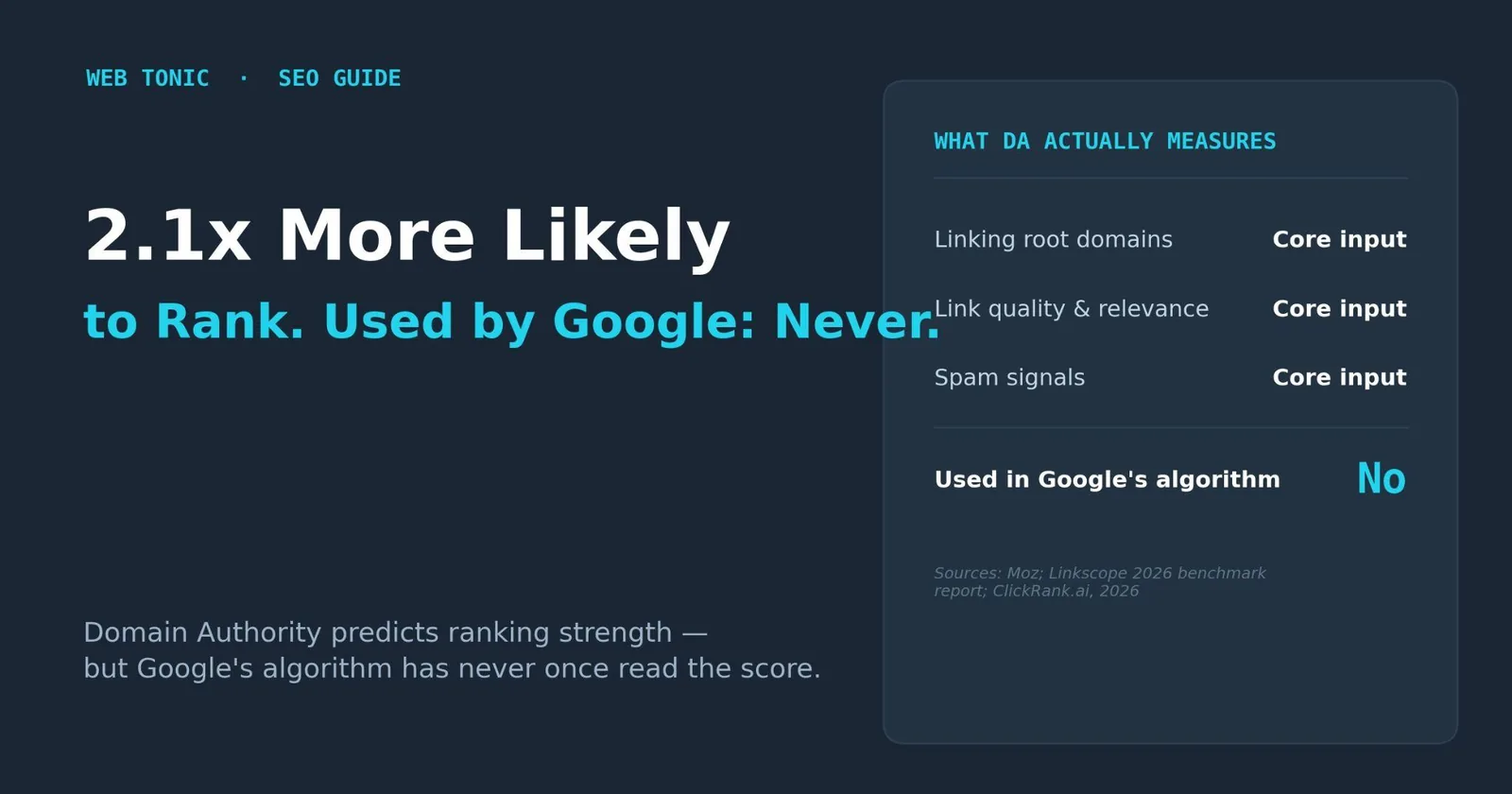
A client checks their Domain Authority, sees a lower number than a competitor, and panics. Here's the part that gets lost in that moment: Google has never once read that score, and it never will. Domain Authority isn't a Google ranking factor. It's a third-party metric, and understanding what it actually measures matters more than the number itself.
What is domain authority? It's a score from 1 to 100, created by Moz, that predicts how likely a website is to rank in search engine results compared to competing sites. Higher generally means a stronger backlink profile and more accumulated trust. But "predicts" is doing a lot of work in that sentence, and most of the confusion around DA comes from skipping past it.
Key Takeaways
- Domain Authority is not a Google ranking factor. It's a third-party score built by Moz; Google has stated for years that its algorithm never reads it (ClickRank.ai, 2026; Search Engine Journal's documented history of Google's denials traces this back to Gary Illyes' 2016 statement that Google has no "overall domain authority" concept).
- DA correlates with rankings because both depend on the same underlying thing: backlinks. Google rewards strong link profiles, and Moz measures those same profiles. The correlation comes from a shared input, not from Google using the score.
- Sites with DA 60 or higher are roughly 2.1 times more likely to rank in the top 10 for competitive keywords, according to a 2026 benchmark analysis of Moz, Ahrefs, and SEMrush data (Linkscope, 2026).
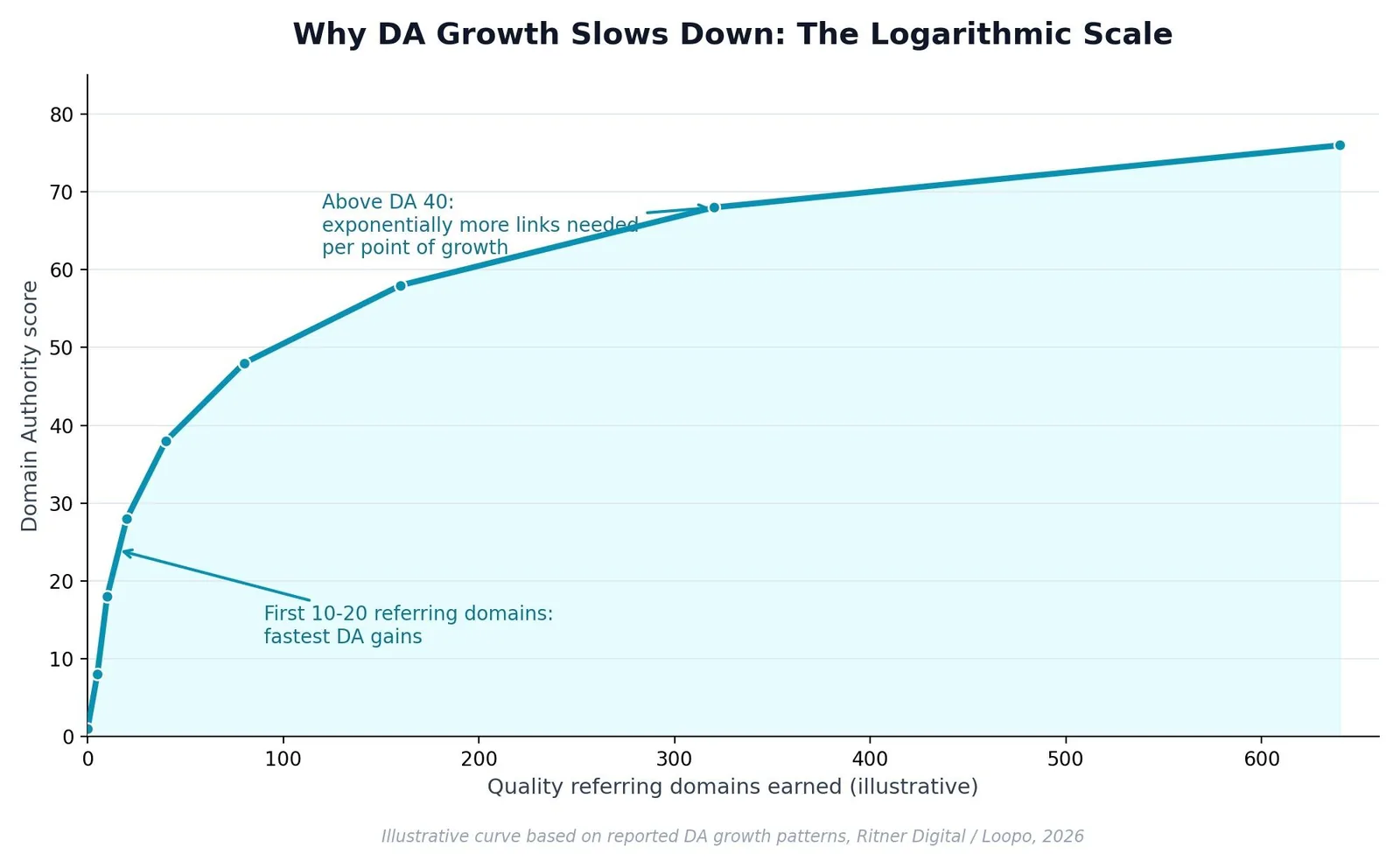
- The scale is logarithmic: moving from DA 20 to 30 is far easier than moving from DA 70 to 80. The first 10 to 20 referring domains typically move a site from DA 1 to the 20-30 range; growth past that requires exponentially more links.
- Ahrefs' Domain Rating (DR) and SEMrush's Authority Score (AS) measure a similar concept with different methodologies (Ritner Digital, 2026) — scores don't translate directly across tools, so a DA 50 and an AS 50 aren't the same thing.
- A "good" DA score depends entirely on the industry and the competition, not a fixed number. Local service businesses average DA 28; finance, a YMYL category, averages DA 58.
What Is Domain Authority, Exactly?
Domain Authority is a predictive metric created by Moz that scores a website from 1 to 100 based primarily on the quality and quantity of its backlink profile. It's calculated using a machine learning model that factors in more than 40 signals, most centrally the number of linking root domains, the quality and relevance of those links, MozRank and MozTrust, and a Spam Score that flags manipulative link patterns.
The important nuance: DA is not a Google metric, and Google does not use it in its algorithm. Google representatives, including Gary Illyes and John Mueller, have said so directly for years. Search Engine Land's account of this history includes Illyes telling a conference audience directly: "We don't use it, and it doesn't align with anything we have at Google." A 2024 leak of Google's internal API documentation (ClickRank.ai, 2026) did reveal an attribute called siteAuthority, confirming that Google does measure some form of site-level trust internally, but that's Google's own separate signal, not Moz's public DA score. This kind of confusion is common across search engine optimization (SEO), where third-party metrics get mistaken for the thing Google itself actually measures.
Why DA Correlates With Rankings Anyway
If Google never reads the score, why does a high DA so often line up with strong rankings? DA works like a thermometer: it reports the heat, it doesn't create it. Google's algorithm rewards websites with strong, relevant backlink profiles, and Moz's model measures those same profiles to calculate DA. The two numbers move together because they're reading the same underlying reality from different angles, not because either one causes the other.
That distinction matters practically. Chasing the DA number directly is the wrong goal. Chasing the backlinks that produce a healthy DA, links from relevant, high-traffic, trustworthy sites, moves both the score and actual rankings together. A high-DA site with no real traffic and no brand searches behind it carries little of the real authority the score implies; Google's internal signals catch these thin "zombie domains" even while the public DA number stays high.
The scale itself explains a lot of the frustration people feel with DA. It's logarithmic, not linear. The first 10 to 20 quality referring domains typically move a new site from DA 1 into the 20-30 range, fast, visible progress. Past DA 40, the quality of referring domains starts to matter roughly three times more than raw quantity (Ritner Digital, 2026): ten links from DA 70+ sites move the score more than fifty links from DA 20-30 sites. Progress slows dramatically the higher the score climbs, which is exactly why a jump from 25 to 35 feels achievable while 65 to 75 can take years.
Domain Authority vs. Domain Rating vs. Authority Score
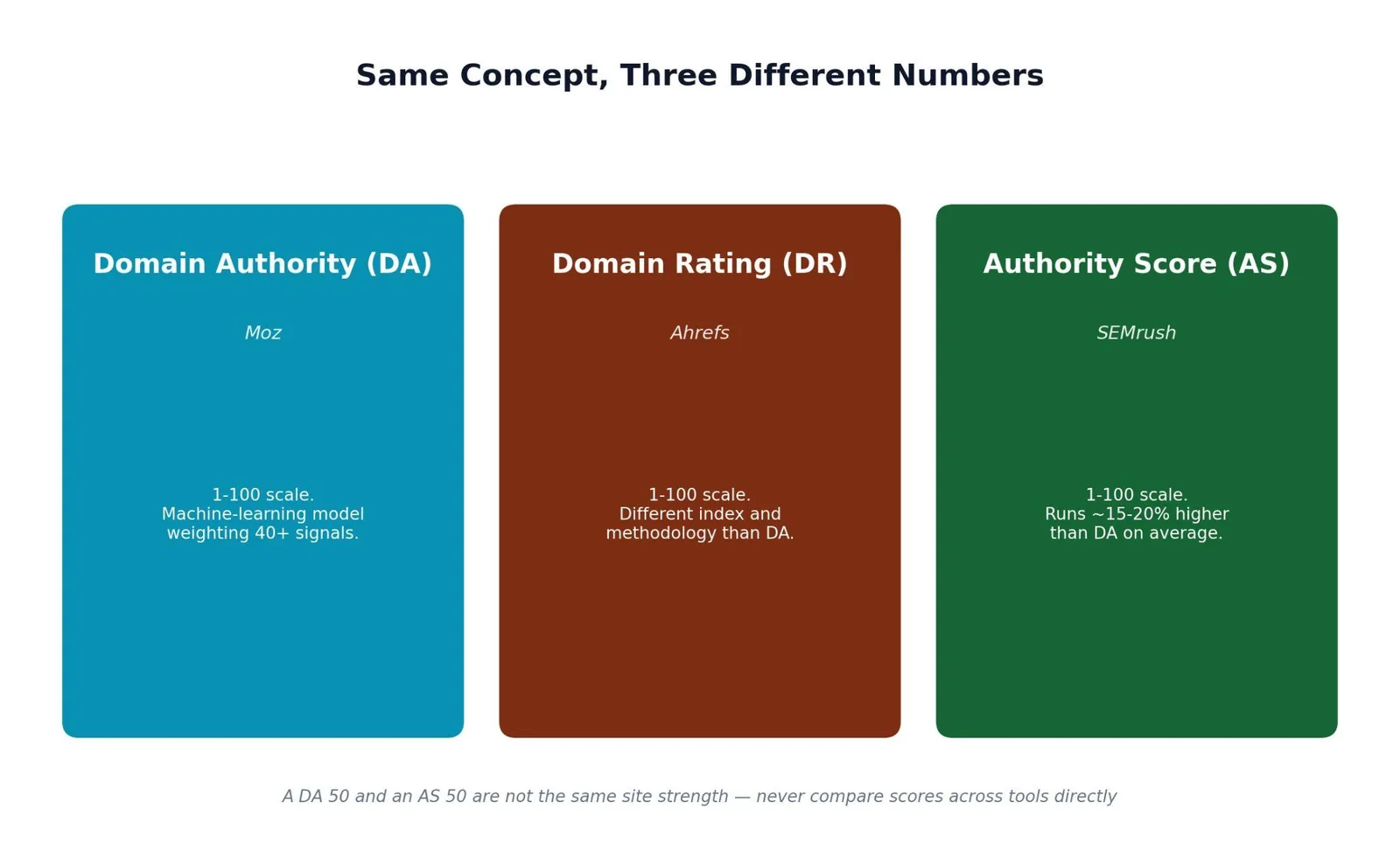
| Factor | Domain Authority (DA) | Domain Rating (DR) | Authority Score (AS) |
|---|---|---|---|
| Provider | Moz | Ahrefs | SEMrush |
| Scale | 1-100 | 1-100 | 1-100 |
| Primary input | Linking root domains, link quality, Spam Score | Backlink profile via Ahrefs' own index | Link power, organic traffic, spam factors |
| Used by Google | No | No | No |
| Update frequency | Roughly monthly | Continuous, via Ahrefs' crawler | Continuous, via SEMrush's index |
| Cross-tool comparability | Not directly comparable to DR or AS | Not directly comparable to DA or AS | Runs ~15-20% higher than DA on average |
The practical takeaway: never mix scores from different tools in the same comparison, and never treat any single number as a verdict on your site's website authority on its own. If a competitor reports "our site scores 60," the first question worth asking is which tool produced that number — an Authority Score of 50 is roughly equivalent to a DA of 40 to 43, not a DA of 50, and the comparison against competitors, built on genuinely high quality content and links, is what actually tells you something.
What's a Good Domain Authority Score?
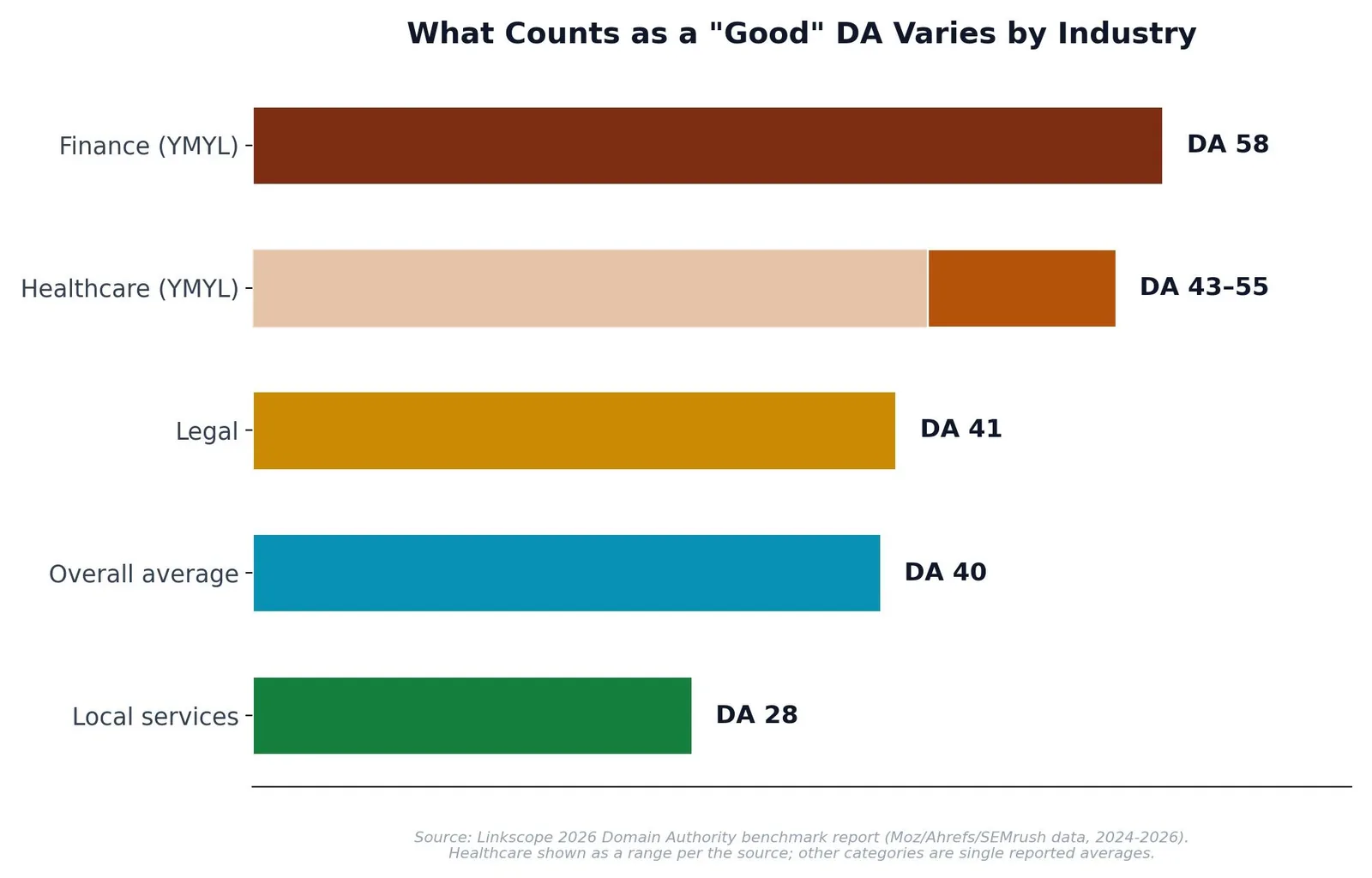
There's no universal answer, because the right DA target depends entirely on who you're actually competing against. A DA of 28 might dominate a local market and mean almost nothing in a national one. A 2026 benchmark analysis of Moz, Ahrefs, and SEMrush data (Linkscope, 2026) found that #1 Google positions average a DA of 68, with top 10 results averaging between DA 51 and 71. Sites with DA 60 or higher are roughly 2.1 times more likely to land in the top 10 for competitive terms.
Industry matters just as much as position. Local service businesses average around DA 28; a local roofing company with DA 15 can still outrank much larger competitors for searches in its own town, because local relevance, reviews, and a well-optimized Google Business Profile outweigh raw authority at that scale. YMYL categories run considerably higher: finance averages DA 58, with the top 10 percent needing DA 75 or more; healthcare sits in a DA 43 to 55 range; legal averages DA 41, with top performers around DA 58-plus. The comparison that actually matters isn't the number in isolation, it's the number against the sites currently ranking for your target keyword.
Is Your Approach to Domain Authority on Track?
Domain authority reality check
Is your approach to DA on track?
Check off what's already true for how your team uses this metric.
0 of 5
Check off items above to see where your approach stands.
How to Actually Increase Domain Authority
Since DA is a downstream measurement, not a direct target, the tactics that raise it are the same tactics that build real SEO strength. Before chasing any of this, run your own site and your closest competitors through a free DA checker or authority checker tool (Moz offers one directly) so you're working from real numbers, not assumptions, and repeat the comparison every few months, since inbound links and competitor movement both shift the picture over time.
Earn backlinks from relevant, high-traffic sites rather than accumulating raw link volume; a hundred backlinks from one domain still counts as a single linking root domain, so diversifying sources matters more than stacking links from the same place. Digital PR and genuine guest contributions to real industry publications tend to outperform link-building tactics that chase volume alone. Creating linkable assets, original research, data studies, and genuinely comprehensive guides other sites want to cite, is what earns the kind of links that move DA sustainably. And removing genuinely toxic or spammy links protects against drops, though it rarely produces gains on its own; the larger impact always comes from earning new, quality links.
Common Misconceptions About Domain Authority
The most common one is treating DA as a Google ranking factor, which leads teams to chase the number directly instead of the backlink quality behind it. A close second is comparing DA against a fixed "good" target rather than against the sites actually ranking for a target keyword; a DA of 28 is excellent in some categories and insufficient in others.
Mixing DA, DR, and Authority Score in the same comparison is a quieter mistake that produces genuinely meaningless conclusions, since the three tools use different data and different formulas. And assuming a low DA means a site can't rank ignores how much relevance, content depth, and local signals can outweigh raw authority, especially for local businesses and specific, well-targeted keyword clusters.
Frequently Asked Questions
Is Domain Authority a Google ranking factor?
No. Domain Authority is a third-party metric created by Moz. Google has stated repeatedly that its algorithm does not read or use the DA score, though a 2024 leak did confirm Google has its own separate internal site-authority signal.
What is a good Domain Authority score?
It depends on the industry and competition. Local service businesses average around DA 28; competitive YMYL categories like finance can require DA 58 or higher. Compare your score against the sites actually ranking for your target keywords, not a universal number.
Why do my DA, DR, and Authority Score numbers all differ?
Moz, Ahrefs, and SEMrush each use their own index and methodology. The scores are not directly comparable; Authority Score, for example, tends to run 15 to 20 percent higher than an equivalent DA score.
How often does Domain Authority update?
Moz updates its Domain Authority index roughly once a month, so scores can fluctuate even without any changes to your own site, since the model is partly relative to what competitors are doing.
Can a website with low Domain Authority still rank well?
Yes, particularly for local businesses and specific, well-targeted keywords. Relevance, content depth, and local trust signals can outweigh raw authority, especially against less-competitive search terms.
The Bottom Line on Domain Authority
Domain Authority is useful as a comparison tool and genuinely misleading as a goal. It reports the strength of a backlink profile; it doesn't decide anything in Google's algorithm. The teams that get the most out of it treat the number as a dashboard light, not the engine, and focus their actual effort on the backlinks, content, and relevance that move both DA and rankings together.
Start by checking your DA against your three closest ranking competitors rather than against an abstract benchmark. That comparison tells you far more than the number alone ever will.
Want Help Turning Authority Into Rankings?
Understanding what Domain Authority measures is one thing; building the backlink profile, content, and technical foundation that actually earns it is another. Web Tonic's growth marketing team handles the link building, content strategy, and technical SEO covered in this guide as part of a full-funnel approach, so authority-building work ties directly to ranking and traffic goals instead of a number in isolation.
More from Web Tonic: growth marketing services, data & analytics.
Sources: clickrank.ai · searchenginejournal.com · linkscope.io · ritnerdigital.com · searchengineland.com