Table of contents
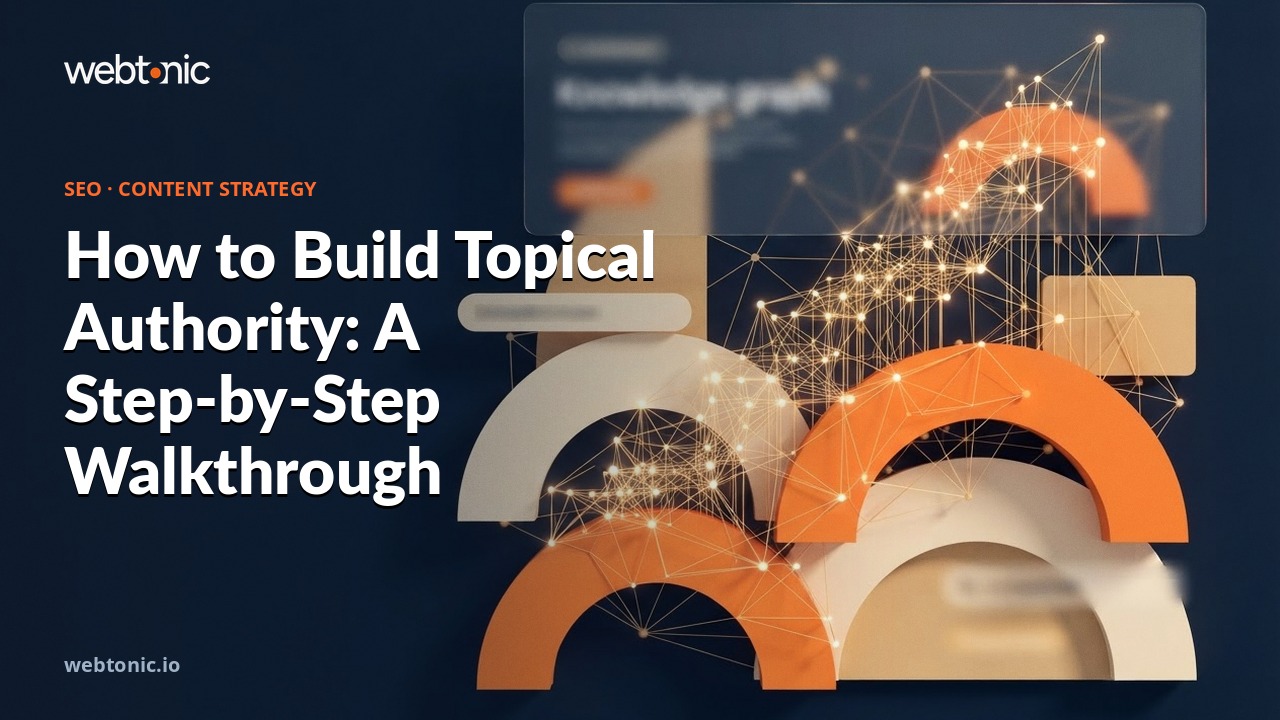
Most sites publish content one keyword at a time and wonder why rankings stay fragile. Topical authority is the alternative: instead of chasing individual terms, you build a connected body of content that makes Google, and increasingly AI systems, treat your site as the genuine expert on a subject. This guide walks through exactly how that gets built, step by step.
Key Takeaways
- Topical authority is a site's perceived expertise on a specific subject, built through comprehensive, interlinked content rather than isolated keyword-targeted pages.
- The pillar-cluster model is the dominant architecture for building it: one comprehensive pillar page surrounded by 8 to 20 supporting cluster articles, all linked bidirectionally.
- Content grouped into topic clusters drives approximately 30% more organic traffic and holds rankings roughly 2.5 times longer than standalone pieces, according to a 2025 analysis cited by Search Engine Land.
- Topical authority and domain authority (DA) are different things; a site can have strong topical authority in one niche while carrying a modest overall DA score.
- Google's own John Mueller has described internal linking as one of the most important things a site can do to guide both Google and visitors toward the pages that matter most.
- Building topical authority is a multi-month process; cluster performance typically compounds over 6 to 12 months rather than showing results overnight.
What Is Topical Authority?
Topical authority is the degree to which Google, and search systems more broadly, consider a website a reliable, comprehensive source on a specific subject. It's specific to a subject, in other words, rather than a general reputation score, and no single search engine publishes this as a visible metric. Domain authority is often treated as a vanity metric, whereas topical authority represents genuine, tangible ranking power; its effects show up clearly in that a site with real topical authority ranks for unoptimized long-tail variations, earns citations in AI Overviews, and gets treated as a recognized entity for brand-plus-topic searches.
A quick terminology note before going further. Whether you call it building topical authority, topic authority, or authority SEO, the underlying idea is consistent. A topic cluster (or topic clusters, plural, when discussing several at once) is the structural expression of that idea, and pillar content is the hub that holds one together. High quality content is necessary but not sufficient on its own: without deliberate structure, even great blog post content and strong content marketing efforts stay isolated from each other, whether the underlying pages are keywords-driven blog content, PPC landing pages, or product pages managed through a CMS. This applies at any scale, from a small blog to a site the size of Amazon's help center or a community platform like Reddit. A site in San Francisco or anywhere else follows the same mechanics; location doesn't change how search engines evaluate topic clusters or search intent, though it can shape which specific topics and keywords are worth pursuing, and Google Analytics data on which topics already draw engaged readers is often the fastest way to decide where to start.
A quick distinction worth making upfront: topical authority isn't domain authority (DA); DA is a generic, site-wide metric built mostly from backlink volume, while topical authority is specific to one subject area and can be genuinely strong even on a site with a modest overall DA. A site with 30 backlinks perfectly aligned with one defined topic can outrank a site with 300 scattered, unfocused links.
The Pillar-Cluster Model

The architecture that reliably builds topical authority is the pillar-cluster model: one comprehensive pillar page covering a broad topic, surrounded by a set of focused cluster articles that each go deep on one specific subtopic. A typical pillar runs 2,500 to 4,000 words and acts as the canonical reference for the whole topic, while cluster articles run roughly 800 to 1,500 words each, targeting a specific long-tail keyword or user question. Most well-built clusters carry 8 to 20 supporting articles per pillar, though this scales with how broad the core topic actually is.
Content grouped into topic clusters drives approximately 30% more organic traffic and holds rankings roughly 2.5 times longer than standalone pieces, according to a 2025 analysis by HireGrowth cited by Search Engine Land. The mechanism works because it mirrors how both humans and AI systems build understanding of a subject: a central concept surrounded by clearly related specifics. Google's Helpful Content system specifically evaluates the depth and breadth of a site's coverage across a topic, and a site with twenty interconnected articles on a subject will consistently outperform a site with a single, longer article on the same subject, even when that single piece is well written.
Internal Linking: The Connective Tissue
Bidirectional internal linking is what actually makes the pillar-cluster structure function as a unit rather than a pile of unrelated pages. Every cluster article should link back to the pillar using anchor text that includes the pillar's target keyword, and the pillar should link out to every cluster page it supports. Google's own John Mueller has described internal linking as one of the single biggest things a site can do to guide both Google and visitors toward the pages it considers important.
A reasonable starting point is 3 to 5 contextual internal links per article, placed naturally in the body rather than bolted on as a link list at the bottom. Pillar pages naturally carry more links than cluster pages, since they shoulder the hub role for the entire topic. Watch specifically for orphan pages: content showing impressions in Google Search Console but zero internal links pointing to it is often ranking on its own despite the site's link structure actively working against it, which makes it one of the highest-return fixes available in any internal linking audit.

A Real Example of the Model at Work
Ahrefs' own Beginner's Guide to SEO pillar page illustrates the compounding effect well: as of March 2026 data, that single pillar page reportedly earns an estimated 2,900 organic visits per month and has attracted backlinks from 649 unique referring domains. When a pillar page earns external backlinks, that authority cascades into the cluster network through the internal links; when a cluster page earns its own backlinks independently, the link back to the pillar amplifies the hub in return. That's the self-reinforcing loop the whole model depends on.
How to Avoid Keyword Cannibalization
One real risk inside cluster architectures is keyword cannibalization: if a cluster page's topic overlaps too closely with the pillar's own coverage, Google can struggle to determine which page should actually rank for a given query, and either page can end up ranking for the wrong term. Before adding new clusters, audit existing content first. Merge pages that are cannibalizing each other, fold or noindex genuine orphans, and tighten internal links across what already exists before expanding into new subtopics.
Table 1: Pillar Page vs. Cluster Article
| Element | Pillar page | Cluster article |
|---|---|---|
| Word count | 2,500-4,000 words | 800-1,500 words |
| Scope | Broad topic overview | One specific subtopic or question |
| Keyword target | High-volume, broad head term | Specific long-tail keyword |
| Role | Canonical hub, links out to every cluster | Supports the pillar, links back to it |
| Typical count per topic | One | 8-20 |
Topical Authority in the Age of AI Search
As AI Overviews, Gemini, and other answer engines increasingly shape how people find information, topical authority matters for a second audience beyond traditional search: the AI systems themselves. Answer engine optimization (AEO) rewards sources that read as coherent topical authorities, since a well-linked cluster presents a clear, citable structure that AI summarization systems can read holistically rather than page by page. Some emerging AI tooling, including protocols like MCP that let AI agents pull structured context directly from a site, make that same clear internal architecture even more valuable, since a messy, disconnected site gives an AI agent far less to work with than a properly linked cluster does.
Table 2: SEO Tools for Building Topical Authority
| Tool | What it helps with | Cost (USD) |
|---|---|---|
| Semrush | Topic research, content gap analysis, cluster tracking | From ~$140/month |
| Ahrefs | Keyword clustering, internal link auditing, backlink tracking | From $129/month (Lite) |
| Google Search Console | Finding orphan pages, tracking impressions by query | Free |
| Google Keyword Planner | Broad topic and subtopic keyword discovery | Free with a Google Ads account |
Common Mistakes When Building Topical Authority
Pillar pages are navigators, not just longer posts; they set the scope, define the vocabulary, and route the reader to the right depth at the right time. Losing sight of that purpose is often where these mistakes start.
Three pillars started at once, instead of completing and validating one before scaling to the next.
No cluster map, with content published page by page and individual articles left isolated with no internal links tying them together.
Cluster pages that cannibalize the pillar's own target keyword, splitting ranking signal between competing pages.
Success measured page-by-page instead of at the cluster level, missing the compounding effect the whole structure is built to create.
Domain authority mistaken for topical authority, when a site can have one without the other in either direction.

Interactive checklist
Topical authority readiness checklist
0 of 10 checked
Frequently Asked Questions
How Long Does It Take to Build Topical Authority?
Cluster performance typically compounds over 6 to 12 months rather than producing overnight results. Google's John Mueller has noted that changes to a small number of important pages can show up within a week or two, but larger structural changes generally take longer to settle into stable rankings.
How Many Cluster Articles Does a Pillar Page Need?
Most well-built clusters run 8 to 20 supporting articles per pillar, though the right number depends on how broad the core topic is. Starting with 3 to 5 cluster articles and expanding gradually based on performance is a reasonable way to begin.
Is Topical Authority the Same as Domain Authority?
No. Domain authority is a generic, site-wide, third-party metric built mostly from backlink volume. Topical authority is specific to one subject and reflects how comprehensively and coherently a site covers that particular topic, regardless of its overall DA.
What's the Biggest Mistake Sites Make When Trying to Build Topical Authority?
Publishing content without a cluster map. Individual articles written in isolation, with no deliberate internal linking plan connecting them, rarely accumulate into real topical authority no matter how good each piece is on its own.
Does Topical Authority Matter for AI Search, Not Just Google?
Yes, increasingly so. AI Overviews and other answer engines favor sources that present coherent, comprehensive topic coverage, since a well-structured cluster is easier for an AI system to read holistically and cite confidently than a collection of disconnected pages.
The Bottom Line on Building Topical Authority
Topical authority comes down to structure and repetition: pick one topic worth owning, build a genuinely comprehensive pillar page, surround it with focused cluster content, and link everything together deliberately rather than hoping search engines connect the dots on their own. None of this happens overnight, but every properly linked cluster compounds in a way that isolated articles never do.
Pick the one topic your site is best positioned to own, and map out what a genuine 8 to 20 article cluster around it would actually look like. That single exercise usually reveals exactly how much content, and how much internal linking work, stands between where the site is now and real topical authority.
Ready to Build Real Topical Authority?
Topical authority takes deliberate content architecture, not just more publishing volume, and that planning work is exactly where most content strategies fall short. Web Tonic's growth marketing team builds pillar-cluster architecture into every content strategy engagement, so the content produced compounds into real authority instead of sitting as isolated pages.
More from Web Tonic: growth marketing services, data & analytics.
Sources: sedestral.com · posicionament-web.cat · wellows.com · searchengineland.com · digitalapplied.com · clickrank.ai · brandvm.com