Table of contents
If you've spent any time in SEO, you've seen the number. Domain Authority, a score from 1 to 100 built by Moz, sitting on every site audit and competitor report. People chase it, brag about it, and sometimes panic when it drops five points overnight. Almost none of that reaction has much to do with what actually moves rankings.
Domain Authority (DA) predicts how likely a website is to rank well in search results, based mostly on the size and quality of its backlinks profile. It is not a Google ranking factor: Google's own team has said so repeatedly (Ahrefs Help Center), and Moz itself frames DA as a comparative tool, not a scoreboard. Still, DA correlates with real search performance often enough that learning how to increase domain authority the right way, through the same work that earns rankings, is worth doing properly rather than chasing the number directly.
Key Takeaways
- Reported benchmarks for "average" Domain Authority vary sharply by source: AgencyAnalytics, using data from 150,000+ real agency campaigns, puts the median at DA 19, while other benchmark studies report medians closer to DA 30-35. What's consistent across every source: the large majority of sites never reach DA 50-60+. (AgencyAnalytics, Ritner Digital)
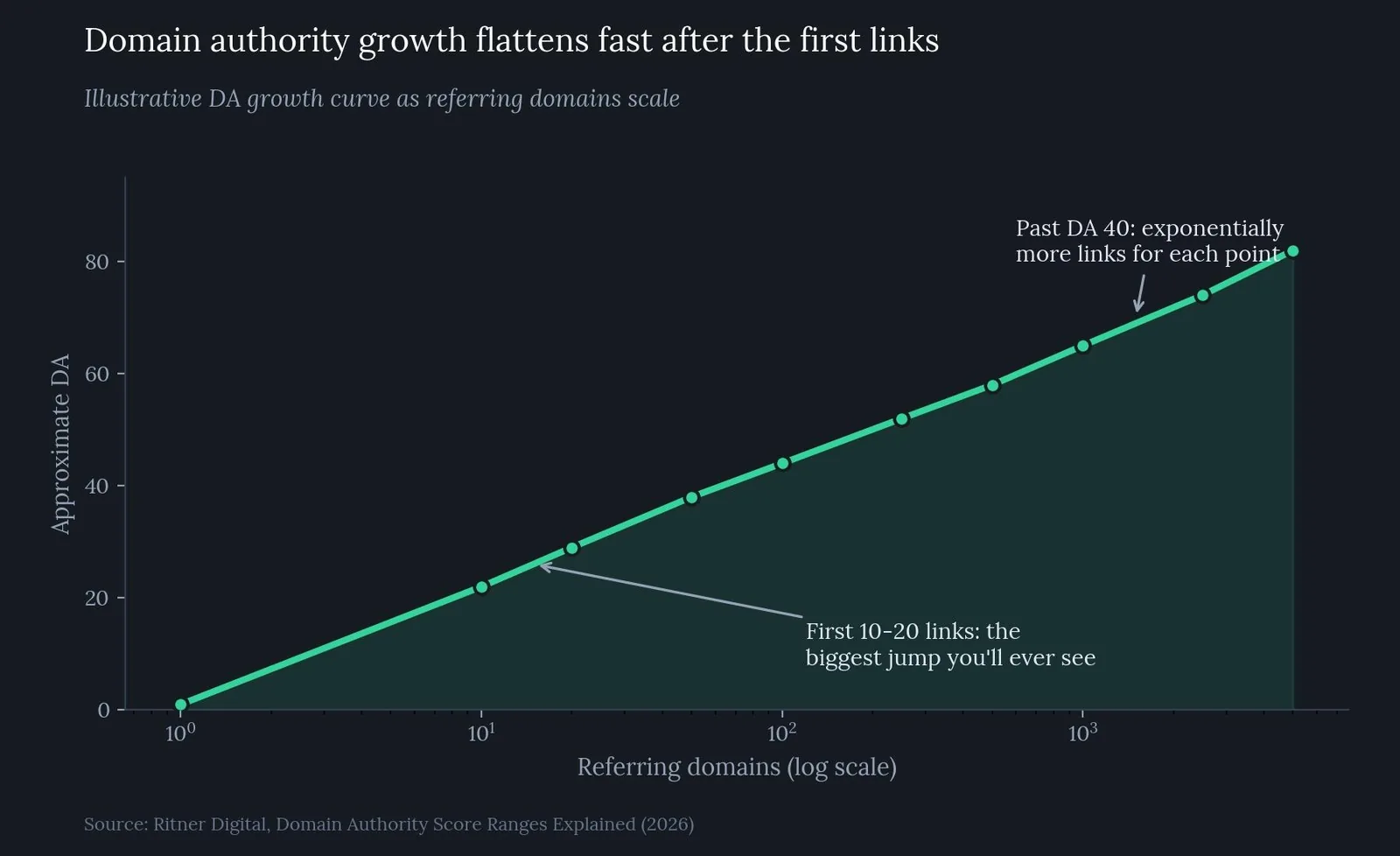
- The first 10 to 20 referring domains produce the biggest jump in domain authority a site will ever see, often moving a new domain from DA 1-10 up to DA 20-30. Growth past that point requires exponentially more links. (Ritner Digital)
- Above DA 40, the quality of referring domains matters roughly three times more than the raw quantity of links.
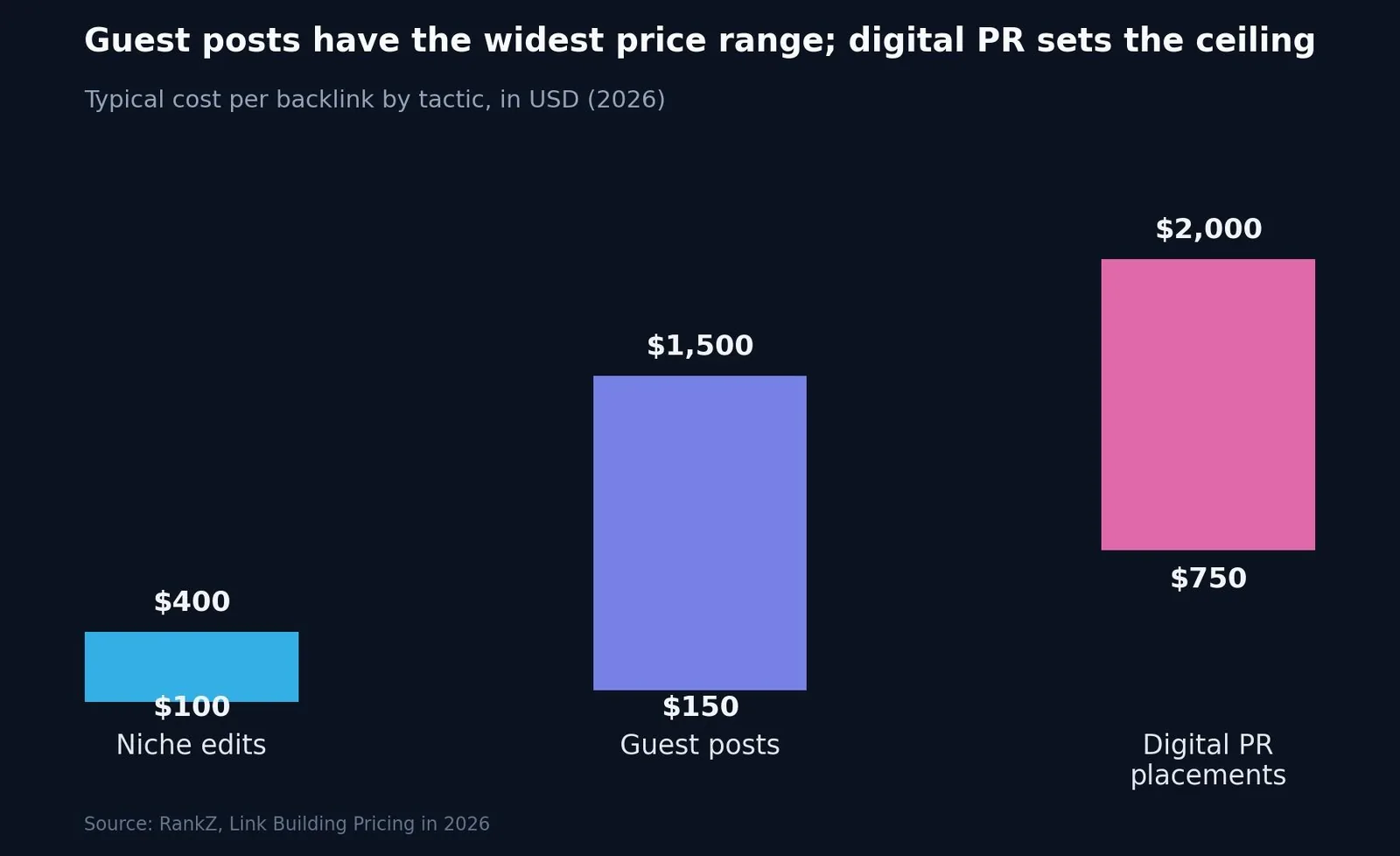
- A typical high-quality backlink costs $300 to $600 in the United States in 2026, with premium editorial placements from digital PR campaigns running $750 to $2,000 or more. (RankZ)
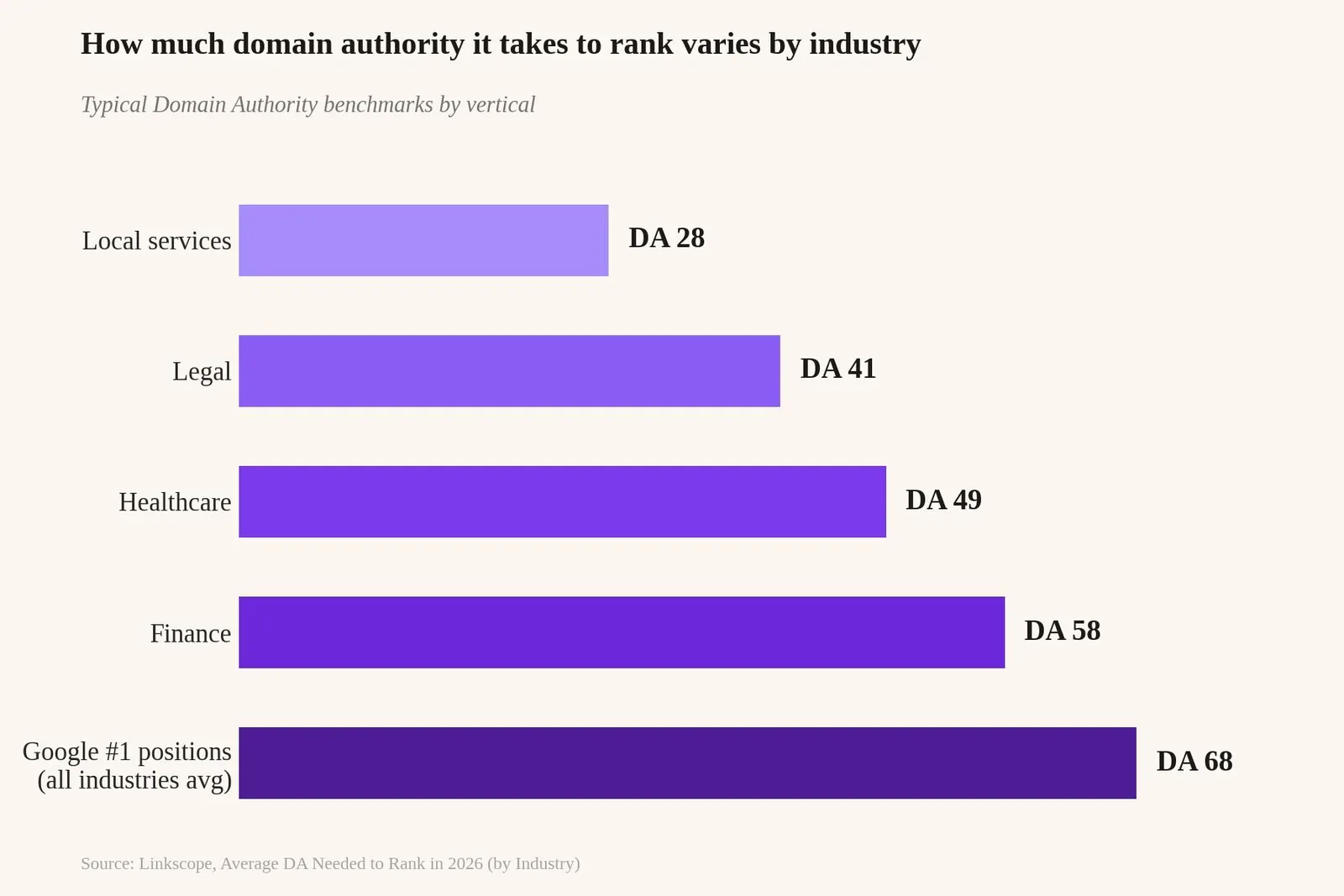
- How much domain authority it takes to rank varies sharply by industry: local services average DA 28, legal averages DA 41, healthcare sits between DA 43 and 55, and finance averages DA 58, while Google's #1 positions average DA 68 across all industries. (Linkscope)
- Removing toxic backlinks protects a site from future drops but rarely produces meaningful gains on its own. Earning new high-quality links is what actually increases domain authority.
What Is Domain Authority, and Why Doesn't Google Use It?
Domain Authority is a score developed by Moz's Domain Authority model that predicts how likely a domain is to rank on search engines compared to other domains competing for the same terms. It runs on a logarithmic 1 to 100 scale, so moving from DA 20 to 30 takes meaningfully less link equity than moving from DA 70 to 80. Page Authority (PA) is the page-level equivalent of the same idea, measuring a single URL's ranking potential rather than the whole domain.
Two things are worth separating clearly. First, Domain Authority is not a Google metric. Google's own analyst John Mueller has confirmed directly that "we don't have anything like a website authority score" (Ahrefs Help Center). Second, other tools measure a similar concept under different names: Ahrefs calls its version Domain Rating (DR), and Semrush's Authority Score (AS) does something comparable using link power, organic traffic, and spam signals (Ritner Digital). All three tools crawl different slices of the web, so a DA of 40 on Moz won't match Ahrefs' DR or Semrush's Authority Score exactly, and mixing scores from different tools in one comparison produces meaningless data. Many teams use "Domain Authority" as informal shorthand for website authority in general, but DA is ultimately just one authority metric among several worth tracking alongside DR and Authority Score.
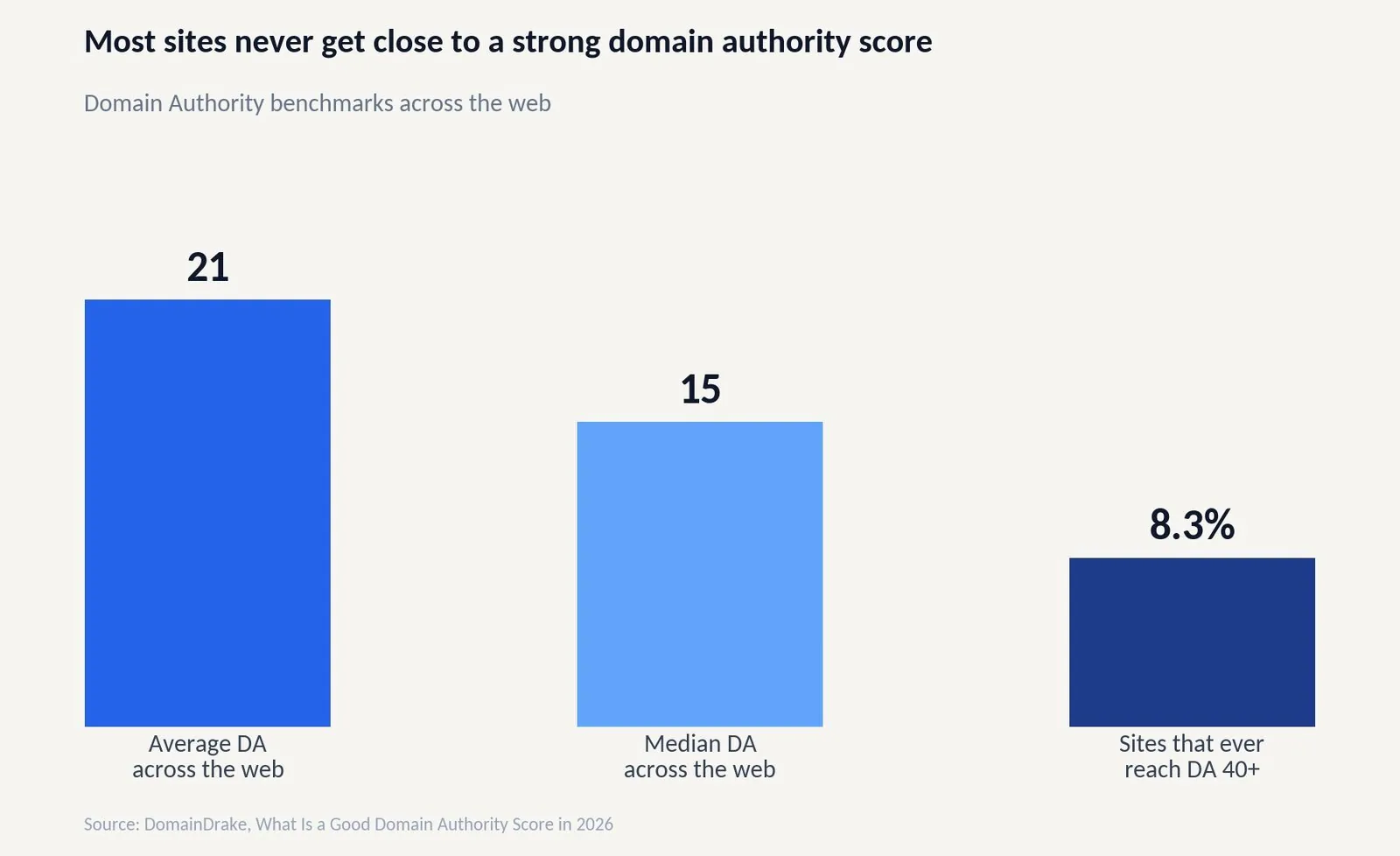
Context matters more than the number itself, and here's a case in point: ask five different SEO sources what the "average" Domain Authority is, and you'll get five different answers. AgencyAnalytics, drawing on 150,000+ real agency campaigns, reports a median DA of 19. RankTracker and Ritner Digital's benchmark studies put the median closer to 30-35. DomainDrake cites Moz's own Top 500 index for an average of 21 and a median of 15. The discrepancy likely comes down to sample composition: agency client bases skew toward younger, smaller sites, while broader web-crawl samples pull in more established domains. The one thing every source agrees on: most sites, by any measure, sit well short of DA 50-60+. Backlinko founder Brian Dean's own analysis of 11.8 million Google search results found that backlink authority and referring-domain diversity were among the factors most strongly associated with first-page rankings, while site speed and schema markup showed no correlation at all (Backlinko). That's the real mechanism behind DA's usefulness: a strong backlink profile is what earns the ranking, and the DA score is just a downstream readout of that same profile.
How Domain Authority Is Calculated
| Metric | Company | Scale | What it measures |
|---|---|---|---|
| Domain Authority (DA) | Moz | 1-100 | Predicted domain-level ranking strength based on linking root domains, total links, and Spam Score |
| Domain Rating (DR) | Ahrefs | 1-100 | Backlink profile strength based on referring domains and link equity flow |
| Authority Score (AS) | Semrush | 1-100 | Link power, organic traffic, and spam-pattern signals combined |
| Page Authority (PA) | Moz | 1-100 | Ranking potential of a single page rather than the whole domain |
Moz's model factors in linking root domains, total inbound links, MozRank link-equity flow, MozTrust, and anchor text distribution, then applies a Spam Score adjustment that pulls the number down when a profile shows manipulation patterns. Sites like Wikipedia, Forbes, The New York Times, Apple, Amazon, and LinkedIn sit at the very top of the DA scale for a simple reason: decades of organic, editorial links from high-quality websites have built genuinely deep backlink profiles. Nobody there was optimizing for the metric itself.
1. Audit your current backlink profile. Before building anything new, pull your website domain profile in Ahrefs, Semrush, or Moz's own Link Explorer and see what's already pointing at your site. Google Search Console's Links report is a free starting point for identifying your top linking sites and anchor text patterns. Note which links carry a rel="ugc" or rel="nofollow" attribute, since Google treats user-generated comment and forum links differently from editorial ones, and they contribute little to DA on their own.
2. Earn quality backlinks, don't buy volume. The first 10 to 20 referring domains move the needle more than almost anything else you'll do, but past DA 40, quality backlinks from relevant, high-authority sites matter roughly three times more than additional link volume. A single link from a genuinely relevant, high-traffic site outweighs dozens of low-quality directory links. This is the single most direct way to improve domain-level trust signals over time.
3. Publish content that earns links on its own. Original research, well-sourced data, and genuinely useful guides attract natural backlinks without outreach. High-quality content is still the foundation search engines and other sites reward with links.
4. Strengthen internal links. Internal links distribute link equity across your site and help search engines understand which pages matter most. A page with strong external backlinks can pass authority to related pages through a deliberate internal linking structure.
5. Fix technical and user experience issues. Site speed, mobile usability, and clean architecture don't directly move Domain Authority, but they support the organic traffic and engagement that make a site worth linking to in the first place, and they matter for actual Google rankings regardless of DA.
6. Clean up toxic links, then keep building. Removing spammy or manipulative backlinks protects against future Spam Score penalties, but it rarely produces a meaningful DA increase by itself. Treat cleanup as risk management, not a growth strategy.
7. Build local and branded signals. Claiming and optimizing a Google Business Profile, earning mentions on social media, and building consistent citations all contribute supporting trust signals, particularly for local and multi-location sites.
8. Monitor progress with Google Analytics and Search Console. Track referring domains, organic traffic, and top linking pages monthly rather than checking your DA score daily. Domain Authority updates irregularly as Moz refreshes its index, so scores can shift 5 to 15 points even when nothing on your site has changed.
How Domain Authority Requirements Vary by Industry
| Industry | Typical DA to compete | Notes |
|---|---|---|
| Local services | ~28 | Lower competition, geo-specific relevance matters more than raw score |
| Legal | ~41 | Top 10% of competitive terms need DA 58+ |
| Healthcare | 43-55 | YMYL content standards raise the bar for trust signals |
| Finance | ~58 | Top 10% of competitive terms need DA 75+ |
| Google #1 positions (all industries) | ~68 | Top 10 results average DA 51-71 |
Chasing an industry-wide benchmark is less useful than benchmarking against your three to five closest organic competitors using the same tool. A DA of 40 might be a strong lead in a niche with light competition and unremarkable in a sector dominated by established publishers. (Linkscope)
What It Costs to Increase Domain Authority Through Link Building
| Tactic | Typical cost per link (USD) | What you get |
|---|---|---|
| Niche edits | $100 – $400 | A backlink inserted into an existing, already-indexed page |
| Guest posts | $150 – $1,500 | A new article published on a third-party site with a contextual link — wide range depending on site quality |
| Digital PR placements | $750 – $2,000+ | Editorial coverage on high-authority publications, often with several backlinks per campaign |
Most businesses spend $3,000 to $10,000 a month on ongoing link building, with startups starting closer to $1,500 a month and competitive industries like finance or legal exceeding $15,000 a month (Outreach Desk). The average price SEO professionals consider acceptable for a single high-quality backlink sits at roughly $509, per a 2025 survey of link-building spend (Editorial.link). Extremely cheap links — dozens of backlinks for a few dollars — are almost always link farms or private blog networks that risk a Google penalty rather than a Domain Authority increase.
Common Mistakes That Stall Domain Authority Growth
The most common mistake is chasing the number instead of the underlying signal. Buying links purely to move a DA score, without regard for relevance or quality, tends to trigger Spam Score penalties that actively suppress the score further.
Content quality gets ignored just as often. Backlinks rarely arrive on their own for thin, generic content. Original research, well-cited guides, and genuinely useful resources are what other sites and social media accounts choose to link to.
A subtler mistake is mixing metrics from different tools. Comparing your Moz DA against a competitor's Ahrefs DR or Semrush Authority Score produces a false sense of the gap between you, since each tool crawls a different slice of the web using a different model.
Expecting fast results causes plenty of people to give up too early. Meaningful domain authority growth compounds over many months: a site chasing DA 40 in a focused niche typically gets there in around 18 months, versus closer to 26 months for a generalist site. (Launchcodex)
Frequently Asked Questions
How long does it take to increase domain authority? Most sites see meaningful movement over 6 to 18 months, depending on niche focus and link velocity. Niche-focused sites tend to reach DA 40 faster than broad, generalist domains.
What's the fastest way to increase domain authority? There's no shortcut that holds up over time. The fastest legitimate path is earning a handful of genuinely high-quality, relevant backlinks early, since the first 10 to 20 referring domains produce the largest jump in score you'll ever see.
Does Domain Authority directly affect Google rankings? No. Google's own team has repeatedly confirmed it doesn't use Domain Authority, Domain Rating, or Authority Score in its algorithm. DA correlates with rankings because both are driven by backlink quality, not because Google reads the score itself.
Is it worth buying backlinks to increase domain authority? Buying links from low-quality sources, including private blog networks or link farms, carries real penalty risk and rarely produces a lasting DA increase. Investing in relevant, editorially earned links costs more but is the only approach that holds up over time.
Should I remove toxic backlinks to increase my score? Cleaning up genuinely toxic or spammy links can prevent future drops and protects against algorithmic penalties, but it rarely increases domain authority on its own. Treat it as maintenance, not a growth tactic.
Building a genuinely strong backlink profile takes time, tooling, and outreach relationships most in-house teams don't have room to build from scratch. Web Tonic's Off-Site SEO service handles link building, digital PR, and domain authority development through high-quality backlink acquisition, for businesses that would rather hand off the outreach and keep the strategy.
Where Domain Authority Growth Actually Comes From
Domain Authority is a useful comparative signal, not a Google ranking factor, and treating it as one leads teams to chase the wrong tactics. Real, durable growth comes from earning quality backlinks, publishing content worth linking to, strengthening internal links, and fixing the technical and user experience issues that make a site worth recommending in the first place.
Start with a backlink audit, fix anything genuinely toxic, then focus every future link-building dollar on relevance and quality over raw volume. The score will follow the work, not the other way around.
More from Web Tonic: growth marketing services, data & analytics, performance creative.
Sources: help.ahrefs.com · agencyanalytics.com · ritnerdigital.com · rankz.co · linkscope.io · backlinko.com · outreachdesk.com · editorial.link · launchcodex.com