Table of contents

Type "domain authority vs domain rating" into Google and you'll find two camps: SEOs who swear by one metric over the other, and SEOs who think both are a waste of time. Domain authority and domain rating are two of the most-cited numbers in SEO, yet neither one is a ranking factor at Google, and mixing them up in a client report is an easy way to lose credibility fast.
This guide breaks down what each score actually measures, where the two numbers diverge, and when each one is genuinely useful instead of just a vanity metric to screenshot for a pitch deck.
Key Takeaways
- Domain Authority (DA) is a search engine ranking score developed by Moz that predicts a website's ability to rank on search engine result pages, on a scale of 1 to 100.
- Domain Rating (DR) is Ahrefs' equivalent, calculated at the domain level by looking at the quantity and quality of domains linking to a website, also scored on a 0-100 scale.
- Google has repeatedly confirmed that neither metric is a direct ranking factor, including several statements from John Mueller.
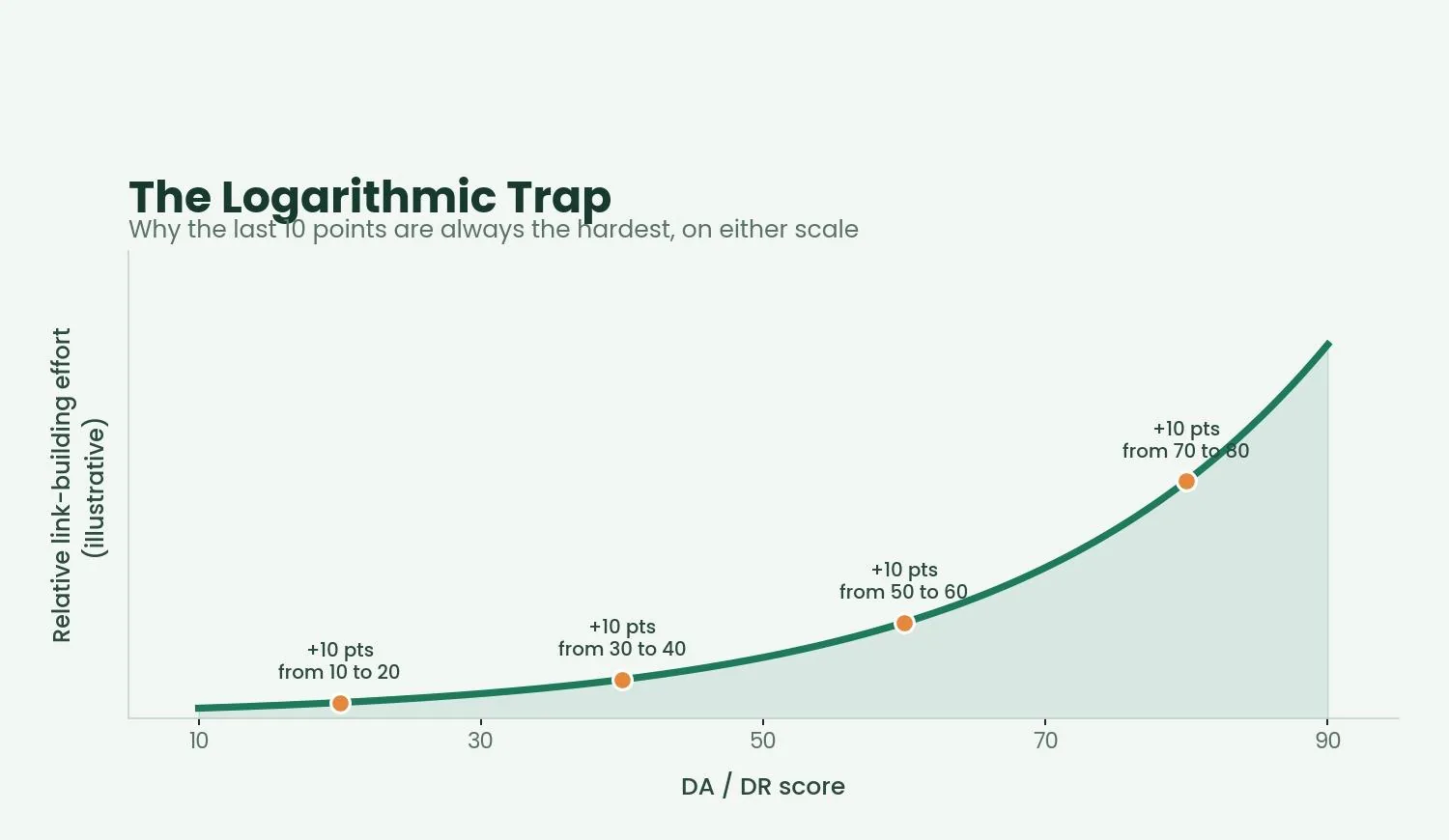
- Both scores are logarithmic, so moving from DA 20 to 30 takes far less link building effort than moving from 70 to 80.
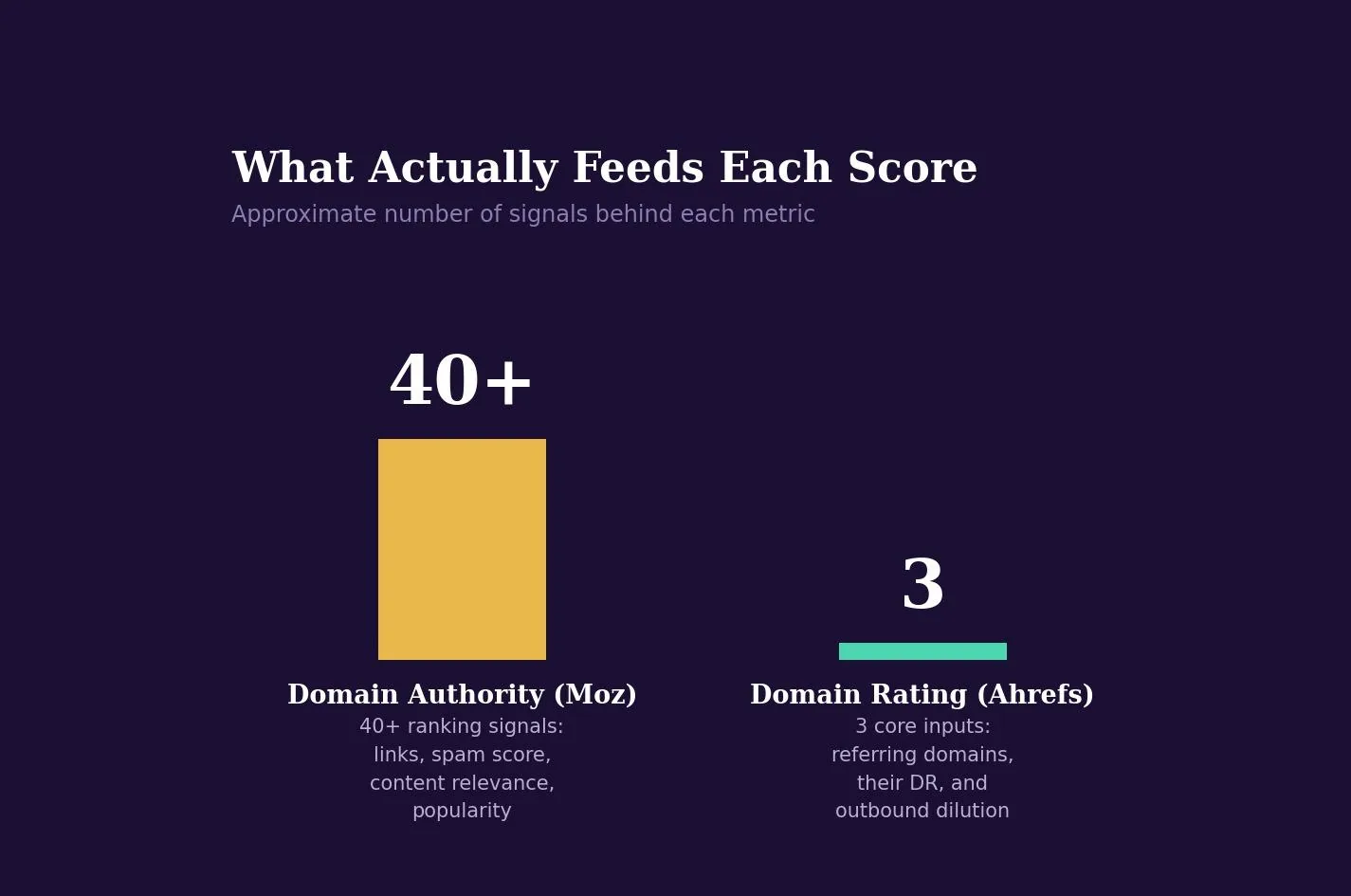
- DA is calculated from 40+ signals and is meant as a comparative metric; DR is built from three core factors: unique referring domains, the DR of those domains, and how many other sites each one links to.
- Neither score should replace organic traffic, keyword rankings, or conversions as your real measure of SEO success.
What Is Domain Authority (DA)?
Domain Authority is a search engine ranking score developed by Moz that predicts how likely a website is to rank on search engine result pages, based on factors such as link equity, content quality, and site popularity. Moz describes its calculation as coming from a machine-learning model that predicts how often Google is likely to serve a given domain in its results compared to other sites; if domain A shows up in Google's results more often than domain B, Moz expects domain A's DA to sit higher too.
DA draws on more than 40 signals, though the heaviest inputs are still link-based. Links from high-authority, relevant domains pass more weight than links from low-quality or unrelated ones, and diversity matters: a hundred links from a single domain contribute less than ten links from ten different authoritative domains. A spam score that flags manipulated link profiles factors in too, along with content relevance and overall site popularity, which is part of why DA and DR don't always agree on the same domain.
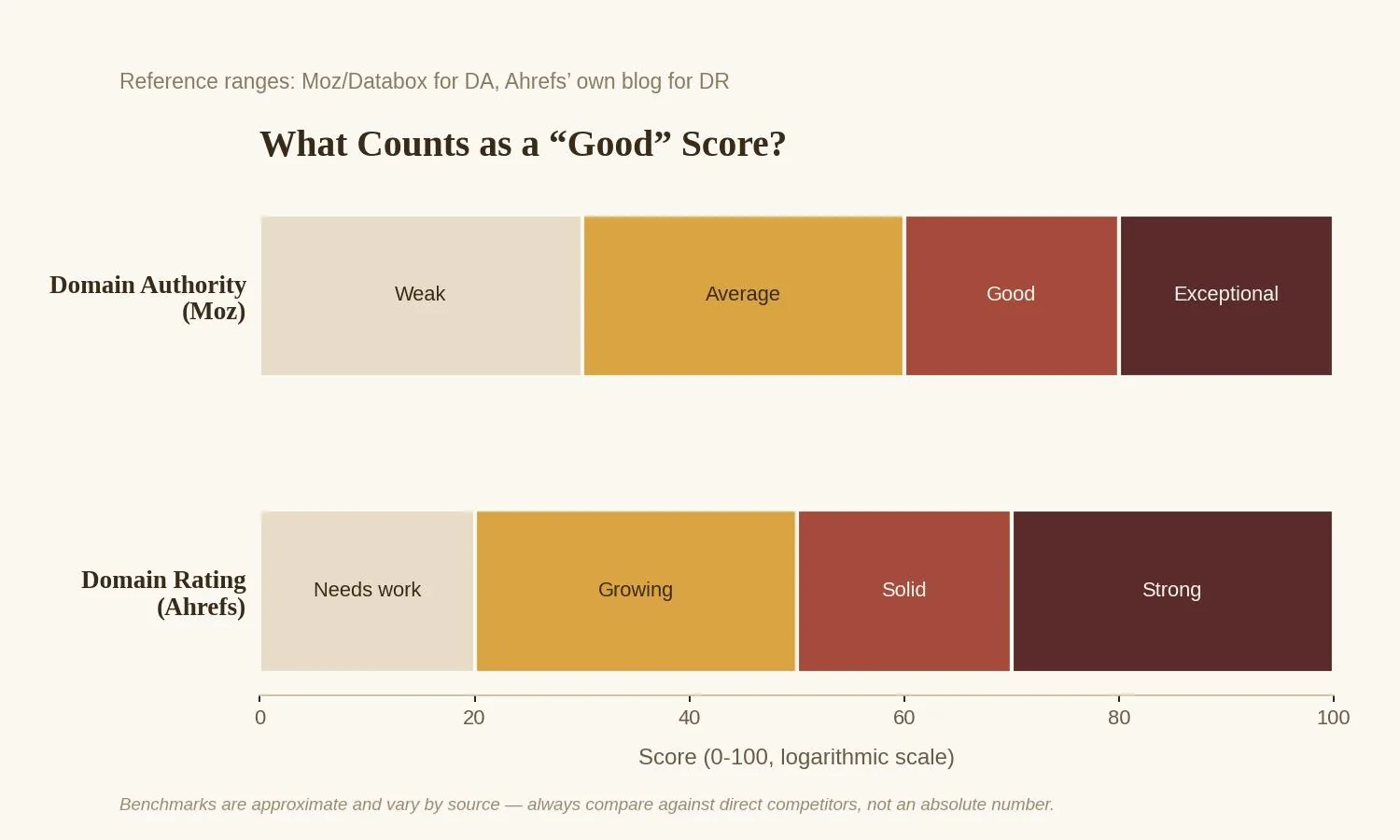
A DA of roughly 30-50 is generally considered average, scores above 60 are considered good, and anything above 80 is exceptional, though the useful comparison is always against your direct competitors rather than an absolute number. DA and Page Authority (PA) aren't the same thing either: DA scores your entire domain, while PA looks at the ranking strength of one individual page.
What Is Domain Rating (DR)?
Domain Rating is Ahrefs' own metric, measuring the relative strength of a website's backlink profile on the same 1-100 logarithmic scale. Where DA blends in a spam score and broader signals, DR stays narrower. It's calculated almost entirely from the number of unique referring domains pointing to a site, the DR of those linking domains, and how many other domains each one links out to.
That narrower formula is deliberate. Ahrefs calculates DR in a way that echoes PageRank, except PageRank works between pages while DR works between whole sites: Ahrefs finds every domain with at least one followed link to the target, checks how many other domains each of those linking domains points to, then passes along some "DR juice" accordingly. Because of this, a DR 100 site can't actually reach DR 101. When one domain picks up more backlinks, every other domain on the scale effectively gets nudged down relative to it. A link from a DR 80 site moves the needle far more than dozens of links from DR 10 sites, and only followed links count toward the score at all; nofollow, sponsored, and UGC links are excluded entirely.
Ahrefs' DR metric doesn't factor in a site's traffic, domain age, or the popularity of a parent brand; it's purely link-based by design. You can pull a site's DR for free through Ahrefs' Website Authority Checker: enter the URL and click Check Authority to see the report, which also surfaces referring domains, organic traffic, and top pages across small sites and enterprise websites alike.
Domain Authority vs. Domain Rating: Side by Side
| Factor | Domain Authority (Moz) | Domain Rating (Ahrefs) |
|---|---|---|
| Scale | 1 to 100, logarithmic | 0 to 100, logarithmic |
| Primary inputs | 40+ signals: backlinks, spam score, content relevance, popularity | Backlinks only: referring domains, their DR, and outbound link dilution |
| Google ranking factor? | No, confirmed repeatedly by John Mueller | No, confirmed by Ahrefs and Google |
| Best use case | Comparing overall site strength against direct competitors | Vetting link-building and guest-post prospects |
| Where to check it | Moz Link Explorer, MozBar | Ahrefs Site Explorer, free DR checker |
| Update frequency | Roughly monthly | Continuously, as the index refreshes |
| Vulnerable to manipulation? | Yes, through low-quality bulk link schemes | Yes, and often more easily, since it's link-count driven |
Is Domain Authority or Domain Rating a Google Ranking Factor?
No, and Google has said so directly, more than once. Search Engine Journal's reporting on Google's stance traces multiple statements from Google's John Mueller confirming that Moz's proprietary Domain Authority metric isn't something Google uses at all. In 2019, a Twitter user asked Mueller if a traffic drop was tied to a DA drop; he replied, "We don't use domain authority; that's a metric from an SEO company." A year later, he was blunter still: "Google doesn't use Domain Authority at all when it comes to Search crawling, indexing, or ranking." In a widely cited 2022 Reddit response, Mueller went further, admitting he'd never once looked up a site's DA in 14 years of doing SEO, and suggesting anyone chasing rankings would be better off focusing on a different metric entirely.
There's a nuance here, though: in a later interview, Mueller did acknowledge that Google has its own site-level signals that "map into similar things" as domain authority, describing them as less purely link-based and more about a general sense of trust. So while Google clearly isn't pulling a number from Moz or Ahrefs, it's not accurate to say Google has zero concept of domain-level trust either, just that it isn't the same metric, and it isn't public.
Ahrefs is equally direct about its own metric: DR is purely link-based and doesn't factor in traffic, domain age, or brand popularity, which is exactly why it was never designed to be an official ranking factor either. Both companies frame their scores as directional tools for SEOs, not as a mirror of Google's actual algorithm.
Why the Two Scores Often Disagree on the Same Domain
Because DA and DR are built from different formulas, it's completely normal for the same domain to show a DA of 45 and a DR of 62, or the reverse. DA folds in a spam score plus broader content and popularity signals; DR is almost entirely a function of referring domains and how much authority those domains pass along. A site with a small number of extremely powerful backlinks can post a strong DR while its DA lags, simply because Moz's model is weighing a wider set of inputs at once.
This is also where both scores become easiest to game. One SEO tool vendor ran an informal test: they hired several freelance "authority hackers" to inflate a handful of new domains, and found that Ahrefs DR was the easiest metric to manipulate through low-quality, bulk link schemes, with Moz DA not far behind. It's a small, single-source experiment rather than a rigorous study, but it lines up with what both companies already admit: a high number on either scale doesn't automatically mean a site earned its links the way Google actually rewards, through relevant, editorially placed backlinks rather than volume alone.
When Should You Actually Use Each Metric?
Use Domain Authority when you want a single number to compare your overall site strength against a handful of direct competitors, especially if you're already inside Moz's toolset for keyword and link tracking.
Use Domain Rating when you're vetting link-building or guest-post prospects one by one. Ahrefs itself frames DR as a strong metric for choosing which sites to build links from, which is exactly the specific question it answers well: "is this a site worth getting a link from," rather than a general SEO strategy scorecard.
Either metric can also help a CMO decide how much to trust a vendor pitch, or whether a proposed PPC budget shift toward organic makes sense. A domain with a track record of earning quality backlinks and quality links naturally is a safer long-term bet than one that inflated its numbers through bulk schemes, even if both currently show a similar score on paper.
Use neither as your primary KPI. Third-party authority scores are backward-looking, lagging indicators built from historical link data, not predictions of future performance. Organic traffic, ranking positions for keywords that matter to the business, and actual conversions remain the real scorecard; DA and DR are reference points for link building decisions, not a substitute for tracking results in Google Search Console.
How to Increase Domain Authority and Domain Rating
The overlap between the two is bigger than the differences, in practice. Both climb when a site earns more unique, relevant referring domains, particularly from sites that are themselves high-quality, rather than a large volume of low-value links from unrelated domains. Moz recalculates DA roughly once a month, so scores can shift even when a site hasn't changed anything, simply because the competitive landscape around it moved.
Consistent, genuinely useful content that earns natural backlinks from high quality publishers, a clean internal linking structure, and steady technical health all feed both scores indirectly. Both, in the end, are measuring how the rest of the web is choosing to link to a given domain.
Decision helper
Which metric should you use right now?
Pick the situation closest to what you're doing today. The recommendation updates instantly.
What are you trying to decide?
Frequently Asked Questions
Is a higher Domain Authority or Domain Rating always better?
Generally yes, but only relative to your specific competitors. Both scales are logarithmic, so a jump from DA 70 to 80 represents far more link building work than a jump from DA 20 to 30, and an absolute number means little without a competitor to compare it to.
Can Domain Authority and Domain Rating be manipulated?
Yes. Because both are calculated largely from backlink data, bulk low-quality link schemes can push either number up temporarily, with DR generally considered the more easily manipulated of the two. Google's own ranking systems aren't fooled by the same tactics, since they weigh relevance and quality far more heavily than raw link counts.
Do Moz and Ahrefs ever update how they calculate these scores?
Yes, both companies periodically refine their models. Moz recalculates Domain Authority roughly once a month, and Ahrefs continuously expands its link index, which is why a site's DR can shift even without any change to its own backlink profile.
Should a small business worry about a low Domain Authority or Domain Rating?
Not as a first priority. A local or niche site can often outrank far bigger domains for specific, well-answered search queries even with a modest DA or DR, since relevance, content quality, and user experience carry more weight for those queries than either metric.
Does Domain Authority or Domain Rating affect visibility in AI search results?
Neither is a confirmed, direct signal used by AI overviews or chatbot-style search tools. Some SEO commentators argue a strong backlink profile still correlates with the kind of established, trustworthy content those systems tend to cite, but that's an industry observation rather than something any AI provider has confirmed about how their systems actually weigh sources.
Picking the Right Number for the Job
Domain Authority vs. domain rating was never really a competition. They're two different measuring sticks built by two different companies, both approximating a concept, site authority, that Google has never scored the same way in public. Use DA when you need a quick comparative snapshot against competitors. Use DR when you're deciding whether a specific backlink opportunity is worth pursuing. And treat organic traffic, rankings, and conversions as the numbers that actually decide whether your SEO strategy is working.
Building a link building program that moves either number honestly, through relevant content and real backlinks rather than manipulation, is where most teams need outside help. Web Tonic's growth marketing team builds that kind of link and content program from the ground up, so the numbers move because the underlying SEO is actually improving.
More from Web Tonic: growth marketing services, data & analytics.
Sources: Moz · Ahrefs · Semrush · Google Search Central