Table of contents
A view-through conversion (VTC) is a sale or lead recorded when someone sees your display or video ad, does not click it, and later converts on your site. Google Ads reports it in a separate column and never mixes it into biddable click data.
Key Takeaways
- On the Google Display Network a view-through conversion needs a viewable impression: at least 50% of the ad onscreen for at least 1 continuous second, per Google's Active View standard.
- The last viewable impression gets the credit, and Google automatically excludes anyone who also interacted with one of your other ads.
- VTCs sit in the "VTCs" and "All conversions" columns only — never in the biddable "Conversions" column.
- A video "view" requires 30 seconds of watch time (or the full ad if shorter); an impression is a much weaker signal than that.
- VTCs from browsers that block cross-site cookies cannot be reported at all, so the number is structurally incomplete.
- Treat VTCs as a directional signal weighted 10–30% of a click-through conversion until a holdout test proves otherwise.
What the metric actually measures
Google's own definition is narrow: the "VTCs" column tells you when customers view, but don't interact with your ad and later complete a conversion on your site (Google Ads Help: understand your conversion tracking data). That makes it an impression-attributed metric, not an engagement metric. Everything else in your conversion reporting starts with a click.
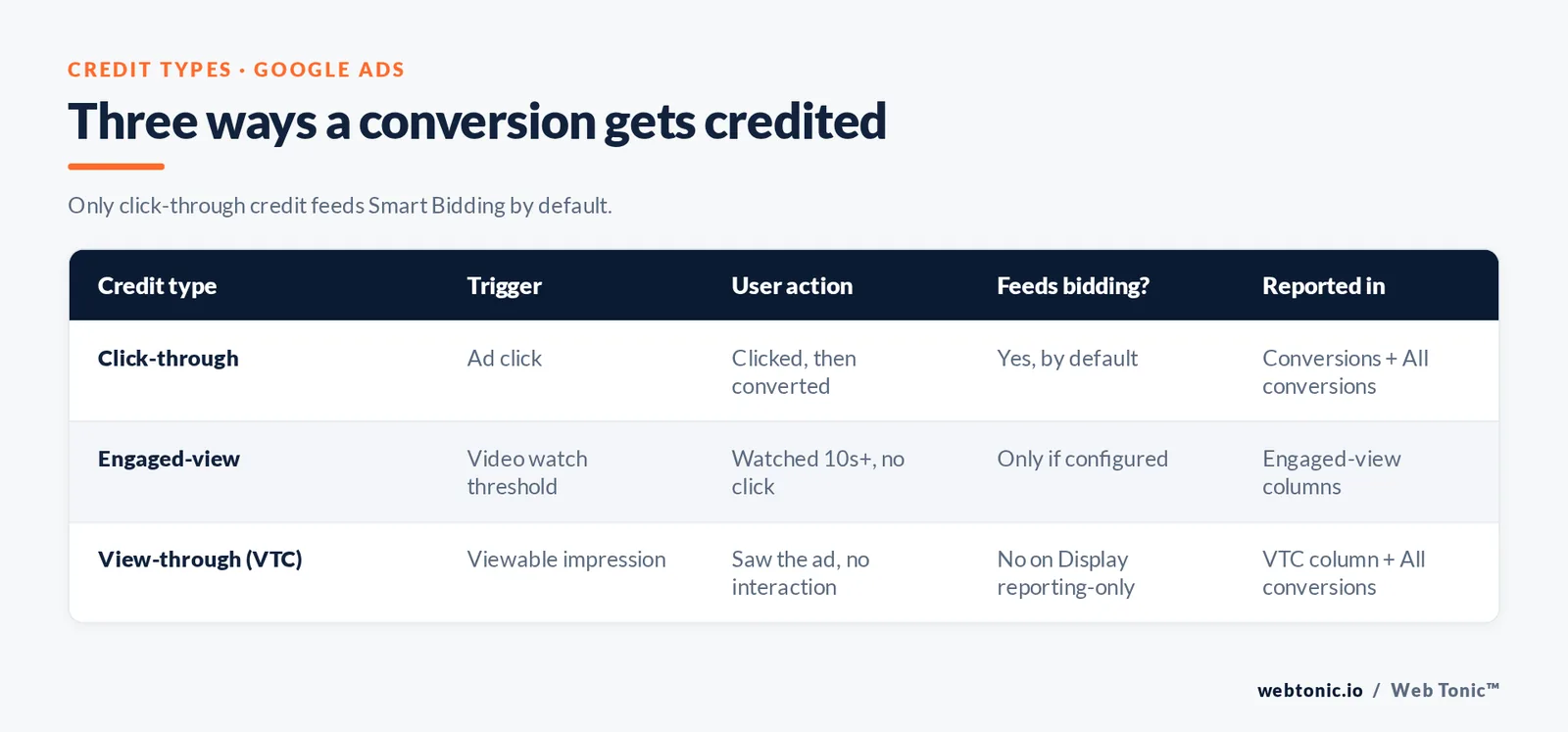
The distinction matters because the three conversion types below are priced, bid on and trusted very differently. Fact 1 — only one of the three drives Smart Bidding by default.
| Credit type | Trigger | User action | Feeds bidding? | Reported in |
|---|---|---|---|---|
| Click-through credit | Ad click | Deliberate click, then convert | Yes, by default | "Conversions", "All conversions" |
| Engaged-view credit | Video watched to threshold | Watched 10s+ (skippable video), no click | Only if configured | Engaged-view columns |
| VTC (impression credit) | Viewable impression | Saw the ad, never interacted | No on Display reporting-only VTC | The VTC column and "All conversions" |
Limit 1 — a view-through conversion carries 0 clicks of evidence. Because a VTC is credited without any interaction, it is the digital advertising metric most exposed to coincidence. That is not a reason to delete the column — it is a reason to build an audit around it, the same way you would for any marketing conversion definition you plan to report to a board.
What counts as a "view": the viewability rules behind the metric
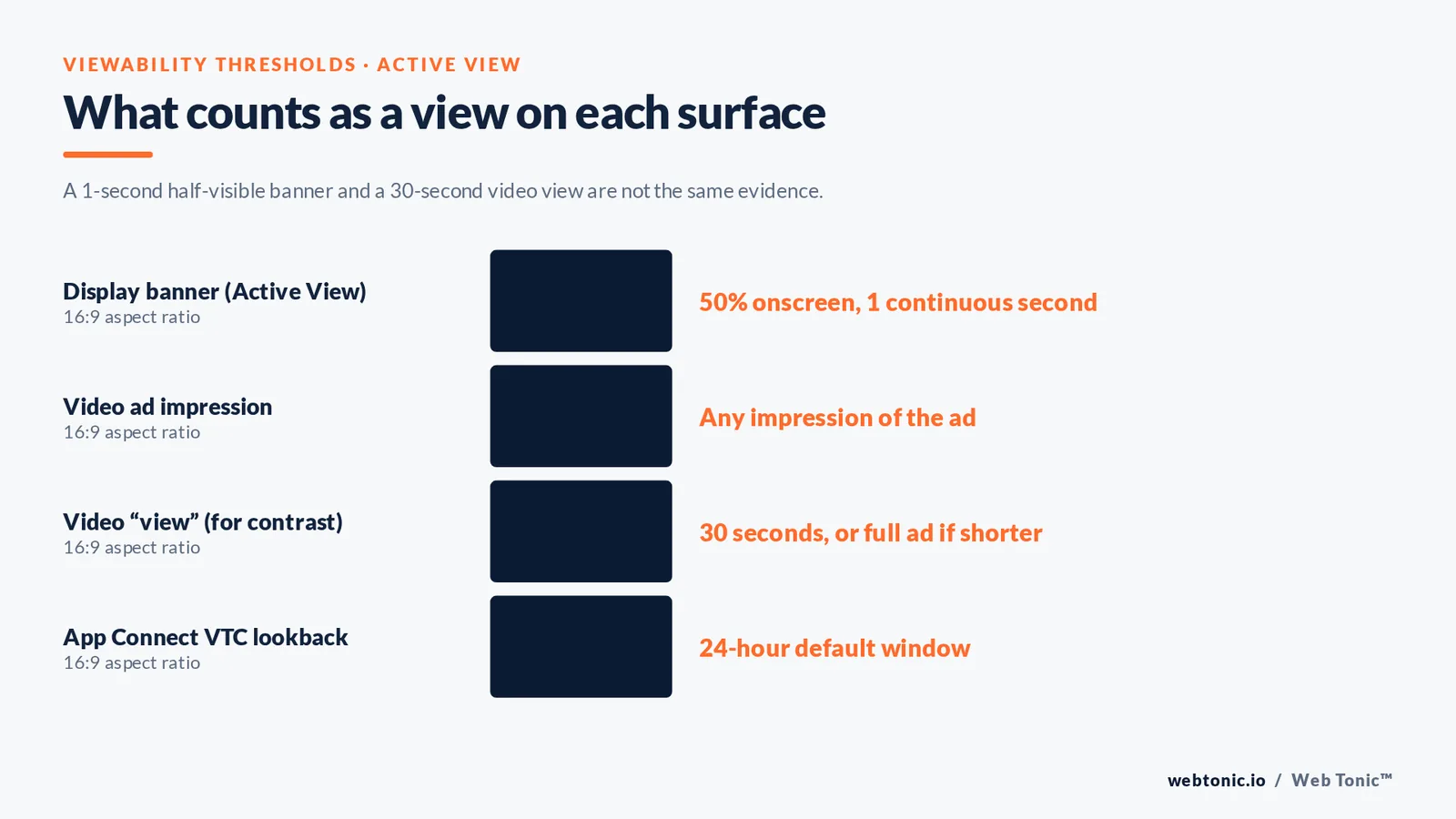
An impression is served; a viewable impression is seen. Only the second one can generate a view-through conversion on Display, and the thresholds are published.
| Surface | Threshold that counts | What gets the credit | Practical read |
|---|---|---|---|
| Google Display Network | 50% of pixels onscreen, 1 continuous second | Last viewable impression | A banner half-seen for one second can earn credit |
| YouTube and video campaigns | Any impression of the video ad | Last video impression | Weaker than a "view", which needs 30 seconds |
| Video "view" (for comparison) | 30 seconds, or the full ad if shorter, or a click | Counted in "Conversions" | This is a genuine attention signal |
| App Connect web-to-app | Active View across YouTube, Display, Gmail | 24-hour lookback window | Reporting-only, non-biddable on Display |
Rule 1 — a 1-second, 50%-visible banner impression and a 30-second video view are not the same evidence, even though both can end up inside "All conversions". The Media Rating Council accredits the measurement of these viewability standards across the industry, which is why the 50%/1-second definition looks familiar across every DSP you buy on.
The lookback window and how it works
A conversion window is the period after an ad interaction during which a conversion is recorded, and Google lets you edit it per conversion action (Google Ads Help: about conversion windows). Limit 2 — the default click conversion window is 30 days, and shortening it silently truncates your time-lag report to the same cap.
| Window behaviour | What Google documents | Failure it creates | Fix |
|---|---|---|---|
| Editable per action | Any web, imported, in-app or call action | Two actions with different windows compared side by side | Standardise windows before benchmarking |
| Changes are forward-only | A 30-to-10-day change applies from that day on | Mixed-window history read as a performance drop | Annotate the change date in your reporting |
| Short window, short buying cycle | 7-day promotion example in Google's docs | Long-cycle sales never recorded | Match the window to real time-to-purchase |
| Impression lookback | App Connect VTC uses 24 hours by default | Assuming impressions get a 30-day lookback | Read each surface's window separately |
The longer the window, the more coincidental conversions your view-through column absorbs. Trap 3 — a 30-day impression lookback on a high-frequency retargeting campaign will "prove" almost any conversion, because nearly every converter saw an ad at some point in the month. Google's reach and frequency reporting is the fastest way to see whether your frequency is high enough for that to happen.
Where the numbers appear in your reports
Most VTC arguments are actually column arguments. This is the column map, and it is worth pinning to the wall of any media team.
| Column | Includes clicks? | Includes VTCs? | Typical use |
|---|---|---|---|
| "Conversions" | Yes, primary actions | No | Bidding and CPA targets |
| "All conversions" | Yes, incl. secondary actions | Yes | Full-funnel reporting only |
| The VTC column | No | Yes, only these | Isolating impression-attributed volume |
| "Cross-device conversions" | Yes | Partly, per action settings | Understanding device hand-offs |
Fact 2 — if your client dashboard pulls "All conversions", every VTC is already inside your reported CPA. Pull the same date range twice, once on each column, and you have the real gap in 30 seconds. Teams that automate this pull through the Google Ads API reporting service can keep both numbers permanently side by side rather than arguing about them monthly. Our data intelligence team builds exactly that split into every paid media dashboard.
How other platforms count impression credit
Fact 4 — expect 3 different conversion totals for the same week when an ad platform, a DSP and an analytics tool all report on the same media. Every stack uses a different rule, which is why platform totals never reconcile. Campaign Manager 360 is the clearest documented example: because you cannot click an ad without viewing it, Floodlight counts the conversion as click-through whenever a click happened inside the click window, precisely to avoid double counting (how Floodlight counts conversions).
| Platform | Impression credit rule | Counting options | Reconciliation risk |
|---|---|---|---|
| Google Ads | Last viewable impression, other-ad interactors excluded | Per conversion action settings | Medium |
| Campaign Manager 360 / Floodlight | Clicks always outrank impressions | Standard, unique per 24h, per session | Low, if counting method is documented |
| Display & Video 360 | Floodlight-based, format-dependent | Set at the Floodlight activity level | Medium on YouTube formats |
| Google Analytics 4 | No impression credit in standard reports | Data-driven or rules-based models | High vs ad platforms |
| Independent DSPs | Own viewability and lookback defaults | Vendor-specific | High |
Google Analytics attributes credit across the touchpoints it can observe rather than impressions, so a display-heavy plan will always look weaker in GA4 attribution than in Google Ads. Neither number is lying; they answer different questions. Choosing which one governs budget is a strategy decision, and the attribution model documentation is the right place to settle it.
Are they trustworthy? Six failure modes
Scepticism about VTCs is healthy and usually well-founded. Here is what actually breaks.
| Failure mode | Why it happens | Symptom in the report | Counter-measure |
|---|---|---|---|
| Trap 4 — coincidence at scale | High frequency plus a long lookback | VTCs rise linearly with impressions | Geo holdout test |
| Trap 5 — brand cannibalisation | Retargeting people already in the funnel | VTCs concentrated on existing customers | Exclude converters, split new vs returning |
| Cookie loss | Browsers blocking cross-site cookies | VTC volume falls with no media change | Read VTCs as a floor, not a total |
| Low-quality placements | Cheap inventory farming viewable impressions | Huge VTCs, near-zero clicks | Placement exclusions, viewability floors |
| Window mismatch | Different windows per conversion action | Channels ranked on unequal terms | Standardise before comparing |
| Double counting across stacks | Ad platform plus DSP plus analytics | Reported totals exceed real orders | One source of truth per KPI |
Two structural protections are already built in: Google excludes anyone who interacted with another of your ads, and VTCs stay out of the biddable "Conversions" column. That is why Rule 2 — a VTC problem is almost always a reporting-hygiene problem, not a tracking bug. Verify the underlying setup first with the Google’s "different ways to track conversions" reference reference before you blame the metric.
A seven-pass VTC audit
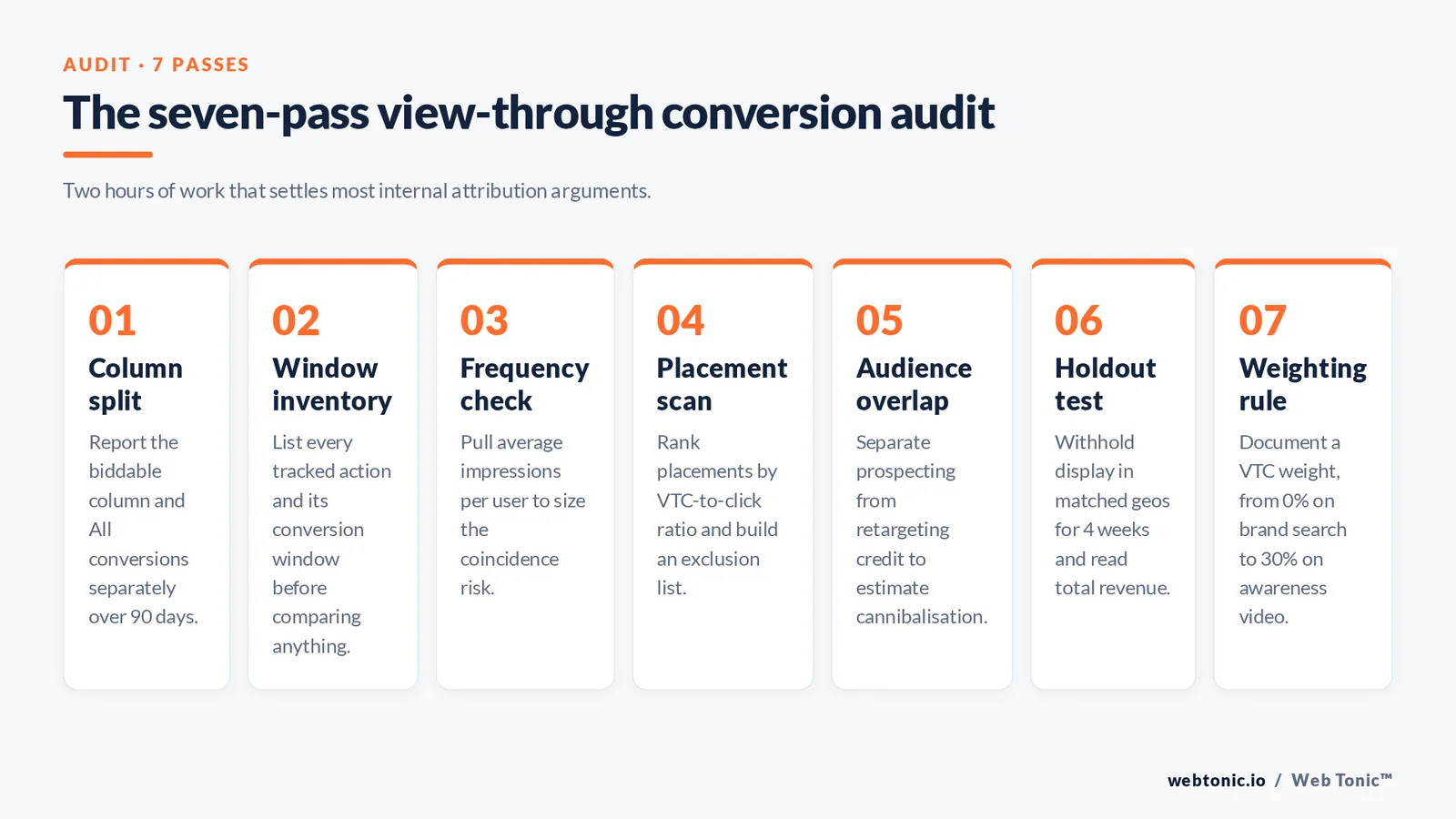
Trap 6 — skipping pass 6 is why 90% of VTC debates never end. Run this once per account, then quarterly. It takes about two hours and settles most internal arguments permanently.
| Pass | What you do | Data you need | Decision it unlocks |
|---|---|---|---|
| 1. Column split | Report the two columns separately | 90 days, campaign level | How much of your CPA is impression-based |
| 2. Window inventory | List every tracked action and its window | Settings export | Whether comparisons are fair |
| 3. Frequency check | Pull average impressions per user | Reach and frequency report | Coincidence risk level |
| 4. Placement scan | Rank placements by VTC-to-click ratio | Placement report | Exclusion list |
| 5. Audience overlap | Separate prospecting from retargeting VTCs | Audience segments | Cannibalisation estimate |
| 6. Holdout test | Withhold display in matched geos for 4 weeks | Regional revenue | Incrementality, the only real proof |
| 7. Weighting rule | Set a documented VTC weight | Holdout result | A CPA everyone agrees on |
Fact 3 — pass 6 is the only one that produces evidence rather than opinion. Google's own measurement guidance pushes advertisers toward experiment-based validation rather than platform-reported credit alone, which is the same logic Think with Google's measurement library applies to upper-funnel media. Industry measurement bodies such as the IAB publish the same recommendation for impression-based credit.
How much weight to give VTCs, by campaign type
Rule 3 — write the weight down once, in 1 line, and apply it to every account. A weighting rule beats a philosophical debate. These are working starting points to test, not universal truths.
| Campaign type | Primary role | Starting VTC weight | Report VTCs to the client? |
|---|---|---|---|
| Search brand | Harvest existing demand | 0% | No |
| Display prospecting | Reach new audiences | 10–20% | Yes, as a secondary line |
| Display retargeting | Recover known visitors | 5–10% | Yes, flagged as overlapping |
| YouTube awareness | Build memory | 20–30% | Yes, with brand-lift context |
| Demand Gen | Create mid-funnel demand | 15–25% | Yes |
| Performance Max | Mixed inventory | Use "Conversions" only | No, channel mix is opaque |
Awareness formats deserve the highest weight because reach is their product, not a by-product — Google documents the available YouTube and partner ad formats in Display & Video 360 that sit in that layer. Display prospecting on the Google Display Network deserves the least generous treatment when frequency is high, because the coincidence risk climbs with every extra impression per user.
Turning the data into budget decisions
Fact 5 — a 4-week matched-geo holdout is the cheapest incrementality test most accounts can run. The whole point of the metric is to stop a viable upper-funnel channel from being cut because it cannot produce clicks. Map each pattern to an action.
| Pattern you see | Likely meaning | Action | Time to decide |
|---|---|---|---|
| VTCs high, holdout shows lift | Genuine incremental demand | Scale budget 20–30%, keep testing | 4 weeks |
| VTCs high, holdout flat | Coincidence | Cut frequency caps, re-test | 4 weeks |
| VTCs high, clicks near zero | Poor placements or creative | Refresh creative, exclude placements | 2 weeks |
| VTCs fell, media unchanged | Cookie or consent loss | Verify tagging, treat data as a floor | 1 week |
| VTCs concentrated on one audience | Retargeting overlap | Exclude converters, re-split budget | 2 weeks |
Benchmarks help set expectations for the click side of the same account: typical landing page conversion rates cluster in the low single digits across most industries, as WordStream's conversion rate benchmarks show, and independent measurement firms including Nielsen publish the brand-side equivalents. If your creative is the constraint rather than the measurement, that is a job for performance creative, not a new attribution model.
Setup and reporting checklist
| Check | Where | Pass condition | Frequency |
|---|---|---|---|
| Tracked actions documented | Goals > Summary | Each action has an owner and a window | Quarterly |
| Primary vs secondary split | Goals menu | Only true business outcomes are primary | Quarterly |
| Duplicate protection | Tag setup | Transaction IDs in place on purchases | On launch |
| Column set locked | Reports and dashboards | Biddable and VTC columns shown apart | Always |
| Frequency cap | Campaign settings | Documented cap on prospecting | Monthly |
| Holdout calendar | Measurement plan | At least 2 experiments per year | Twice yearly |
Limit 4 — no dashboard should ever show a single blended figure that silently contains view-through credit. Google's conversion measurement overview is the reference to hand any new analyst before they touch the column picker, and more of our thinking on measurement lives on the Web Tonic blog.

FAQ
What is a view-through conversion in simple terms?
It is a conversion counted when someone saw your display or video ad, did not click it, and later converted on your site. On the Google Display Network the impression must be viewable, meaning at least 50% of the ad was onscreen for at least one continuous second.
What is the view-through conversion window?
It is the lookback period during which an earlier viewable impression can still be credited. Conversion windows are set per conversion action in Google Ads, changes apply only going forward, and App Connect VTCs use a 24-hour default lookback.
Are VTCs included in the Conversions column?
No. They appear only in the "VTCs" and "All conversions" columns, so they do not drive Smart Bidding by default. If your CPA is calculated on "All conversions", view-through credit is already inside it.
Why are my VTCs dropping?
The most common cause is not media: VTCs from browsers that block cross-site cookies cannot be reported. Consent changes, tagging errors and shorter conversion windows produce the same pattern, so verify the setup before changing budget.
How do I prove view-through conversions are real?
Run a geo holdout: withhold display or video in matched regions for four weeks and compare total revenue, not platform-reported conversions. That experiment is the only method that measures incrementality rather than credit.
Sources
Google Ads Help — Understand your conversion tracking data; About conversion windows; About conversion measurement; Different ways to track conversions; About attribution models; Measuring reach and frequency; About Display ads and the Google Display Network. Campaign Manager 360 Help — How Floodlight counts conversions. Display & Video 360 Help — YouTube & partners ad formats. Google Analytics Help — Get started with attribution. Google Ads API — Reporting overview. Media Rating Council. IAB Insights. Think with Google — Data and measurement. WordStream conversion rate benchmarks. Nielsen Insights. All sources verified live at publication.