Table of contents

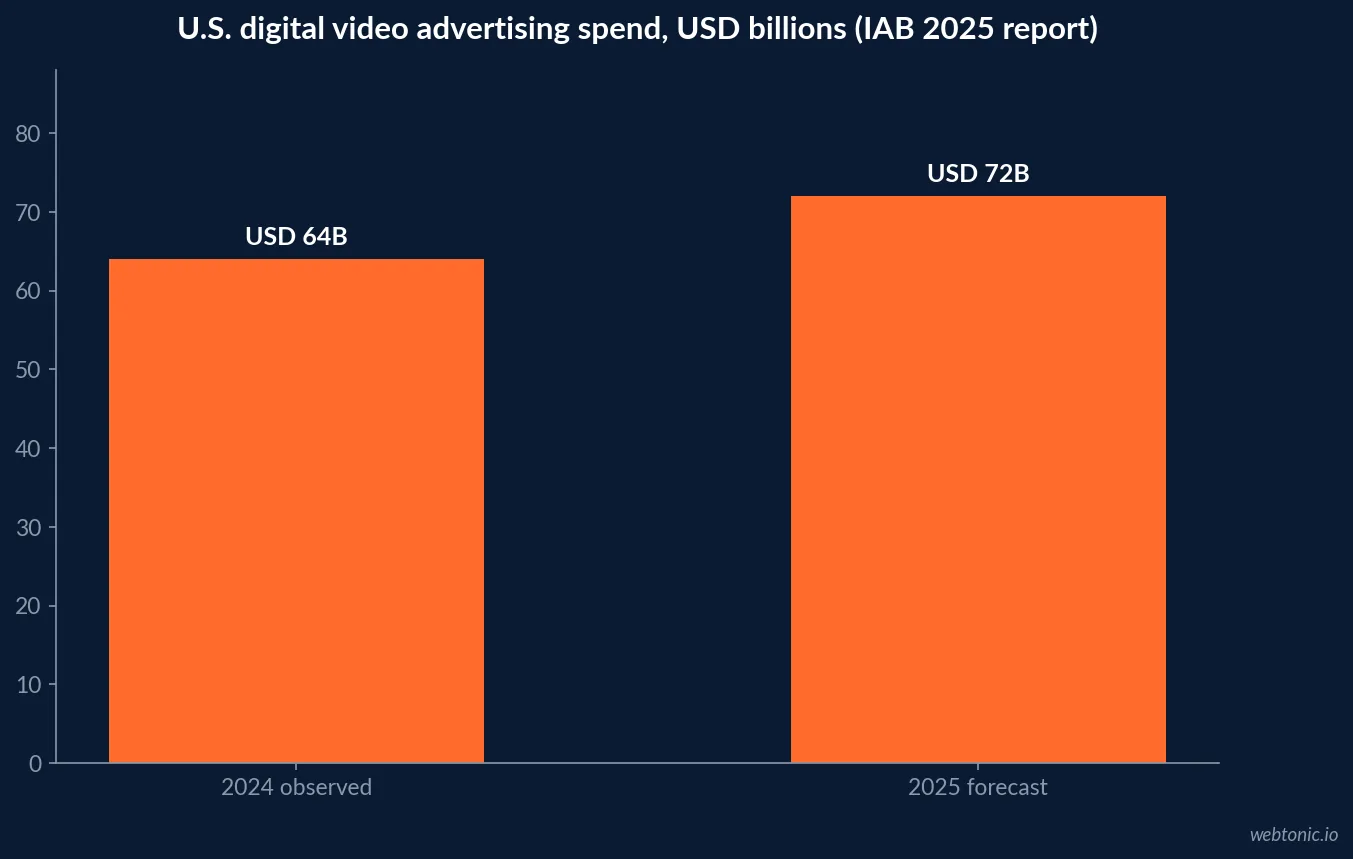
Video advertising budgets should be built from addressable audience, buying method, creative volume, and measurement—not from the size of the national market. The IAB projected U.S. digital video ad spend would reach US$72 billion in 2025, following 18% growth to US$64 billion in 2024. That is a market forecast and an indicator of competition, not the amount an individual advertiser should spend.
Key Takeaways
- IAB projected US$72B in U.S. digital video spend for 2025, up from US$64B in 2024.
- The 2025 IAB report covers investment outlook and media-buyer priorities, not a universal CPM card.
- National spend growth does not establish an advertiser’s target budget or expected return.
- Separate CTV, online video, and social video because inventory and buying models differ.
- Budget for production, versions, trafficking, measurement, and platform media separately.
- Use an audience and outcome plan before selecting a channel allocation.
- Report reach, frequency, viewability, completion, and conversions with their definitions.
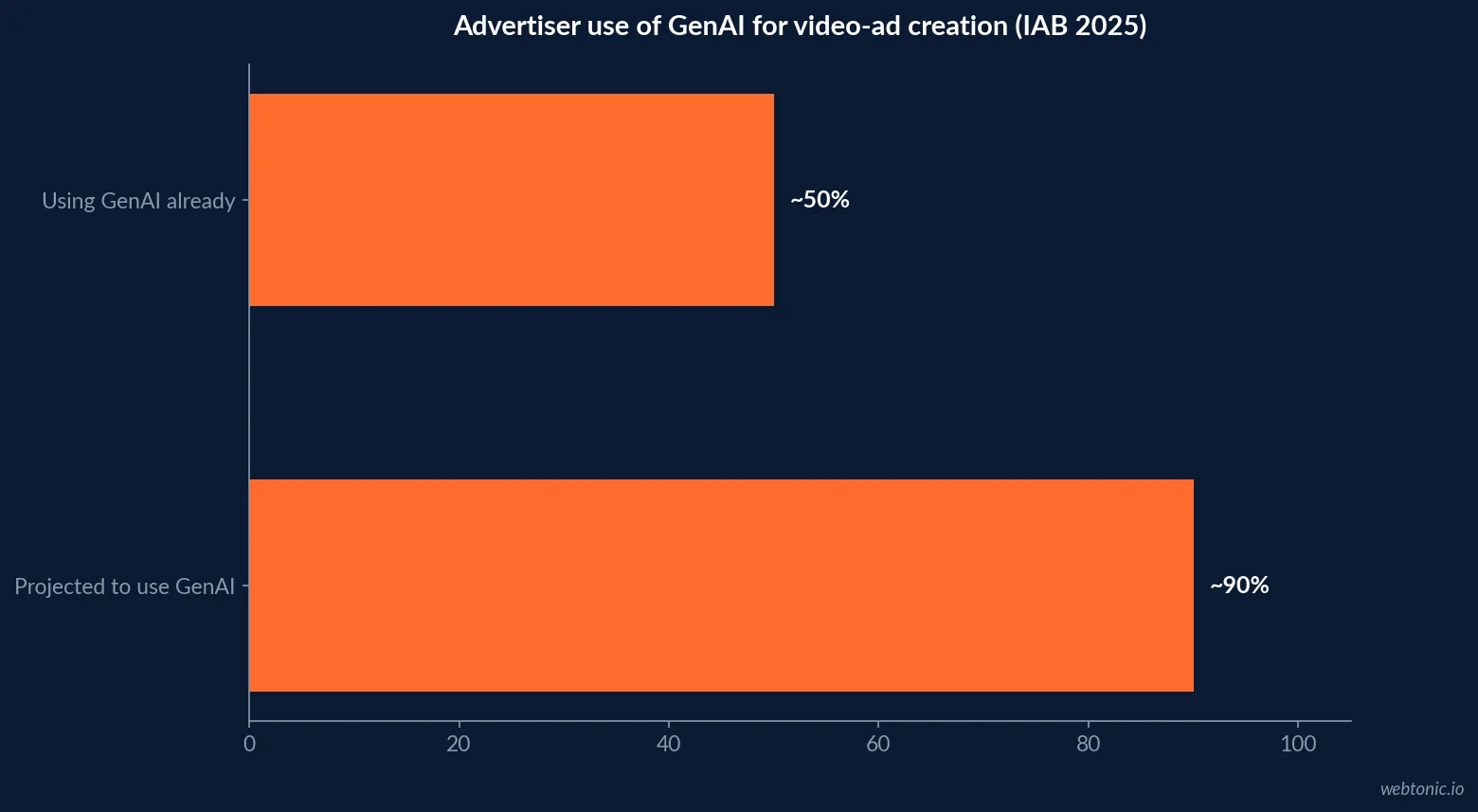
- IAB found half of advertisers were already using GenAI to build video ads in its 2025 research.
- Run creative tests with a defined hypothesis; more asset volume alone is not learning.
- Include incrementality or lift measurement when conversion attribution is incomplete.
- Keep short-form and long-form creative variants fit to the placement.
- Plan a contingency for auction costs and platform inventory shifts.
- A 2025 IAB projection is a forecast for 2025, not an observed final 2026 benchmark.
- Reconcile platform reporting with deduplicated reach where possible.
- Shift spend only after marginal performance and audience saturation are assessed.
Evidence references: IAB — 2025 Digital Video Ad Spend & Strategy Report · IAB — GenAI video ad adoption (2025) · IAB/PwC — Internet Advertising Revenue Report FY2025.
Related: performance creative · growth marketing · paid-media ROI measurement.
Budget benchmarks at a glance
This table deliberately places market-level indicators beside planning implications, rather than implying the numbers are directly comparable. The sources should stay attached to their units: national spend, advertiser adoption, and organic video engagement are different populations. Production and media are also separate budget categories, even when a platform bundles services.
| Planning signal | Source figure | Unit / period | How buyers should use it |
|---|---|---|---|
| U.S. digital video spend | US$64B | Observed 2024; +18% YoY, IAB | Market scale, not advertiser budget |
| U.S. video spend projection | US$72B | IAB forecast for 2025 | Forecast, not final 2026 actual |
| GenAI in video ads | 50% already using | Advertisers surveyed, IAB 2025 | Adoption context only |
| Expect to use GenAI | Nearly 90% | Advertisers, IAB 2025 | Plan governance and review |
| Webinar clips repurposed in email | 47% | Wistia State of Video 2025 | Organic production practice, not paid ad norm |
Reading the evidence boundary: Keep population, period, unit, and decision owner visible when comparing internal results with published evidence.
| Budget component | What it includes | Common planning failure |
|---|---|---|
| Media | Net placements, fees, and auction reserve | Using market growth as a recommended spend |
| Creative | Concepts, edits, versions, and rights | Launching one asset across incompatible formats |
| Measurement | Tracking, lift design, and reporting | Choosing KPIs after seeing early results |
| Operations | Trafficking, accessibility, and brand safety | Leaving required work outside the approved total |
Operating workflow: Separate the recurring work from the decision it supports.
| Flight stage | Required inputs | Decision owner |
|---|---|---|
| Plan | Objective, audience, and inventory | Media lead |
| Build | Concepts, rights, formats, and QA | Creative lead |
| Measure | Events, holdout, and reporting window | Analytics lead |
| Scale | Frequency, marginal outcome, and reserve | Budget owner |
A market forecast is not a line-item recommendation
The IAB’s 2025 Digital Video Ad Spend & Strategy report said U.S. digital video spend grew 18% year over year in 2024 to US$64 billion and was projected to reach US$72 billion in 2025. The forecast describes total market investment, not the expected return of a campaign or a media buyer’s recommended starting budget. For 2026 planning, label it as a historical forecast and retrieve a current report before presenting a new-year market size. An advertiser’s own allocation should start with the business objective, audience size, conversion economics, and role of video in the customer journey. A national figure can help explain why competition and inventory matter, but it cannot set a daily cap for a local campaign or determine whether video is efficient against search. Build a budget around the evidence the campaign can actually collect, then let measured marginal outcomes govern scale.
Define the inventory before pricing it
“Video” may refer to connected TV, publisher online video, video within social feeds, short-form clips, or sponsored placements. Each has different targeting, auction, viewability, and outcome conventions. A buyer should define channel and format in the brief, along with the length, audience, geography, placement, buying mechanism, and whether the objective is reach, consideration, or action. A blended video number can conceal a platform that is spending but not reaching the intended audience. The IAB’s 2025 report focuses on the U.S. digital video market and highlights how rapidly the ecosystem is evolving, including GenAI, precision targeting, and performance-oriented KPIs. Use those topics to shape questions for a media plan, not to assume every platform offers comparable measurement. Ask vendors for the exact inventory definition and reporting denominator. If the plan combines CTV with social, preserve channel-level reporting so that a change in mix does not look like a change in creative quality.
The all-in budget has more than media in it
A usable video plan accounts for media, concept development, production, edits, accessibility, versioning, trafficking, brand safety, measurement, and any required rights. A low media test can still require meaningful production capacity if it needs multiple cuts or localized versions. Conversely, existing assets may support a narrow paid test if rights and format are suitable. The media budget should not quietly absorb costs that are necessary to make the creative usable. Build a production matrix from the channels and audience segments the test needs to cover. State how many unique concepts, lengths, aspect ratios, captions, and refreshes are funded. Price any creator or talent rights separately and clarify the term and territory. Then phase spend: a pilot to validate audience and creative, a learning period, and a scale reserve. This keeps teams from overcommitting to a large media line before the campaign has assets and tracking in place.
Creative supply and GenAI planning
IAB reported in July 2025 that half of advertisers were already using generative AI to build video ads and nearly 90% expected to do so, based on its study conducted with Advertiser Perceptions and Guideline. That is an adoption signal, not proof of cost reduction, performance lift, or suitability for every brand. Include governance, review, and rights in any AI-enabled production plan. Creative tests should vary a deliberate factor—opening hook, offer, proof, length, or audience relevance—while holding enough constant to interpret results. A large batch of near-identical variants may increase operational burden without producing useful learning. Use a creative log that records concept, format, live dates, spend, audience, and outcome. Define a refresh trigger based on reach, frequency, and performance deterioration rather than a fixed cadence copied from another account.
Choose measurement before launch
The primary KPI depends on the role of the campaign. Reach activity needs deduplicated reach and frequency where available; consideration may use qualified visits or engaged views; conversion activity needs a valid outcome event and a plan for view-through attribution. Report viewability, completion, and click-through with platform definitions, because one platform’s “view” may not equal another’s. If the business has meaningful offline or delayed sales, include a plan to connect exposure to qualified outcomes. Where attribution cannot establish incrementality, reserve budget for a lift study, geo split, or another appropriate comparison. A campaign that earns view-through conversions can be valuable, but platform-attributed conversions alone do not establish that the exposure caused additional demand. Agree on the measurement cost and minimum sample before the test starts. A clear null result is more useful than a dashboard whose result cannot support a budget decision.
Fund a measurable decision: Specify what will be learned, who will review it, and what changes the allocation. This prevents a market reference becoming an unsupported target.
| Gate | Evidence to review | Budget action |
|---|---|---|
| Pilot | Delivery, audience, and valid tracking | Hold reserve until a test can be read |
| Learning | Creative and channel-level outcome | Keep only interpretable variants live |
| Scale | Marginal cost, frequency, and quality | Increase only where new reach is available |
Keep the source qualifier attached: The same number can mean very different things across populations and instruments.
| Claim class | 2025 evidence | Planning implication |
|---|---|---|
| Market size | US$64B observed 2024 | Set context only |
| Market forecast | US$72B projection for 2025 | Do not label as 2026 actual |
| Adoption | 50% GenAI use; nearly 90% expected | Budget governance, not assumed savings |
Build a staged 2026 allocation
A practical 2026 plan can be organized into three envelopes: a controlled test, a proven-channel allocation, and a reserve for scaling or new creative. The size of each depends on historical results and the cost of reaching a meaningful audience. Do not infer an optimal split from the IAB’s market-level growth projection. Start with a minimum test that can distinguish a plausible winning concept or audience; if it cannot, call it a pilot rather than a performance proof. Set stop and scale rules in advance. A scale decision should consider marginal cost per outcome, quality of downstream leads or sales, frequency, and whether the next tranche reaches new people. A channel with an efficient average may have already exhausted its cheapest inventory. Keep an unspent reserve if the campaign depends on new creative or measurement that is not yet ready.
How to compare channel proposals
Ask every platform, agency, or publisher to quote the same buying unit and state fees separately. Compare net media, gross spend, audience definition, geography, inventory, placement, reporting window, viewability threshold, invalid-traffic controls, and any production component. Request reach curves, not only an average CPM, and ask what happens to frequency as budget rises. For performance proposals, demand a clear event definition and attribution window. A proposal with the lowest apparent CPM may deliver lower-quality inventory or repeat exposure to the same audience. A higher unit cost may be justified if the format provides valuable attention or a stronger measurement design. The comparison should therefore use a common objective and include expected reach, meaningful actions, and the confidence of the evidence. Avoid presenting a projection as an actual result. Save assumptions so the forecast can be updated when a platform changes its inventory or targeting.
Use organic video data carefully
Wistia’s State of Video 2025 analyzes a large body of hosted business video and reports that webinar recordings are repurposed in email campaigns by 47% of surveyed respondents. Its report also describes video engagement changes by content length and type. These observations can help a media team think about creative reuse and video attention, but the audience and measurement environment are not the same as paid ad impressions. Do not apply an organic completion or conversion rate directly to a paid media plan. A more defensible use is to identify what assets exist and whether they can be adapted for campaign tests. A webinar clip may provide credible product proof, yet require an edit to fit a mobile feed. Match each asset to the intended placement, then benchmark its paid performance within that channel. Record the source and year when using any adjacent video marketing evidence in a buyer presentation.
Planning for volatility and fatigue
Video auctions, audience supply, and platform policies can change during a quarter. A budget model should include flexibility to move money if costs rise, delivery stalls, or a channel’s inventory shifts. This does not mean moving spend daily based on noisy results. Use thresholds for delivery, frequency, marginal outcome costs, and creative fatigue, with enough time for measurement to mature. Plan for replacement assets and rights renewal before the live campaign begins. A creative that performs well can still become unusable when a usage term expires or product claims change. Separate budget for creative refresh from the contingency reserved for media. If the test shows fatigue, do not automatically increase spend to maintain volume; revise the creative or audience and evaluate whether the new exposure remains incremental.
The buyer’s 2026 budget checklist
Before sign-off, the media plan should show the business objective, channel and inventory, audience estimate, campaign dates, media allocation, production scope, versions, measurement design, and decision thresholds. Include a low/base/high scenario and state whether rates are quotes, historical account data, or market estimates. Refresh public market references using the newest available issuer report; do not relabel a 2025 forecast as a 2026 observed result. At the first review, reconcile actual delivery with the original plan. Report spend, reach, frequency, viewability, creative-level performance, conversions or lift, and cost by channel. Explain differences in definitions and timing. Then decide whether to continue, adjust creative, change audience, or hold budget. A strong plan creates a repeatable learning cycle; the point is not to spend simply because video is growing as a category.
Frequently Asked Questions
How much should a company spend on video advertising in 2026?
There is no defensible universal amount. Build it from audience size, objective, media costs, production, measurement, and prior account evidence. IAB market totals are not a budget recommendation.
How large was U.S. digital video advertising in 2025?
The IAB projected US$72 billion for 2025 in its 2025 report, following US$64 billion in 2024. Treat the former as a projection for that year, not a verified final or 2026 figure.
Should I include production in the media budget?
Show production separately, but include it in the all-in plan. Include editing, versioning, rights, captions, trafficking, and measurement so the campaign is fully costed.
Can organic video engagement benchmarks predict paid ad results?
No. Organic video platforms and paid ad placements have different audiences and exposure conditions. Use organic evidence for creative hypotheses, then test in the actual paid placement.
Sources
IAB — 2025 Digital Video Ad Spend & Strategy Report
IAB — GenAI video ad adoption (2025)
IAB/PwC — Internet Advertising Revenue Report FY2025
Wistia — State of Video 2025 report (PDF)
Google — Video ad viewability study
Google — YouTube ad creative research
Web Tonic — performance creative
Web Tonic — growth marketing
Web Tonic — paid media ROI analysis
Wyzowl — Video Marketing Statistics
IAB/PwC — Digital video share in FY2025
LinkedIn Marketing — campaign planning resources
Meta for Business — advertiser resources
TikTok for Business — advertiser resources
CB Insights — State of Venture 2025
IAB/PwC — Internet Advertising Revenue Report FY2025