Table of contents
59% of people aged 16 to 74 in Germany actively used social media for private purposes in 2025, up from 47% in 2021, according to the Federal Statistical Office (Destatis) - the country's official statistics agency. That is also below the EU average of 67%, making Germany one of the two lowest-usage large EU markets. This page builds the state of German social media use from that official baseline plus the ARD/ZDF Medienstudie's platform-level reach data.
Key Takeaways
- 59% of Germans aged 16-74 actively used social media in 2025 (Destatis).
- That is up from 47% in 2021, a 12-percentage-point rise in four years.
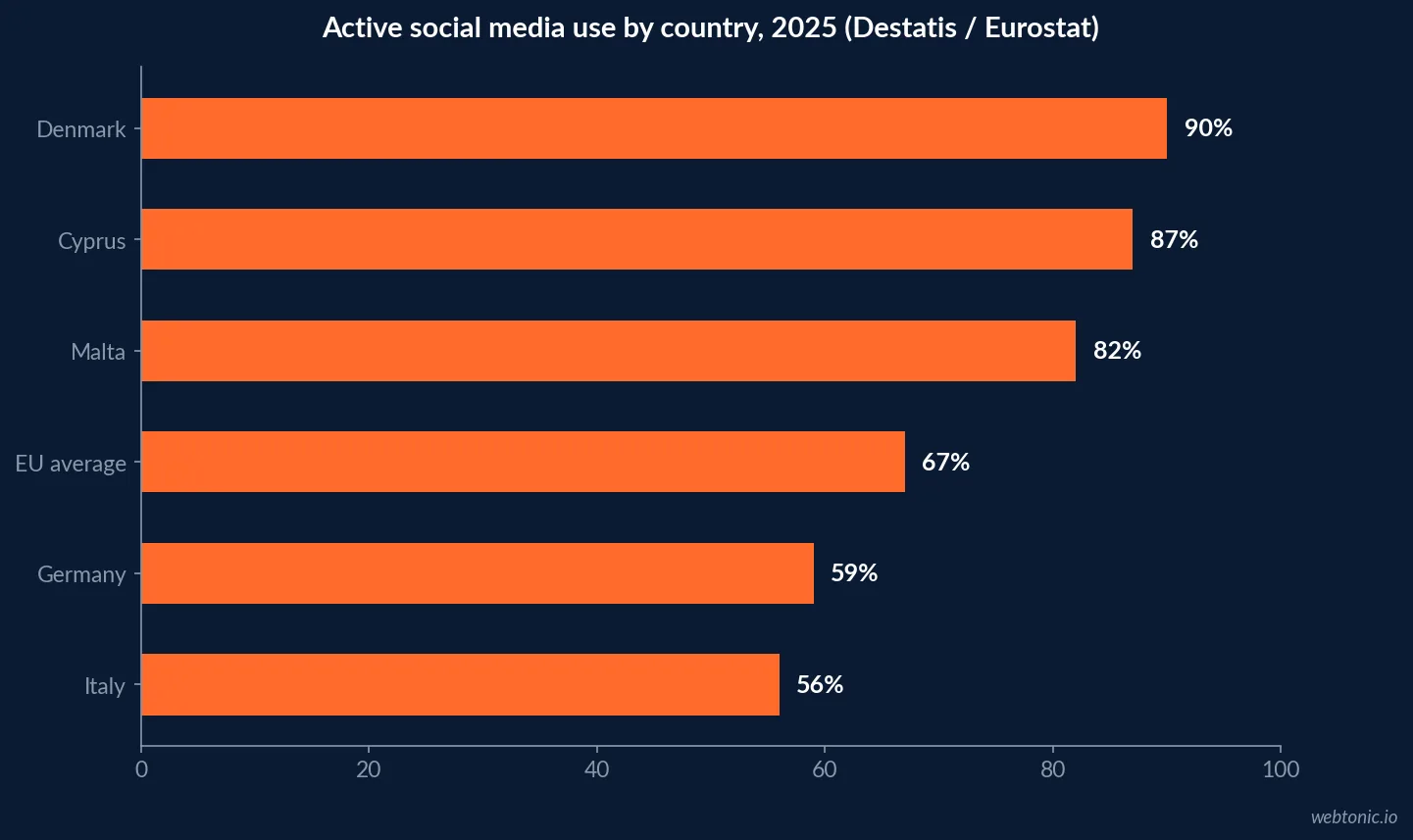
- Germany sits below the EU average of 67% active social media use.
- Only Italy (56%) ranks lower than Germany among EU member states.
- Denmark leads the EU at 90% active use, followed by Cyprus (87%) and Malta (82%).
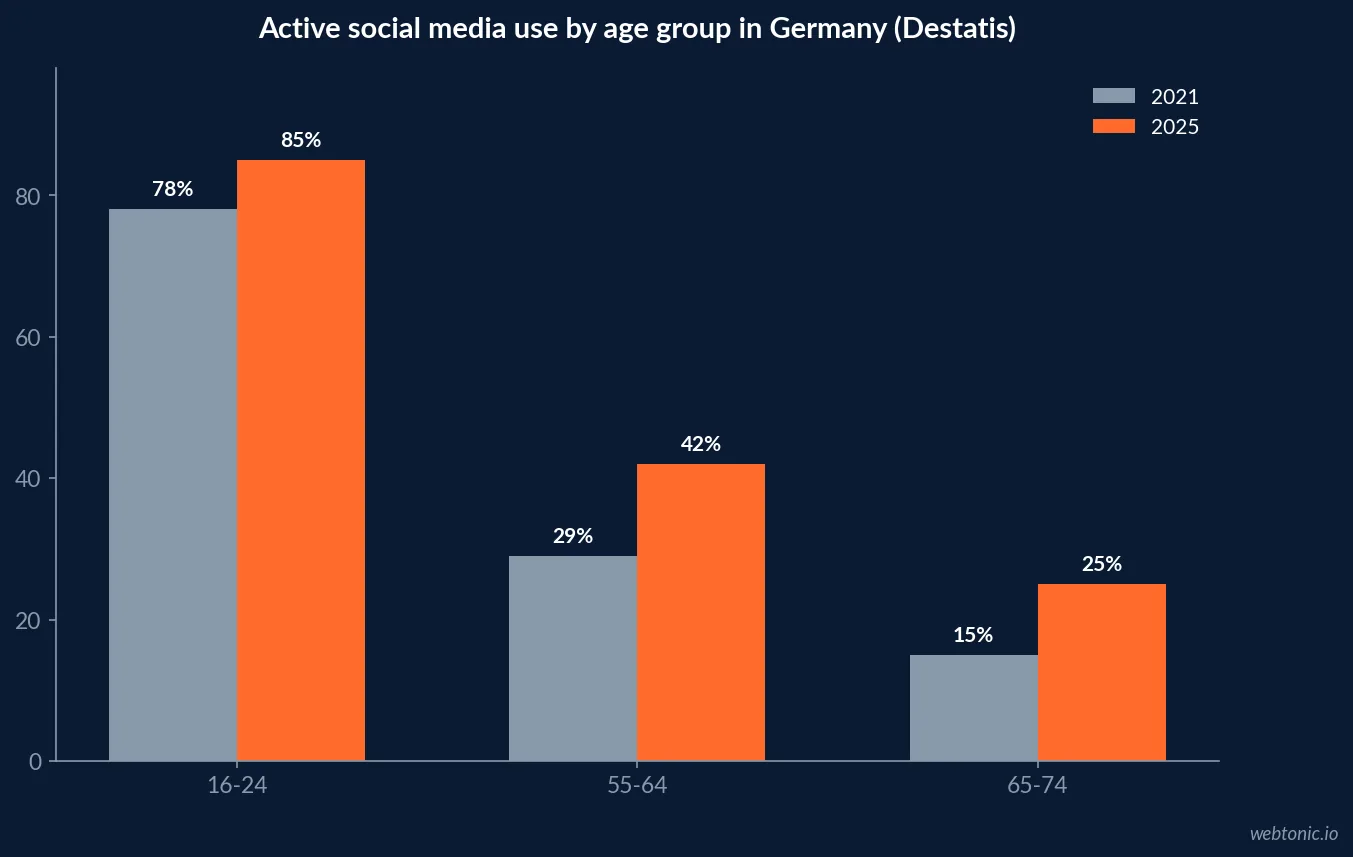
- 85% of 16-to-24-year-olds actively use social media, the highest of any German age group.
- 81% of 25-to-34-year-olds and 72% of 35-to-44-year-olds are active users.
- Only 25% of 65-to-74-year-olds actively use social media, the lowest age band.
- That older group's usage grew fastest since 2021, up from just 15% to 25%.
- 55-to-64-year-olds jumped from 29% to 42% active use over the same period.
- Instagram is the most-used platform in the ARD/ZDF Medienstudie 2026, ahead of Facebook and TikTok.
- No platform gained weekly reach year over year in 2026; Facebook and TikTok both lost users.
- Meta's own ad tools count 31.3 million Instagram users in Germany, 44.2% of adults 18+.
- Facebook's ad reach fell 11.5% year over year, per Meta's own advertising tools.
- AI tool adoption jumped from 42% to 59% of the German population in one year, outpacing social media's growth rate entirely.
The official number: 59%, and rising by 12 points since 2021
Destatis's March 2026 release, based on its IT-usage survey within the Mikrozensus, found 59% of the population aged 16 to 74 actively used social media for private purposes in 2025, up from 47% in 2021. Destatis defines active use narrowly: creating an account, posting content or interacting with other users - simply using a messaging app does not count. The rise happened in every age group, which is the more striking part of the finding than the topline number itself.
| Age group | Active social media use, 2025 | Active use, 2021 | Percentage-point change | Source |
|---|---|---|---|---|
| 16-24 | 85% | 78% | +7 pts | Destatis, March 2026 |
| 25-34 | 81% | Not separately released | - | Destatis, March 2026 |
| 35-44 | 72% | Not separately released | - | Destatis, March 2026 |
| 55-64 | 42% | 29% | +13 pts | Destatis, March 2026 |
| 65-74 | 25% | 15% | +10 pts | Destatis, March 2026 |
Germany against the rest of the EU
Destatis explicitly frames its national figure against Eurostat's EU-wide comparison, and the result is unflattering: Germany's 59% active-use rate trails the EU average of 67% by eight points, and every age group in Germany reports lower usage than its EU counterpart. Only Italy, at 56%, ranks below Germany among the member states Destatis cites. At the other end, Denmark (90%), Cyprus (87%) and Malta (82%) post the highest active-use rates in the EU.
| Country | Active social media use (16-74), 2025 | Source |
|---|---|---|
| Denmark | 90% | Destatis / Eurostat |
| Cyprus | 87% | Destatis / Eurostat |
| Malta | 82% | Destatis / Eurostat |
| EU average | 67% | Destatis / Eurostat |
| Germany | 59% | Destatis, March 2026 |
| Italy | 56% | Destatis / Eurostat |
Which platforms actually hold German attention
Destatis measures whether people use social media at all; it does not break results down by platform. For that, the ARD/ZDF Medienstudie 2026 - the annual media-use study jointly commissioned by Germany's public broadcasters - is the standard reference. It found Instagram is the most-used social network tracked, ahead of Facebook and TikTok. The more notable finding: no platform in the study grew its weekly reach compared with the previous year, and Facebook and TikTok both lost users. Existing users of Instagram, Snapchat, Facebook and TikTok still check those platforms daily; the platforms are simply not growing into new audiences the way they were.
| Platform | Ad-tool audience, late 2025 | Share of adults 18+ reached | YoY trend | Source |
|---|---|---|---|---|
| 31.3 million users | 44.2% | Growing per ad tools | Meta ads via DataReportal | |
| 22.8 million users | Not separately published | -11.5% ad reach YoY | Meta ads via DataReportal | |
| TikTok | 23.7 million users (18+) | 33.9% | Weekly reach declined | TikTok ads via DataReportal |
| 24.0 million members | Not separately published | Includes lapsed accounts | LinkedIn ads via DataReportal |
Why official and platform data tell slightly different stories
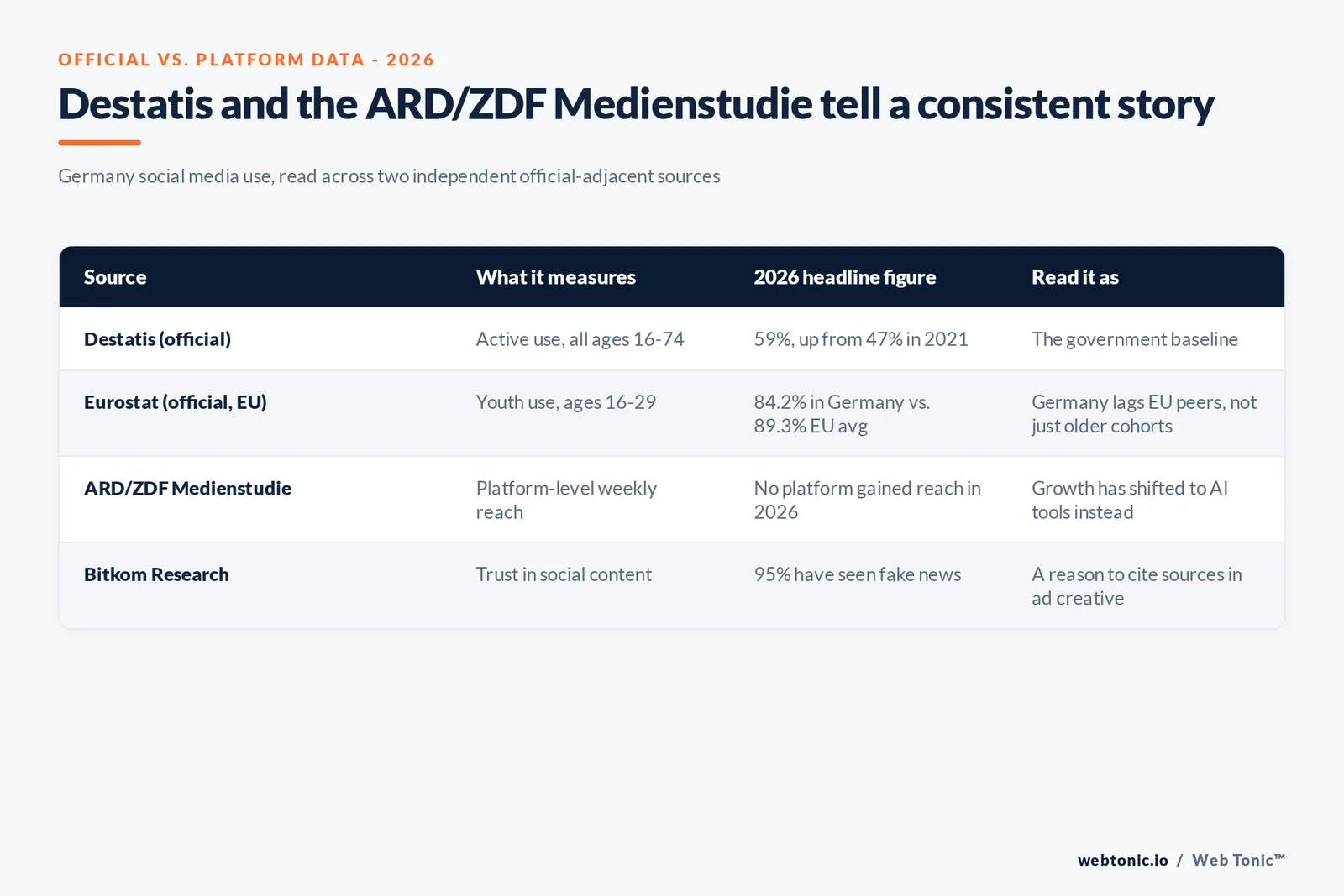
Destatis measures a person's own report of whether they actively participate in social media at all; the ARD/ZDF Medienstudie and the platforms' own ad tools measure reach and habit on named networks. Both agree the market has matured: Destatis's overall growth is now driven by older age groups catching up rather than young people adopting social media for the first time, and the Medienstudie shows the established platforms losing rather than gaining weekly reach. The clearest growth story in either dataset is not social media at all - it is AI tool adoption, which the Medienstudie found jumped from 42% to 59% of the population in a single year, matching Destatis's entire social-media figure in absolute terms but getting there four times faster.
| Metric | 2025 figure | 1-year change | Source |
|---|---|---|---|
| Active social media use (16-74) | 59% | +12 pts since 2021 | Destatis, March 2026 |
| Facebook ad reach | 22.8 million | -11.5% | Meta ads via DataReportal |
| AI tool adoption (any use) | 59% of population | +17 pts since 2025 | ARD/ZDF Medienstudie 2026 |
| Platforms gaining weekly reach in 2026 | 0 of the platforms tracked | n/a | ARD/ZDF Medienstudie 2026 |
German youth also lag their EU peers, not just the general population
Germany's lag is not confined to older age groups. Eurostat's April 2026 release found 89.3% of 16-to-29-year-olds across the EU used social networks in 2025, but Germany's youth figure sat at just 84.2% - among the lowest in the bloc, alongside Italy (80.3%) and Luxembourg (84.8%). The highest youth rates were in Cyprus (98.3%), Czechia (97.2%) and Denmark (96.9%). That gap matters for brands assuming German Gen Z behaves like its EU counterparts: on this measure, it is measurably less online-social than most of the continent's under-30 population.
| Country | Social media use, ages 16-29 (2025) | Source |
|---|---|---|
| Cyprus | 98.3% | Eurostat, April 2026 |
| Czechia | 97.2% | Eurostat, April 2026 |
| Denmark | 96.9% | Eurostat, April 2026 |
| EU average | 89.3% | Eurostat, April 2026 |
| Germany | 84.2% | Eurostat, April 2026 |
| Italy | 80.3% | Eurostat, April 2026 |
Trust in what social media shows Germans is falling
Bitkom Research's 2026 survey of 1,006 people in Germany aged 16 and up found 95% have already encountered fake news on social platforms, and 63% say they find it hard to judge whether information on social media is reliable. Nearly half of under-30s, 47%, say social media is their first source for breaking news - and even among adults 65 and older, 18% now turn to social platforms first. Deepfakes are also now mainstream: 61% say they have encountered one, most often as video content (87%). Brands running paid social campaigns in Germany should factor that trust deficit into creative that leans on verifiable claims rather than assertion. A campaign that cites a named, checkable source performs a different job in Germany than the same claim asserted without attribution, precisely because so much of the audience has already learned to distrust unverified claims on the same platforms carrying the ad.
| Trust metric (Germany, 2026) | Figure | Source |
|---|---|---|
| Have encountered fake news on social media | 95% | Bitkom Research 2026 |
| Find it hard to judge information reliability | 63% | Bitkom Research 2026 |
| Under-30s using social media as first news source | 47% | Bitkom Research 2026 |
| Adults 65+ using social media as first news source | 18% | Bitkom Research 2026 |
| Have encountered a deepfake | 61% | Bitkom Research 2026 |
What this means for a German content or media plan
A German audience skewing 55-plus is now a meaningfully larger social media audience than it was in 2021, which changes who a brand can reasonably reach organically on Facebook and Instagram. But new-user growth on any single platform has largely stopped, per the Medienstudie, so incremental reach in 2026 is more likely to come from better targeting inside an existing audience than from a platform still adding new users. Our growth marketing team plans German campaigns against this stalled-reach reality rather than assuming platform growth will do the work, and our broader digital marketing statistics roundup covers the adjacent channels worth testing as social reach flattens. The practical sequence for 2026: confirm which age bands still have headroom to grow (55-plus, per Destatis), check whether a given platform is one of the ones losing weekly reach per the Medienstudie before committing new budget to it, and weight any performance claim in creative against a population that overwhelmingly says it has already seen fake news on the same channel.
Frequently Asked Questions
What share of Germans use social media?
The Federal Statistical Office (Destatis) found 59% of people aged 16 to 74 actively used social media for private purposes in 2025, up from 47% in 2021. Active use is defined as creating an account, posting content or interacting with other users - messaging-app use is explicitly excluded from that figure.
How does Germany compare to the rest of the EU?
Below average. Destatis reports Germany's 59% active-use rate sits under the EU average of 67%, and only Italy, at 56%, ranks lower among EU member states in the same Eurostat comparison. Denmark (90%), Cyprus (87%) and Malta (82%) lead the EU.
Which age group uses social media most in Germany?
16-to-24-year-olds lead at 85% active use in 2025, per Destatis, followed by 25-to-34-year-olds at 81% and 35-to-44-year-olds at 72%. Usage drops steadily with age, falling to 25% among 65-to-74-year-olds - though that older group's usage grew the fastest in percentage-point terms since 2021, up from 15%.
Which social platform is most used in Germany?
Instagram is the most-used platform tracked in the ARD/ZDF Medienstudie 2026, followed by Facebook and TikTok. Notably, none of the platforms in that study grew their weekly reach year over year in 2026, and Facebook and TikTok both lost users, even as existing users kept checking those platforms daily.
Is social media use in Germany still growing?
Overall active use is still growing by Destatis's measure, up 12 percentage points from 2021 to 2025 across all age groups. But the ARD/ZDF Medienstudie 2026, which tracks weekly reach per platform rather than overall active use, found growth has stalled at the platform level: no tracked network gained weekly reach in 2026, while AI tool adoption grew sharply instead, from 42% to 59% of the population.
Sources
Statistisches Bundesamt (Destatis) - Pressemitteilung Nr. N014, March 2026
ZDFheute - ARD/ZDF Medienstudie 2026 coverage
DataReportal (Kepios analysis) - Digital 2026: Germany
Eurostat - 89% of 16-29-year-olds used socials in 2025
Bitkom Research - Social Media, Desinformation und Deepfakes 2026