Table of contents
A unique selling proposition (USP) is the clearest reason a buyer should choose you over a competitor. Without one, your business blends into market noise.
Below you will find what a USP is, how to create one, and 10 examples from companies that turned differentiation into lasting advantage.
Key Takeaways
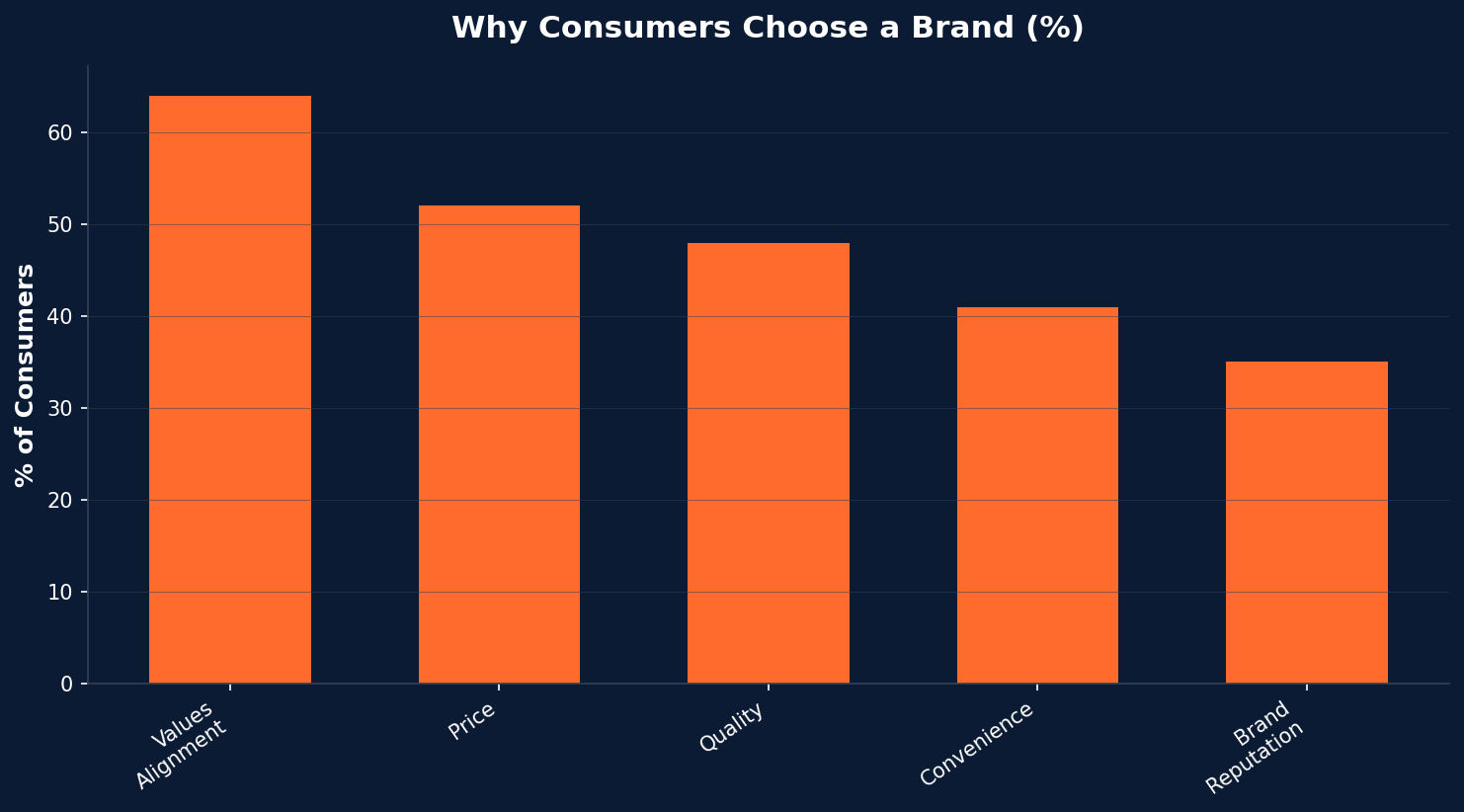
- 64% of consumers say shared values are the primary reason they maintain loyalty to a company — a differentiator anchored in values outperforms feature-only claims (HubSpot).
- A strong core promise reduces acquisition cost by 25–40% because go-to-market messages convert better when they communicate a clear benefit (HubSpot Sales).
- Only 23% of small businesses can clearly articulate what makes them stand out in one sentence, which is why most compete on price alone (BDC).
- The best differentiators are specific, measurable, and outward-facing — they answer "why you?" in under 15 words.
- Your USP is not your tagline. It is the strategic foundation that informs every tagline, ad, landing page, and sales conversation your company produces.
- Companies with a well-defined positioning see 3–5× higher conversion rates on paid advertising because the ad-to-landing-page promise stays consistent and compelling.
What Is a Unique Selling Proposition?
A unique selling proposition is a concise statement that explains what makes your offering different from every competitor in your market. It answers three questions simultaneously: What do you sell? Who is it for? Why should they choose you over alternatives?
The term was coined by advertising pioneer Rosser Reeves in the 1940s, who defined three criteria that still hold: the proposition must offer a specific benefit to the customer, the benefit must be one competitors cannot or do not offer, and it must be strong enough to pull new buyers to you.
A USP is not a mission statement, a value proposition (which is broader), or a tagline (which is shorter). It sits between strategy and messaging — the single deciding factor you want customers to associate with your company.
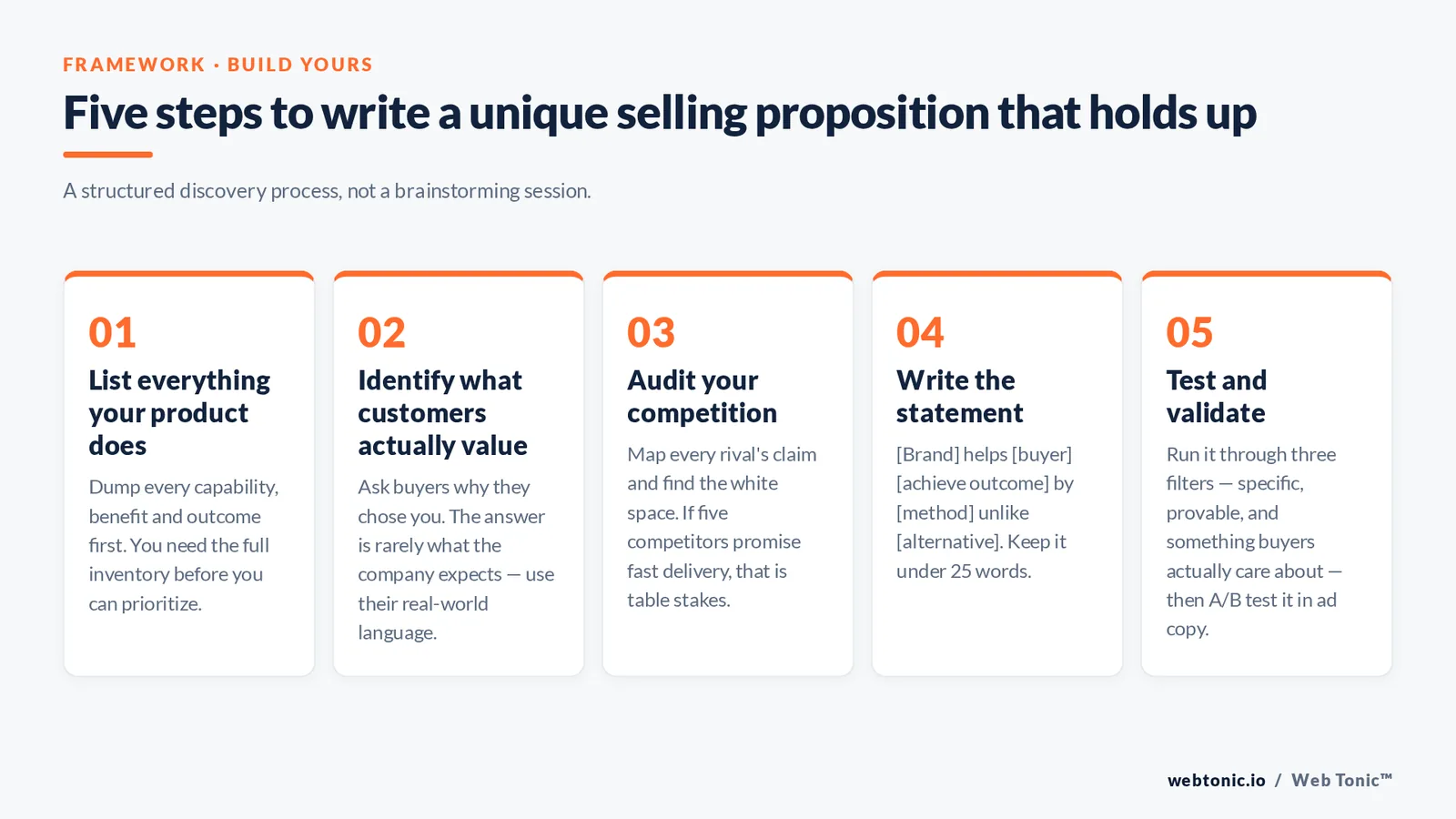
| Concept | Definition | Scope | Example |
|---|---|---|---|
| USP | The one differentiator that makes your offering the obvious choice | Single benefit, customer-facing | "Fresh, hot pizza delivered in 30 minutes or it's free" |
| Value Proposition | The full bundle of benefits your solution delivers | Multi-benefit, company-wide | "Affordable CRM that saves sales teams 5 hours/week" |
| Tagline | A memorable phrase that captures your essence | Creative, emotional | "Just Do It" (Nike) |
| Mission Statement | Your company's purpose and long-term direction | Internal, aspirational | "To accelerate the world's transition to sustainable energy" (Tesla) |
Why Every Business Needs a Clear Differentiator
Markets are crowded. The average consumer encounters 6,000–10,000 ads per day, according to industry research. Without something that sets you apart, your company is invisible — or worse, interchangeable. Here is what a strong market position actually does for your business:
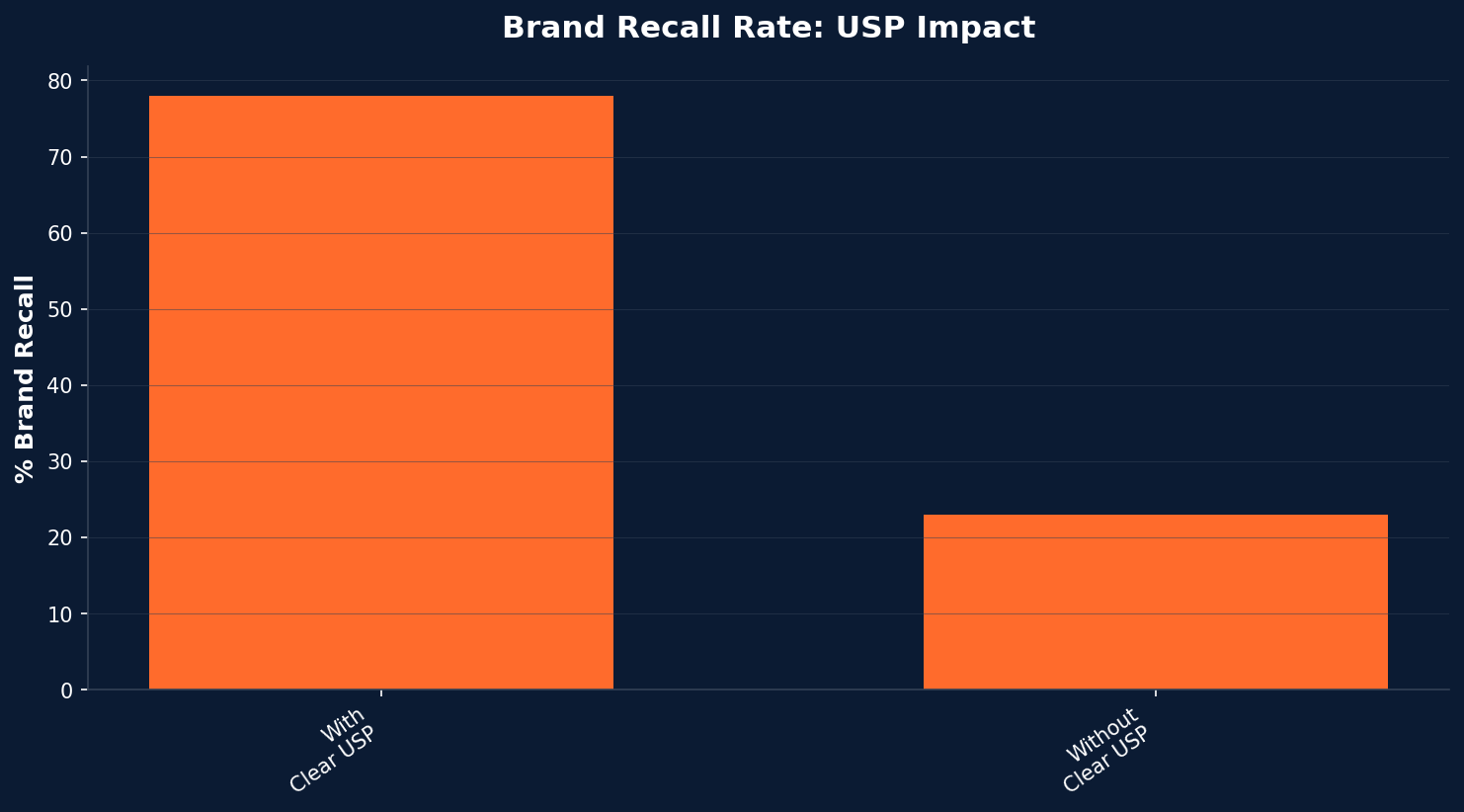
1. Clarifies your marketing messages. When you know your core promise, every ad, email, and landing page has a consistent foundation. Marketing teams stop debating angles and start executing against a known advantage.
2. Reduces price sensitivity. Buyers who understand why your offering stands out are willing to pay 20–30% more than for a commodity alternative. Brands like Apple and Dyson prove this at scale — their products carry premiums because buyers perceive differentiation, not just features.
3. Guides product development. A defined strategic filter acts as a filter for every new feature or service line. If a proposed addition does not reinforce what makes you different, it dilutes the message. Your growth marketing strategy should directly reflect this positioning.
4. Improves advertising ROI. According to WordStream research, ad campaigns built around a specific promise see click-through rates 2–3× higher than generic awareness campaigns because the claim is testable and concrete.
5. Attracts the right customers. A sharp differentiator repels poor-fit leads as effectively as it attracts ideal ones. That is a feature, not a bug — it lowers churn and increases lifetime value by 15–25%.
10 Real-World Examples of Powerful Competitive Differentiation
The fastest way to understand what makes great positioning is to study companies that nailed it. The table below breaks down 10 real-world examples across different industries, highlighting each company's core promise, why it works, and the business model behind it.
| Company | Core Promise | Why It Works | Industry |
|---|---|---|---|
| Domino's Pizza | "Fresh, hot pizza delivered to your door in 30 minutes or less — or it's free" | Specific, time-bound, risk-free guarantee | Food & Delivery |
| FedEx | "When it absolutely, positively has to be there overnight" | Addresses the fear of late delivery with certainty | Logistics |
| TOMS Shoes | "With every product you purchase, TOMS will help a person in need" | Values-driven; buying = giving | Retail / Apparel |
| Patagonia | "We're in business to save our home planet" | Mission-first brand; people buy the cause | Outdoor Apparel |
| Stripe | "Payments infrastructure for the internet" | Developer-first positioning in a market of merchant-first tools | FinTech |
| Warby Parker | "Designer eyewear at a revolutionary price" | Specific price disruption with a premium feel | Eyewear / DTC |
| HubSpot | "Grow better with a CRM platform that's crafted, not cobbled" | Positions against Frankenstein tech stacks | SaaS / Marketing |
| Slack | "Where work happens" | Redefines email-replacement as a workspace category | Collaboration |
| Dollar Shave Club | "A great shave for a few bucks a month" | Price + convenience vs. overpriced retail razors | Consumer Goods / DTC |
| Canva | "Design anything. Publish anywhere. No design skills needed." | Removes the barrier (skill) that defined the entire design industry | Design / SaaS |
Notice the pattern: every example is specific (not "best quality"), audience-focused (not "we have 20 years of experience"), and defensible (competitors cannot easily copy the claim). The weakest positions in any market are the vague ones — "quality service," "competitive pricing," "customer-first" — because every competitor says the same thing.
How to Build Your Own Winning Position in 5 Steps
Crafting this statement is not a creative exercise — it is a strategic one. The goal is to find the intersection of what your customers care about, what you do better than anyone else, and what competitors cannot easily replicate. Salesforce recommends approaching it as a structured discovery process, not a brainstorming session.
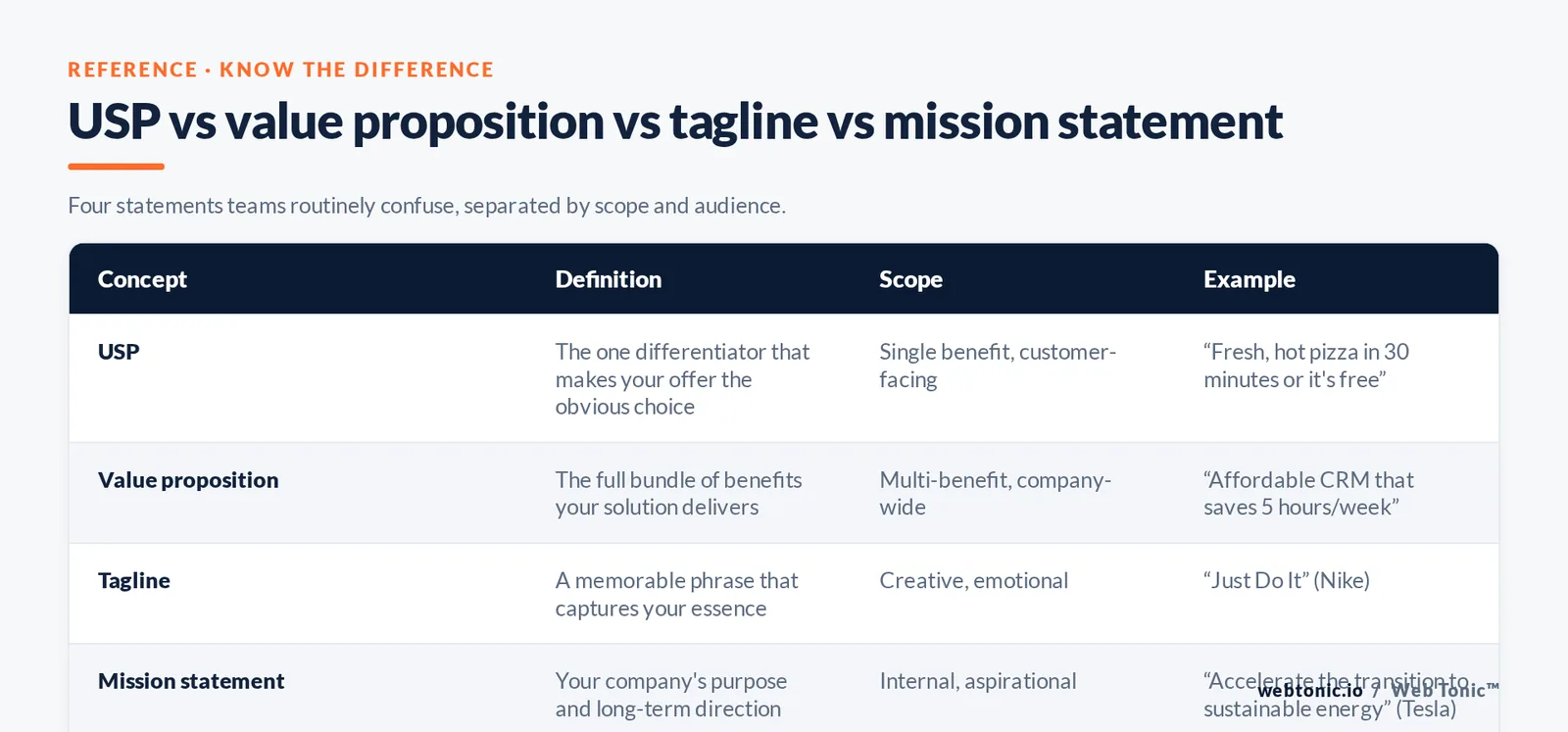
Step 1: List Everything Your Product or Service Does
Start with a raw feature dump. Write down every capability, benefit, and outcome your product delivers. Do not edit yet — you need the full inventory before you can prioritize.
Step 2: Identify What Your Customers Actually Value
Survey existing customers. Ask: "What made you choose us over alternatives?" The answer is rarely what companies expect. You may think your strength is speed, but customers may value your transparent pricing or onboarding support more. CXL's research shows the best promises come from real-world language, not internal assumptions.
Step 3: Audit Your Competition
Map every competitor's positioning. What do they claim? Where are the gaps? A strong claim occupies white space — the benefit nobody else is talking about. If 5 competitors all promise "fast delivery," that is not a selling point; it is table stakes.
Step 4: Write the Statement
Use this formula: [Your Brand] helps [ideal buyer] [achieve outcome] by [method or benefit] unlike [competitor alternative]. Keep it under 25 words. If you cannot explain it in one sentence, you have not found the real distinction yet.
Step 5: Test and Validate
Run your statement through three filters. First, is it specific? ("We deliver in 30 minutes" beats "We're fast.") Second, is it provable? Can you back it with data, a guarantee, or a case study? Third, does it matter? A benefit that buyers do not care about is just trivia. Zendesk suggests A/B testing the claim in ad copy and on landing pages to see which version drives higher conversions. For help turning your positioning into high-converting ad creative, explore professional creative services.
How These Concepts Differ From a Value Proposition and Brand Positioning
These three concepts are often confused because they overlap. The key difference is scope and audience.
| Element | What It Answers | Audience | Length | Changes How Often |
|---|---|---|---|---|
| USP | Why choose us over competitor X? | Customers at the decision stage | 1 sentence (under 25 words) | Rarely (strategic anchor) |
| Value Proposition | What value does our product deliver? | Prospects exploring solutions | 1–3 sentences | Updated as product evolves |
| Market Positioning | Where does our company sit in the market? | Internal teams and stakeholders | Positioning statement (50–100 words) | Reframed with market shifts |
Your core positioning feeds into both the value proposition and the market positioning, but it is narrower. Think of it as the sharp point of the spear — the single most compelling reason a prospect should care, distilled from the broader value story.
Mistakes That Weaken Your Market Position
Even well-intentioned businesses undermine their market positioning with predictable errors. According to Mailchimp's glossary, the most common mistakes include:
Being too vague. "We offer the best customer service" is not a distinction — it is a claim everyone makes. Specificity wins: "We respond to every support ticket in under 2 hours, with a 98.5% resolution rate."
Focusing on features, not outcomes. People do not buy a 14-megapixel camera; they buy the ability to capture memories in stunning detail. Translate features into the end-user benefit they enable.
Copying competitors. If your statement could be swapped into a competitor's website without anyone noticing, it is not doing its job. The whole point is standing apart.
Changing it too often. A competitive advantage needs time to anchor in the market. Companies that rotate their core positioning every quarter confuse customers and dilute market recall.
Not communicating it consistently. Your core message should appear in your advertising, website hero section, sales decks, and email signatures. If it lives only in a strategy document, it is not working. For more strategic insights, visit the Web Tonic blog or reach out to our team.
Frequently Asked Questions
What is the difference between a unique selling proposition and a unique selling point?
They mean the same thing. "Unique selling proposition" is the original term from Rosser Reeves; "unique selling point" is a common alternative. Both refer to the single distinction that separates your offering from competitors. Shopify and most modern sources use the terms interchangeably.
Can a small business have a strong market advantage?
Absolutely. In fact, smaller companies often have an easier time crafting a compelling messaging because they can specialize. A local bakery that uses only organic, locally sourced ingredients has a clearer differentiator than a national chain trying to be everything to everyone. BDC research shows that small businesses with a defined strategic edge grow 2× faster than those competing on price alone.
How do I know if my positioning is working?
Measure three things: conversion rate on pages where your promise appears, acquisition cost (a strong differentiator lowers it), and brand recall (ask new new arrivals "why did you choose us?" — if they echo your core message, it is landing). You can also A/B test the statement in ad copy to compare click-through and conversion rates.
How often should I update my market positioning?
A core differentiator should be stable for years, not months. Update it only when the market shifts fundamentally — a new competitor enters with a similar claim, market needs evolve, or your offering changes direction. Minor messaging refreshes are normal; wholesale changes should be rare and data-driven.
What if my product is not truly unique?
Very few products are objectively one-of-a-kind. The "unique" in this context refers to how you communicate your benefit, not whether the product itself is unprecedented. Domino's did not invent pizza or delivery — they promised 30-minute delivery with a guarantee. Find the angle, packaging, guarantee, or audience niche that competitors are not owning.
Sources: CXL Brand Differentiation Examples · Salesforce Positioning Guide · BDC Market Positioning · HubSpot Sales Guide · Zendesk Sales Strategy · Shopify Brand Positioning · Mailchimp Marketing Glossary · WordStream Advertising Strategy · Neil Patel Marketing