Table of contents

Cross-selling and upselling get treated as one tactic in most vendor content, but Bain, HubSpot, Salesforce and Gainsight data all point the same direction: they win under different conditions, on different timelines, and they should be measured with different numbers. This page separates the two using primary research rather than a single ecommerce app's own benchmark.
Key Takeaways
- Up to 60% of telecom customers split services across providers, Bain found.
- Converting 10% of switchers to one service was worth USD 480 million.
- Converting 10% to all services was worth USD 630 million.
- 42% of successful upsellers say understanding customer needs is key.
- 40% point to building genuine trust.
- 39% point to consistently delivering value first.
- 37% say timing the ask right after a win matters most.
- Sephora's loyalty program captures over 80% of transactions.
- Vertical SaaS fintech reports 96% gross revenue retention.
- The same segment reports 112% net revenue retention.
- That 16-point gap is expansion revenue at work.
- Bootstrapped SaaS runs 91% GRR against 103% NRR.
- Vertical SaaS back-office runs 90% GRR against 110% NRR.
- 57% of sales professionals say the sales cycle is getting longer.
- 73% of B2B buyers actively avoid sellers with irrelevant outreach.
Why lumping the two together hides the decision
Cross-selling and upselling solve different problems. A cross-sell adds a second product to an existing relationship - insurance alongside a mortgage, a second telecom service alongside the first. An upsell moves the customer within the same product line to a higher tier. Bain & Company's 2016 telecom research - still the most detailed public breakdown of the economics - frames cross-selling as a share-of-wallet and churn problem, not a pricing problem, which is exactly where most "10 cross-sell tactics" listicles get it wrong by treating both as the same upsell mechanic with a different SKU attached.
| Dimension | Cross-selling | Upselling | What decides which wins |
|---|---|---|---|
| What changes | A second, related product | A pricier tier of the same product | Portfolio breadth vs. tier depth |
| Primary economic lever | Share of wallet + reduced churn | Higher average order or contract value | Bain, 2016 |
| Best timing | After trust is established, ~3 months in | Right after a customer hits a goal | Bain / HubSpot, 2025 |
| Scoreboard metric | Attach rate, share of wallet | Expansion ARR, upsell conversion rate | Gainsight, 2026 |
| Failure mode | Pitching before trust exists | Asking before value is proven | HubSpot, 2025 |
The cross-sell math, from Bain's telecom analysis
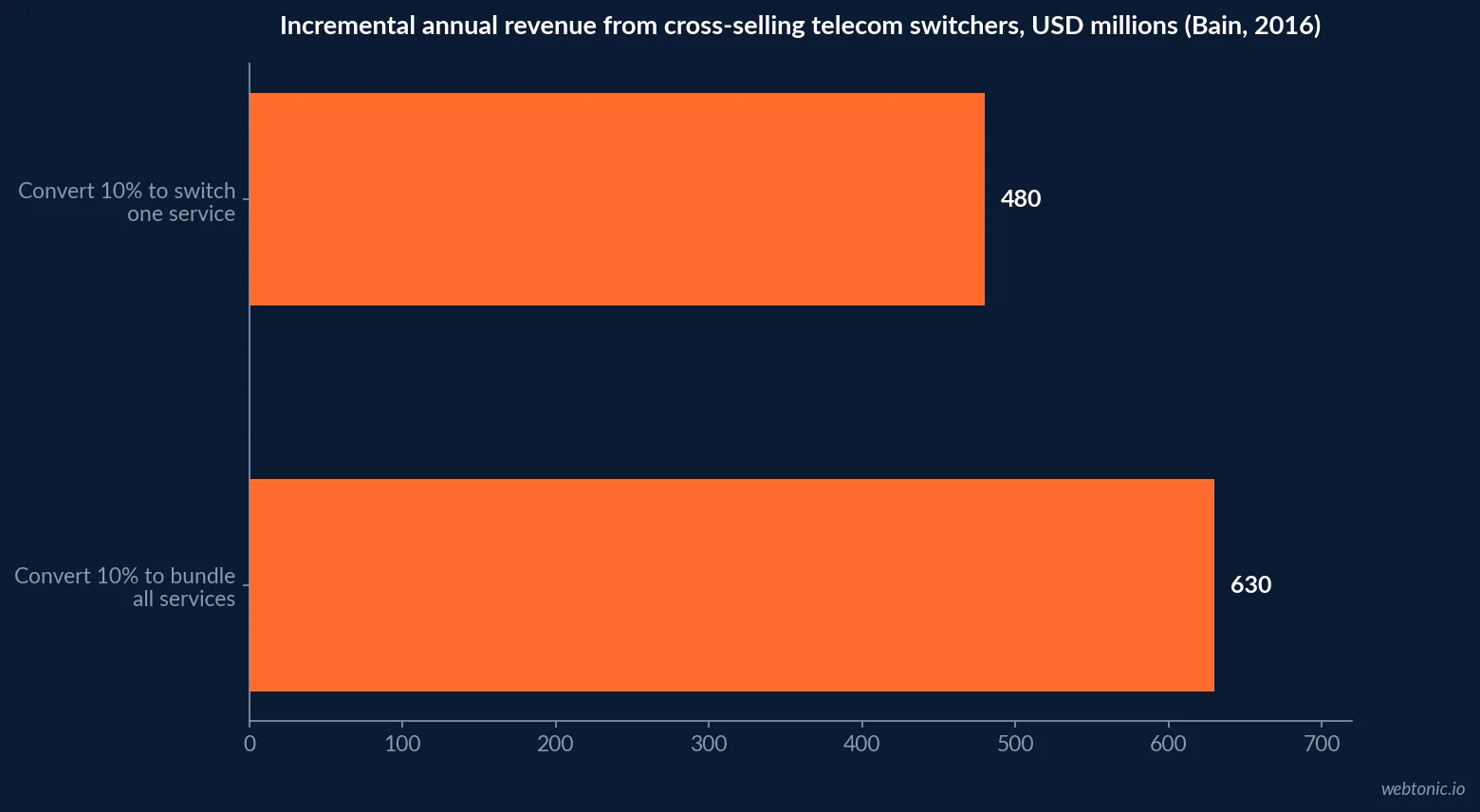
Bain's research found that up to 60% of customers split their services across multiple providers for mobile, landline, TV or internet. For one telecom provider studied, convincing just 10% of these split-service customers to switch one additional service from a competitor was worth up to USD 480 million of incremental annual revenue. Converting that same 10% of customers to take all their services from one provider could be worth up to USD 630 million - and Bain notes the resulting decline in churn multiplies that effect further, since a bundled customer is more disruptive to leave.
The same mechanic shows up outside telecom. Sephora's "Beauty Insider" loyalty program, cited in the same Bain research, captures more than 80% of all customer transactions in order to personalize cross-sell offers, with digital-wallet users spending roughly twice the level of other customers.
| Cross-sell scenario (telecom, Bain) | Customers converted | Incremental annual revenue | Extra effect |
|---|---|---|---|
| Switch one additional service | 10% of split-service base | Up to USD 480 million | Reduced churn, not counted |
| Consolidate all services | 10% of split-service base | Up to USD 630 million | Churn drops further with bundling |
| Baseline split-service population | Up to 60% of the customer base | Addressable opportunity | Bain telecom analysis |
What actually makes an upsell land
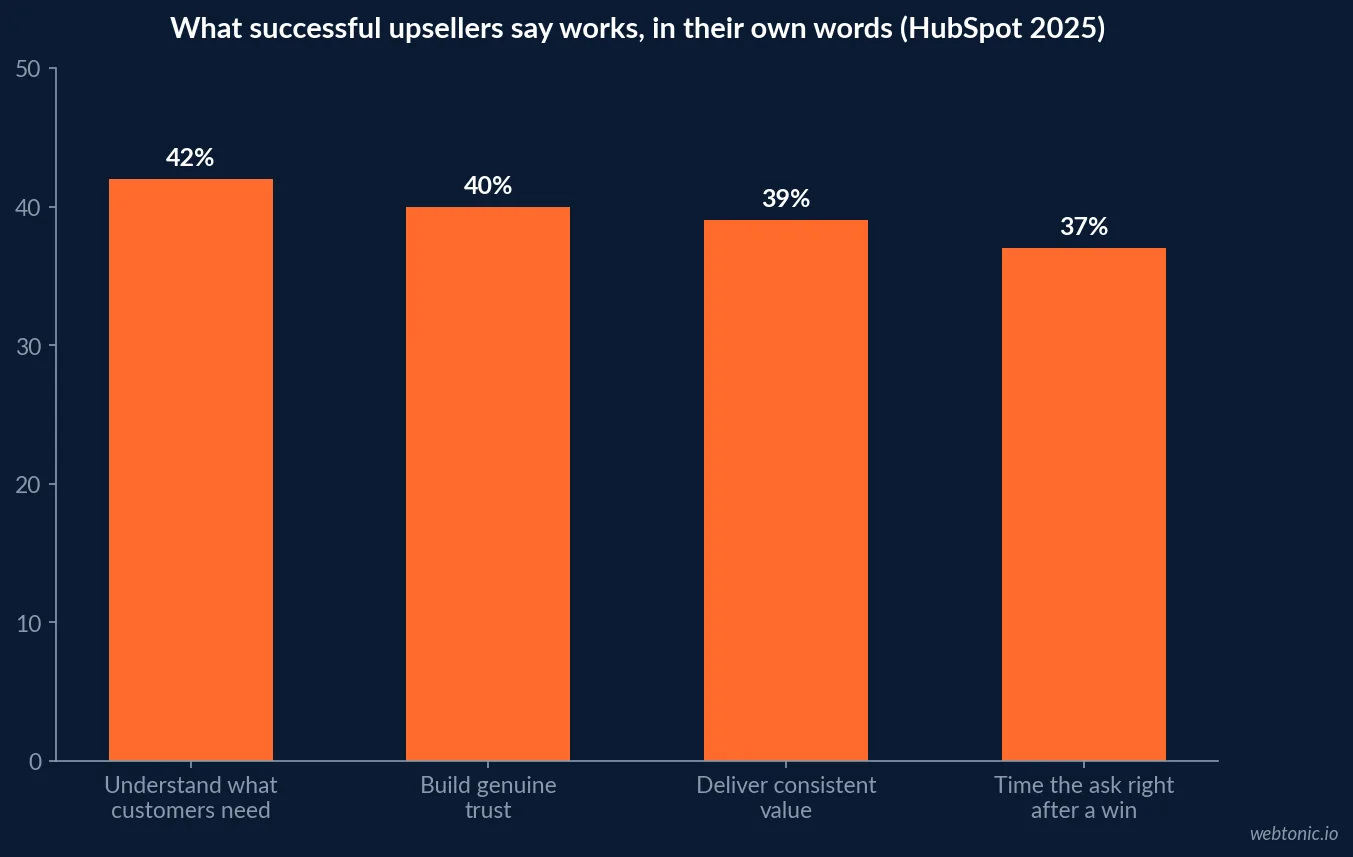
Timing and trust, not discounting, drive upsell success according to HubSpot's 2025 sales research. Among sales professionals who consider themselves successful upsellers, 42% point to understanding what the customer actually needs, 40% to building genuine trust, 39% to consistently delivering value before asking, and 37% to timing the ask right after the customer hits a goal. None of the leading answers involve price - the signal is relationship state, not offer structure.
That timing insight matters more as deals get harder to close. Salesforce's 2026 sales statistics report that 57% of sales professionals now say the sales cycle is getting longer, and 73% of B2B buyers actively avoid sellers who send irrelevant outreach - a pointed argument against upselling on a schedule rather than a signal.
| Self-reported driver of upsell success | Share of successful upsellers | Source |
|---|---|---|
| Understanding what the customer needs | 42% | HubSpot, 2025 |
| Building genuine trust | 40% | HubSpot, 2025 |
| Consistently delivering value first | 39% | HubSpot, 2025 |
| Timing the ask right after a win | 37% | HubSpot, 2025 |
| Sales cycle getting longer (context) | 57% agree | Salesforce, 2026 |
| B2B buyers avoiding irrelevant outreach | 73% | Salesforce, 2026 |
The metric that actually scores both tactics: net revenue retention
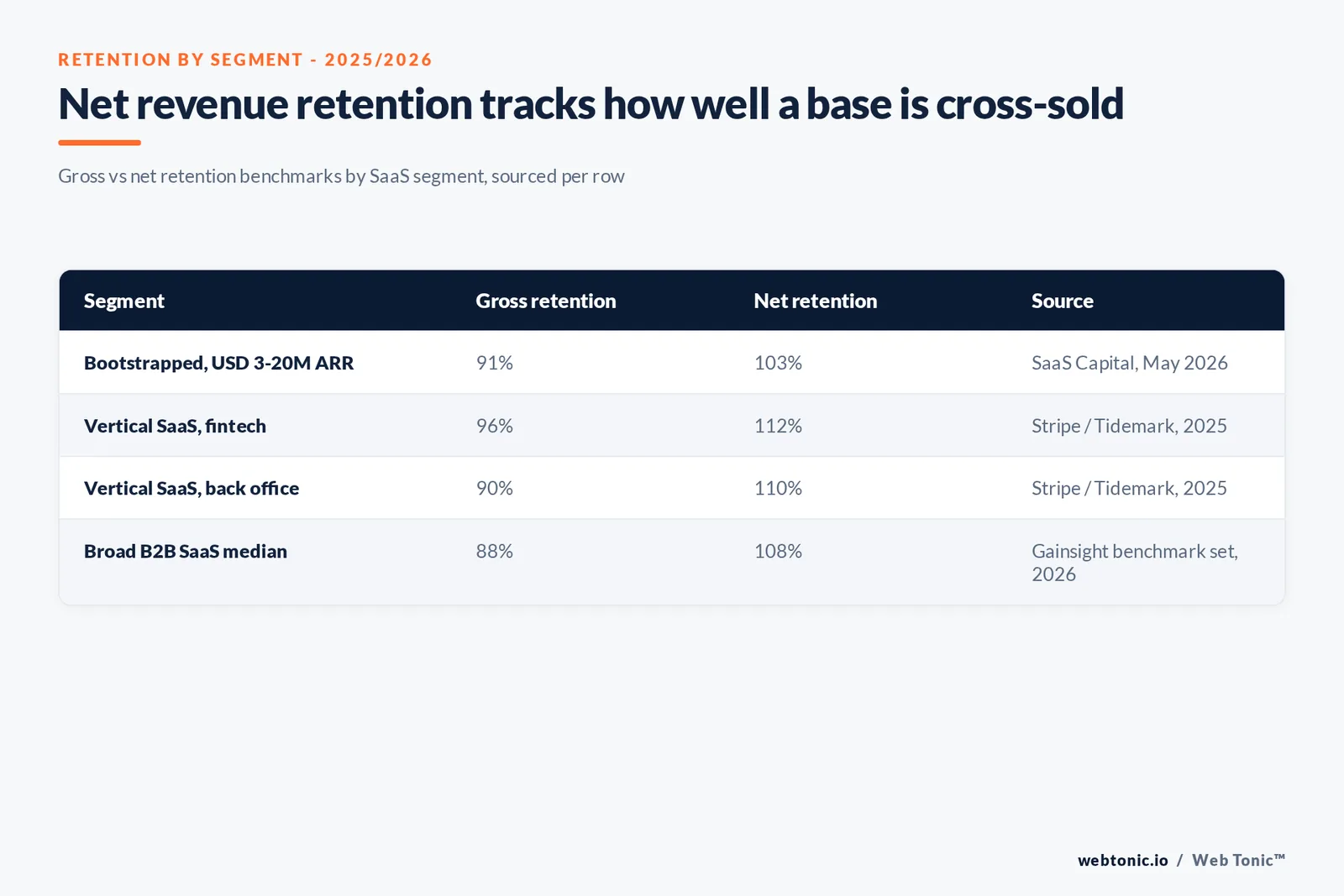
Cross-sell and upsell revenue both land in the same line on a SaaS scorecard: expansion revenue, which is what separates net revenue retention (NRR) from gross revenue retention (GRR). Gainsight's 2026 benchmark data shows vertical SaaS in fintech reporting 96% GRR against 112% NRR - a 16-point gap that is almost entirely cross-sell and upsell activity. Vertical SaaS in back-office software runs 90% GRR against 110% NRR, and bootstrapped companies between USD 3 and 20 million ARR report 91% GRR against 103% NRR as of May 2026.
A business where GRR and NRR sit close together is a business where expansion - cross-sell and upsell combined - is not doing meaningful work. That gap, not the win rate on any single upsell campaign, is the number worth tracking quarter over quarter.
| SaaS segment | Gross revenue retention | Net revenue retention | Expansion gap |
|---|---|---|---|
| Vertical SaaS, fintech | 96% | 112% | 16 points |
| Vertical SaaS, back office | 90% | 110% | 20 points |
| Bootstrapped, USD 3-20M ARR | 91% | 103% | 12 points |
| High Alpha benchmark, 2025 | ~90% | ~100-104% | 0-14 points |
Subscription businesses treat expansion as one of three growth levers
Zuora's Subscription Economy Index frames subscription growth as three levers: acquiring new customers, retaining existing ones, and expanding revenue through upselling or cross-selling within the existing base. Companies that lean on the third lever are structurally less exposed to rising customer acquisition costs elsewhere on this site's paid acquisition cost data, because expansion revenue does not carry a new-customer acquisition cost at all.
Our growth marketing practice builds the segmentation and timing triggers - not just the offer - that separate a cross-sell campaign that lifts NRR from one that annoys an existing customer base.
Where AI changes the cross-sell moment
The newest lever in cross-selling is timing precision, not a new offer type. Bain's work with an insurance carrier built machine-learning models across a dozen levers to identify the right moment to cross-sell an existing policyholder, anticipating an approximate 25% boost in additional revenue potential through cross-selling alone, and a roughly 10x improvement in marketing performance versus the carrier's prior approach. The mechanism is the same one Bain's 2016 telecom brief described - USAA's data mining to catch signature life events like a teenager turning 16 - just executed with more current tooling.
The pattern holds across Bain's insurance research more broadly: cross-selling a second or third policy to an existing customer measurably reduces churn, because a customer with multiple bundled products faces more friction switching providers than one with a single policy.
| AI-driven cross-sell result | Figure | Context | Source |
|---|---|---|---|
| Additional revenue potential from cross-selling | ~25% | Modeled across a dozen targeting levers | Bain, InsuranceCo case |
| Marketing performance improvement | ~10x | Versus the carrier's prior targeting approach | Bain, InsuranceCo case |
| Split-service customer base addressable (telecom) | Up to 60% | Same underlying mechanic as insurance | Bain, 2016 |
A decision rule for choosing between the two
Reach for a cross-sell when the customer already trusts the brand but is meeting a second need elsewhere - Bain's telecom data says up to 60% of customers are in exactly that position. Reach for an upsell when the customer has just hit a milestone with the current product and the next tier solves a problem they can now see clearly. Both fail for the same reason: asking before the customer has a reason to say yes, which is precisely what HubSpot's 42%/40%/39%/37% breakdown is measuring.
If the growth plan needs both motions instrumented against real retention data, talk to us, or see how we approach the acquisition side of the funnel in our guide to building a paid search strategy that funds the customer base worth expanding.
Frequently Asked Questions
What is the difference between cross-selling and upselling, in practice?
Cross-selling sells a related product alongside the one a customer is already buying; upselling moves the same customer to a pricier version of that same product. Bain's research on telecom bundling frames cross-selling as a share-of-wallet problem - persuading a customer who already splits services across providers to consolidate - while HubSpot's 2025 sales data frames upselling as a timing and trust problem, won or lost in the weeks right after a customer's first success with the product.
How much revenue is actually on the table from cross-selling?
Bain & Company's telecom analysis found that converting just 10% of customers who split services across providers to switch one additional service to a single provider was worth up to USD 480 million in incremental annual revenue for one provider studied. Converting that same 10% to consolidate all services with one provider was worth up to USD 630 million - and that figure excludes the further reduction in churn that consolidation tends to produce.
What actually makes an upsell succeed, according to sales data?
HubSpot's 2025 research on sales professionals found the top self-reported drivers of a successful upsell are understanding what the customer actually needs (42%), building genuine trust (40%), consistently delivering value before asking (39%), and timing the ask right after a customer hits a goal (37%). None of the top answers were about discounting or urgency - the data points at relationship timing, not pricing tactics.
Is net revenue retention a cross-sell metric?
It is the scoreboard for cross-sell and upsell combined. Gainsight's 2026 benchmark data shows net revenue retention (NRR) running well above gross revenue retention (GRR) precisely because expansion - cross-sell and upsell together - offsets churn: vertical SaaS in fintech reports 96% GRR against 112% NRR, for example. A business with GRR and NRR sitting close together is one where expansion revenue, cross-selling included, is not doing much work.
Does bundling always increase loyalty as well as revenue?
Bain's telecom research found that cross-selling drops customer churn sharply as an insurer or telecom provider sells a customer a second or third product, because switching becomes more disruptive for the customer once multiple services are bundled together. That loyalty effect compounds on top of the direct revenue gain, which is why Bain frames cross-selling as a retention lever first and a revenue lever second.
Sources
Bain & Company - Reinvigorate Cross-Selling, 2016
Bain & Company - Five Ways to Increase Your Cross-Selling
Bain & Company - InsuranceCo Harnesses the Power of AI to Boost Cross-Selling
HubSpot - 10 Upselling Strategies for 2025 (New Data)
Salesforce - 40 Sales Statistics to Watch for in 2026
Gainsight - Net Revenue Retention: How to Calculate NRR with Benchmarks
Gainsight - GRR vs. NRR: Formulas, Benchmarks and Key Differences
Zuora - The Subscription Economy Index Report