Table of contents
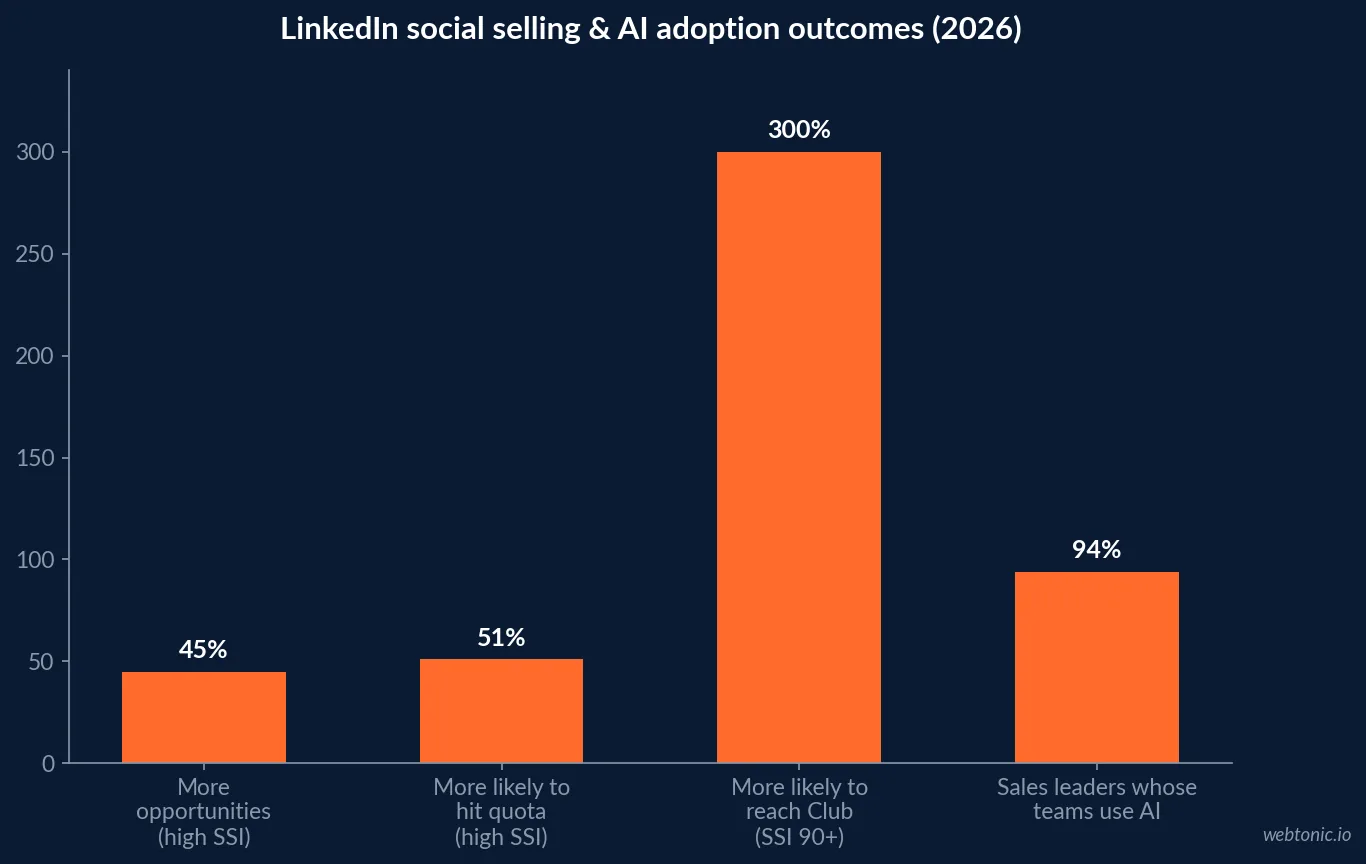
Reps who score high on LinkedIn's Social Selling Index create 45% more opportunities per quarter and are 51% more likely to hit quota than low-SSI peers. That is LinkedIn's own research, and it still holds up against 2026 sales data - but the platform sits inside a sales process where buying committees have grown to more than twenty people and AI agents already touch a third of the pipeline. This page reads the current numbers so a marketing or sales leader can budget for what is actually working, not for the badge.
Key Takeaways
- High-SSI reps create 45% more opportunities per quarter.
- High-SSI reps are 51% more likely to hit quota.
- SSI above 90 makes President's Club three times more likely.
- The Social Selling Index scores four pillars out of 25 points each.
- 94% of sales leaders using AI agents call them essential to growth.
- One Salesforce team turned 130,000 untouched leads into 3,200 opportunities.
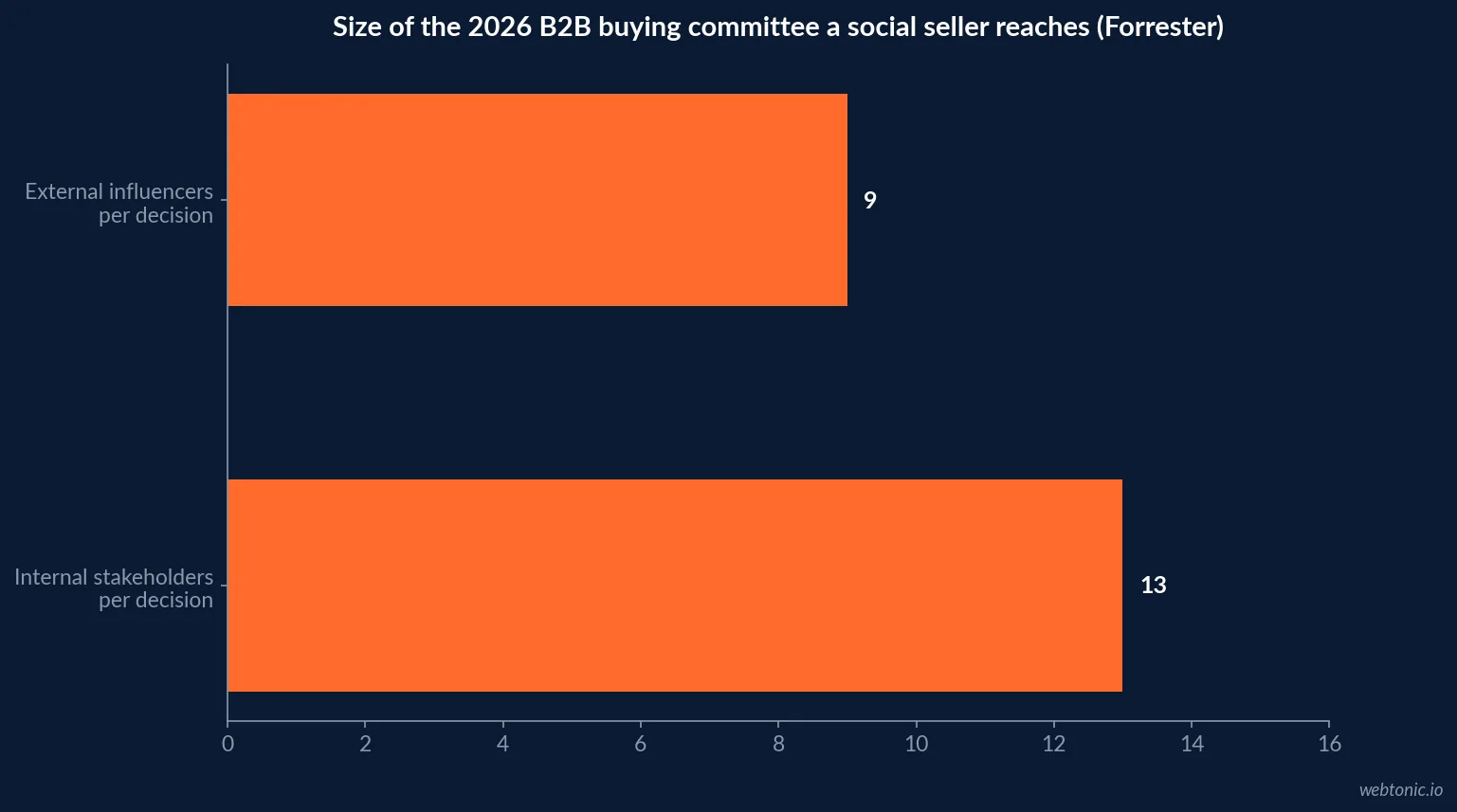
- The typical B2B buying decision now includes 13 internal stakeholders.
- It also includes 9 external influencers.
- 94% of buyers in groups of six or more report clear benefits from that size.
- Procurement is a decision-maker in 53% of buying cycles.
- Over 60% of B2B buyers now use a trial before deciding.
- 59.9% of sales teams are on track to meet or beat their 2026 targets.
- 91% report win rates holding steady or improving.
- 68% report lead quality has improved year over year.
- Only 9% of teams call enablement budget hard to source.
- 45% of sales leaders plan to grow their teams this year.
- Poor perceived value kills 35% of stalled deals.
- No product fit kills another 37%.
What the Social Selling Index actually measures
LinkedIn Sales Solutions scores every Sales Navigator seat on a 0-100 scale built from four pillars worth 25 points each: establishing a professional brand, finding the right people, engaging with insights and building relationships. Team scores are visible under Usage Reporting, though LinkedIn withholds any team average for groups under 10 seats to protect individual privacy.
That structure matters for budgeting: an SSI number alone does not say which pillar is weak. A rep can max out "professional brand" with a polished headline and profile photo while scoring near zero on the two pillars LinkedIn's own coaching content flags as most neglected - insight engagement and relationship building.
| SSI pillar | Points available | What it rewards | Common gap |
|---|---|---|---|
| Establish a professional brand | 25 | Complete profile, content posted regularly | Low |
| Find the right people | 25 | Search and connection precision, Sales Navigator use | Medium |
| Engage with insights | 25 | Sharing and reacting to relevant content | High |
| Build relationships | 25 | Seniority and breadth of the reps's network | High |
Does a high SSI score actually predict revenue?
LinkedIn's own Sales Solutions research is direct about the correlation: reps with a high SSI create 45% more opportunities per quarter than reps with a low score, are 51% more likely to hit quota, and reps who push their score above 90 are three times more likely to make President's Club than reps at any other score band. That is a correlation LinkedIn has reported consistently across its research, not a single-year anomaly.
Correlation is not the same as causation, and LinkedIn's methodology does not isolate SSI from the seniority or tenure of the reps who tend to score highest. Treat the number as a leading indicator worth coaching toward, not a guarantee that raising a score alone raises revenue.
| Sales benchmark (HubSpot 2026) | Reported figure | What it tells a budget owner |
|---|---|---|
| Teams on track to meet or beat quota | 59.9% | A slim majority, not a guarantee |
| Win rates stable or improving | 91% | Deal quality is not the bottleneck |
| Average deal size stable or growing | 93% | Pricing pressure is not the bottleneck |
| Lead quality improved year over year | 68% | Upstream targeting is working |
| Teams planning to expand headcount | 45% | Growth is funded, not frozen |
| Teams calling sourcing budget difficult | 9% | Budget is not the constraint this year |
Where deals actually stall despite social activity
The same 2026 HubSpot survey of 1,000+ sales professionals finds the two most common reasons a deal dies are not about outreach volume at all: no product fit at 37% and poor perceived value at 35%. A well-scored SSI profile can open a conversation; it cannot fix a fit or value problem once the conversation starts. Reps rank average profit margin (30%), conversion rate (29%) and win rate (28%) as the metrics that matter most to their own success, ahead of pure activity counts.
The buying committee a single LinkedIn thread cannot cover
Forrester's 2026 Buyer Insights research puts the typical business buying decision at 13 internal stakeholders and 9 external influencers, rising further for complex purchases. 94% of buyers in groups of six or more report clear benefits from that size, including easier internal budget approval, and procurement is a decision-maker in 53% of cycles, engaging from the start rather than only at the contract stage. More than 60% of buyers now use a trial to de-risk the purchase before signing.
A social seller reaching one champion on LinkedIn is reaching roughly one-twentieth of the group that actually decides. SSI activity has to be paired with a plan to surface content to procurement and technical evaluators, not just the original contact.
| Buying-committee fact (Forrester 2026) | Figure | Budget implication |
|---|---|---|
| Internal stakeholders per decision | 13 | One LinkedIn contact is not the buying group |
| External influencers per decision | 9 | Analysts and peers shape the deal outside the CRM |
| Buyers in groups of 6+ reporting clear benefit | 94% | Large committees are now the default |
| Cycles where procurement is a decision-maker | 53% | Content has to satisfy a cost lens too |
| Buyers using a trial before deciding | >60% | Product access now precedes the close |
AI agents are already inside the funnel social selling feeds
Salesforce's seventh-edition State of Sales report, surveying 4,050 sales professionals in 22 countries, finds 94% of sales leaders already using AI agents call them essential to growth. Salesforce's own internal example: agents worked 130,000 previously untouched leads and created 3,200 opportunities in four months, a volume no manual social-selling program could match.
That does not make the human layer optional. Agents can qualify and route volume; they cannot yet build the trust signal a real profile, real posts and a real reply thread create. The realistic 2026 split is agents for reach, reps for the relationship pillar of SSI.
A scorecard before renewing the social selling budget
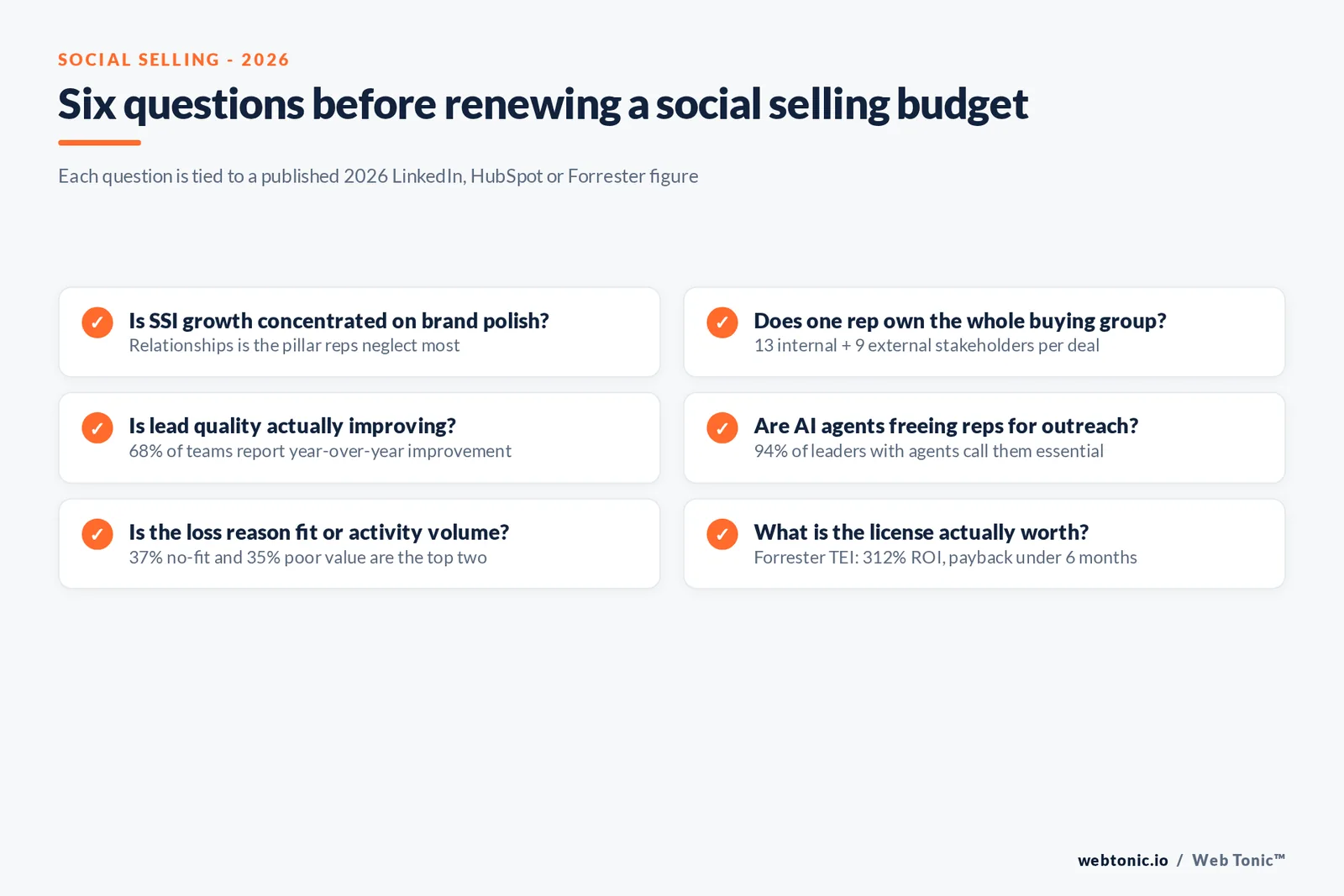
Run the program against what the 2026 data actually rewards, not against a raw SSI target. Coach the two pillars LinkedIn itself flags as weakest - insight engagement and relationship depth - before spending more on profile polish, and route AI agent capacity at the volume work that frees reps to cover more of a 22-person buying committee.
| Question to ask before renewing budget | 2026 benchmark to check it against |
|---|---|
| Is SSI growth concentrated on brand, not relationships? | Relationships is the most commonly weak pillar |
| Does one rep own the whole buying group? | 13 internal + 9 external stakeholders per deal |
| Is lead quality actually improving? | 68% of teams report year-over-year improvement |
| Are agents freeing reps for outreach, or replacing it? | 94% of leaders with agents call them essential |
| Is the loss reason fit or activity volume? | 37% no-fit, 35% poor value are the top two |
The one ROI study that puts a number on Sales Navigator
LinkedIn commissioned Forrester Consulting to study the license cost behind social selling directly. Forrester's composite organization, built from interviews with nine Sales Navigator customers, realized $6.25 million in three-year benefits against $1.79 million in costs, for a 312% ROI, a $4.73 million net present value and a payback period of under six months. The single biggest benefit line was not new pipeline - it was a 15% efficiency gain in sales research tasks, the "finding the right people" pillar of SSI.
Because LinkedIn commissioned the study, treat the 312% figure as a vendor-backed ceiling case, not a guaranteed return - but the underlying benefit breakdown is a useful budget model even if a smaller organization only captures a fraction of it.
| Forrester TEI benefit line (composite org, 3yr) | Present value | SSI pillar it maps to |
|---|---|---|
| Net operating profit from new opportunities | $1.30M | Building relationships |
| Efficiency gained in sales research | $2.57M | Finding the right people |
| Legacy tool consolidation savings | $2.37M | Platform cost, not SSI |
| Total benefits (risk-adjusted) | $6.25M | - |
| Total costs | $1.79M | - |
How AI adoption is actually spreading through sales teams
HubSpot's 2026 State of Sales Trends Report, drawn from 1,000+ sales and revenue professionals, found 94% of sales leaders say their teams already use AI in some form, and only 8% of individual reps say they do not use it at all in their workflow. That adoption curve is what makes the human-only version of social selling - manually finding and researching every prospect - increasingly rare; the realistic 2026 workflow pairs AI research with a human-authored outreach message, since HubSpot's data shows perceived value, not research effort, is what actually closes deals.
A budget line for social selling enablement in 2026 should assume reps already have AI research tools and price training time on message quality and relationship pillars instead, which is the gap our own team sees most often when auditing a client's sales enablement stack.
| AI adoption in sales (HubSpot 2026) | Figure |
|---|---|
| Sales leaders whose teams use AI in some form | 94% |
| Reps reporting no AI use at all | 8% |
| Leaders citing ARR as the top success metric | 42% |
| Teams expecting headcount growth this year | 45% |
What to budget for next
The 2026 numbers argue for spending on coaching content and relationship-building time, not on more Sales Navigator seats alone. Only 9% of teams call enablement budget hard to source this year and 45% plan to grow headcount, so the constraint is rarely money - it is whether that budget goes toward the two SSI pillars that correlate with quota attainment or toward vanity profile metrics that do not. If a license-cost justification is still needed, Forrester's risk-adjusted breakdown above is the more defensible number to bring to a board than the raw SSI score.
Reading these benchmarks together, not in isolation
None of the figures above stand alone. A high SSI score without AI-assisted research behind it wastes rep hours; AI-assisted research without a social presence to build trust with a 22-person buying committee produces reach without relationships. The 2026 data argues for budgeting both halves of the stack in the same line item, and reviewing them against the same quarterly quota-attainment number rather than as separate initiatives. Teams unsure where their own gap sits can run a short audit conversation against these benchmarks before renewing either budget.
Frequently Asked Questions
Is social selling on LinkedIn still working in 2026?
The activity metric says yes. LinkedIn Sales Solutions research finds reps with a high Social Selling Index create 45% more opportunities per quarter and are 51% more likely to hit quota than low-SSI peers, and reps who cross an SSI of 90 are three times more likely to reach President's Club. The harder question is what it is working against: HubSpot's 2026 State of Sales data shows 68% of teams already report improving lead quality without crediting any one channel, so treat SSI as a leading indicator of activity, not a stand-alone proof of causation.
What is the Social Selling Index and how is it scored?
LinkedIn's SSI is a 0-100 score built from four pillars worth 25 points each: establishing a professional brand, finding the right people, engaging with insights and building relationships. It is visible to any LinkedIn Sales Navigator user under Usage Reporting and can be aggregated for a team, though LinkedIn withholds team scores under 10 seats to protect member privacy.
How big is the buying committee a social seller now has to reach?
Larger than a single LinkedIn connection can cover. Forrester's 2026 buyer insights research puts the typical business buying decision at 13 internal stakeholders and 9 external influencers, and finds 94% of buyers in groups of six or more report clear benefits from that size, including easier budget approval. Procurement is a decision-maker in 53% of cycles. A single-thread LinkedIn relationship cannot carry a deal through a committee that size.
Are AI agents replacing social selling outreach?
Not yet, but they are absorbing the volume work around it. Salesforce's seventh-edition State of Sales report, surveying 4,050 sales professionals across 22 countries, finds 94% of sales leaders using AI agents call them essential to growth, and cites an internal case where agents worked 130,000 previously untouched leads into 3,200 new opportunities in four months. Social selling still supplies the relationship signal agents cannot fabricate.
What should a marketing or sales leader actually budget for this?
Budget for the training and content production behind SSI, not for the platform badge itself. HubSpot's 2026 data shows 42% of sales teams call sourcing budget for this kind of enablement easy and only 9% call it difficult, and 45% of leaders plan to grow their teams this year against just 3% planning cuts. Direct that headroom at the two pillars LinkedIn's own research says most reps neglect: engaging with insights and building relationships, not brand polish.
Sources
LinkedIn Sales Solutions - Social Selling Index
LinkedIn Sales Solutions - Achieving Social Selling Success
HubSpot - The State of Sales in 2026
HubSpot - 2026 State of Sales findings
Salesforce - State of Sales, 7th Edition (2026)
Salesforce - 2026 sales statistics
Forrester - 2026 Buyer Insights
Forrester Consulting (commissioned by LinkedIn) - TEI of LinkedIn Sales Navigator