Table of contents
A tax or accounting firm cannot advertise its services in Google Shopping: Google's Unsupported Shopping content policy names accounting services as a disallowed example. What remains is the product side of the category and the Google formats built for service businesses.
Key Takeaways
- Accounting services and financial planning services are named examples of unsupported Shopping content.
- Google issues a warning at least 7 days before a policy suspension for this content type.
- 142,225,000 individual returns reached the IRS by April 24, 2026.
- 73,898,000 of 139,221,000 e-filed returns came from tax professionals.
- IRS.gov logged 534,164,000 visits in the 2026 season, up 59.8%.
- Tax software has its own category, ID 5304, in Google's taxonomy.
- Only software prepaid for 12 months or more is eligible.
- Google Shopping ad spend rose 16% year over year in Q4 2025 (Tinuiti clients).
- Shopping CPC fell 1% in the same quarter.
- Search advertising reached USD 114.2 billion in 2025 (IAB/PwC).
- CPA firm net client fees rose a median 6.7% (AICPA MAP 2025).
What Google's policy says about tax and accounting
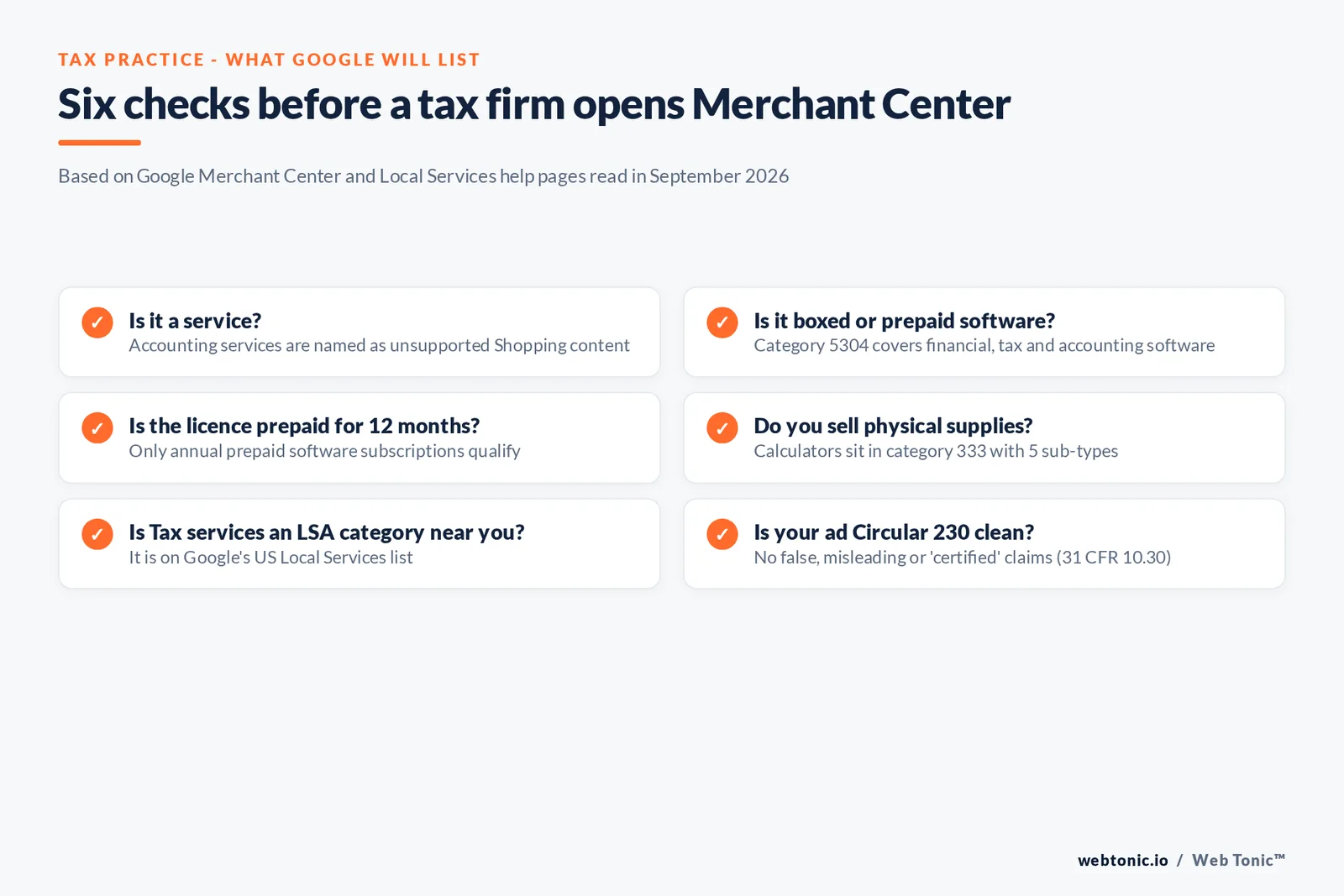
Google's policy text is short and unambiguous. Under "Services" it disallows "labor, time, effort, expertise, or actions, which do not result in ownership of a tangible product", adds that this "includes any services sold bundled with physical goods", and lists as examples "maintenance or repair services, accounting services, financial planning services". The same page excludes financial products such as insurance policies and investment products. For a tax practice, that removes the core offer - return preparation, bookkeeping, advisory, audit representation - from Shopping ads and from free product listings alike.
Enforcement is not instant: the page states that violations will not lead to immediate suspension and that a warning is issued at least 7 days before any account suspension. But a feed that tries to list "2026 individual return preparation - USD 250" as a product is a policy violation, not a grey area.
| Offer a tax firm might have | Shopping eligibility | Policy basis | Where it can run instead |
|---|---|---|---|
| Individual or business return preparation | Not eligible | Services: accounting services named | Search, Local Services Ads |
| Bookkeeping and payroll retainers | Not eligible | Services: labor and expertise | Search, Performance Max |
| Financial planning packages | Not eligible | Services: financial planning named | Search |
| Insurance or investment products | Not eligible | Financial products section | Search, subject to financial-services policy |
| Prepaid annual tax software licence | Eligible if rules met | Recurring billing: annual prepaid allowed | Shopping, Performance Max |
| Calculators, forms binders, office supplies | Eligible as physical goods | Standard product listing | Shopping, free listings |
Where tax demand actually concentrates in 2026
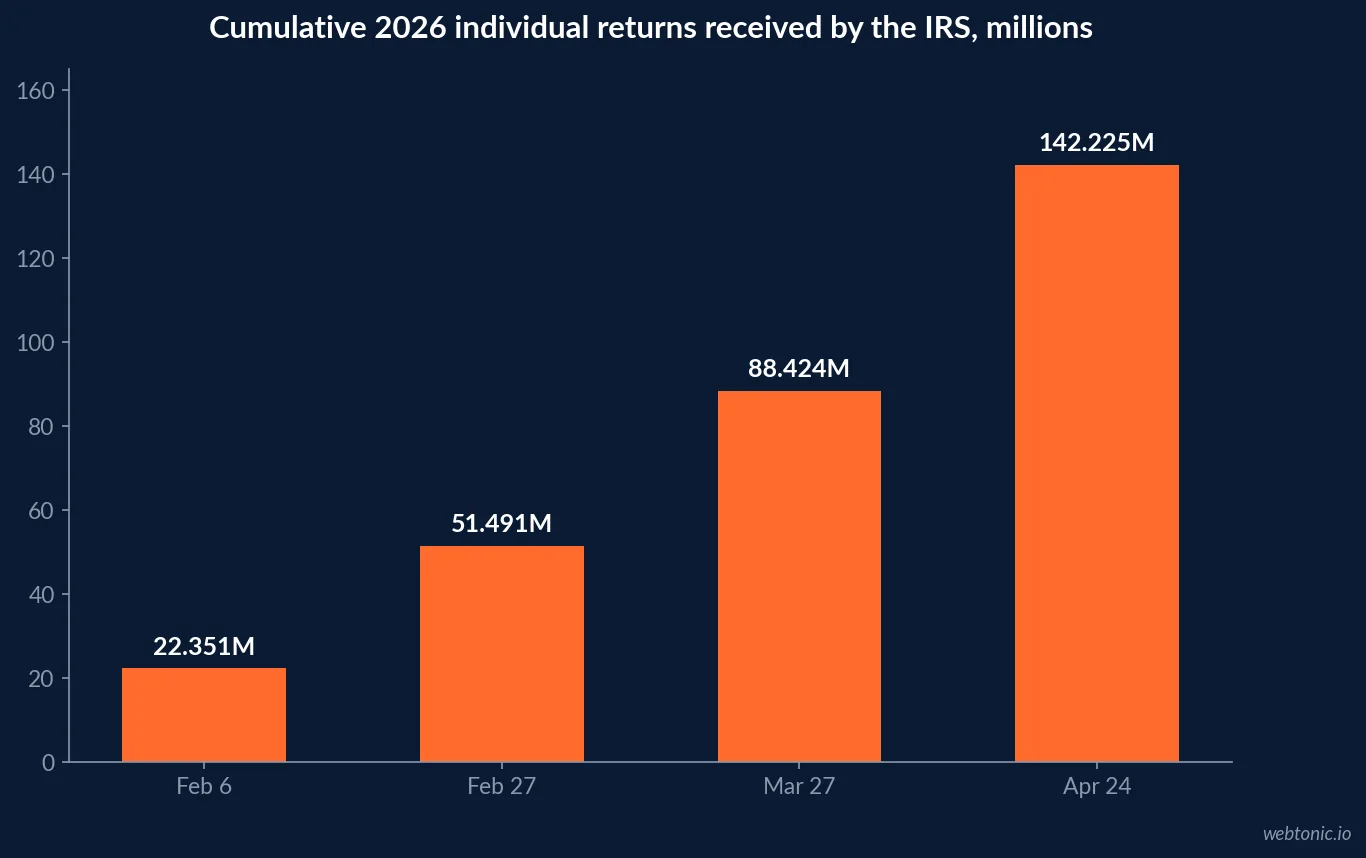
The demand a tax firm pays to reach is extremely seasonal, and the IRS publishes it weekly. By February 6, 2026 the agency had received 22,351,000 returns; by February 27 the count was 51,491,000; by March 27 it was 88,424,000; and by April 24 it reached 142,225,000, down 0.2% from the same point in 2025. That means about 54 million returns - more than a third of the season - arrived in the final four weeks.
For budgeting Google formats, the takeaway is timing rather than channel: Search and Local Services Ads budgets that are flat across January to April under-spend in exactly the weeks when the most people are still looking for a preparer.
| IRS checkpoint (2026) | Cumulative returns received | Added since prior checkpoint | Implication for ad pacing |
|---|---|---|---|
| February 6 | 22,351,000 | - | Early filers, refund-driven searches |
| February 27 | 51,491,000 | 29,140,000 | Peak refund season |
| March 27 | 88,424,000 | 36,933,000 | Business and complex returns |
| April 24 | 142,225,000 | 53,801,000 | Deadline rush; highest weekly intake |
The professional share of filing
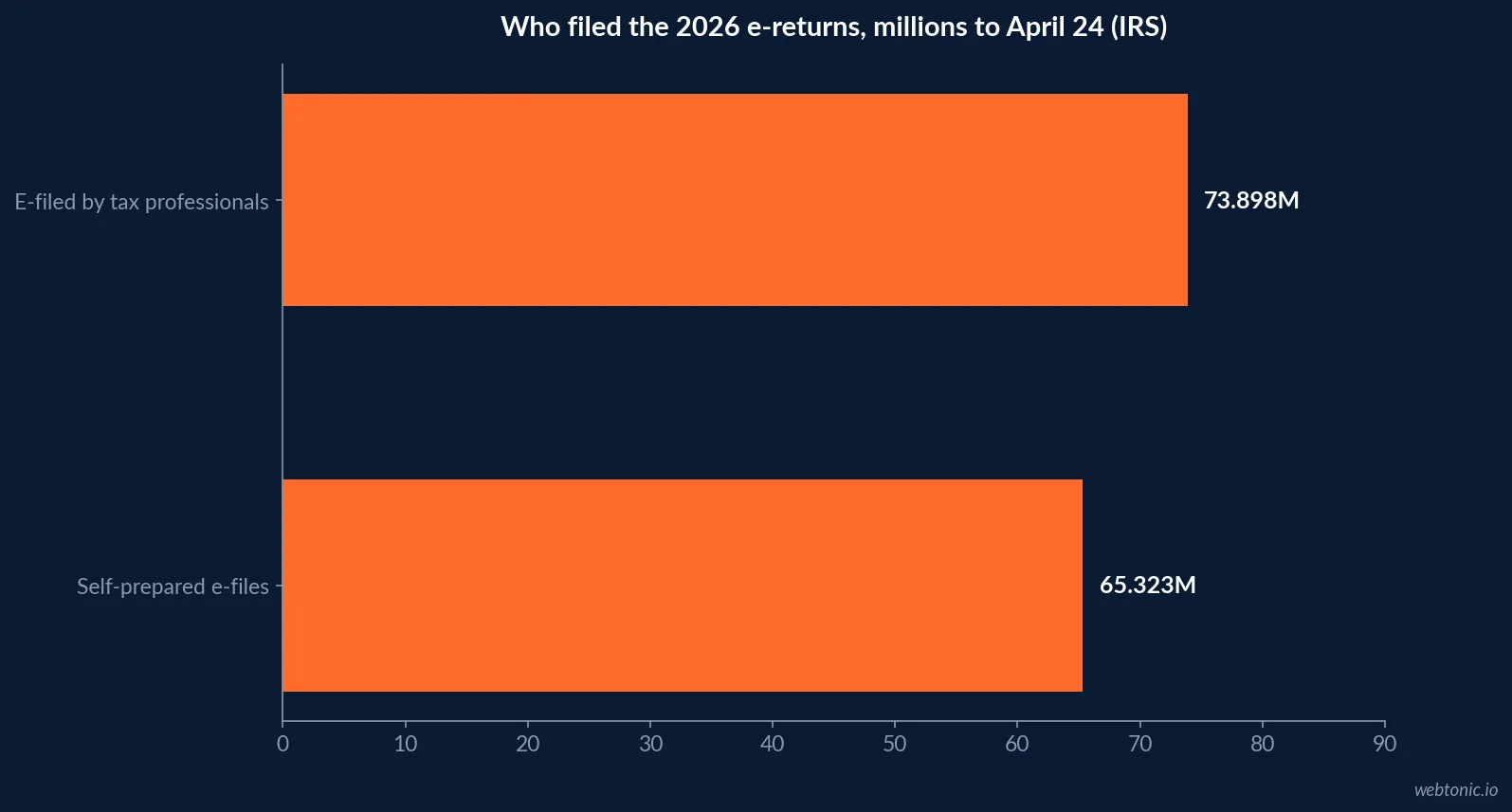
The same IRS release splits e-filing by preparer. Of 139,221,000 e-filed returns, 73,898,000 came from tax professionals (up 0.6%) and 65,323,000 were self-prepared (up 1.9%). Professionals still file the majority, but the self-prepared line grew faster - and that self-prepared line is the part of the market that buys tax software, the one tax product that can legitimately appear in Shopping. Web traffic tells the same story: IRS.gov visits rose 59.8% to 534,164,000.
| IRS metric, season to April 24 | 2025 | 2026 | Change |
|---|---|---|---|
| Total e-filed returns | 137,560,000 | 139,221,000 | +1.2% |
| E-filed by tax professionals | 73,460,000 | 73,898,000 | +0.6% |
| Self-prepared e-files | 64,099,000 | 65,323,000 | +1.9% |
| IRS.gov visits | 334,172,000 | 534,164,000 | +59.8% |
| Average refund | USD 2,945 | USD 3,268 | +11.0% |
The product side: software and supplies
Google's product taxonomy contains 5,595 categories, and two branches matter here. Software > Computer Software > Financial, Tax and Accounting Software (ID 5304) is the home for tax-preparation software, and Office Supplies > Office Equipment > Calculators (ID 333) covers financial calculators. Software is only eligible under Google's software subscription rules: it must be available "in prepaid, 12-month (yearly) increments with a duration of at least 1 year", the title must include "subscription" and the term, and the price must be the full prepaid amount. Monthly auto-renewing plans fall under the policy's recurring-billing exclusion.
In practice that makes Shopping a channel for software vendors and office-supply retailers, not for a firm that happens to recommend a tax product. A firm that resells a licence on its own checkout can list it; a firm that simply refers clients cannot.
Local Services Ads: the Google format built for tax preparers
Google's US Local Services Ads category list includes Tax services and Financial planning services, and Google's product page lists tax specialist among professional services. The model is the opposite of Shopping: no feed, no product price, and you are charged per valid lead. One detail matters for this industry: Google states that automatic lead credits are not available for tax specialists, the same exclusion it applies to health care verticals. Google also recommends a minimum budget of 10 leads per week under its Maximise leads bidding mode.
Local Services Ads are also changing platform. Google's migration notice says campaigns move into a Performance Max campaign type with pay-per-lead goals, starting in August 2026 with home services, expanding in late 2026, and reaching all remaining categories in 2027.
| Google format | Can promote tax services? | Pricing basis | Source |
|---|---|---|---|
| Shopping ads | No | Per click on a product | Merchant Center policy |
| Free product listings | No | No cost | Free listings help |
| Search campaigns | Yes | Per click, average daily budget | Google Ads budget help |
| Performance Max (no feed) | Yes | Bid to conversion goals | Performance Max help |
| Local Services Ads | Yes, Tax services category | Per valid lead | How leads work |
Search and Performance Max budgets for a practice
For Search, Google's budget rules let a campaign spend up to 2 times its average daily budget on a busy day, capped at 30.4 times the daily budget over a month. That is useful in April: a firm can raise its daily budget for the deadline weeks knowing the monthly ceiling is fixed. For Performance Max, Google's setup guidance advises a daily budget of at least 3 times your CPA. Performance Max can run without a product feed, using text, image and video assets across Search, YouTube, Display, Discover, Gmail and Maps, which is the relevant version for a service firm. For price context on clicks, see our guide to what Google Ads costs in 2026.
Cross-industry Shopping data, for software sellers only
No published study reports Shopping CTR, conversion rate or ROAS for tax products, and we will not estimate one. The nearest named data is cross-industry and comes from agency client portfolios. Tinuiti's Q4 2025 Digital Ads Benchmark Report (vendor data, same-client growth) found Google Shopping ad spend up 16% year over year, with CPC down 1%, and Performance Max taking 62% of Shopping investment for brands running both campaign types. The IAB/PwC Internet Advertising Revenue Report puts US search advertising at USD 114.2 billion in 2025, 38.8% of all internet ad revenue.
| Cross-industry metric | Figure | Period | Issuer |
|---|---|---|---|
| Google Shopping ad spend growth | +16% YoY | Q4 2025 | Tinuiti (client data) |
| Google Shopping CPC change | -1% YoY | Q4 2025 | Tinuiti (client data) |
| PMax share of Shopping spend | 62% | Q4 2025 | Tinuiti (client data) |
| US search ad revenue | USD 114.2 billion | FY 2025 | IAB/PwC |
| US e-commerce share of retail | 17.1% | Q2 2026 | US Census Bureau |
Advertising rules that apply to every tax ad
Whatever the format, tax practitioners face a federal advertising standard that most advertisers do not. 31 CFR 10.30 states that a practitioner "may not... use or participate in the use of any form of public communication or private solicitation containing a false, fraudulent, or coercive statement or claim; or a misleading or deceptive statement or claim". Enrolled agents and registered preparers "may not utilize the term 'certified' or imply an employer/employee relationship" with the IRS. That rules out ad copy such as "IRS-certified preparer" and constrains refund-size promises in Search or Local Services headlines.
Firm economics behind the budget
The AICPA 2025 MAP Survey reported a median 6.7% rise in net client fees, down from 9.1% in the prior survey, and net remaining per partner up 11.9% to USD 252,663. 81% of responses came from firms with revenue of USD 5 million or less. Firms are growing, but mostly through deeper client relationships - a lead-generation job for Search and Local Services, not a product catalogue job for Shopping.
How to plan Google spend for a tax practice
- Remove any service "products" from Merchant Center before Google flags them.
- List only goods you sell on your own checkout, such as prepaid annual software in category 5304.
- Apply for Local Services Ads in the Tax services category and budget for leads, not clicks.
- Weight Search budgets toward March and April, when the IRS intake is highest.
- Review every headline against Circular 230 before launch.
Our data intelligence team can connect call and form leads back to campaigns, and the tax and accounting CTV data covers the awareness side of the same season.
Frequently Asked Questions
Can an accounting or tax preparation firm run Google Shopping ads?
Not for its services. Google's Unsupported Shopping content policy defines services as labor, time, effort, expertise or actions that do not result in ownership of a tangible product, and it lists accounting services and financial planning services by name as examples. A firm can only use Merchant Center for physical or eligible digital products it genuinely sells, such as prepaid tax software licences or office supplies.
What Google ad formats can a tax preparer use instead?
Google's own alternatives are Search campaigns, Performance Max with non-Shopping assets, and Local Services Ads, where Tax services appears on Google's US category list. Local Services Ads charge per valid lead rather than per click, and Google notes that automatic lead credits are not available for tax specialists.
Can tax software be listed on Google Shopping?
Yes, if it meets Google's software rules. A software subscription must be prepaid in 12-month increments with a duration of at least one year, carry the word subscription and its duration in the title, and use the full prepaid price. Google's taxonomy has a dedicated category, Financial, Tax and Accounting Software (ID 5304).
When does tax-season search demand peak?
The IRS count of individual returns received climbed from 22,351,000 by February 6, 2026 to 142,225,000 by April 24, 2026, so roughly 54 million returns arrived between late March and late April alone. Budgets for Search and Local Services Ads are usually weighted toward that window, not spread evenly across the year.
Are there advertising rules specific to tax practitioners?
Yes. Treasury Circular 230, section 10.30, bars practitioners from any public communication containing a false, fraudulent, coercive, misleading or deceptive claim, and bars enrolled agents and registered preparers from using the term certified or implying an employment relationship with the IRS.
Sources
Google Merchant Center - Unsupported Shopping content
Google Merchant Center - Software subscriptions
Google product taxonomy
Google Local Services Ads - Getting started (US)
Google - Local Services Ads
IRS - Filing season statistics, April 24, 2026
AICPA - 2025 MAP Survey
eCFR - 31 CFR 10.30
Tinuiti - Digital Ads Benchmark Report Q4 2025
IAB/PwC - Internet Advertising Revenue Report FY 2025
US Census Bureau - Quarterly Retail E-Commerce