Table of contents
A SWOT analysis template is a pre-built four-box grid — strengths, weaknesses, opportunities, threats — that you fill in to separate what your business controls from what the market does to it. Below are 18 free SWOT analysis templates by format, 3 completed SWOT analysis examples, and the prompts that stop each quadrant from turning into a wish list.
Key Takeaways
- Every SWOT analysis template splits 4 quadrants into 2 internal factors you own (strengths, weaknesses) and 2 external factors you can only react to (opportunities, threats).
- 18 free templates below cover Word, PowerPoint, Google Docs, Google Slides, PDF and live diagram tools, so the format matches where the output actually gets presented.
- A working session needs 60 to 90 minutes and 4 to 8 participants from different functions — a solo SWOT diagram almost always over-rates strengths.
- Aim for 5 to 8 entries per box. Fewer than 3 means the team stopped thinking; more than 10 means nothing has been prioritised.
- Roughly 14,800 US searches a month go to SWOT analysis template queries, and most land on a blank grid with no instructions — the gap is guidance, not another PNG.
- The matrix is a middle step, not the deliverable. Pairing quadrants (TOWS) converts a filled grid into 4 concrete strategy tracks.
What a SWOT analysis template actually gives you
A SWOT analysis is a structured audit of strengths, weaknesses, opportunities and threats, used to compare internal capability against external conditions before committing budget. Mind Tools traces the framework to 1960s corporate planning research, and Corporate Finance Institute still treats it as the entry point for strategic planning coursework. The template is simply the container: a 2×2 grid that forces four different kinds of thinking into four different spaces.
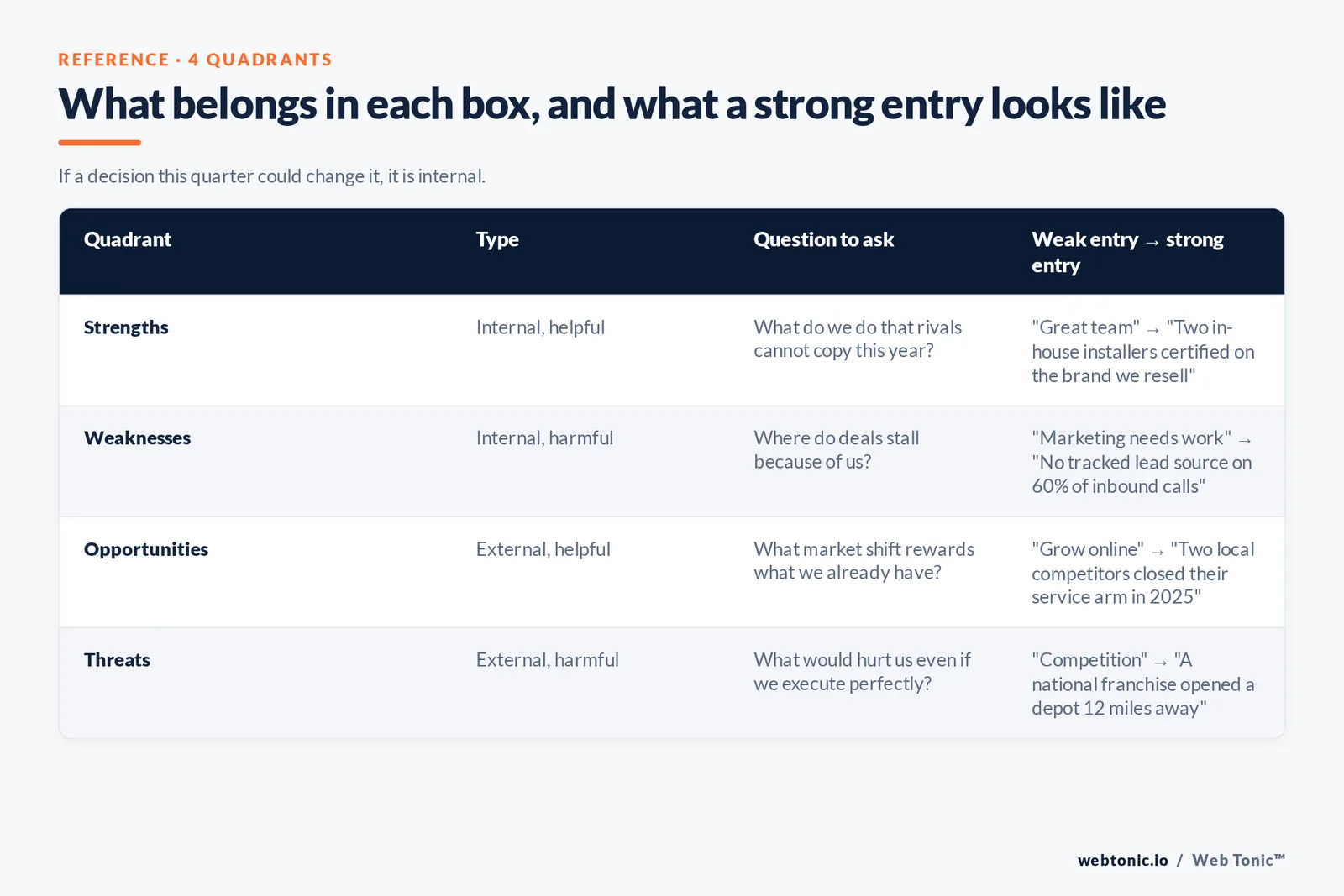
The container matters more than it looks. Without one, planning sessions collapse into a single undifferentiated list where "our team is small" appears as both a strength and a weakness, and "the market is growing" gets recorded as a strength even though no one in the room controls it. The quadrant walls are the discipline. IBM frames the same split as controllable versus contextual, which is the test we use in workshops: if you could change it with a decision this quarter, it is internal.
| Quadrant | Type | Question to ask | Weak entry vs strong entry |
|---|---|---|---|
| Strengths | Internal, helpful | What do we do that competitors cannot copy this year? | "Great team" → "Two in-house installers certified on the brand we resell" |
| Weaknesses | Internal, harmful | Where do deals or projects stall because of us? | "Marketing needs work" → "No tracked lead source on 60% of inbound calls" |
| Opportunities | External, helpful | What shift in the market rewards what we already have? | "Grow online" → "Two local competitors closed their service arm in 2025" |
| Threats | External, harmful | What would hurt us even if we execute perfectly? | "Competition" → "A national franchise opened a depot 12 miles away" |
Two rules keep the grid honest. First, every entry must be specific enough that someone outside the room could verify it. Second, internal and external stay strictly separated — a growing market is an opportunity, and your ability to serve that market is a strength. Mixing them is the single most common reason a completed SWOT matrix produces no decisions.
18 free SWOT analysis templates by format
Pick the format by destination. A SWOT diagram destined for a board deck belongs in PowerPoint or Google Slides; one destined for a business plan appendix belongs in Word or PDF; one built live with a remote team belongs in a collaborative canvas. All 18 options below are free to access at the time of writing.
Document templates (Word, Google Docs, PDF)
| Template | Format | Best for | Why it works |
|---|---|---|---|
| 1. Microsoft Create SWOT set | Word, PowerPoint | Business plan appendices | Editable text boxes, prints cleanly to one page |
| 2. Microsoft one-page grid | Word | Solo founders | No design work; type straight into the four cells |
| 3. Google Docs 2×2 table | Google Docs | Async comments from a team | Comment threads sit beside each quadrant |
| 4. Google Docs prompt-led version | Google Docs | First-time facilitators | Each box ships with the guiding question inside it |
| 5. Printable PDF grid | In-person workshops | Print A3, one per table, sticky notes on top | |
| 6. Asana planning worksheet | Web, exportable | Turning findings into tasks | Each entry converts into an owned action item |
Microsoft Create hosts the largest free set of Word and PowerPoint SWOT templates, and the files open in the free web versions of both apps. Asana publishes a worksheet-style walkthrough that is worth copying even if you never open the tool, because it pairs each quadrant with an owner field.

Presentation templates (PowerPoint, Google Slides)
| Template | Format | Best for | Why it works |
|---|---|---|---|
| 7. Four-quadrant slide | PowerPoint | Board and investor decks | Colour-coded boxes read at a glance from the back of a room |
| 8. Arrow / funnel SWOT | PowerPoint | Narrative presentations | Shows sequence rather than four equal boxes |
| 9. Icon-led SWOT slide | Google Slides | Client-facing workshops | Icons carry meaning when text is trimmed to keywords |
| 10. Competitive side-by-side | Google Slides | Two-brand comparisons | Your grid and a rival's grid on one slide |
| 11. Quarterly review layout | PowerPoint | Recurring planning | Last quarter's entries greyed out beside this quarter's |
| 12. Single-colour minimal grid | Google Slides, PNG export | Brand-strict decks | One accent colour, no stock imagery to clash with |
Diagram and whiteboard templates
Live canvases are the strongest option for a remote session because contributions arrive in parallel rather than through one note-taker. Miro and Lucidchart both offer free SWOT diagram templates with sticky-note input and PNG or PDF export at the end.
| Template | Format | Best for | Why it works |
|---|---|---|---|
| 13. Miro sticky-note SWOT | Web canvas | Remote workshops | Silent brainstorm then dot-voting inside one board |
| 14. Miro TOWS extension | Web canvas | Turning grid into strategy | Adds the four pairing cells beside the matrix |
| 15. Lucidchart classic matrix | Web diagram | Documentation | Version history and shareable read-only links |
| 16. Lucidchart cross diagram | Web diagram | Teaching the framework | Internal / external axes are drawn explicitly |
| 17. Personal SWOT worksheet | Docs or canvas | Career planning | Prompts about skills and network rather than market share |
| 18. Marketing-channel SWOT | Sheet or canvas | Channel audits | One grid per channel, scored side by side |
3 completed SWOT analysis examples
Blank grids are easy to find; filled ones are rare, and they are what people actually copy. Each example below uses 3 entries per quadrant for readability — in a live session, expect 5 to 8.
Example 1 — Local home services business
- Strengths: 4.8-star average across 200+ reviews; two manufacturer-certified installers; same-week scheduling.
- Weaknesses: no call tracking on 60% of inbound enquiries; quotes take 3 days; one-page website with no service pages.
- Opportunities: two rivals stopped offering maintenance contracts; grant-funded upgrades increasing demand; almost no local video content.
- Threats: a national franchise opened a depot nearby; parts lead times; one technician holds all commercial relationships.
Example 2 — B2B software company (Series A)
- Strengths: 112% net revenue retention in the top tier; a founder with category credibility; 9 native integrations.
- Weaknesses: onboarding takes 6 weeks; 1 enterprise account is 18% of revenue; no self-serve tier.
- Opportunities: compliance deadlines forcing tool replacement; partner marketplaces; a rival sunsetting its low tier.
- Threats: a platform vendor bundling the same feature free; rising paid acquisition costs; hiring competition for engineers.
Example 3 — Personal SWOT analysis
- Strengths: 7 years of category experience; a portfolio of shipped work; a network across 3 adjacent industries.
- Weaknesses: no formal management experience; weak public profile; narrow technical range.
- Opportunities: internal role opening in 2 quarters; a funded certification; conference speaking calls.
- Threats: restructuring in the division; skills commoditised by automation; a peer with the same target role.
How to conduct a SWOT analysis in 6 steps
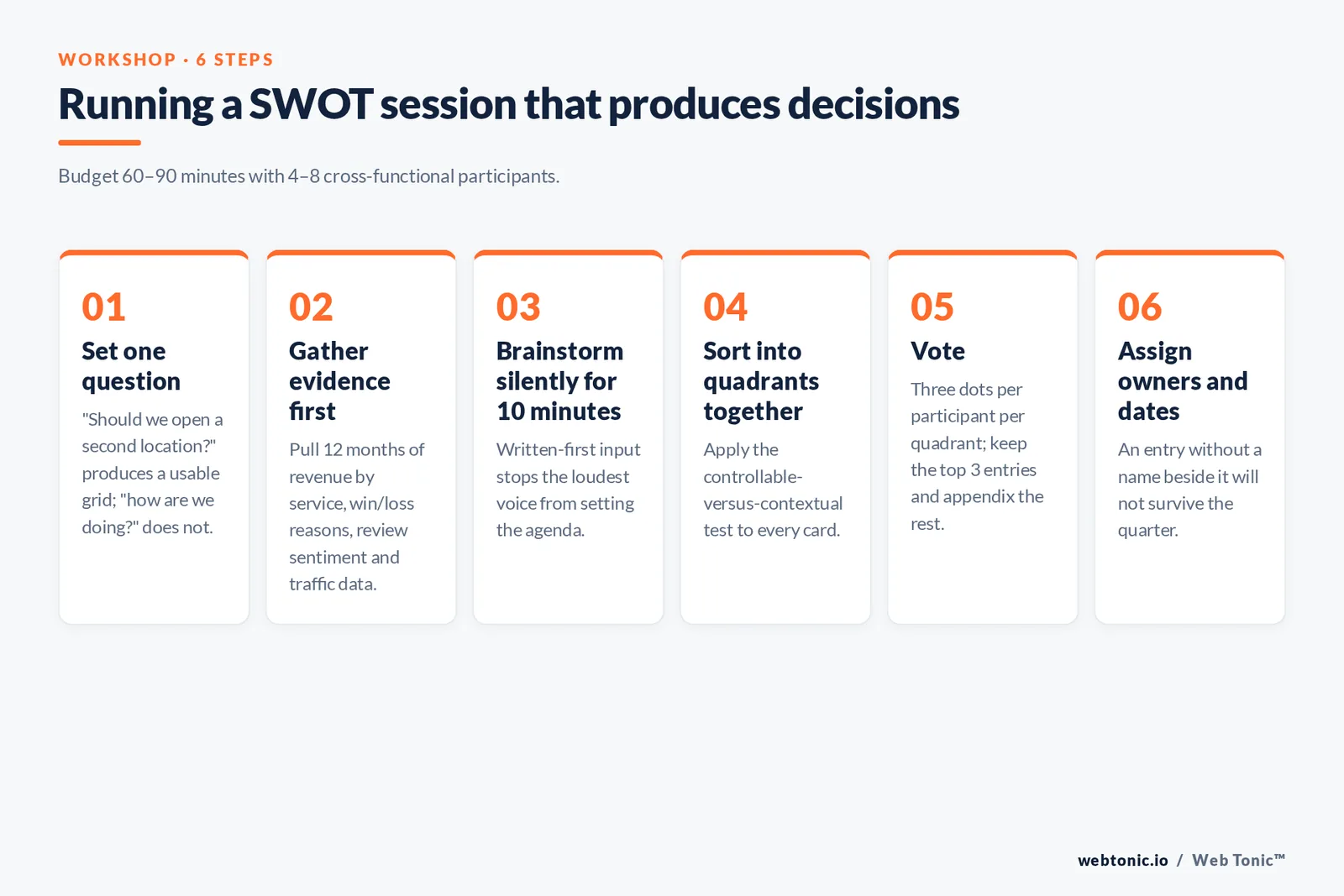
- Set one question. "Should we open a second location?" produces a usable grid; "how are we doing?" does not.
- Gather evidence first. Pull 12 months of revenue by service, win/loss reasons, review sentiment and traffic data before anyone opens the template.
- Brainstorm silently for 10 minutes. Written-first input stops the loudest voice from setting the agenda.
- Sort into quadrants together, applying the controllable-versus-contextual test to every card.
- Vote. Give each participant 3 dots per quadrant and keep the top 3 entries. Everything else moves to an appendix.
- Assign owners and dates. A quadrant entry without a name beside it will not survive the quarter.
If the output feeds a formal plan, the US Small Business Administration guidance on business plans shows where the completed matrix sits in the wider document. And because most weaknesses are internal execution issues, Gallup's work on engagement is a useful cross-check on whether the problem is strategy or delivery.
From matrix to strategy: pairing the quadrants
The step almost every free template skips is pairing. Cross the quadrants and you get four action tracks instead of four lists.
| Pairing | Question | Output |
|---|---|---|
| Strengths × Opportunities | Which strength lets us take this opening first? | Growth bets — fund these now |
| Strengths × Threats | What do we defend with what we already have? | Defensive moves |
| Weaknesses × Opportunities | What must we fix to qualify for this opening? | Capability projects |
| Weaknesses × Threats | Where are we genuinely exposed? | Risk register items |
A useful sanity check: if the pairing exercise produces fewer than 4 decisions, the grid was too vague. This is also where the analysis connects to delivery — our teams route growth bets into growth marketing, measurement weaknesses into data intelligence, and site-side capability gaps into web development.
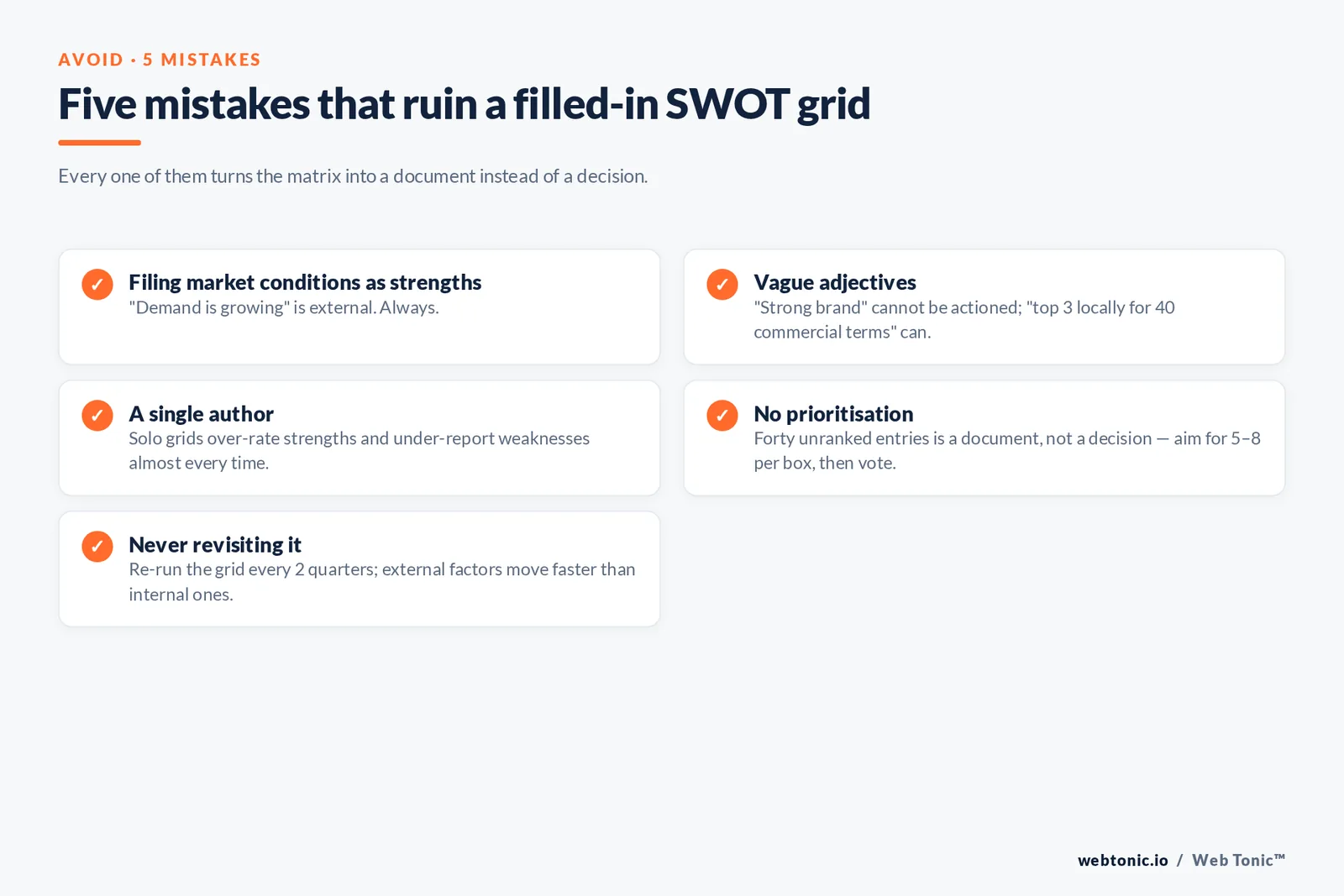
5 mistakes that ruin a SWOT analysis template
- Mistake 1 — filing market conditions as strengths. "Demand is growing" is external. Always.
- Mistake 2 — vague adjectives. "Strong brand" cannot be actioned; "ranked in the top 3 locally for 40 commercial terms" can.
- Mistake 3 — a single author. Solo grids over-rate strengths and under-report weaknesses almost every time.
- Mistake 4 — no prioritisation. 40 unranked entries is a document, not a decision.
- Mistake 5 — never revisiting it. Re-run the grid every 2 quarters; external factors move faster than internal ones.
FAQ
What are the four parts of a SWOT analysis template?
Strengths, weaknesses, opportunities and threats. Strengths and weaknesses are internal factors you control, while opportunities and threats are external factors in the market. Most templates draw them as a 2×2 grid with internal on the left and external on the right.
Where can I find a free SWOT analysis template?
Microsoft Create hosts free Word and PowerPoint SWOT templates, Miro and Lucidchart offer free diagram versions for remote sessions, and a 2×2 table in Google Docs or Google Slides works just as well. The eighteen options above cover every common format including printable PDF.
How do I fill in each section of a SWOT template?
Answer one question per quadrant with evidence rather than opinion, aiming for five to eight specific entries per box. Apply one test to every entry: if a decision this quarter could change it, it belongs on the internal side; if not, it is external.
What is a personal SWOT analysis?
The same grid applied to a career instead of a company. Strengths and weaknesses cover skills, experience and network, while opportunities and threats cover role openings, industry shifts and automation risk. It is the most common non-business use of the framework.
Is SWOT analysis still relevant?
Yes, as a structuring step rather than a strategy in itself. It is still taught as the entry point to strategic planning, but the value comes from pairing the quadrants afterwards to produce growth bets, defensive moves, capability projects and risk items.
How long should a SWOT session take?
Budget sixty to ninety minutes with four to eight cross-functional participants, plus preparation time to gather revenue, win/loss and traffic data beforehand. Sessions that run longer usually lack a single guiding question.
Sources: Mind Tools — SWOT Analysis · Corporate Finance Institute · HubSpot — How to Run a SWOT Analysis · IBM Think · Microsoft Create templates · Asana Resources · Miro template library · Lucidchart templates · US SBA · Gallup · Web Tonic keyword research, July 2026. Need help turning a completed matrix into a plan? Talk to our strategy team or browse the Web Tonic blog.