Table of contents
A SWOT analysis maps internal strengths, weaknesses, opportunities, and threats so decision-makers can act on evidence rather than instinct. This strategic management tool — rooted in the work of Albert Humphrey at the Stanford Research Institute — has guided organizations from Fortune 500 boardrooms to community nonprofits for over six decades.
Key Takeaways
- SWOT stands for strengths, weaknesses, opportunities, and threats — the four quadrants divide every factor into internal vs. external and favorable vs. unfavorable.
- 72% of companies that conduct regular SWOT analysis outperform competitors over a five-year period, according to Coursera research.
- Internal factors (strengths and weaknesses) are controllable; external factors (opportunities and threats) require strategic management and adaptation.
- Teams complete a comprehensive SWOT analysis in 60–90 minutes when they identify internal and external factors before the session begins.
- 89% of strategic planning professionals use at least one structured framework, with SWOT analysis ranking as the most popular strategic management tool worldwide.
- Albert Humphrey at the Stanford Research Institute developed the SWOT model during the 1960s — later refined at Harvard Business School — while studying why long range planning in organizations failed.
What a SWOT Analysis Is and Why It Matters
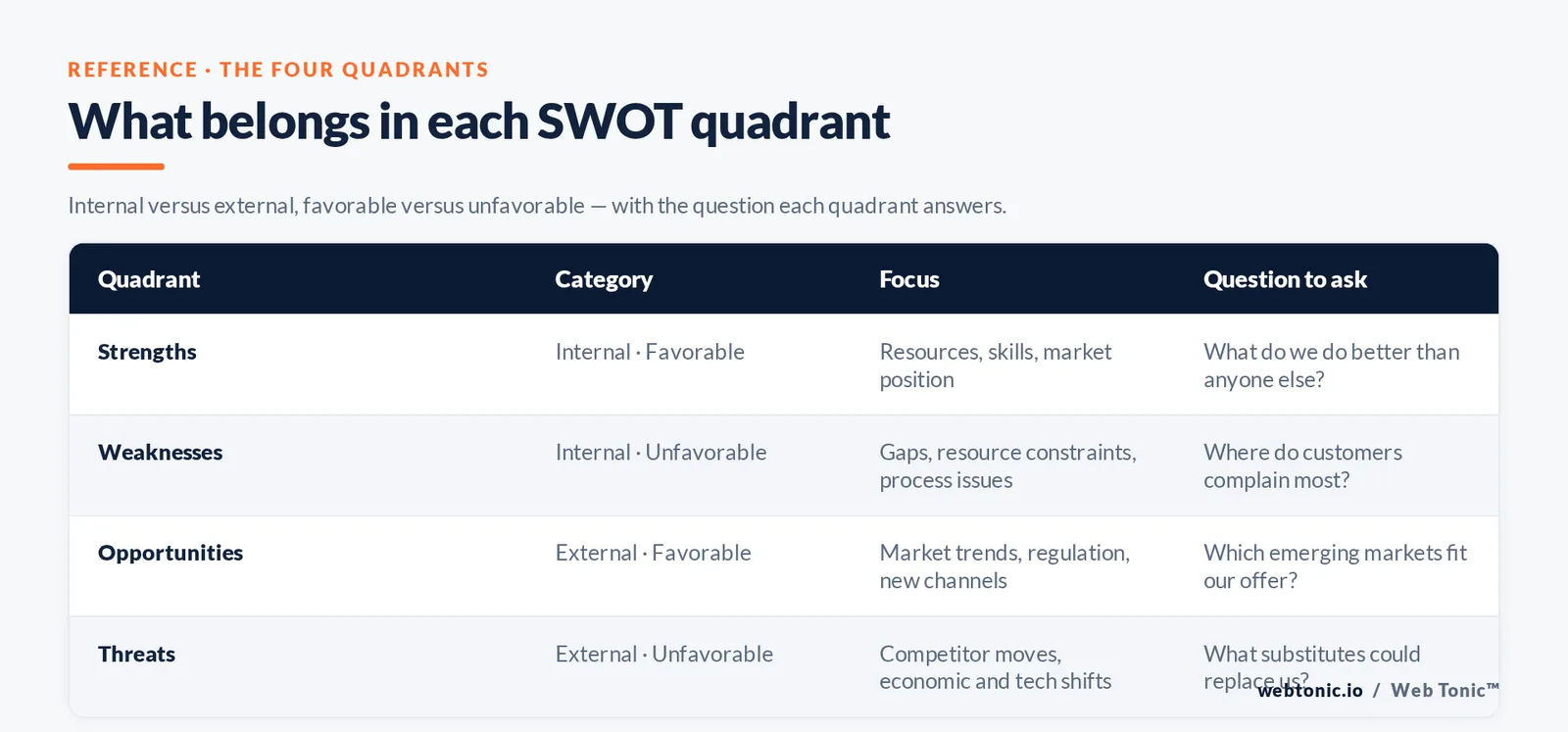
A SWOT analysis is a strategic planning framework that helps an organization identify internal strengths, weaknesses, external opportunities, and threats. The acronym — SWOT — stands for strengths, weaknesses, opportunities, and threats, dividing every factor into internal versus external and favorable versus unfavorable. Albert Humphrey is widely credited with creating the SWOT analysis at the Stanford Research Institute in the 1960s, and the approach later gained traction at Harvard Business School in Boston through Michael Porter's broader competitive strategy work.
This approach matters because it forces cross-functional team members to confront uncomfortable truths and identify hidden resources. Unlike complex analytical tools that require specialized software, a SWOT matrix only needs a whiteboard and honest participants. Over 80% of business schools include this assessment in core strategy and management curricula, and consulting firms from McKinsey to Deloitte recommend it as a first step before deeper competitive analysis. It pairs naturally with a broader growth marketing strategy when organizations want actionable direction rather than theoretical models. In human resource management (HRM) and community development alike, the framework helps teams identify strategies that align internal strengths with external opportunities.
| Quadrant | Category | Focus | Example Questions |
|---|---|---|---|
| Strengths | Internal · Favorable | Resources, skills, market position | What do we do better than anyone else? |
| Weaknesses | Internal · Unfavorable | Gaps, resource constraints, process issues | Where do customers complain most? |
| Opportunities | External · Favorable | Market trends, regulation changes, new channels | Which emerging markets fit our offer? |
| Threats | External · Unfavorable | Competitor moves, economic shifts, technology disruption | What substitutes could replace us? |
How to Create a SWOT Analysis in 6 Steps
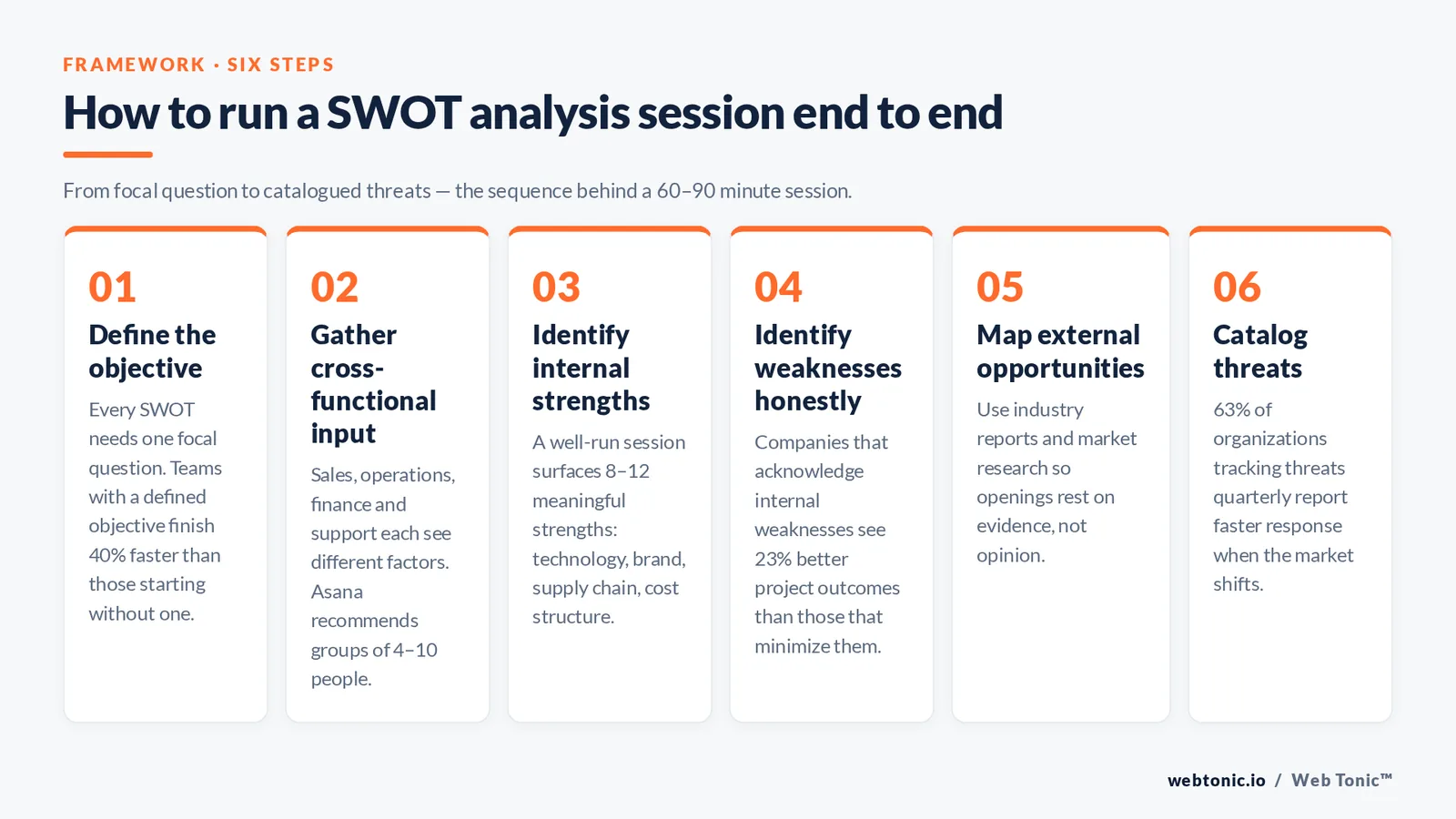
Running a productive SWOT analysis session requires preparation, diverse perspectives, and a clear link to strategic planning. Follow these steps to create a SWOT analysis that moves your organization from brainstorming to an actionable roadmap.
Step 1 — Define the objective. Every SWOT analysis needs a focal question: launching a product line, entering a geographic market, or deciding whether to acquire a competitor. Without a specific question, sessions produce vague lists. Teams with a defined objective complete their analysis template 40% faster than those that begin without one.
Step 2 — Gather cross-functional input. Include team members from sales, operations, finance, and customer support. Each department sees different internal and external factors — engineering knows technical debt while sales understands win/loss patterns. Asana recommends groups of 4–10 people for the richest discussion.
Step 3 — Identify internal strengths. Document organizational advantages: proprietary technology, strong brand recognition, loyal community, efficient supply chain, talented resources, or favorable cost structure. The average team identifies 8–12 meaningful internal strengths in a well-run session.
Step 4 — Identify weaknesses. Catalog internal weaknesses honestly: outdated infrastructure, high employee turnover, thin margins, poor human resource management strategies, or dependency on a single revenue stream. Companies that acknowledge internal weaknesses see 23% better project outcomes versus those that minimize shortcomings.
Step 5 — Map external opportunities. Scan the landscape for favorable conditions: regulatory shifts, market trends, competitor exits, technological advances, or resource gaps. Use sources like industry reports, market research, and data intelligence to identify external opportunities with concrete evidence. A comprehensive assessment helps organizations spot openings that internal-only reviews miss.
Step 6 — Catalog threats. Record external threats to the organization: new entrants, commodity pricing pressure, shifting consumer preferences, pending legislation, or supply chain instability. 63% of organizations that track external threats and opportunities quarterly report faster response times when market trends shift. Porter's Forces framework can supplement this step by mapping competitive dynamics in detail.
12 SWOT Analysis Examples and Templates
Real-world SWOT analysis applications vary dramatically by industry, organization stage, and strategic planning objective. The following SWOT analysis examples show how different businesses fill their strengths, weaknesses, opportunities, and threats matrix — and what actionable strategies result from each comprehensive SWOT analysis.
| Organization / Scenario | Top Strength | Critical Weakness | Best Opportunity | Biggest Threat |
|---|---|---|---|---|
| Tech Startup (SaaS) | Agile development cycles | Limited brand awareness | Enterprise remote-work adoption | Well-funded incumbent clones feature |
| Local Restaurant Chain | Loyal neighborhood customer base | No online ordering system | Ghost kitchen expansion | Food delivery aggregator commissions |
| E-Commerce Retailer | Direct-to-consumer data ownership | High return rates (28%) | Social commerce growth | Rising customer acquisition costs |
| Healthcare Provider | Board-certified specialist network | Outdated patient portal | Telehealth mandate expansion | Staffing shortages |
| Manufacturing Firm | Patented production process | Single-supplier dependency | Nearshoring trend from Asia | Raw material price volatility |
| Nonprofit Organization | Strong volunteer community | Grant-dependent revenue mix | Corporate ESG partnership demand | Donor fatigue during economic downturns |
| Personal Brand / Freelancer | Niche expertise and portfolio | No recurring revenue model | Course or digital product launch | AI tools replacing deliverables |
| Retail Bank | Established trust and branch network | Slow digital transformation | Open banking API partnerships | Fintech disintermediation |
| University / College | Recognized accreditation | Declining in-person enrollment | Micro-credential and online degree demand | Alternative certification programs |
| Real Estate Agency | Deep local market knowledge | Manual lead follow-up process | Virtual staging and 3D tours | Discount brokerage platforms |
| B2B Software Company | High net promoter score (72) | Complex onboarding flow | Vertical-specific product line | Consolidation by platform incumbents |
| Marketing Agency | Multi-channel campaign expertise | Revenue concentrated in 3 clients | AI-powered performance creative demand | In-house team trend reducing outsource budgets |
Each SWOT analysis template above maps directly to a real industry context — replace the placeholders with your organization's own data and the matrix becomes a strategic management tool, not decoration. The Smartsheet template library offers downloadable versions in Excel, Word, and PowerPoint for team members who prefer visual layouts to identify strengths, weaknesses, opportunities, and threats.
SWOT Analysis vs. Other Strategic Planning Frameworks
No single tool captures the full picture. Organizations often combine a SWOT analysis with multiple strategic management frameworks, starting with strengths, weaknesses, opportunities, and threats and then drilling deeper with specialized models. Understanding where each tool fits alongside Porter's Forces and other tools prevents redundancy and blind spots.
| Framework | Best For | Key Difference from the Four-Quadrant Model | When to Use Together |
|---|---|---|---|
| Porter's Five Forces | Industry profitability analysis | Focuses exclusively on competitive dynamics, not internal capabilities | Feed Five Forces outputs into the external quadrants |
| PESTLE | Macro-environment scanning | Covers political, economic, social, technological, legal, and environmental factors — no internal lens | Use PESTLE findings to populate opportunities and threats |
| Value Chain Analysis | Operational efficiency | Maps every activity in the production process; more granular than internal quadrants | Refine internal capabilities and limitations with value chain data |
| Balanced Scorecard | Performance measurement | Tracks KPIs across four perspectives over time; it executes, where the matrix diagnoses | Translate matrix action items into scorecard metrics |
| TOWS Matrix | Strategy formulation from quadrant intersections | Extends the basic grid by cross-matching all four categories into strategic options (SO, WO, ST, WT) | Always — the TOWS matrix is the natural next step after the initial quadrant exercise |
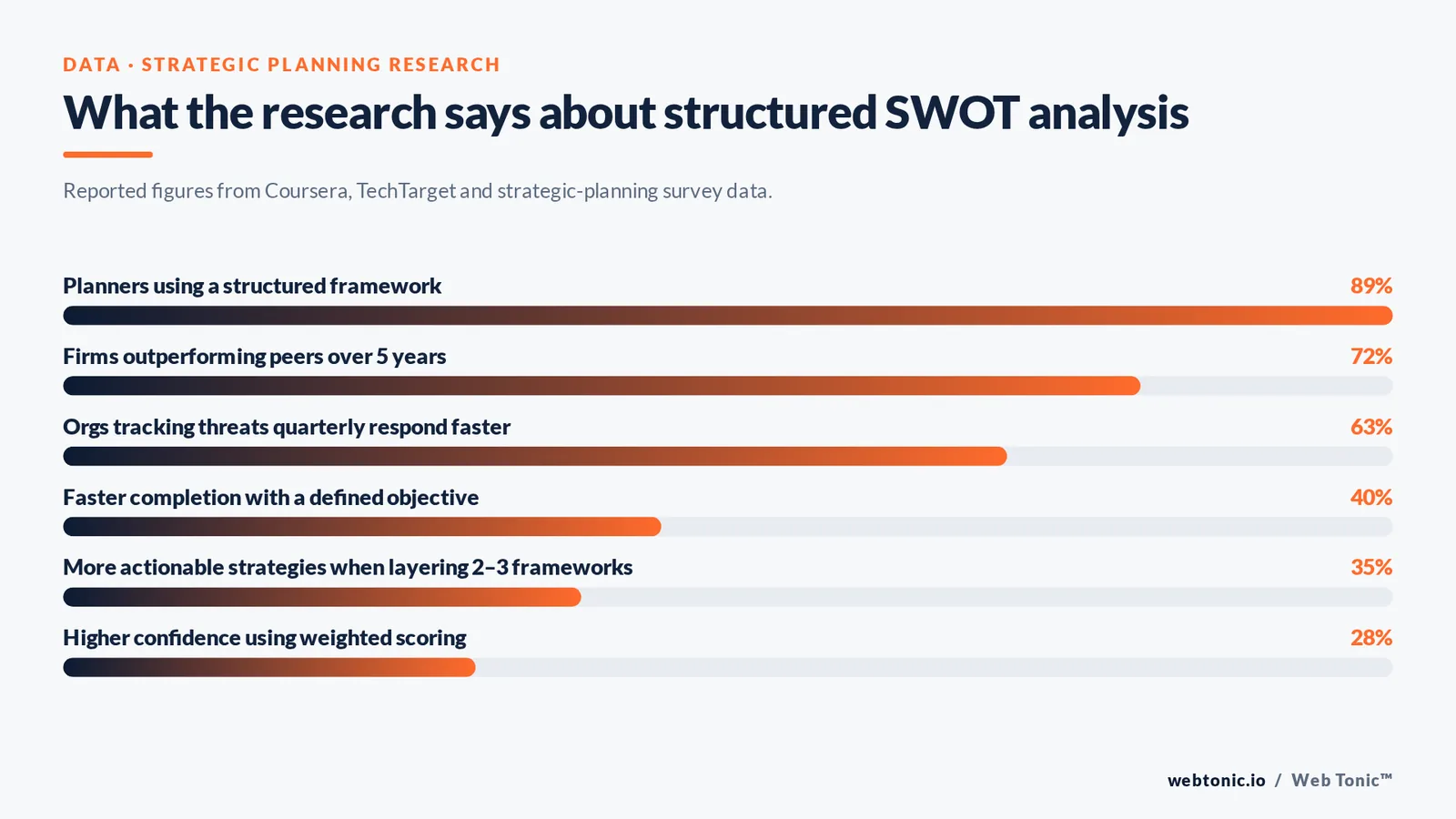
Strategic planners who layer 2–3 complementary frameworks produce 35% more actionable strategies than teams relying on a single tool, according to TechTarget's strategic management research. Many organizations run the assessment first, then feed internal and external factors into Porter's Forces or a PESTLE scan for deeper long range planning.
Common SWOT Analysis Pitfalls and How to Avoid Them
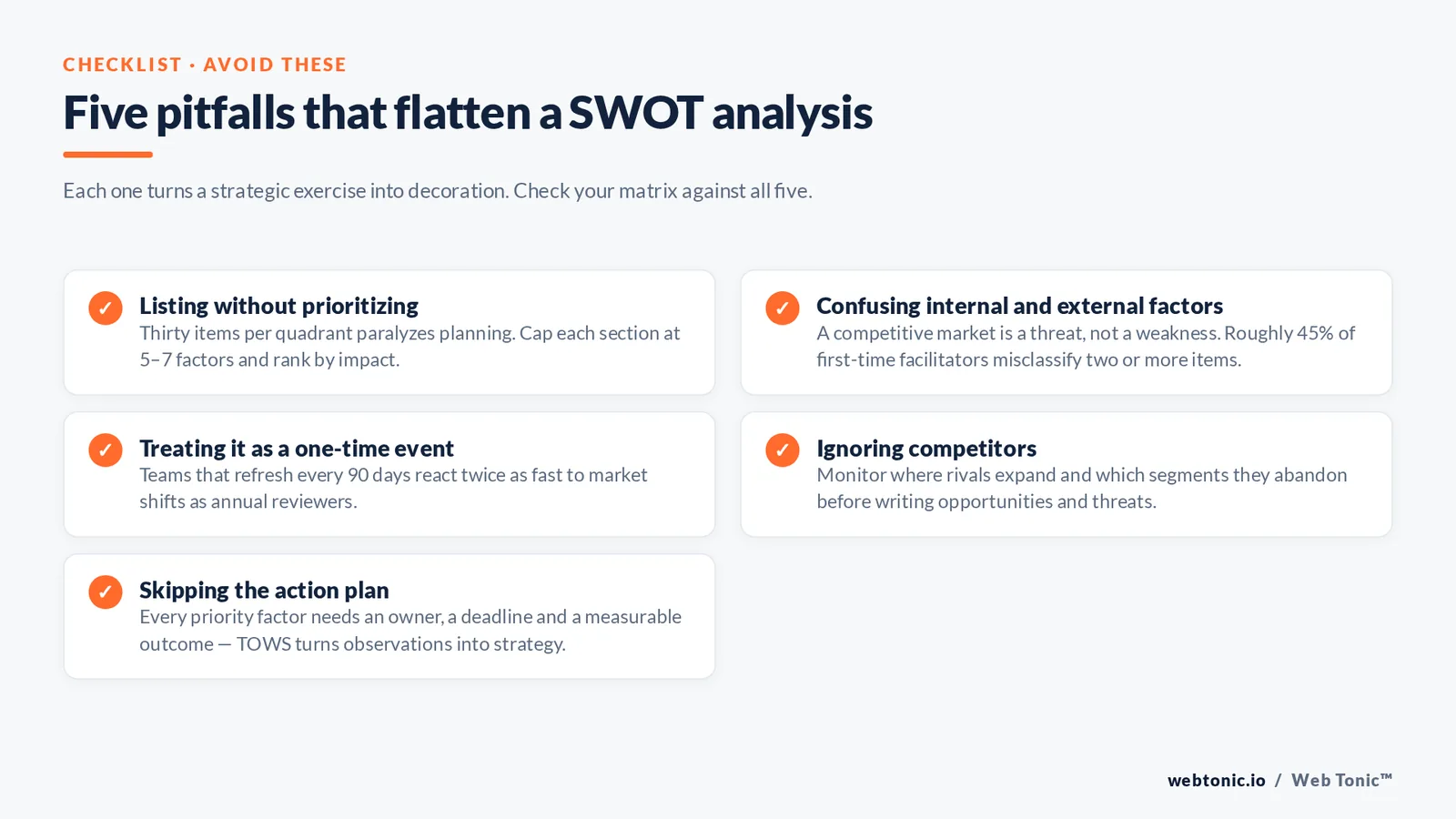
Listing without prioritizing is the most frequent SWOT analysis mistake. A matrix with 30 items per quadrant looks thorough but paralyzes strategic planning. Cap each section at 5–7 factors and rank them by impact. Shopify's guide recommends voting on the top three strengths, weaknesses, opportunities, and threats before moving to strategy.
Confusing internal factors with external factors distorts the entire SWOT analysis. A "competitive market" is not a weakness — it belongs in the threats quadrant. A weakness must be something the organization controls: a skill gap, a process bottleneck, or a resource constraint. Approximately 45% of first-time facilitators misclassify at least two items during a live session.
Treating the SWOT analysis as a one-time event limits its value. Market trends shift, internal resources evolve, and external threats emerge. Schedule quarterly reviews — organizations that update their assessment every 90 days react 2× faster to market shifts than those that revisit annually. Tie each review to your broader marketing services planning cycle for maximum impact.
Ignoring competitors when listing external opportunities and threats leaves gaps. Monitor what rivals do well, where they expand, and which community segments they abandon. Cross-reference the external factors with competitive intelligence from industry reports and public filings.
Skipping the action plan renders the exercise academic. Each priority factor needs an owner, a deadline, and a measurable outcome. The TOWS matrix (pairing each category with another) converts passive observations into concrete strategies — SO strategies leverage internal strengths to capture external opportunities, while WT strategies build defenses where weaknesses intersect with threats.
Advanced SWOT Analysis Techniques for Stronger Results
Once the foundational SWOT analysis is complete, experienced strategists apply layering techniques that sharpen insight quality and strengthen long range planning.
Weighted scoring assigns impact and likelihood scores (1–5) to each factor and multiplies them together. A threat with high probability but low impact (score: 10) demands less attention than one with moderate probability and catastrophic impact (score: 15). Teams using weighted scoring report 28% higher confidence in their priority rankings.
TOWS cross-matching extends the SWOT analysis by producing four distinct strategy types. SO strategies use internal strengths to seize external opportunities. WO strategies overcome weaknesses to capture favorable conditions. ST strategies deploy organizational strengths against threats. WT strategies minimize vulnerability where weaknesses intersect with threats — a critical output of any comprehensive assessment.
Pair the SWOT matrix with customer and market research data to prevent opinion-based entries from dominating the quadrants. Revenue figures, NPS scores, churn rates, and operational metrics anchor each factor in reality. Human resource development professionals also use this framework to identify training resources and community engagement strategies that bridge capability gaps.
Scenario planning stress-tests the framework against multiple futures. Duplicate the grid for best-case, worst-case, and most-likely scenarios — this reveals which strengths, weaknesses, opportunities, and threats remain constant across conditions versus those that shift with market trends. Strategic management teams that model 3+ scenarios identify 50% more risk mitigation options than single-scenario planners.
Frequently Asked Questions
Who invented the SWOT analysis framework?
Albert Humphrey is widely credited with developing the SWOT analysis at the Stanford Research Institute during the 1960s. His team studied Fortune 500 corporate planning processes and identified recurring patterns in how successful organizations evaluated internal strengths, weaknesses, and external opportunities and threats. The SWOT analysis eventually became the most taught strategic planning and strategic management tool in business education worldwide, later championed by researchers at Harvard Business School in Boston and referenced alongside Michael Porter's competitive strategy work.
How often should an organization update its SWOT analysis?
Quarterly SWOT analysis reviews deliver the strongest results. Internal strengths and weaknesses shift as teams grow, technology changes, and resources improve. External opportunities and threats — competitor moves, regulation, and market trends — evolve even faster. Annual-only SWOT reviews leave dangerous gaps between what the organization knows and what strategic planning demands.
Can small businesses benefit from SWOT analysis?
Absolutely. Small and mid-size businesses gain disproportionate value from SWOT analysis because they typically lack formal strategic planning processes. A 60-minute session with the founding team members can surface blind spots — an over-reliance on one client, untapped community resources, or a competitor's pending price move — that larger organizations catch through dedicated management departments. WordStream's case studies show agencies and small businesses using the SWOT analysis to identify strengths, weaknesses, opportunities, and threats that help refocus limited marketing budgets for higher returns.
What is the difference between SWOT analysis and a TOWS matrix?
The SWOT analysis identifies and categorizes internal and external factors. The TOWS matrix takes the SWOT output and cross-matches strengths, weaknesses, opportunities, and threats into four strategy types: SO (use internal strengths to seize external opportunities), WO (overcome weaknesses to capture opportunities), ST (deploy strengths against threats), and WT (minimize vulnerability where weaknesses meet threats). Think of the SWOT analysis as diagnosis and TOWS as prescription for strategic management.
How many factors should each SWOT analysis quadrant contain?
5–7 factors per quadrant is the practical sweet spot for a SWOT analysis. Fewer than four suggests a shallow investigation, while more than ten creates paralysis. Rank each strength, weakness, opportunity, and threat by strategic importance and focus resources on the top three in each category. Long lists indicate the team hasn't prioritized — use visual SWOT analysis templates with constrained space to enforce discipline in your strategic planning process.
Sources: MindTools · Shopify · Asana · WordStream · TechTarget · Business Queensland · Smartsheet · Coursera · Venngage