Table of contents
Comparative advertising is advertising that names or clearly identifies a competitor, or its product or service, and sets your own offering against it. In the United States it is legal and openly encouraged by regulators — as long as every comparison is truthful, substantiated and not misleading.
Key Takeaways
- 2 legal tests decide almost every US dispute: is the claim literally false, and is it likely to mislead a reasonable consumer?
- 15 U.S.C. §1125(a) of the Lanham Act lets a competitor sue you directly for a false comparative claim — you do not have to wait for a regulator.
- Article 4 of EU Directive 2006/114/EC sets 8 cumulative conditions a comparison must satisfy in every member state.
- 1 rule beats all others: hold the substantiation before the ad runs, in the exact form the claim is worded.
- 3 fast routes exist for a rival to challenge you: a self-regulatory case, a regulator complaint, or a court injunction.
- Challenger brands gain most; the category leader usually loses share of voice by naming a smaller rival.
What comparative advertising actually is
Comparative advertising is any advertisement that identifies a competing brand, product or service — explicitly or by unmistakable implication — and draws a comparison on price, performance, features, ingredients or reputation. It differs from ordinary competitive marketing because the reference point is a named rival rather than an unnamed “other brands”. That naming is what triggers the legal framework.
The Federal Trade Commission has long treated comparative advertising as pro-consumer: it speeds up product comparison, sharpens competition on price and pushes weak products out of a category. The regulator's concern is never the comparison itself, only its accuracy.
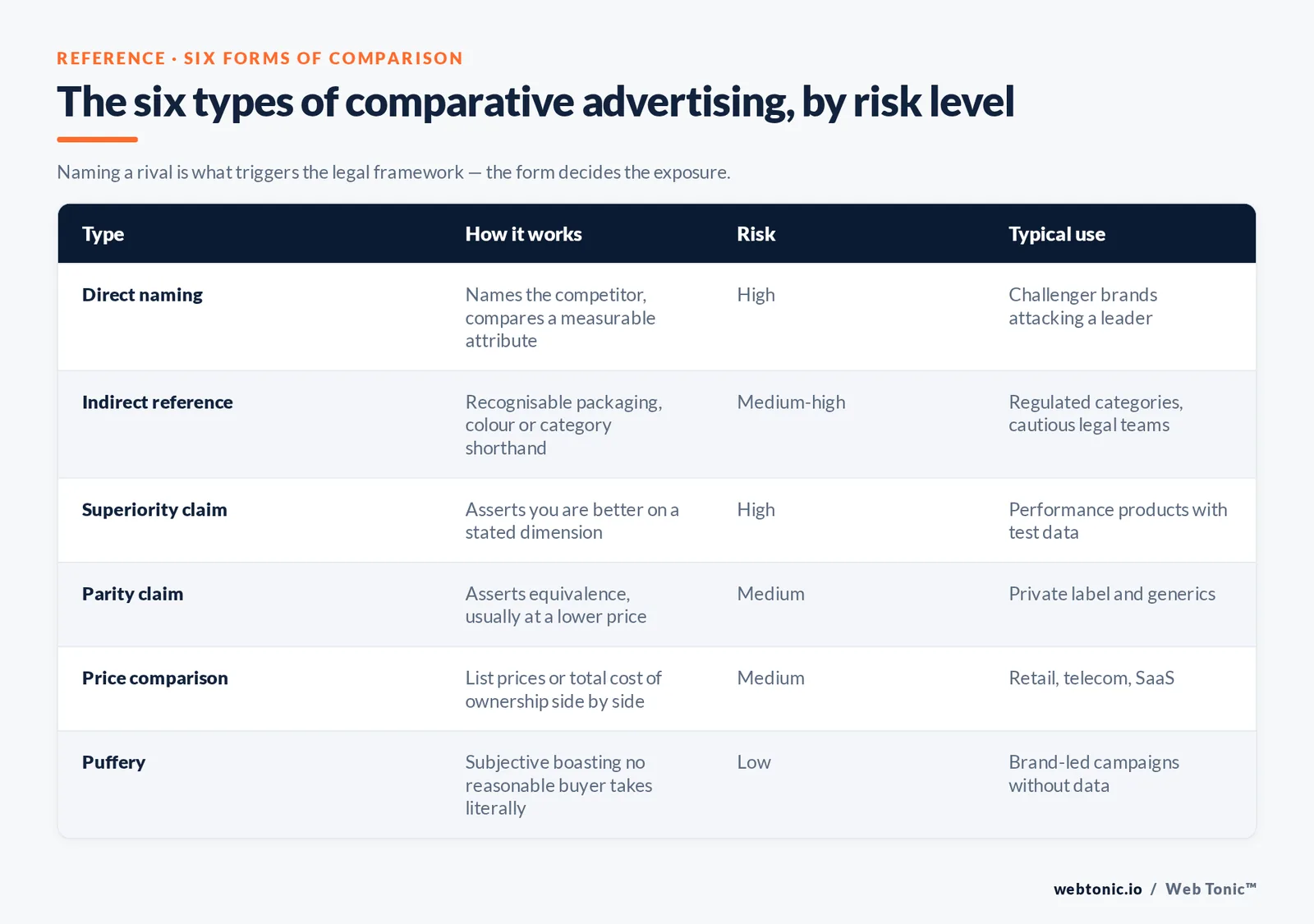
| Type | How it works | Risk level | Typical use |
|---|---|---|---|
| Type 1 — Direct naming | Names the competitor and compares a measurable attribute | High | Challenger brands attacking a leader |
| Type 2 — Indirect reference | Uses recognisable packaging, colour or a category shorthand | Medium-high | Regulated categories and cautious legal teams |
| Type 3 — Superiority claim | Asserts your product is better on a stated dimension | High | Performance-led products with test data |
| Type 4 — Parity claim | Asserts equivalence, usually at a lower price | Medium | Private label and generics |
| Type 5 — Price comparison | Sets list prices or total cost of ownership side by side | Medium | Retail, telecom, SaaS |
| Type 6 — Puffery | Subjective boasting no reasonable buyer takes literally | Low | Brand-led campaigns without data |
Is comparative advertising legal in the United States?
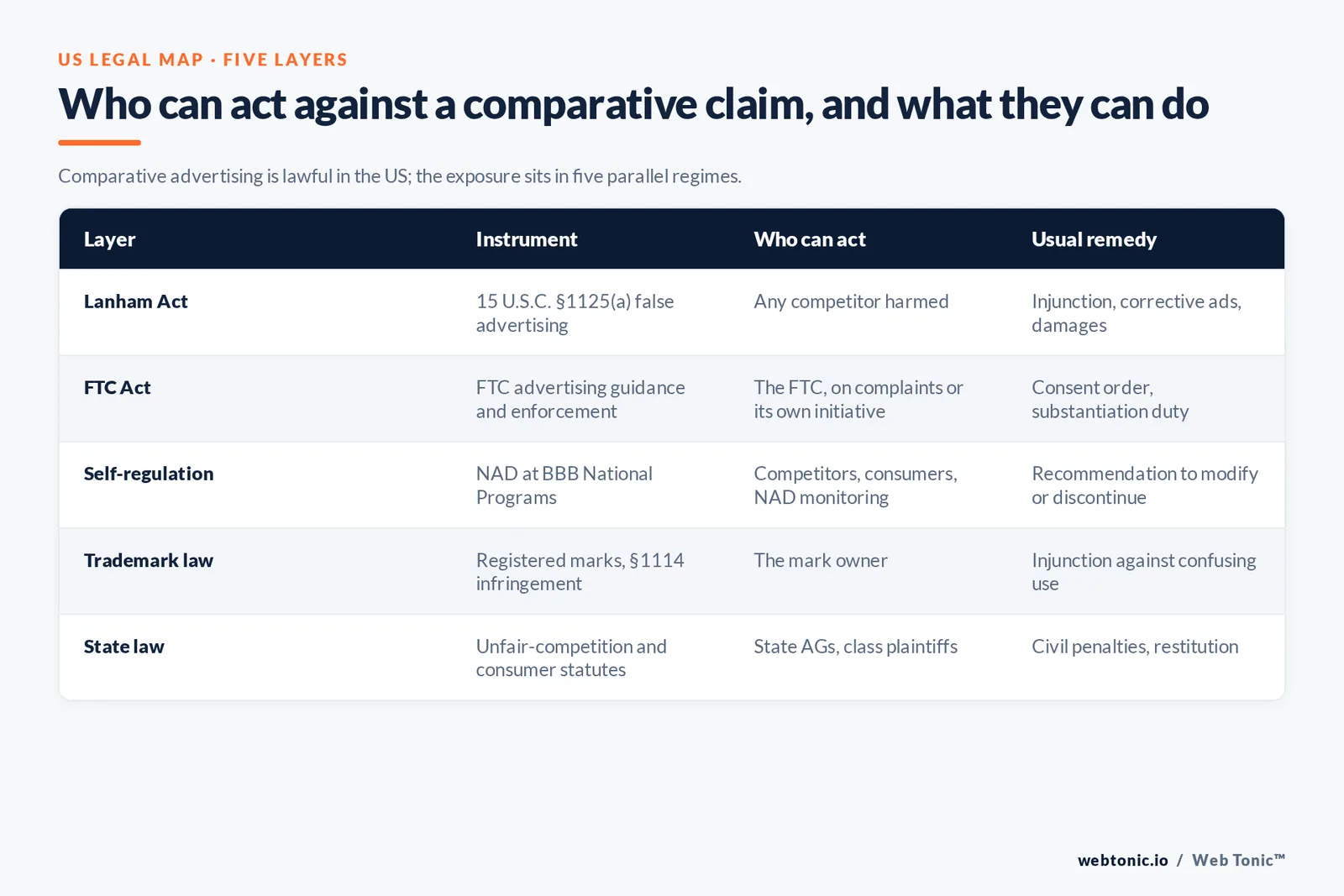
Yes. Two federal regimes govern it in parallel, plus a private self-regulatory forum that moves far faster than either. Layer 1 is the Lanham Act, which gives the injured competitor a private right of action. Layer 2 is the FTC's consumer-protection authority over unfair or deceptive practices. Layer 3 is industry self-regulation through the National Advertising Division.
| Layer | Instrument | Who can act | Usual remedy |
|---|---|---|---|
| Layer 1 — Lanham Act | 15 U.S.C. §1125(a) false advertising | Any competitor harmed by the claim | Injunction, corrective advertising, damages |
| Layer 2 — FTC Act | FTC advertising guidance and enforcement | The FTC, on its own initiative or complaints | Consent order, claim substantiation duty |
| Layer 3 — Self-regulation | NAD at BBB National Programs | Competitors, consumers, NAD monitoring | Recommendation to modify or discontinue |
| Layer 4 — Trademark law | Registered marks and §1114 infringement | The mark owner | Injunction against confusing use |
| Layer 5 — State law | State unfair-competition and consumer statutes | State AGs, class plaintiffs | Civil penalties, restitution |
Using a rival's trademark to identify its product is normally permissible nominative use: you may say the competitor's name in order to compare. What is not permissible is using the mark in a way that suggests endorsement, or dressing your ad so consumers believe it came from the competitor. FTC case records show the same pattern repeatedly: the claim itself was defensible, the evidence behind it was not.
Outside the US: the rules tighten
Most markets permit comparative advertising but attach explicit conditions. The EU harmonised the position under Directive 2006/114/EC, which allows comparison only where it is not misleading, compares goods meeting the same needs, compares verifiable and material features, and does not denigrate or take unfair advantage of the rival's reputation.
| Market | Framework | Practical constraint |
|---|---|---|
| Market 1 — United States | Lanham Act plus FTC guidance | Most permissive; substantiation is everything |
| Market 2 — European Union | Directive 2006/114/EC, Article 4 | 8 cumulative conditions; national courts enforce |
| Market 3 — United Kingdom | CAP Code section 3, ASA rulings | Comparisons must be objective and verifiable |
| Market 4 — UK competition law | CMA consumer-protection powers | Misleading price comparisons draw direct action |
| Market 5 — Trademark treaties | WIPO-administered systems | Local rules on mark use in ads still differ |
Substantiation: the only thing that really protects you
Regulators and courts look at the claim a consumer takes away, not the claim your legal team drafted. That means the evidence has to match the wording, the tested product version, the audience and the time period. Step 1 is to write the claim. Step 2 is to write down what a sceptic would demand as proof. Step 3 is to obtain that proof before media is booked.
| Claim type | Evidence expected | Most common failure |
|---|---|---|
| Claim 1 — Performance superiority | Independent test on both products, current versions | Testing an outdated competitor model |
| Claim 2 — Consumer preference | Blind test, representative sample, disclosed method | Small or self-selected panel |
| Claim 3 — Price advantage | Dated price capture across comparable configurations | Comparing list price to your discounted price |
| Claim 4 — Speed or coverage | Third-party measurement with stated geography | National claim from regional data |
| Claim 5 — Health or safety | Competent and reliable scientific evidence, per FTC health-claim guidance | Extrapolating from ingredient studies |
| Claim 6 — “Number 1” ranking | Named source, metric and period, disclosed on screen | Undisclosed or stale ranking basis |
7 traps that turn a comparison into a legal problem
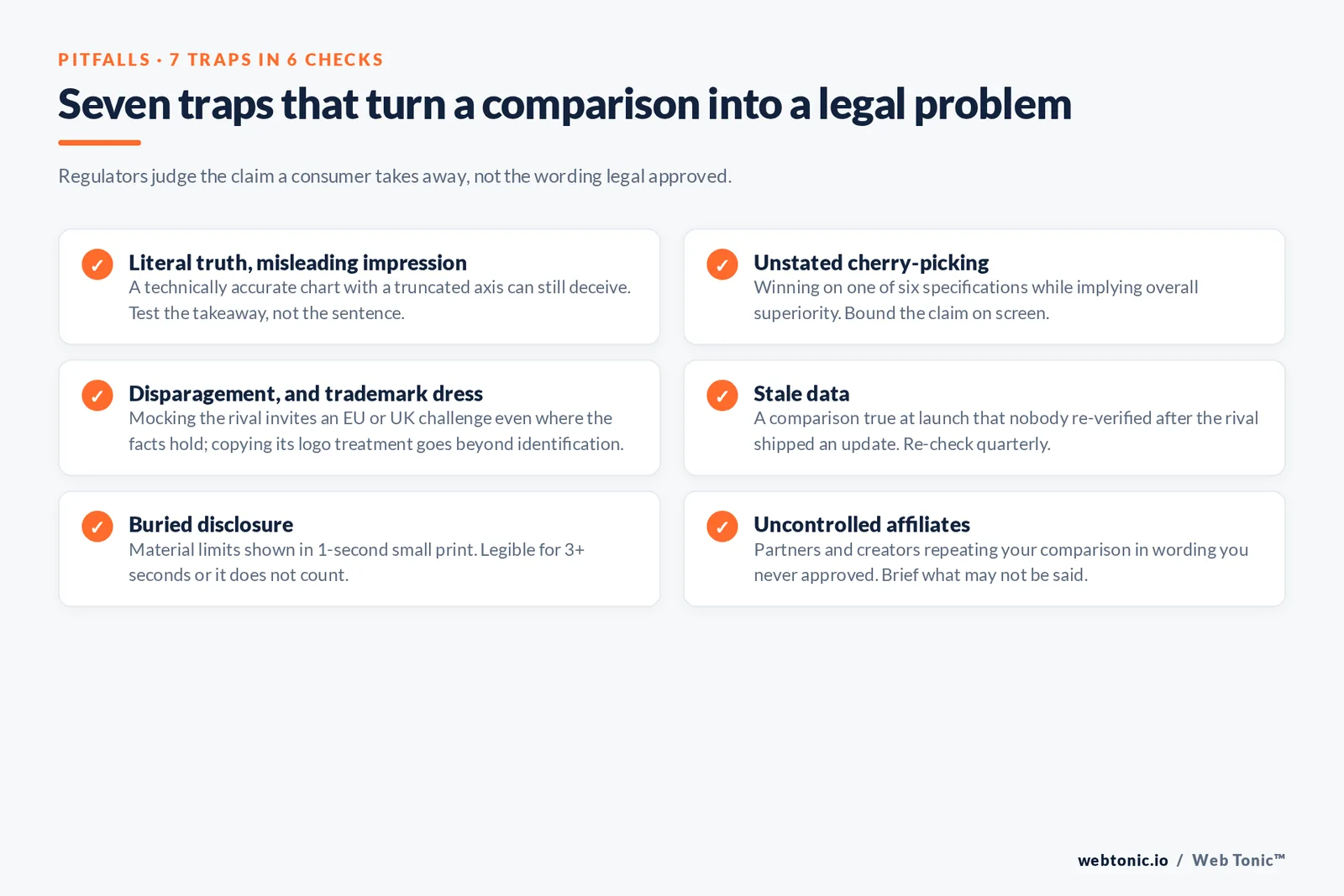
Trap 1 — Literal truth, misleading impression. A technically accurate chart with a truncated axis can still deceive. Trap 2 — Unstated cherry-picking. Winning on one of six specifications while implying overall superiority. Trap 3 — Disparagement. Mocking the rival rather than comparing it invites an EU or UK challenge even where the facts hold. Trap 4 — Trademark dress. Copying the competitor's logo treatment or trade dress beyond what identification requires. Trap 5 — Stale data. A comparison true at launch that nobody re-verified after the rival shipped an update. Trap 6 — Buried disclosure. Material limits shown in 1-second small print. Trap 7 — Uncontrolled affiliates. Partners and creators repeating your comparison in wording you never approved.
Where comparative advertising pays — and where it backfires
Market position decides the return more than creative quality does. Naming a leader borrows its salience; naming a small rival donates yours. Sensitivity to the tactic also varies by category: business buyers expect feature grids, while emotionally driven categories punish visible aggression.
| Situation | Expected effect | Recommended form |
|---|---|---|
| Case 1 — Challenger vs leader | Strongest upside; borrows category salience | Direct naming on 1 decisive attribute |
| Case 2 — Leader vs challenger | Usually negative; legitimises the smaller brand | Category-level claim, no naming |
| Case 3 — Two near-equals | Escalation risk on both sides | Verifiable specification table only |
| Case 4 — B2B software | High intent capture on comparison queries | Alternative and versus landing pages |
| Case 5 — Regulated categories | Low tolerance, high scrutiny | Indirect reference with cited evidence |
| Case 6 — Retail price wars | Short-term traffic, margin pressure | Dated basket comparison with method note |
Famous comparative campaigns and why they worked
The canonical campaigns share one trait: a single, checkable proposition a viewer could restate in one sentence. None of them relied on a complex chart.
| Campaign | Comparison used | Why it worked |
|---|---|---|
| Example 1 — Pepsi Challenge | Blind taste test against Coca-Cola | Consumer-run test made the proof visible |
| Example 2 — Avis “We try harder” | Openly second to the market leader | Turned a weakness into a service promise |
| Example 3 — Apple “Get a Mac” | Personified PC versus Mac trade-offs | Character-led, so claims stayed subjective |
| Example 4 — US telecom coverage maps | Network coverage shown side by side | Single attribute buyers already cared about |
| Example 5 — Light beer taste wars | Ingredient and calorie comparisons | Simple, verifiable, endlessly repeatable |
| Example 6 — SaaS versus pages | Feature and pricing grids on owned pages | Meets high-intent search demand directly |
A pre-flight checklist by channel
Comparative claims fail most often in the channels nobody reviewed. Run the same checklist everywhere the claim will appear, including organic content and creator briefs. Our performance creative team keeps a claim register per client for exactly this reason.
| Channel | Check before launch | Owner |
|---|---|---|
| Check 1 — Paid search | Competitor terms in copy comply with platform policy | Paid media lead |
| Check 2 — Paid social | On-screen disclosure legible for 3+ seconds | Creative lead |
| Check 3 — Website | Versus pages dated and re-verified quarterly | Web and content owner |
| Check 4 — Email and sales decks | Only approved claim wording in circulation | Sales enablement |
| Check 5 — Creators and affiliates | Brief states what may not be said or implied | Partnership manager |
| Check 6 — PR and analyst material | Source, metric and period cited in full | Communications |
How to measure a comparative campaign
Because the ad references someone else's brand, standard brand metrics under-read the effect. Track competitive query movement and switching, not just your own lift. Trade-body measurement guidance from the IAB and audience context from Pew Research Center help set realistic expectations before launch.
| Metric | What it tells you | Read after |
|---|---|---|
| Metric 1 — Competitor-brand search volume | Whether you grew the rival's demand instead of yours | 2 weeks |
| Metric 2 — Versus-query impression share | Capture of active comparison intent | 4 weeks |
| Metric 3 — Switching or win-rate | Whether the claim changed real decisions | 1 sales cycle |
| Metric 4 — Claim recall in survey | Whether the takeaway matches the wording | 3 to 6 weeks |
| Metric 5 — Complaint and challenge log | Early warning of a legal or NAD action | Continuous |
Comparison-driven demand is measurable in the same systems as any other campaign; our data intelligence practice instruments it alongside standard media reporting, and you can see the broader approach across our service lines or in the rest of the Web Tonic blog.
Comparative advertising by industry and business type
How far a comparative advertisement can go depends on the category. In regulated industries the legal review is longer than the creative process; in commodity goods and services the comparison is often the whole marketing strategy. The table below sets out what companies in each sector usually compare, and where the FTC, courts and self-regulatory review boards concentrate their attention.
| Industry | What competitors compare | Evidence review risk |
|---|---|---|
| Sector 1 — Consumer packaged goods | Ingredients, taste tests, price per unit | Medium: blind test method is challenged first |
| Sector 2 — Telecom and utilities | Coverage, speed, total monthly cost | High: national claims from partial data |
| Sector 3 — Software and B2B services | Features, integrations, licence pricing | Medium: competitor product versions move fast |
| Sector 4 — Healthcare and supplements | Efficacy and safety of the product | Very high: scientific substantiation required |
| Sector 5 — Automotive | Warranty, efficiency, standard equipment | High: trim-level comparisons mislead easily |
| Sector 6 — Retail and grocery | Basket price against a named rival | Medium: dated, like-for-like capture needed |
| Sector 7 — Financial services | Rates, fees, returns on comparable terms | Very high: disclosure rules stack on top |
How consumers actually read a comparative advertisement
Regulators judge the takeaway, not the wording, so it pays to know how consumers process comparison. Most viewers extract one claim and one brand from an advertisement; the small print, the qualifying period and the tested configuration rarely survive. That gap between what an advertiser wrote and what the consumer remembers is where litigation begins.
| Perception effect | What consumers take away | What advertisers should do |
|---|---|---|
| Effect 1 — Single-claim recall | 1 comparison, rarely the qualifiers | Make the headline claim the one you can prove |
| Effect 2 — Halo transfer | Superiority on 1 feature reads as overall | Bound the claim visibly, not in small print |
| Effect 3 — Leader legitimisation | The named competitor gains salience too | Only name brands larger than yours |
| Effect 4 — Aggression backlash | Mockery reads as weakness in some categories | Keep the tone factual and confident |
| Effect 5 — Price anchoring | The cheaper number becomes the reference | Compare total cost, not headline price alone |
| Effect 6 — Category doubt | Repeated attacks reduce trust in all brands | Limit comparative bursts to 1 or 2 per year |
What challenges and litigation actually look like
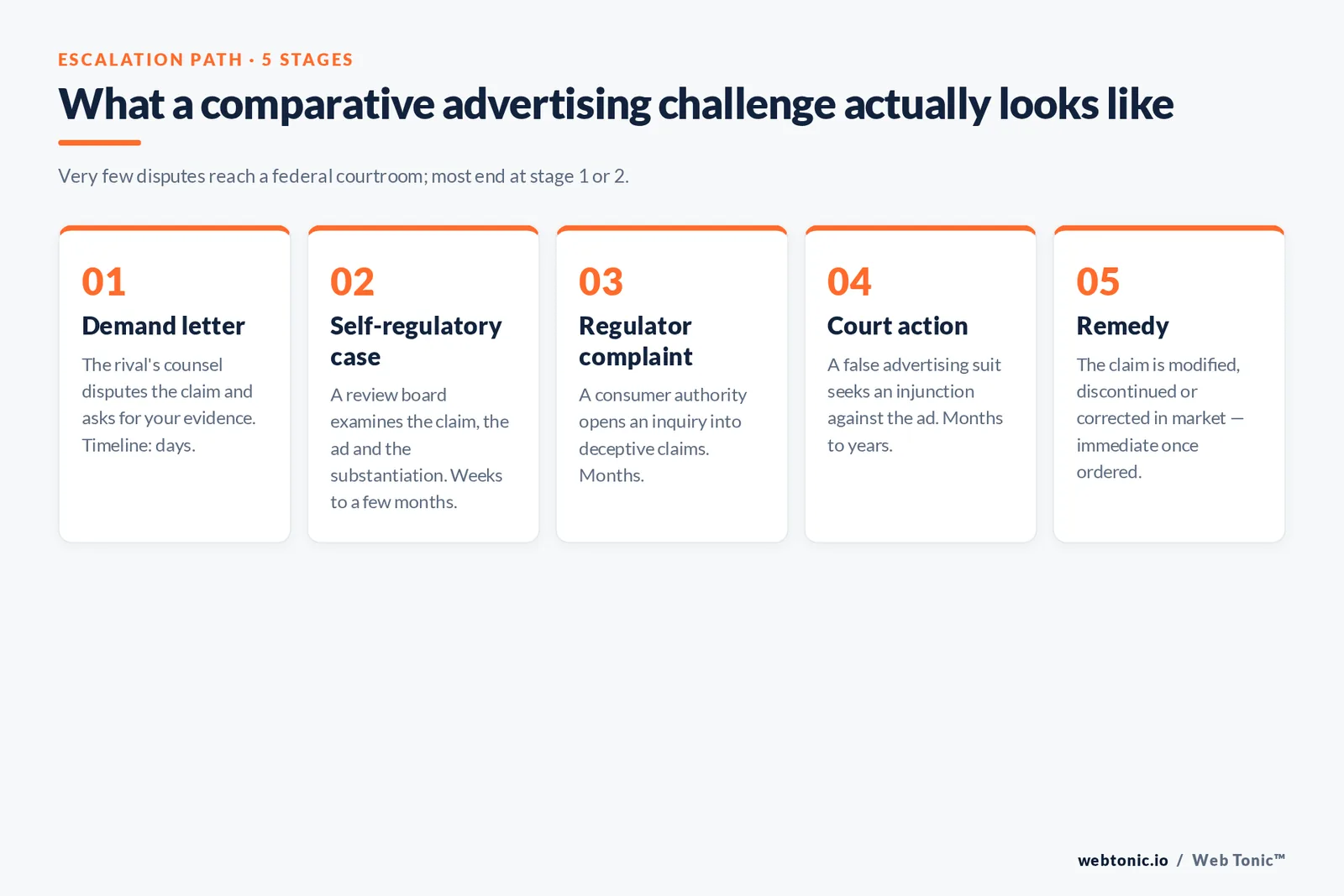
Very few comparative advertising disputes reach a federal courtroom. Most are resolved through self-regulatory review, a competitor's demand letter, or a quiet edit to the advertisement. Knowing the sequence lets a business plan its evidence file rather than improvise under deadline.
| Stage | What happens | Typical timeline |
|---|---|---|
| Stage 1 — Demand letter | The competitor's counsel disputes the claim and asks for evidence | Days |
| Stage 2 — Self-regulatory case | A review board examines the claim, the advertisement and the substantiation | Weeks to a few months |
| Stage 3 — Regulator complaint | A federal or national consumer authority opens an inquiry into deceptive claims | Months |
| Stage 4 — Court action | A false advertising suit seeks an injunction against the advertisement | Months to years |
| Stage 5 — Remedy | The claim is modified, discontinued or corrected in market | Immediate once ordered |
Rule 1 for any business running comparative ads: keep the evidence file, the tested product batch and the dated competitor data together, so a challenge is answered in 48 hours rather than 4 weeks. Rule 2: name 1 competitor per advertisement. Rule 3: re-verify every live comparison quarterly, because the competitor's product, price and marketing claims all move without telling you.
FAQ
Is it legal to name a competitor in an advertisement?
In the United States, yes. Naming a competitor is lawful nominative use of its trademark when the purpose is genuine comparison, and the FTC has actively encouraged truthful comparative advertising because it helps buyers choose. The claim must be accurate, substantiated and free of any suggestion that the competitor endorses you.
What happens if a competitor challenges my comparative ad?
There are 3 routes. A rival can file a case with the National Advertising Division, which typically issues a recommendation to modify or discontinue the claim; it can complain to a regulator; or it can seek a court injunction under the Lanham Act. The self-regulatory route is the fastest and the one most brands encounter first.
How much evidence do I need for a comparative claim?
Enough to support the message consumers actually take away, in the exact terms used. For performance and health claims that usually means independent testing of both current products; for price claims it means dated, like-for-like capture. Hold the evidence before launch, not after a challenge arrives.
Is comparative advertising allowed in the EU and the UK?
Yes, under conditions. EU Directive 2006/114/EC permits comparison where it is not misleading, addresses products meeting the same need, compares verifiable material features, and neither denigrates the competitor nor exploits its reputation. The UK CAP Code applies equivalent requirements, and the ASA rules on complaints.
Should a market leader use comparative advertising?
Rarely. Naming a smaller competitor spends your reach on its awareness and frames the category as a 2-horse race you did not need. Leaders generally do better defending on category-level benefits and reserving comparison for owned channels where buyers are already comparing.
Sources: Federal Trade Commission (truth in advertising, advertising and marketing guidance, health claims, case records); Cornell Legal Information Institute (15 U.S.C. 1125, 15 U.S.C. 1114); BBB National Programs, National Advertising Division; EUR-Lex, Directive 2006/114/EC; Advertising Standards Authority, UK advertising codes; UK Competition and Markets Authority; USPTO trademark basics; WIPO; IAB; Pew Research Center. All sources accessed August 2026.