Table of contents
An advertising slogan is the short, repeatable line a brand attaches to its campaigns so buyers remember who it is and what it promises. The best ones — Coca-Cola's "It's the Real Thing," Nike's "Just Do It," Dollar Shave Club's "Shave Time. Shave Money." — outlive the ads that carried them.
Key Takeaways
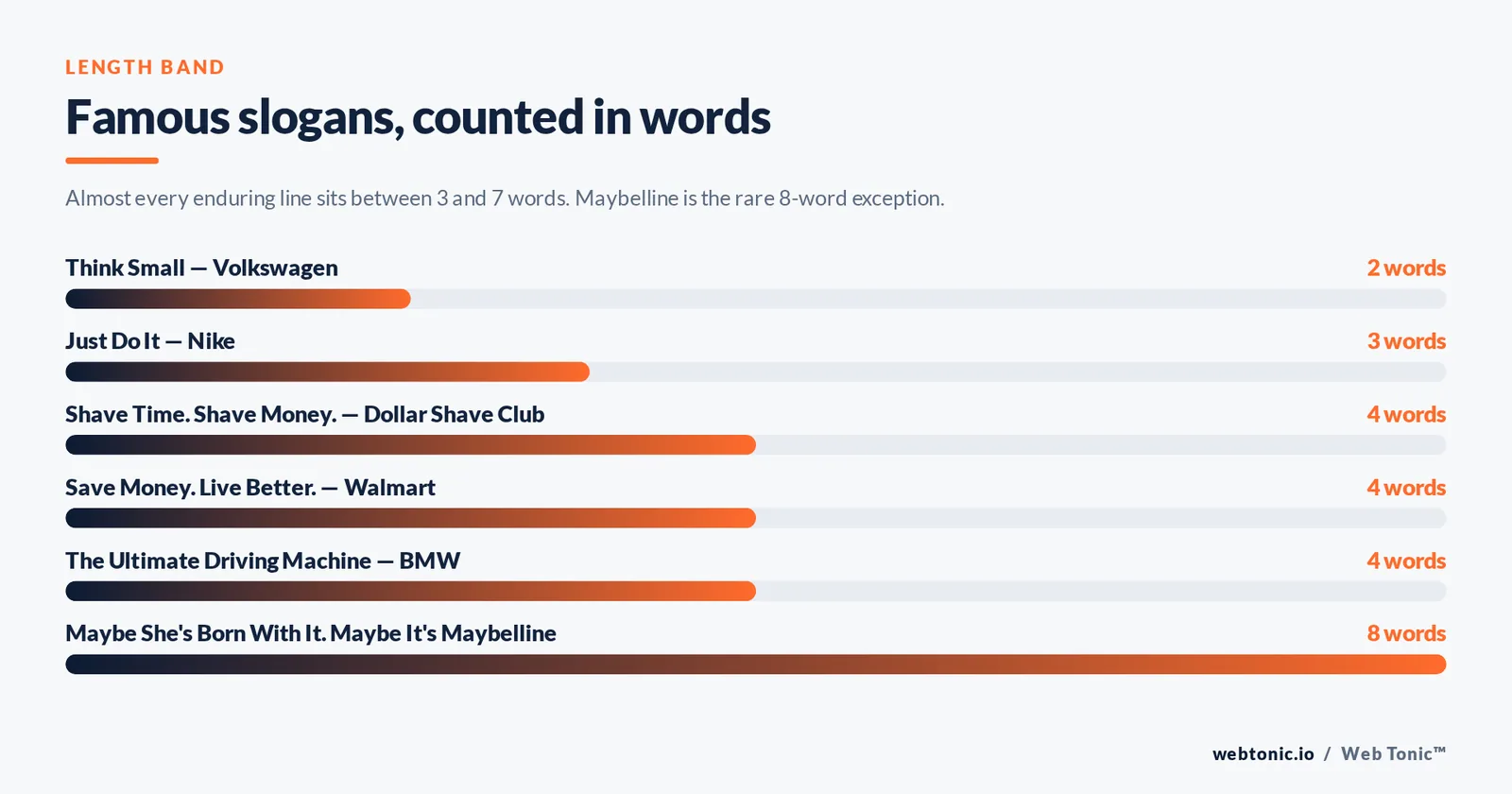
- 3 to 7 words is the length band almost every enduring advertising slogan sits inside — "Just Do It" is 3, "Maybe She's Born With It. Maybe It's Maybelline" is the rare 8-word exception.
- 1 promise per slogan. Lines that try to carry price, quality and speed at once get remembered for none of them.
- Coca-Cola has run more than 50 distinct advertising slogans since 1886, yet only a handful — "It's the Real Thing" (1969), "Have a Coke and a Smile" (1979), "Open Happiness" (2009) — are recalled by name.
- A slogan is campaign-level and replaceable; a tagline is brand-level and permanent. Limit 1 tagline per brand, many slogans over time.
- Step 6 of 6 in slogan development is the one most teams skip: clearing the line for trademark use before production spend.
- Brand-line recall compounds with repetition, which is why 7+ years of consistent use separates a real tagline from a seasonal campaign hook.
Slogan, tagline, jingle, positioning statement: what's actually different
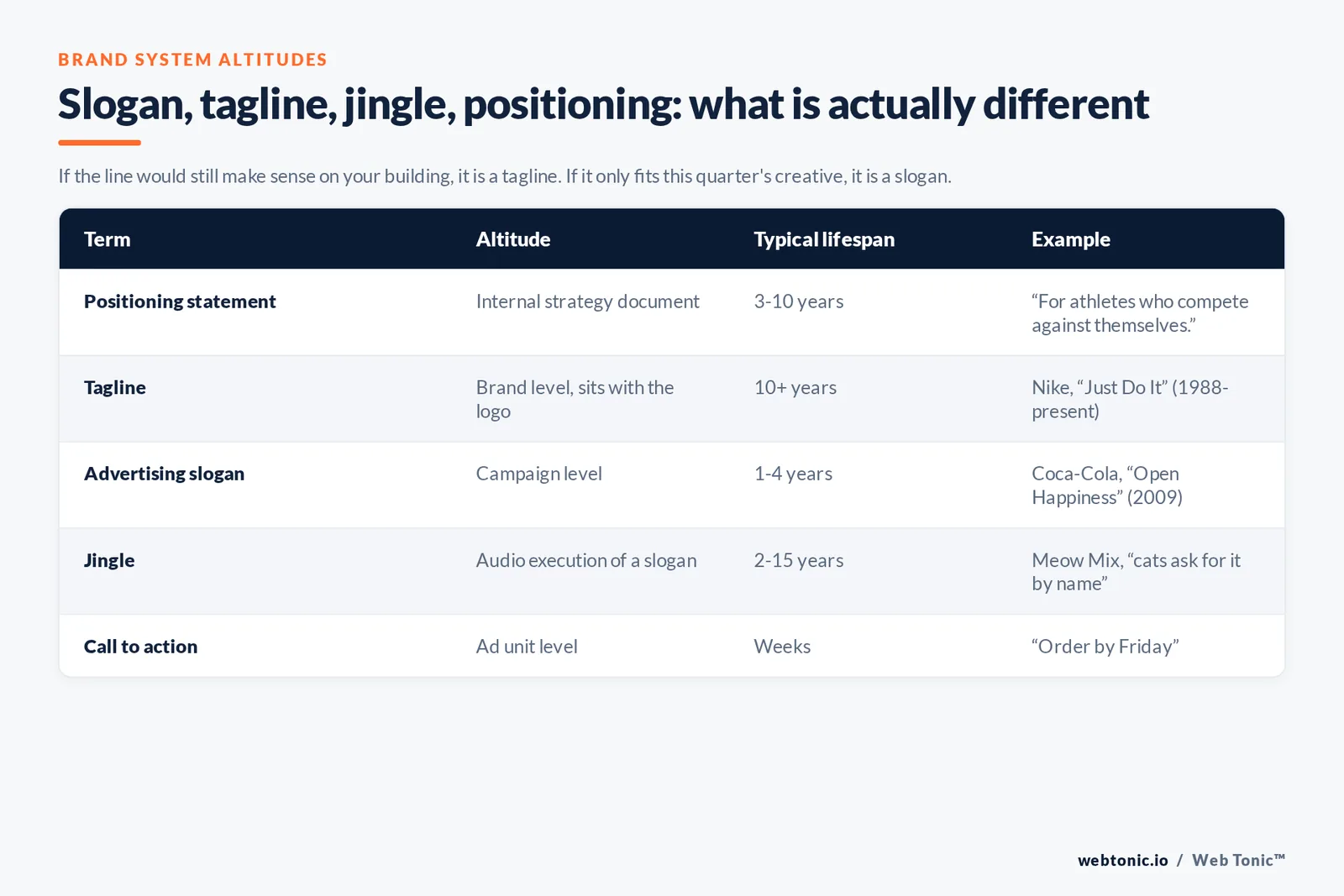
These four terms get used interchangeably in briefs, and that confusion is why so many approval meetings stall. They sit at different altitudes in a brand system. A positioning statement is internal strategy. A tagline is the public compression of that strategy. A slogan is the campaign-specific line that flexes underneath it. A jingle is a slogan set to music.
Coca-Cola is the cleanest teaching case. The Coca-Cola Company's own corporate history archive documents a long chain of campaign lines running from "Drink Coca-Cola" in 1886 through "Real Magic" — while the brand's underlying positioning (universal, everyday refreshment and togetherness) never moved. The slogans changed with the culture; the position didn't.
| Term | Altitude | Typical lifespan | Example |
|---|---|---|---|
| Positioning statement | Internal strategy document | 3–10 years | "For athletes who compete against themselves, not just others." |
| Tagline | Brand level, sits with the logo | 10+ years | Nike, "Just Do It" (1988–present) |
| Advertising slogan | Campaign level | 1–4 years | Coca-Cola, "Open Happiness" (2009) |
| Jingle | Audio execution of a slogan | 2–15 years | Meow Mix, "tastes so good, cats ask for it by name" |
| Call to action | Ad unit level | Weeks | "Order by Friday" |
Practical rule for marketing teams: if the line would still make sense on your building, it is a tagline. If it only makes sense next to this quarter's creative, it is an advertising slogan. Both are legitimate — mislabelling them is what causes a brand to burn a good tagline on a two-month promotion.
34 famous advertising slogans, grouped by the mechanic that makes them work
Reading a list of great lines teaches very little. Reading them grouped by mechanic — the specific job the words do — is how you get a usable template. The four mechanics below cover nearly every famous company slogan in circulation.
Mechanic 1: Authenticity and category ownership
These lines claim the category itself. They work only for leaders, because a challenger saying them sounds absurd. Coca-Cola's "It's the Real Thing" (1969) is the archetype: it does not describe taste, it declares that every other cola is an imitation. Budweiser's "King of Beers" performs the same land-grab in three words.
| Slogan | Brand | Introduced | Why it works |
|---|---|---|---|
| It's the Real Thing | Coca-Cola | 1969 | Reframes every rival as a copy without naming one |
| The King of Beers | Budweiser | 1800s-era claim, still in use | Category monarchy in 4 words; scales to any pack size |
| The Ultimate Driving Machine | BMW | 1974 | Superlative plus a functional noun, so it reads as engineering not boasting |
| A Diamond Is Forever | De Beers | 1947 | Sells the category, not the brand — and invented a purchase ritual |
| Finger Lickin' Good | KFC | 1956 | Describes the customer's behaviour, not the product |
| Melts in Your Mouth, Not in Your Hands | M&M's | 1954 | A single product truth stated as a competitive gap |
| Real Magic | Coca-Cola | 2021 | Modern echo of "the real thing" — continuity in the brand's own vocabulary |
Mechanic 2: Identity and self-image
The line is about the buyer, not the product. Nike's "Just Do It" contains no reference to shoes; it is an instruction the customer gives themselves. Apple's "Think Different" (1997) works the same way. These are the hardest lines to write and the most durable once they land, because customers repeat them about themselves.
| Slogan | Brand | Introduced | Why it works |
|---|---|---|---|
| Just Do It | Nike | 1988 | 3 words, zero product reference, infinitely portable across sports |
| Think Different | Apple | 1997 | Grammatically wrong on purpose, which is why it is memorable |
| Impossible Is Nothing | Adidas | 2004 | Inverted syntax forces a second reading |
| Because You're Worth It | L'Oréal Paris | 1971 | Permission to spend, aimed at the buyer's self-worth |
| Maybe She's Born With It. Maybe It's Maybelline | Maybelline | 1991 | Built-in compliment plus 1 mandatory brand mention |
| Open Happiness | Coca-Cola | 2009 | Verb plus emotion — describes an action the buyer performs |
| Have It Your Way | Burger King | 1974 | Turns an operational capability (custom orders) into a personality |
| Fly the Friendly Skies | United Airlines | 1965 | Sells the feeling of the journey rather than schedule or price |
Mechanic 3: Plain benefit, stated faster than the competition can
The unglamorous mechanic that sells the most units. Dollar Shave Club's "Shave Time. Shave Money." is the modern reference point: a pun that states both benefits of the subscription model in 4 words, which is why it carried a 2012 launch video into mainstream recognition with almost no paid media behind it at first. Direct-response brands should start here, not with identity lines.
| Slogan | Brand | Benefit stated | Why it works |
|---|---|---|---|
| Shave Time. Shave Money. | Dollar Shave Club | Convenience + price | Double meaning on 1 verb; 2 benefits, 4 words |
| You're in Good Hands | Allstate | Reassurance | Answers the only question insurance buyers actually have |
| Like a Good Neighbor, State Farm Is There | State Farm | Proximity, availability | Simile plus brand name plus promise in 1 sentence |
| Red Bull Gives You Wings | Red Bull | Energy | Metaphor for a functional effect; brand name is inside the line |
| Gimme a Break | Kit Kat | Pause, snack occasion | Owns an occasion rather than an attribute |
| Priceless | Mastercard | Value beyond price | 1 word that reframes a payments company as a memory-maker |
| When You Care Enough to Send the Best | Hallmark | Quality signal | Flatters the sender, not the recipient |
| Save Money. Live Better. | Walmart | Price + outcome | 2 short clauses; the second gives the first a reason to matter |
| Tastes So Good, Cats Ask for It by Name | Meow Mix | Palatability | Absurd proof device that a jingle made unforgettable |
Mechanic 4: Honest disadvantage (the challenger move)
The rarest and most respected mechanic: admit the weakness, then convert it. Avis ran "We Try Harder" from 1962 while openly conceding it was second to Hertz. Volkswagen's "Think Small" did the same with the Beetle's size. Buyers reward this because it signals a brand confident enough to be accurate — and accuracy is a compliance asset too, since the FTC's advertising and marketing guidance holds that objective claims must be substantiated before they run.
| Slogan | Brand | Admitted weakness | Conversion |
|---|---|---|---|
| We Try Harder | Avis | Not the market leader | Effort becomes the differentiator |
| Think Small | Volkswagen | Tiny car in a big-car market | Size becomes intelligence |
| It's Not for Everyone | Challenger-brand pattern line | Narrow appeal | Exclusion becomes belonging |
| Reassuringly Expensive | Stella Artois (UK) | High price | Price becomes a quality proof |
| We're Number 2, So We Try Harder | Avis (long form) | Rank | Transparency becomes trust |
The 7 traits shared by slogans that survive a decade
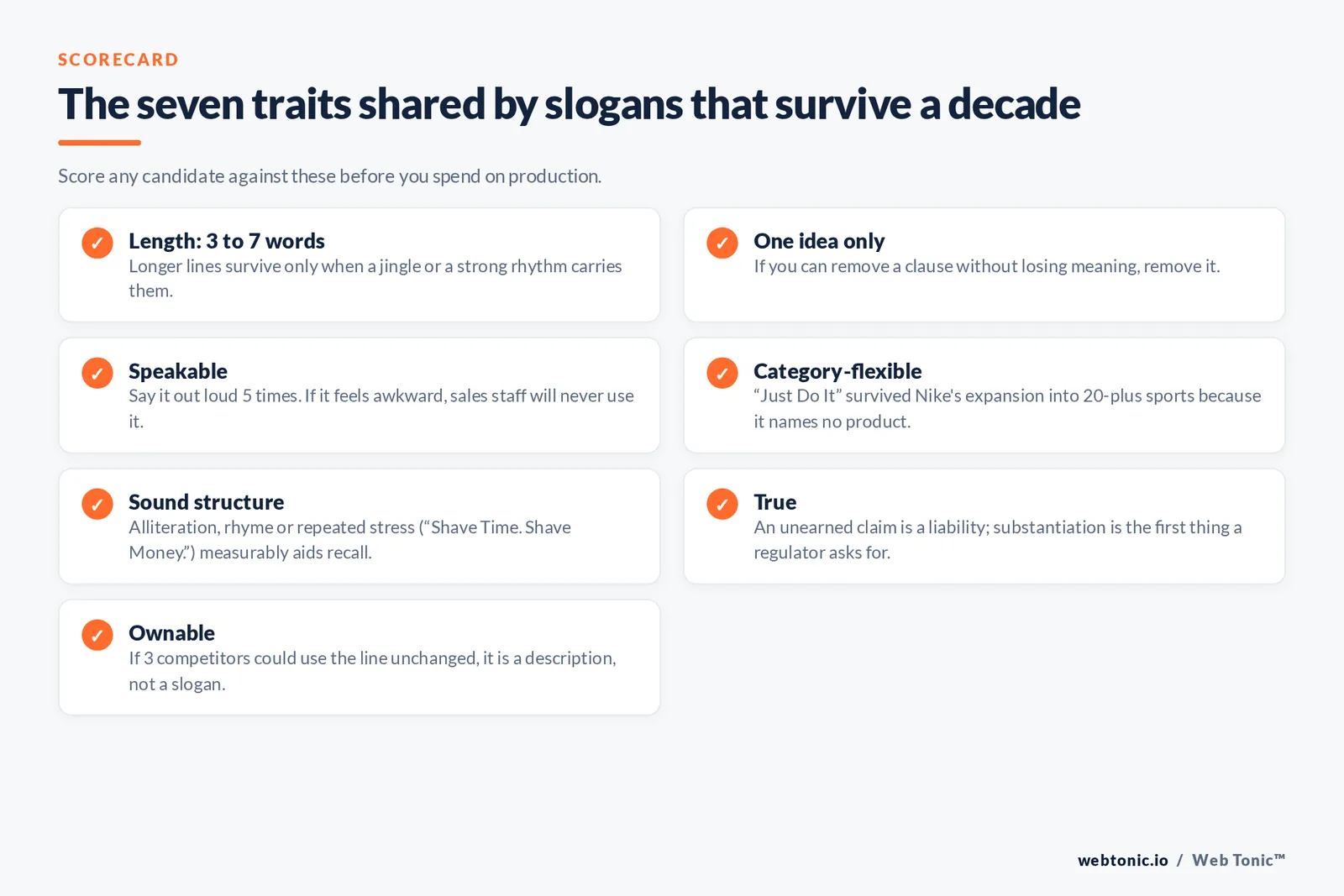
Across the four mechanics, the durable lines share measurable properties. Score any candidate against these before you spend on production.
- Trait 1 — Length: 3 to 7 words. Longer lines survive only when a jingle or a rhythm carries them.
- Trait 2 — 1 idea only. If you can remove a clause without losing meaning, remove it.
- Trait 3 — Speakable. Say it out loud 5 times. If it feels awkward, sales staff will never use it.
- Trait 4 — Category-flexible. "Just Do It" survived Nike's expansion from running into 20-plus sports because it names no product.
- Trait 5 — Sound structure. Alliteration, rhyme or repeated stress ("Shave Time. Shave Money.") measurably aids recall.
- Trait 6 — True. An unearned claim is a liability, and substantiation is the first thing a regulator asks for.
- Trait 7 — Ownable. If 3 competitors could use the line unchanged, it is a description, not a slogan.
Ownability is also what makes a line an asset rather than a decoration. Brand valuation work such as Interbrand's Best Global Brands and Kantar's BrandZ rankings both treat consistent, distinctive brand assets as a driver of measurable brand strength — which is why the companies at the top of those lists rarely change their taglines.
Slogan patterns that work by business type
The mechanic you should reach for depends on your market position and how the purchase is made. A local service business does not need an identity line; it needs a line that answers a worried buyer in 5 words. This table maps business type to pattern.
| Business type | Best mechanic | Pattern to use | Line to avoid |
|---|---|---|---|
| Local home services | Plain benefit | Speed or reliability plus place: "Same-day service, city-wide" | Abstract identity lines nobody can verify |
| DTC ecommerce | Plain benefit | 2 clauses, 1 pun, price implied: the "Shave Time. Shave Money." shape | Anything requiring 30 seconds of context |
| B2B SaaS | Plain benefit + outcome | Job-to-be-done in a verb: "Ship faster" | Category jargon that 2 competitors already use |
| Professional services | Honest disadvantage | Narrow the audience explicitly | "Your trusted partner" — used by thousands of firms |
| Consumer packaged goods | Authenticity | 1 sensory product truth | Corporate mission language |
| Insurance and finance | Plain benefit | Reassurance in the second person, as Allstate and State Farm do | Rate claims that need footnotes |
| Restaurants and QSR | Authenticity | Describe the eating behaviour, as KFC does | Menu specifics that change quarterly |
| Automotive | Authenticity | Superlative plus engineering noun, the BMW shape | Financing-led lines that date instantly |
| Apparel and footwear | Identity | Instruction to the customer | Fabric or feature detail |
| Energy drinks and stimulants | Plain benefit as metaphor | Functional effect, exaggerated — the Red Bull shape | Literal ingredient claims |
| Nonprofits | Identity | Name the change, not the organisation | Internal program names |
| Marketplaces and platforms | Plain benefit | Both sides in 1 line | Feature lists |
Category commodity trap: sector-wide claims such as "quality you can trust" fail Trait 7 by definition. If your line survives a find-and-replace with a competitor's logo, it is doing no work. This is the single most common failure we see when auditing a brand's messaging as part of growth marketing engagements.
How to write an advertising slogan in 6 steps
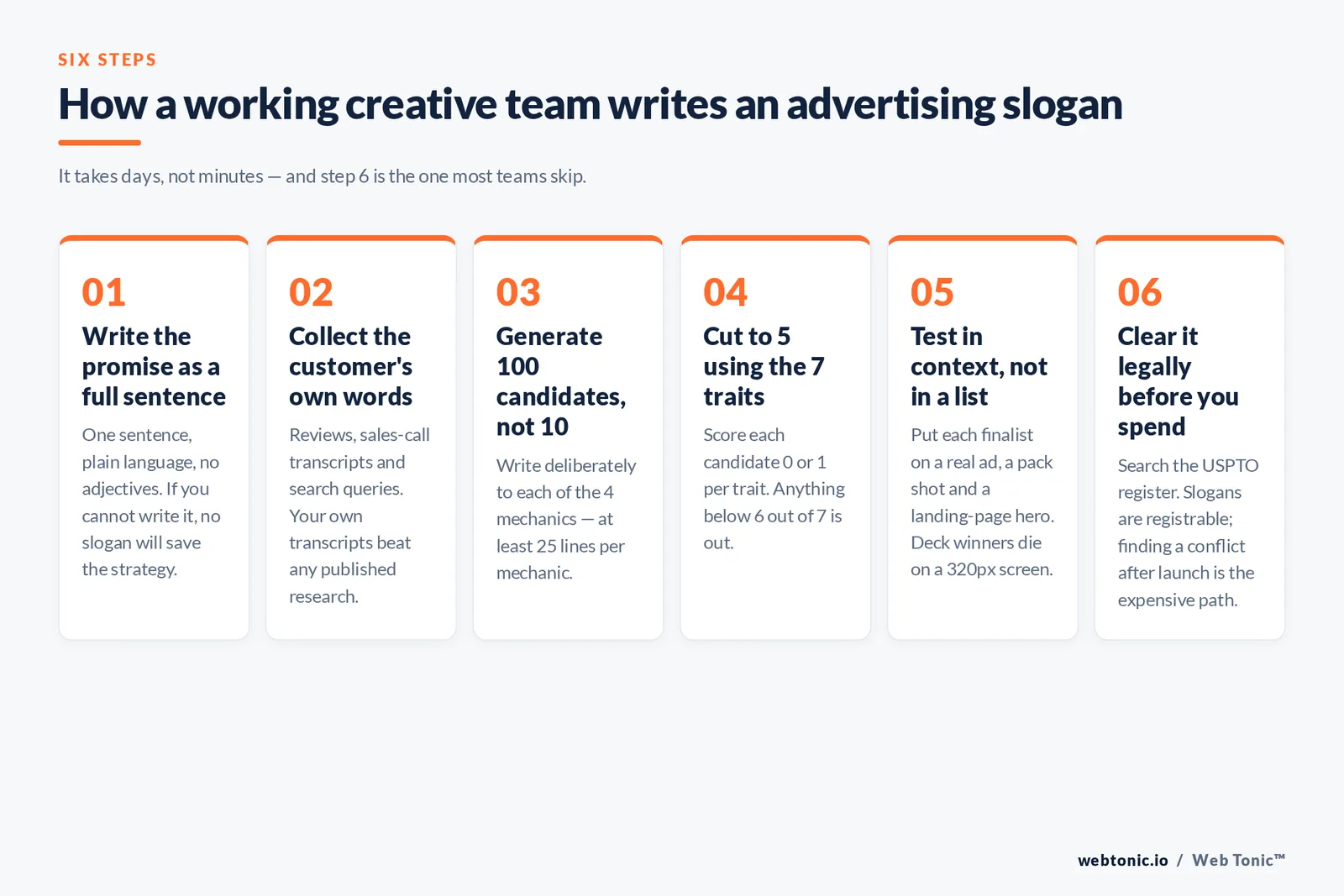
This is the sequence a working creative team follows. It takes days, not minutes, and Step 6 is non-negotiable.
- Step 1 — Write the promise in a full sentence first. One sentence, plain language, no adjectives. If you cannot write the sentence, no slogan will save the strategy.
- Step 2 — Collect the customer's own words. Reviews, sales-call transcripts and search queries. Framing research such as Think with Google helps, but your own transcripts beat it.
- Step 3 — Generate 100 candidates, not 10. Volume is the mechanism. Write to each of the 4 mechanics deliberately, at least 25 lines per mechanic.
- Step 4 — Cut to 5 using the 7 traits. Score each candidate 0 or 1 per trait; anything below 6 out of 7 is out.
- Step 5 — Test in context, not in a list. Put each finalist on a real ad, a real pack shot and a real landing page hero. Slogans that win in a slide deck often die on a 320-pixel-wide phone screen.
- Step 6 — Clear it legally before you spend. Search the register at USPTO trademark search and read the office's explanation of what a trademark protects. Slogans can be registered; discovering a conflict after launch is the expensive path.
Once a line survives all 6 steps, the work shifts from writing to repetition — the same line, everywhere, for years. Applying it consistently across ads, packaging and site copy is exactly the job our performance creative and web development teams handle together, and it is covered in more depth across the Web Tonic blog.
Honest, unconventional and parody slogans
A whole genre of "honest slogans" circulates online — parody lines that replace a brand's aspirational claim with the blunt truth ("we're expensive because you'll buy it anyway"). They are entertaining, and they are a genuinely useful diagnostic: if the honest version of your slogan is funnier than your real one, your real one is overclaiming.
Two rules if you flirt with the genre commercially. First, self-deprecation only works from a position of competence — Avis could say "We Try Harder" because its service actually was good. Second, parody of a competitor's registered slogan invites legal attention, and comparative claims must still be substantiated under the same FTC standards as any other objective claim.
Award juries are a better guide to what the industry considers effective than any listicle. The case studies published by the Effie Awards (which judge on business results), Cannes Lions and D&AD show the strategy behind the line, which is the part worth copying.
Measuring whether your slogan is working
Slogans feel unmeasurable. They are not. Track 4 things: unaided brand recall in a survey panel, correct slogan-to-brand attribution, branded search volume, and the line's lift when A/B tested as a landing-page headline. If attribution is low after 12 months of consistent use, the line is not distinctive enough — that is a Trait 7 failure, not a media-weight problem.
Trust and recall benchmarks from research organisations such as Nielsen and Gallup's brand trust indicator are useful context for setting realistic targets, and connecting survey movement to revenue is the kind of question our data intelligence practice is built to answer. If you want help pressure-testing a shortlist, get in touch.
FAQ
What are the best advertising slogans of all time?
The lines that appear on nearly every serious list are Nike's "Just Do It" (1988), De Beers' "A Diamond Is Forever" (1947), Coca-Cola's "It's the Real Thing" (1969), Volkswagen's "Think Small," McDonald's "I'm Lovin' It" (2003) and Avis's "We Try Harder" (1962). They qualify on longevity and correct brand attribution, not on cleverness.
What is the difference between a slogan and a tagline?
A tagline is brand-level and long-lived — it sits with the logo and typically runs for a decade or more. An advertising slogan is campaign-level and expected to be replaced when the campaign ends. Coca-Cola has used dozens of slogans while keeping one consistent brand position.
How long should an advertising slogan be?
Aim for 3 to 7 words. Longer lines can work when rhythm or a jingle carries them, as with Meow Mix's "tastes so good, cats ask for it by name," but every extra word reduces the odds of accurate recall.
Can you trademark a slogan?
Yes. Slogans are registrable as trademarks when they function as source identifiers rather than as ordinary descriptive or promotional phrases. Search the register first and read the USPTO's guidance on what a trademark covers before committing production budget to a line.
How often should a company change its slogan?
Change campaign slogans as often as the campaign strategy changes, typically every 1 to 4 years. Change a tagline rarely — ideally never. Brands that rotate their core line every 18 months spend continuously to rebuild recall they had already paid for.
Sources: The Coca-Cola Company corporate history; United States Patent and Trademark Office (trademark basics and search); Federal Trade Commission advertising and marketing guidance; Interbrand Best Global Brands; Kantar BrandZ; Nielsen Insights; Gallup brand trust indicator; Think with Google marketing strategies; Effie Awards; Cannes Lions; D&AD Awards. Slogan attributions and introduction years reflect brands' own published campaign histories and widely documented advertising records.