



Table of contents
Key Takeaways
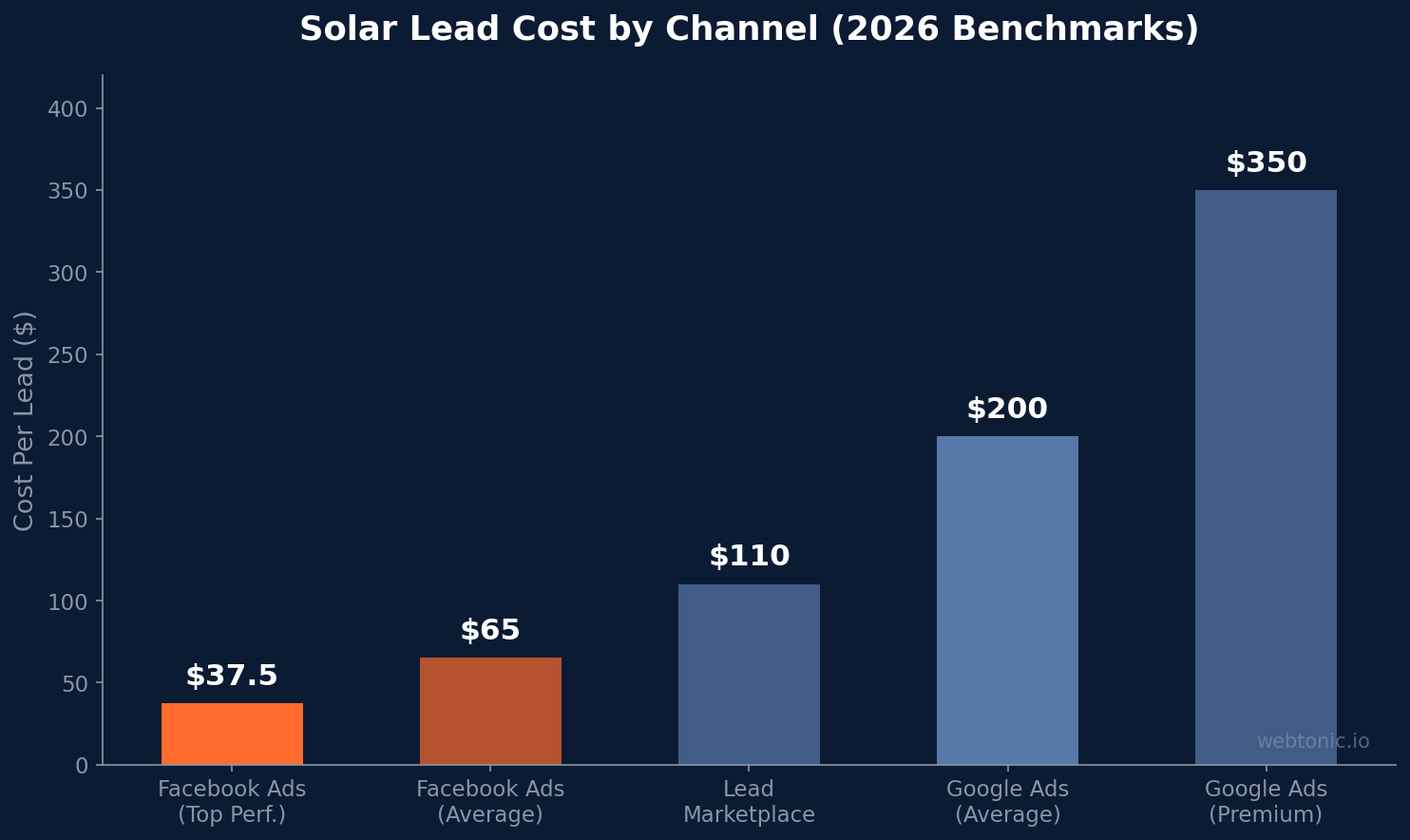
- Facebook ads for solar companies cost $30–$100 per lead in 2026, with top performers achieving $25–$50 CPL through precise targeting and optimized creative (SurgePV).
- Meta ads deliver CPL figures roughly 60% below Google Ads for the same solar installation services, making the platform the most cost-efficient paid acquisition channel for this vertical (SurgePV).
- Residential customer acquisition costs jumped 40% in early 2026 to approximately $0.84 per watt — for a 7 kW system that translates to roughly $5,880 per acquired customer (PipelineOn).
- Advantage+ Audience campaigns report 32% lower cost per acquisition and 22% higher ROAS versus manual targeting across comparable verticals (SurgePV).
- Lead Ads with Instant Forms generate 3–5× the volume of website-based conversion campaigns, though lead quality requires qualification questions to filter serious buyers (SurgePV).
- A UK installer generated sub-£50 CPL with 82% click-to-page-view rate and 6.3% landing page conversion on their first active campaign month (Daniel Latto).
- Meta CPL averages rose 21% year-over-year to $41.60 across verticals, but solar-specific accounts saw softening in some markets post-ITC step-down (Elevarus).
Facebook Ads Cost Benchmarks for Solar Companies
| Metric | Solar Industry Benchmark | Cross-Industry Average |
|---|---|---|
| Cost per lead (CPL) | $30–$100 | $20–$55 |
| Top-performer CPL | $25–$50 | — |
| Cost per click (CPC) | $1.50–$4.00 | $1.72 |
| Click-through rate (CTR) | 1.2–2.5% | 1.49% |
| Landing page conversion | 4–8% | ~5% |
| Customer acquisition cost | $700–$1,100 | Varies |
| Average ROAS | 5–12× (high-ticket) | 2–4× |
These benchmarks reflect 2025–2026 performance data from SurgePV, Elevarus, and Daniel Latto. The wide CPL range ($30–$100) reflects geographic and seasonal variation: summer months in sun-belt states produce the cheapest leads, while winter campaigns in northern markets push costs toward the upper range. Operators considering their channel mix can review our Meta Ads services overview for a full breakdown of platform capabilities.
The Post-ITC Landscape: How the Step-Down Changed Lead Economics
The Section 25D federal residential solar credit ended for new installations after December 31, 2025, under the One Big Beautiful Bill. This eliminated the 30% tax credit urgency lever that had driven conversion behavior for nearly two decades. The immediate impact on advertising was counterintuitive: headline CPL on Meta actually softened in several accounts — but that drop masked a dangerous shift in lead quality (Elevarus).
The real cost metric that changed is cost per sat appointment (CPSA). Pre-step-down, the lead-to-sat-appointment multiplier was roughly 2.4×, meaning 2.4 leads produced one sat appointment. Post-step-down, that multiplier widened to approximately 3.6× — installers paying the same CPL are now paying about 50% more per actual sat appointment. The sit-to-close rate has held within roughly 5 points of pre-step-down levels, but the appointment-set-to-sit rate dropped from around 75% to roughly 55%. For campaign managers, CPL is now a vanity metric — CPSA is the budgeting unit that matters.
Targeting Strategies That Drive Results
The best solar advertising campaigns on Meta combine demographic precision with behavioral signals. The target audience profile for residential panel installation:
- Age: 35–65+ — homeowners in their peak earning years with established residences.
- Household income: $50,000+ — the minimum threshold for financing eligibility on a typical residential system.
- Homeowner status: Use Meta's homeowner targeting interest layer combined with zip-code-level filtering.
- Behavioral signals: Interest in renewable energy, environmental advocacy, home improvement, and cost-savings content.
Advantage+ Audience — Meta's AI-driven targeting engine powered by the Andromeda system — has shown 32% lower CPA and 22% higher ROAS versus manual interest-based targeting in comparable verticals. Companies should set hard constraints (location, minimum age, language) and let the algorithm optimize within those guardrails. For specific geographic campaigns, layer radius targeting around service areas — most installation businesses operate within a 50–100 mile radius of their warehouse or office.
Lead Ads vs. Website Conversion Campaigns
| Campaign Type | Volume | Lead Quality | Best Use Case |
|---|---|---|---|
| Lead Ads (Instant Forms) | 3–5× higher | Lower (requires qualification Qs) | High-volume prospecting for companies with strong sales follow-up |
| Website conversion | Moderate | Higher intent | Companies with optimized landing pages and conversion tracking |
| Messenger / WhatsApp | Low–moderate | High (conversational) | Markets where messaging apps dominate; specific local campaigns |
Lead Ads with Instant Forms remain the dominant ad format for solar lead generation on Meta. The key to maintaining quality at scale is adding 2–3 qualification questions to the form: roof age, monthly electric bill amount, and homeownership status. These questions filter out renters and low-intent browsers, bringing qualified-lead rates from ~15% up to 40–55% of total submissions. Companies that skip qualification questions consistently report 50–70% junk lead rates — free-form submissions from renters, students, and people in apartments with no decision-making authority (SurgePV).
Creative Strategy and Ad Performance
Solar advertising creative on Meta must address two competing priorities: capturing attention in a crowded feed and building enough trust for a high-ticket purchase decision. The best-performing ad formats and content strategies include:
- Before-and-after installations: Real photos of completed rooftop systems with savings data overlay. These generate 2–3× higher engagement than stock imagery.
- Customer testimonial videos: 30–60 second clips from homeowners discussing their electric bill savings. Video ads drive 25–40% lower CPL versus static image ads when the content is authentic and locally relevant.
- Savings calculator hooks: Ad copy leading with "Find out how much you could save" paired with a landing page calculator. This format achieves the highest conversion rates (6–10%) because it delivers immediate personal value.
- Social proof elements: Star ratings, installation count badges ("500+ homes powered"), and local business certifications increase click-through by 15–25% over generic solar imagery.
- Seasonal urgency: Even without the federal credit, state-level incentives and utility rate hikes create natural urgency hooks. Reference specific local utility company rate increases when available.
Creative fatigue sets in faster for solar campaigns than for most verticals because the target audience size is inherently limited (homeowners in a defined service area). Plan to refresh ad creative every 3–4 weeks and maintain at least 4–6 active ad variations per ad set at any time. Companies running performance creative programs that systematically test and rotate assets consistently maintain CPL 20–30% below those running the same creative for months.
Full-Funnel Economics: From Ad Click to Closed Installation
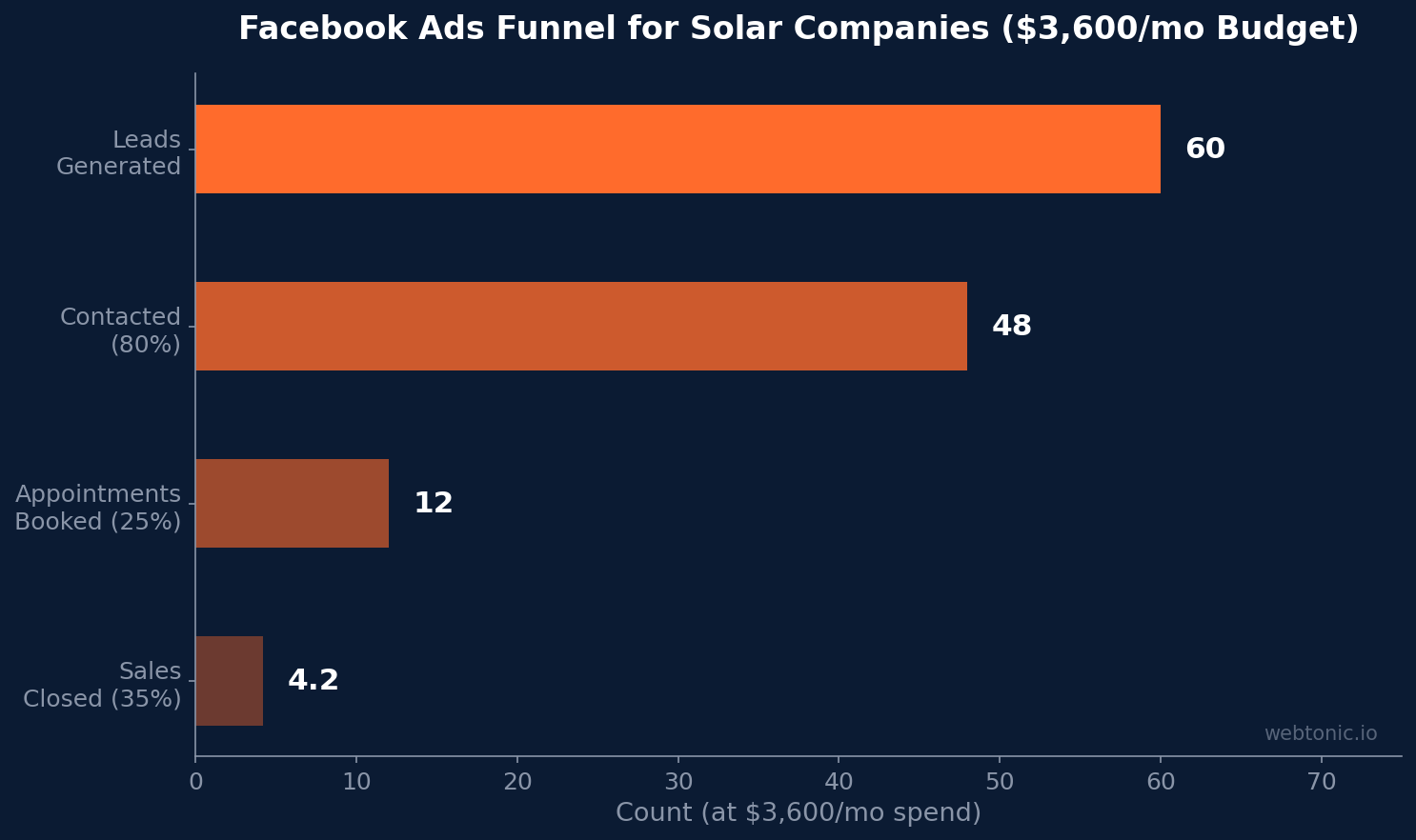
Understanding the complete sales funnel is critical for accurate budgeting. Here is the full-funnel math for a representative solar company spending $3,600/month on Meta advertising (SurgePV):
| Funnel Stage | Facebook Ads | Google Ads (Comparison) |
|---|---|---|
| Monthly ad spend | $3,600 | $3,600 |
| Average CPL | $60 | $120 |
| Leads per month | 60 | 30 |
| Contact rate | 80% | 90% |
| Appointments booked | 12 | 11 |
| Close rate | 35% | 47% |
| Sales closed | 4.2 | 5.2 |
| Customer acquisition cost | $857 | $692 |
The critical insight: Meta generates more leads at a lower CPL, but Google Ads produces higher-intent leads that close at better rates. The most effective solar marketing strategies allocate budget to both channels — learn more about whether Facebook Ads are worth it for high-ticket services. Companies should use Google Ads for high-intent search capture and Facebook for top-of-funnel awareness and volume generation. The blended cost per acquisition across both channels typically settles at $700–$900 — more efficient than either channel alone (BaaDigi).
Campaign Structure and Budget Management
Solar companies running effective Meta advertising campaigns follow a structured three-tier approach:
- Testing campaigns (20% of budget): Broad audiences with multiple ad creative variations. The goal is to identify winning combinations of copy, imagery, and targeting before scaling. Use CBO (Campaign Budget Optimization) at the campaign level with $20–$50/day per ad set during testing.
- Scaling campaigns (60% of budget): Proven audiences and creative from the testing tier. Move winners into dedicated ad sets with higher budgets. Scale by no more than 20% per day to avoid resetting the learning phase.
- Retargeting campaigns (20% of budget): Website visitors, video viewers, and lead form openers who did not convert. These audiences typically deliver 40–60% lower CPL than cold prospecting because the prospect already knows the brand.
For budget management, solar advertising managers should track cost per sat appointment (CPSA) as the primary KPI — not CPL. A lead that never sits for a consultation has zero value regardless of how cheaply it was acquired. Companies spending $3,000–$10,000/month on Meta should expect to generate 30–160 leads and close 3–12 installations depending on their local market, sales team speed, and follow-up processes (WiFi Talents).
Best Practices for Solar Advertising on Meta
- Add qualification questions to every Lead Ad. Roof age, monthly electric bill, and homeownership status filter out 40–50% of junk leads before they cost sales team time.
- Use Advantage+ Audience for prospecting. Set location and age constraints, then let Meta's AI optimize. Manual interest targeting still works for niche audiences but often delivers higher CPL at lower scale.
- Build dedicated landing pages. Companies sending ad traffic to their homepage see 30–50% lower conversion rates than those using purpose-built pages with a single CTA, social proof, and a savings calculator.
- Implement CRM integration for lead scoring. Connect your lead ads directly to your CRM (HubSpot, Salesforce, GoHighLevel) with real-time notifications. Speed to first contact is the single biggest predictor of lead-to-appointment conversion — respond within 5 minutes for best results.
- Track the full funnel, not just CPL. Install the Meta Pixel and Conversions API (CAPI) on your website. Upload offline conversion data (appointments and closed deals) to feed Meta's algorithm with real business outcomes.
- Refresh creative every 3–4 weeks. Maintain 4–6 active ad variations and test new content monthly. Monitor frequency — when it exceeds 3.0 in a 7-day window, the audience is saturated and CPL will rise.
Related reading
- Pool Building Facebook Ads Statistics
- Surrogacy Facebook Ads Statistics
- Tax & Accounting Meta Ads (Facebook & Instagram) Statistics (2026 Benchmarks)
- Meta Ads Agency services at Web Tonic
FAQ
How much do Facebook ads cost for solar companies?
Solar companies can expect to pay $30–$100 per lead on Facebook in 2026, with top performers achieving $25–$50 CPL. The average CPC ranges from $1.50 to $4.00, and landing page conversion rates typically fall between 4% and 8%. Total customer acquisition cost through the full sales funnel averages $700–$1,100.
Are Facebook ads cheaper than Google Ads for solar leads?
Yes, on a CPL basis. Facebook ads generate leads at roughly 60% lower cost than Google Ads for solar installation services. However, Google Ads leads tend to have higher purchase intent and close at better rates. The best strategy allocates budget to both platforms for a blended acquisition cost that outperforms either channel alone.
What ad format works best for solar companies on Facebook?
Lead Ads with Instant Forms generate the highest volume — 3–5× more leads than website conversion campaigns. Adding 2–3 qualification questions (roof age, electric bill, homeownership) is essential to maintain lead quality. Video testimonials from real customers drive 25–40% lower CPL versus static image ads.
How does Advantage+ Audience perform for solar campaigns?
Meta's Advantage+ Audience uses the Andromeda AI engine to find converters from broad starting pools. Early data shows 32% lower CPA and 22% higher ROAS versus manual interest-based targeting. Set hard constraints (location, minimum age, language) and let the algorithm handle the rest.
What is the most important KPI for solar Facebook ad campaigns?
Cost per sat appointment (CPSA) — not cost per lead. Post-ITC step-down, the lead-to-sat-appointment multiplier has widened from roughly 2.4× to 3.6×. A lead that never sits for consultation has zero value, regardless of CPL. Track the full funnel from ad click through to closed installation.
Sources
surgepv.com/blog/facebook-ads-solar-companies
elevarus.com/solar-lead-generation-cpl-2026-post-itc
daniellatto.co.uk/case-studies/solar-energy-facebook-ads
pipelineon.com/blog/solar-digital-marketing
baadigi.com/tools/benchmarks/solar
wifitalents.com/marketing-in-the-solar-industry-statistics
gitnux.org/marketing-in-the-solar-industry-statistics
sproutsagesolutions.com/google-ads-for-solar-companies-cost


