



Table of contents
Facebook and Instagram are the dominant paid channels for surrogate recruitment, while serving as critical awareness drivers for intended parent acquisition. These statistics cover cost benchmarks, platform restrictions, and documented campaign results from surrogacy-focused Meta Ads campaigns.
Key Takeaways
- Surrogate recruitment CPL on Facebook ranges from $50–$200, with only 10–25% of leads qualifying after screening — effective cost per qualified surrogate reaches $500–$2,000.
- Intended parent Facebook CPL ranges from $150–$500 depending on segment, with gay male couples and international IPs at the lower end.
- Documented Facebook-driven surrogacy case studies report ROAS of 600–844%, with one agency generating $600K in net revenue from $96K annual ad spend.
- Facebook Lead Ads average $34.10 CPL across all industries, making surrogacy's $50–$200 range a 1.5–6× premium driven by compliance restrictions and audience sensitivity.
- Meta classifies fertility/surrogacy under restricted health advertising, limiting targeting options and requiring sensitivity disclaimers — but not Special Ad Category designation.
- Healthcare Meta Ads CTR averages 1.72% with a 2.8× ROAS benchmark for fertility clinics, though top surrogacy campaigns significantly outperform these averages.
Surrogacy Facebook Ads Cost Benchmarks
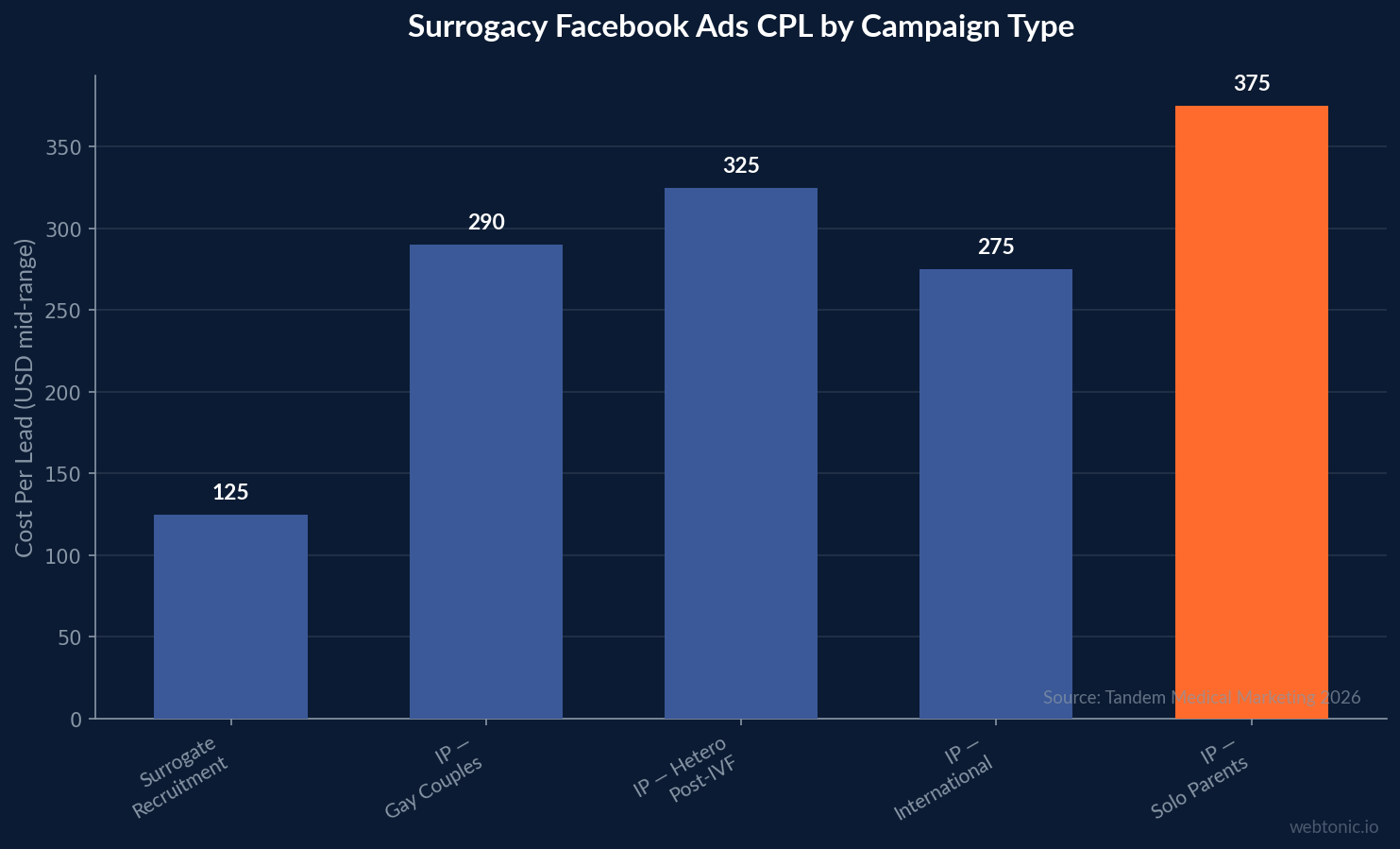
Cost per lead in surrogacy Facebook advertising varies dramatically between the two audience funnels — surrogate recruitment and intended parent acquisition — and by geographic market.
| Campaign Type | CPL Range | Qualification Rate | Effective CPQL | Monthly Spend |
|---|---|---|---|---|
| Surrogate Recruitment | $50–$200 | 10–25% | $500–$2,000 | $3,000–$10,000 |
| IP — Heterosexual Post-IVF | $200–$450 | 40–55% | $400–$1,100 | $2,000–$8,000 |
| IP — Gay Male Couples | $180–$400 | 45–60% | $350–$900 | $2,000–$8,000 |
| IP — Solo Parents | $250–$500 | 35–50% | $500–$1,400 | $2,000–$6,000 |
| IP — International | $150–$400 | 30–45% | $400–$1,300 | $1,500–$5,000 |
Tier-1 metro markets (NYC, LA, SF, Boston, Chicago) run 30–60% higher CPL than tertiary U.S. markets, though they also produce higher conversion rates due to greater surrogacy awareness. The most meaningful metric is cost per signed contract — ranging from $800–$3,000 for surrogates and $1,200–$5,000 for intended parents.
Facebook Ads Performance vs. Industry Benchmarks
Surrogacy Facebook campaigns operate within the healthcare advertising tier, where costs and engagement metrics differ substantially from general direct-to-consumer categories.
| Metric | Surrogacy (Est.) | Healthcare Avg. | All-Industry Avg. |
|---|---|---|---|
| CTR | 1.2–2.3% | 1.72% | 0.9–1.1% |
| CPC | $2.80–$8.50 | $2.80–$12.00 | $1.50–$3.00 |
| CPL (Lead Form) | $50–$500 | $18–$45 | $34.10 |
| Landing Page Conv. Rate | 4.0–8.5% | 6.2% | 5.8% |
| ROAS | 5–8× (on fees) | 2.8× | 3.5–4.5× |
Healthcare CTR climbed 67% during 2025, finishing the year at 2.29% — suggesting patients respond increasingly well to healthcare content in feeds, driven by improved creative formats and provider video content. Surrogacy campaigns leveraging video creative and authentic surrogate testimonials consistently outperform these benchmarks.
Case Study Performance Data
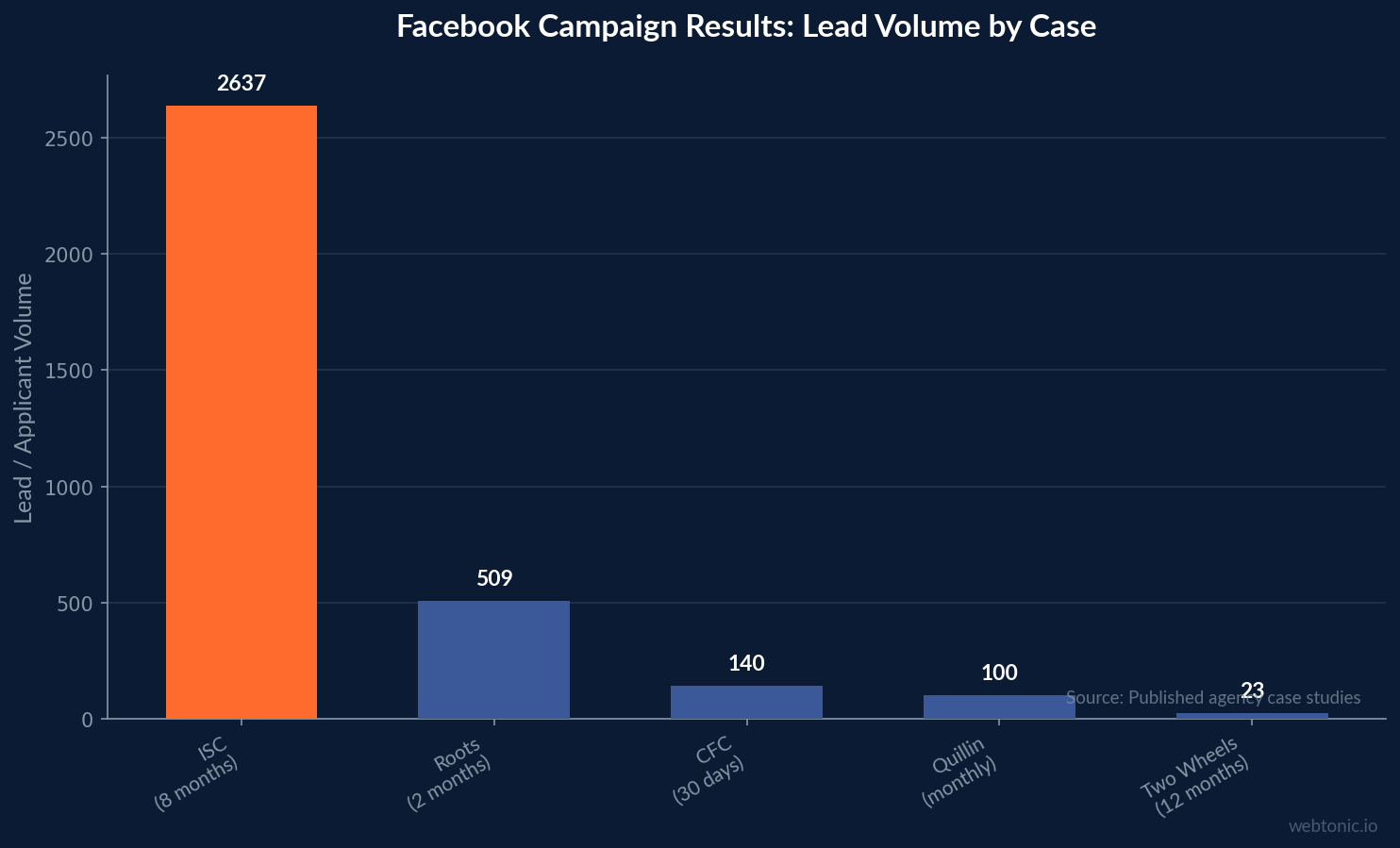
Published case studies from surrogacy-focused Facebook advertising agencies reveal the scale of results achievable with optimized campaign structures.
| Agency / Case | Results | CPL | Revenue / ROAS | Timeframe |
|---|---|---|---|---|
| International Surrogacy Center | 2,637 leads, 324 applications, 40 qualified | $6.75 | Not disclosed | 8 months |
| Canadian Fertility Consulting | 140 consultations, 43 sign-ups | Not disclosed | $2.7M revenue | ~30 days |
| Roots Surrogacy | 509 opt-ins, 32 qualified | $8.90 | Not disclosed | 2 months |
| US Surrogacy (Quillin) | 1.8M impressions, 100+ monthly leads | Not disclosed | 2× lead volume | 5 months |
| Two Wheels — Unnamed Agency | 23 matched surrogates | ~$348/surrogate | $600K / ~600% ROAS | 12 months |
| Alcea Surrogacy (Mayple) | Ongoing optimization | $200→$90 | 55% CPL reduction | Ongoing |
| Limes Agency — Surrogacy Services | 1,500 site visits, 34 requests | $62.29 | 844% payback | 1 month |
The standout result is the International Surrogacy Center case, which generated 2,637 leads at just $6.75 CPL through a Facebook-first strategy, converting 324 into applications and moving forward with 40 qualified surrogates. This demonstrates the volume potential of Facebook Lead Ads when combined with rigorous post-lead qualification processes.
Ad Format Performance in Surrogacy
Creative format significantly impacts both cost and conversion quality in surrogacy advertising, with format selection varying between the two audience funnels.
- Facebook Lead Ads (Instant Forms) deliver the lowest CPL at $34.10 average across all industries — surrogacy agencies using lead forms for surrogate recruitment achieve the bottom end of the $50–$200 range.
- Video ads generate 2–4× the engagement of static image ads in surrogacy, with owner/surrogate testimonial videos achieving the strongest performance creative results.
- Carousel ads ($41.50 avg. CPL) outperform single image ($38.60) for intended parent campaigns, where multiple touch points in a single ad unit help address the complex decision factors.
- Instant Experience ads ($49.70 avg. CPL) work for premium IP targeting, providing immersive landing experiences within the Facebook app.
- User-generated content (UGC) style creative consistently outperforms polished studio production in surrogate recruitment, where authenticity drives trust with potential candidates.
Platform Restrictions and Compliance
Meta's advertising policies create unique constraints for surrogacy campaigns that directly impact targeting capabilities, creative options, and campaign structure.
| Restriction Area | Impact on Surrogacy Ads | Workaround |
|---|---|---|
| Health & Wellness Category | Cannot target based on personal health conditions | Broad interest + lookalike audiences |
| Sensitivity Disclaimers | Required for fertility-related messaging | Build into creative templates |
| Success Rate Claims | Cannot guarantee outcomes | Use ranges with stated conditions |
| Before/After Imagery | No pregnancy/infant outcome images | Focus on journey, not outcome |
| Age Targeting | Must target 18+ | Standard for surrogacy audiences |
Compliance violations can trigger account-level suspensions lasting 3–6 months, and the opportunity cost of a flow gap during peak recruitment periods can exceed an entire year of preventable acquisition cost. Agencies should maintain backup ad accounts and pre-approved creative libraries to minimize disruption risk.
Facebook vs. Google Ads for Surrogacy
- Meta Ads generate 45% of fertility digital conversions by volume — primarily affordable single-service inquiries and surrogate recruitment leads.
- Google Search captures 20% of conversions but at higher average revenue per user, typically 2–3 cycle packages or premium surrogacy programs.
- Facebook excels at surrogate recruitment (55–65% of recruitment budgets) because the target audience isn't actively searching — they need to be reached with awareness messaging.
- Google dominates intended parent high-intent capture for queries like "surrogacy agency near me" and "how much does surrogacy cost."
- The optimal split is 60/40 Facebook/Google for surrogate recruitment and 40/60 Facebook/Google for intended parent acquisition, adjusted by market maturity.
- Cross-channel attribution shows Facebook ad exposure reduces Google Ads CPL — pre-warmed audiences searching Google after seeing surrogacy content on Facebook convert at lower cost.
Audience Targeting Strategies for Surrogacy
Effective surrogacy Facebook targeting requires creative approaches to work within Meta's health advertising restrictions while still reaching qualified audiences.
- Lookalike audiences built from existing client databases outperform interest-based targeting by 40–60% in qualification rate for intended parent campaigns, as they identify behavioral patterns beyond declared interests.
- Broad targeting with creative-driven qualification increasingly outperforms narrow interest targeting — Meta's algorithm identifies high-propensity users more efficiently when given a larger audience pool and strong creative signals.
- Retargeting website visitors with 90-day and 180-day windows produces the highest conversion rates (typically 3–8× cold audience performance) for intended parent campaigns.
- Geographic targeting adjustments are essential — agencies in states with surrogacy-friendly legal frameworks (California, Texas, Illinois) face lower CPAs than those marketing across state lines into legally complex jurisdictions.
- Sequential messaging strategies that serve different creative to users based on prior ad engagement reduce CPL by 15–25% compared to showing the same ad repeatedly.
- LinkedIn is generally not viable for surrogate recruitment due to demographic mismatch, though it serves B2B relationship-building with reproductive attorneys and IVF clinics that generate referral leads.
Campaign Structure Best Practices
The dual-funnel nature of surrogacy marketing requires distinct campaign architectures for surrogate recruitment and intended parent acquisition, each with different optimization objectives.
- Separate campaigns for surrogate recruitment vs. intended parent acquisition — blending audiences in a single campaign confuses Meta's optimization algorithm and inflates costs for both funnels.
- Use Conversion campaigns optimized for qualified leads rather than link clicks or landing page views — Facebook's algorithm is significantly better at finding conversion-prone users when given a clear conversion signal.
- Test 3–5 creative concepts per ad set with diverse hooks, angles, and formats before scaling winners. Creative testing budgets should represent 20–30% of monthly spend.
- Implement CRM-based custom audiences to exclude existing clients, current surrogates, and disqualified applicants from ad delivery, preventing wasted impressions and potential brand damage.
- Maintain 3–5 active ad sets per campaign to allow Facebook's algorithm sufficient testing room while avoiding audience overlap and internal competition.
- Set up the Facebook Conversions API (CAPI) alongside the pixel for server-side event tracking — this improves match rates and attribution accuracy, especially for multi-device surrogacy research journeys.
Budget Allocation for Surrogacy Facebook Campaigns
Optimal Facebook budget allocation depends on whether the agency prioritizes surrogate recruitment, intended parent acquisition, or balanced growth across both funnels.
- Surrogate recruitment on Meta: $3,000–$10,000/month, with 55–65% of total recruitment budget allocated to Facebook and Instagram.
- Intended parent Meta campaigns: $2,000–$8,000/month, focused on awareness and retargeting rather than direct conversion.
- Retargeting budgets: 15–25% of total Facebook spend with 3–6 month windows for intended parents who visited high-intent landing pages.
- Creative testing: allocate 20–30% of monthly budget to testing new ad concepts, with winning creative scaled across audience segments.
- Total recommended Meta investment: $5,000–$18,000/month for agencies managing both funnels, excluding management fees ($1,250/month or 12% of spend).
Seasonal Trends in Surrogacy Facebook Advertising
Surrogacy Facebook advertising performance fluctuates predictably throughout the year, driven by both intended parent behavior patterns and surrogate recruitment cycles.
- January through March is peak intended parent inquiry season — New Year resolution psychology and post-holiday family planning discussions drive 25–35% higher lead volumes compared to summer months.
- Surrogate recruitment peaks in January and September as women reassess personal goals after holidays and back-to-school transitions, making these windows critical for recruitment ad budget increases.
- Summer months (June–August) see the highest CPL — reduced decision urgency and vacation disruptions to nurture sequences push intended parent CPL 15–25% above annual averages.
- Q4 holiday season produces mixed results — surrogate recruitment slows during Thanksgiving-Christmas, but intended parent research activity increases in the final two weeks of December as families discuss future plans.
- Agencies that maintain consistent year-round ad spend outperform seasonal advertisers by 30–40% in annual CPA, as Facebook's algorithm requires stable learning periods to optimize delivery effectively.
- National Infertility Awareness Week (April) creates a content marketing opportunity that temporarily reduces social media CPL by 10–20% as media coverage increases public awareness and reduces cold audience resistance.
Measuring Facebook Ads Success in Surrogacy
Attribution and measurement in surrogacy Facebook campaigns require specialized approaches due to the long sales cycle and multi-touch nature of the decision journey.
- Standard 7-day click / 1-day view attribution windows undercount Facebook's impact by 30–50% in surrogacy, where intended parents may take weeks to months between ad exposure and inquiry.
- Track cost per qualified lead (CPQL) rather than raw CPL — a $200 lead that converts at 50% (CPQL: $400) is more valuable than a $50 lead that converts at 5% (CPQL: $1,000).
- Implement UTM parameters on all Facebook ad URLs to track post-click behavior through CRM and identify which ad creative, audiences, and placements produce the highest-quality leads.
- Set up offline conversion tracking — feeding signed contracts back to Facebook as offline events enables the algorithm to optimize for actual business outcomes rather than form submissions.
- Calculate blended ROAS across both funnels quarterly, since monthly fluctuations in the long surrogacy sales cycle create misleading short-term ROI snapshots.
Frequently Asked Questions
How much do surrogacy Facebook ads cost per lead?
Surrogate recruitment leads cost $50–$200 on Facebook, though only 10–25% qualify after screening — making the effective cost per qualified surrogate $500–$2,000. Intended parent leads range from $150–$500 depending on demographic segment, with Tier-1 metros running 30–60% higher.
What ROAS can surrogacy agencies expect from Facebook ads?
Documented case studies show ROAS ranging from 600% to 844%. Against $25K–$45K agency fees per completed journey, sustainable ROAS of 5–8× is realistic with competent execution and optimized campaign structures.
Are surrogacy Facebook ads subject to Special Ad Category restrictions?
Surrogacy ads fall under Meta's restricted health and wellness category rather than Special Ad Category (which applies to credit, employment, housing). You cannot target based on personal health conditions, but you retain more targeting options than Special Ad Category advertisers.
What creative format works best for surrogacy Facebook ads?
Video testimonials from surrogates and intended parents generate 2–4× the engagement of static images. Facebook Lead Ads with Instant Forms achieve the lowest CPL ($34.10 average), while carousel formats outperform single images for intended parent campaigns by showcasing multiple aspects of the surrogacy journey.
How should surrogacy agencies split budget between Facebook and Google?
For surrogate recruitment, allocate 60% to Facebook and 40% to Google. For intended parent acquisition, flip to 40% Facebook and 60% Google. Facebook excels at reaching passive audiences (potential surrogates), while Google captures active searchers (intended parents). Cross-channel exposure reduces overall CPL.
Sources
tandemmedicalmarketing.com — Marketing for Surrogacy Agencies
tandemmedicalmarketing.com — Intended Parent Marketing Playbook
linkedselling.com — International Surrogacy Center Case Study
twowheelsmarketing.com — Surrogacy Agency Lead Gen Case Study
mayple.com — Alcea Surrogacy Case Study
quillinlv.com — US Surrogacy Campaign Results
benchmarketing.org — Fertility Clinics Marketing Benchmarks 2026
adsuploader.com — Facebook Lead Ads CPL Benchmarks 2026
ichelonconsulting.com — IVF Google Ads vs Meta Ads Data
adlibrary.com — Facebook Ads Healthcare Performance Metrics 2026


