Table of contents

Meta Ads offer tax and accounting firms a cost-effective channel for client acquisition, with average CPCs between $1.72 and $2.45 depending on the subcategory — significantly lower than Google Ads in the same vertical. Benchmarketing’s 2026 data confirms that tax-service advertisers achieve a 3.2x ROAS on Facebook and Instagram, making Meta a strong complement to search-based campaigns. Here are the numbers driving strategy decisions in 2026.
Key Takeaways
- Tax services average $2.45 CPC on Meta Ads, while accounting broadly averages $1.72 (CuFinder, 2026)
- ROAS for tax-service advertisers averages 3.2x across Facebook and Instagram (Benchmarketing)
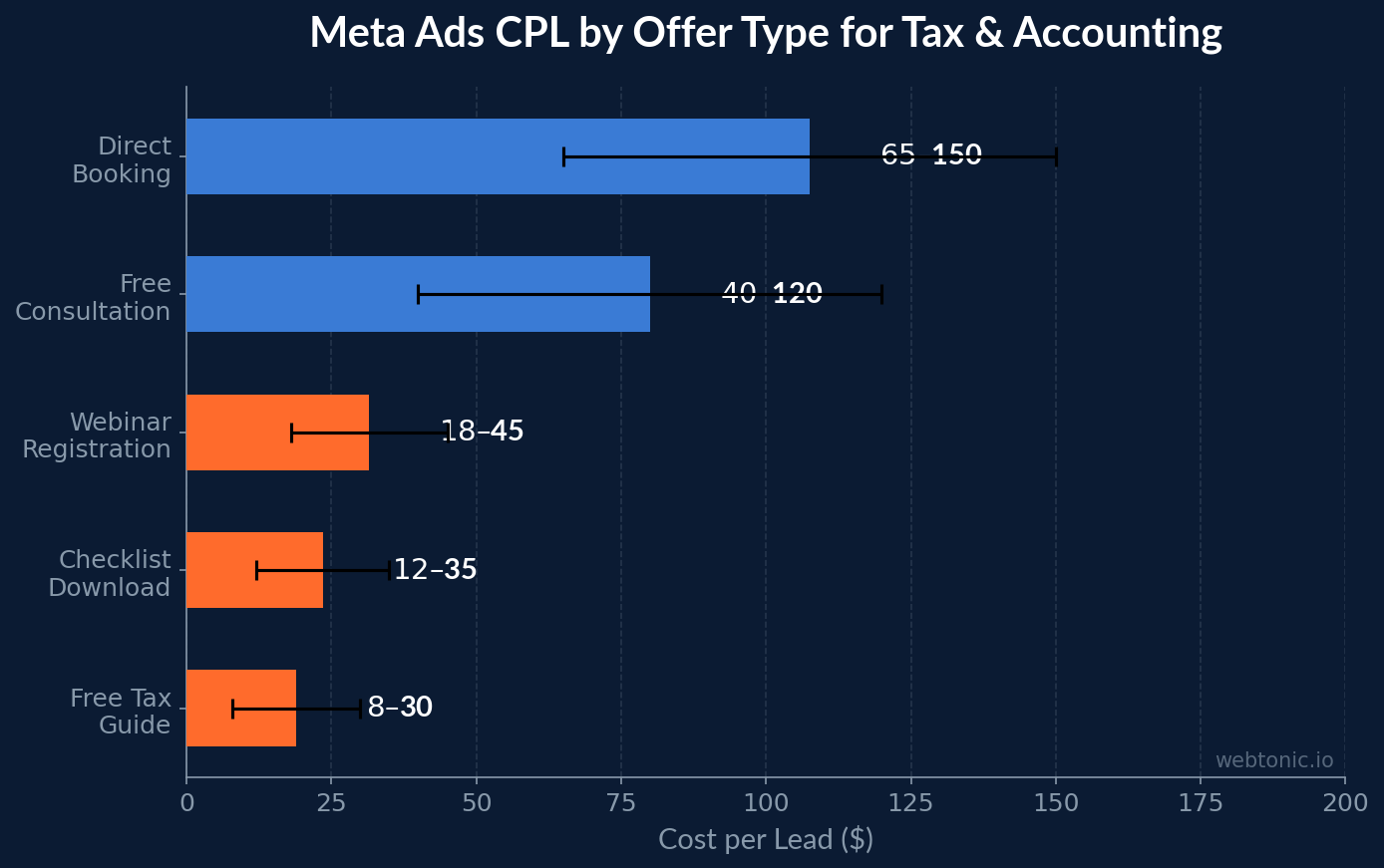
- Cost per lead ranges from $8 to $120 depending on offer type — free guides at $8–$30, consultations at $40–$120
- Video ads outperform static images by 22–30% in conversion rate for accounting services
- Monthly budgets below $2,000 struggle to exit learning phase consistently on Meta’s algorithm
- Retargeting campaigns deliver 4.2x higher ROAS than prospecting campaigns for tax services
- Q1 (Jan–Apr) CPL drops 20–35% due to high-intent seasonal demand during tax season
Meta Ads Cost Benchmarks for Tax & Accounting
Cost metrics vary significantly across accounting subcategories. CuFinder’s CPA Firm report and Benchmarketing’s accounting data provide the most granular breakdown available. Tax services command higher CPCs than general accounting because the audience is more defined and the competition is more concentrated around seasonal peaks. Finance and insurance as a broad category sits even higher at $3.77 CPC, reflecting the competitive intensity across the entire financial vertical.
| Metric | Accounting (General) | CPA Firms | Tax Services | Finance & Insurance |
|---|---|---|---|---|
| Avg. CPC | $1.72 | $1.95 | $2.45 | $3.77 |
| Avg. CTR | 1.08% | 1.15% | 1.28% | 0.82% |
| Avg. CVR | 3.6% | 3.2% | 4.1% | 2.8% |
| Avg. CPA / CPL | $48 | $61 | $60–$90 | $135 |
| ROAS | 2.8x | 3.0x | 3.2x | 2.4x |
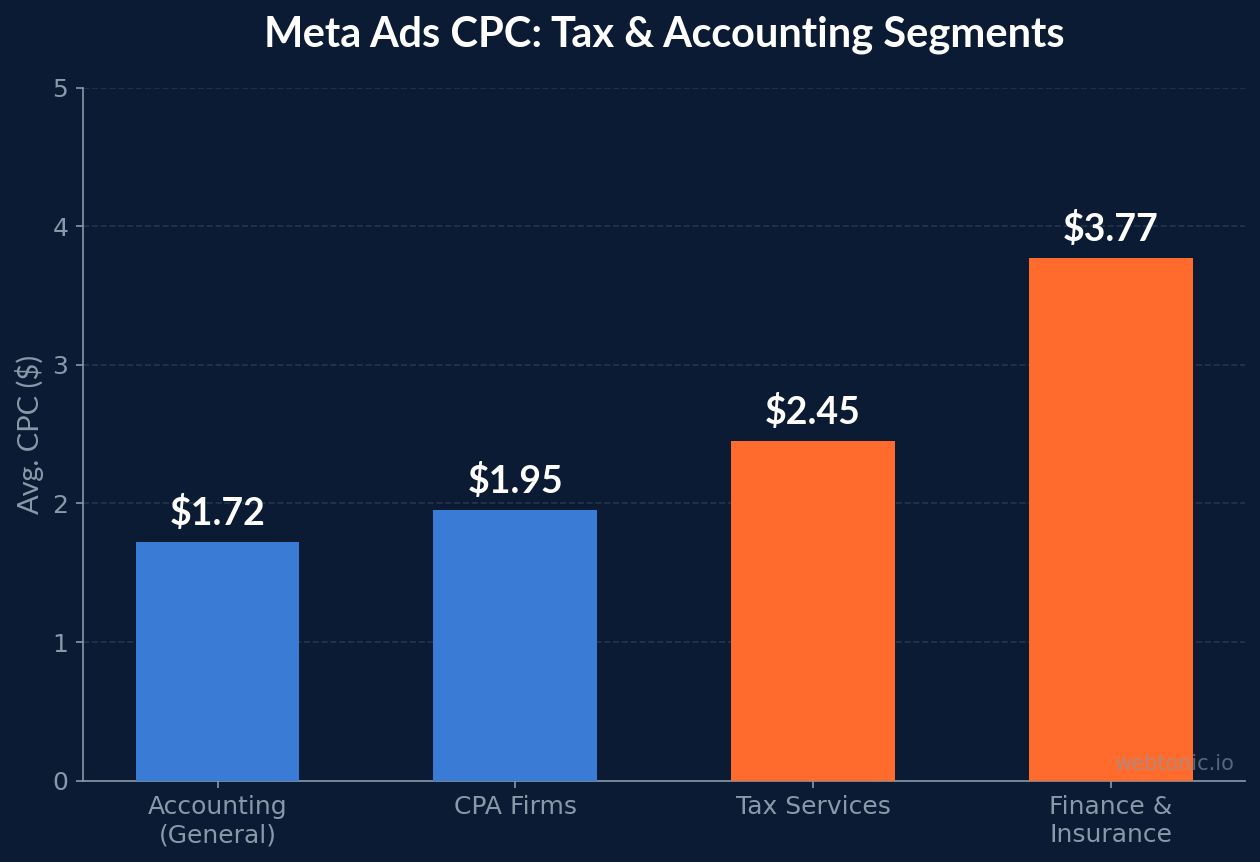
The CPC differences across subcategories reflect audience specificity rather than quality. Tax services carry higher CPCs because campaigns target people with explicit intent around filing deadlines, deductions, or IRS issues. General accounting campaigns cast a wider net with lower competitive pressure. CPA firms sit in the middle, balancing personal service positioning with professional services targeting. For firms running Meta Ads campaigns, understanding where your service falls on this spectrum determines both budget requirements and expected efficiency benchmarks.
Cost per Lead by Offer Type
Industry CPL benchmarks reveal that offer type is the single biggest determinant of CPL on Meta for accounting firms. Low-friction offers like free tax guides and downloadable checklists generate leads at $8–$35 per lead, while high-intent offers like free consultations and direct appointment bookings cost $40–$150. The trade-off is lead quality: guide downloaders require substantial nurturing to convert, while consultation bookers are pre-qualified and convert to paying clients at 3–5x the rate of guide leads.
| Offer Type | CPL Range | Lead Quality | Avg. Close Rate | Effective CPA |
|---|---|---|---|---|
| Free Tax Guide / eBook | $8–$30 | Low–Medium | 3–5% | $160–$600 |
| Tax Checklist Download | $12–$35 | Medium | 5–8% | $150–$440 |
| Webinar Registration | $18–$45 | Medium–High | 8–12% | $150–$375 |
| Free Consultation | $40–$120 | High | 15–25% | $160–$480 |
| Direct Appointment Booking | $65–$150 | Very High | 25–40% | $163–$375 |
When you calculate effective CPA — total ad spend divided by actual paying clients acquired — the gap between cheap guide leads and expensive consultation bookings narrows considerably. A $10 guide lead that converts at 4% yields an effective CPA of $250, while an $80 consultation lead converting at 30% yields an effective CPA of $267. The difference is that consultation leads close faster, require less nurturing infrastructure, and typically become higher-value clients. For firms without established email nurture sequences, investing in direct-response offers often produces better overall ROI despite the higher upfront CPL.
Creative Performance Benchmarks
Industry creative benchmarks show that only 12% of ads score above 70 out of 100 on creative effectiveness indexes, meaning most accounting firms are running underperforming creative. In the tax and accounting vertical, video ads outperform static images by 22–30% in conversion rate, with UGC-style testimonials delivering the highest engagement. Hook rates — the percentage of viewers who watch past the first 3 seconds — average 28% on Meta for financial services content.
| Creative Format | Avg. CTR | Avg. CVR | Relative Performance | Best Use Case |
|---|---|---|---|---|
| Static Image (Single) | 0.92% | 2.8% | Baseline | Retargeting, simple offers |
| Carousel (3–5 cards) | 1.15% | 3.4% | +21% CVR | Multi-service showcase |
| Video (≤15 sec) | 1.38% | 3.6% | +29% CVR | Brand awareness, trust |
| Video (15–60 sec) | 1.22% | 4.1% | +46% CVR | Testimonials, case studies |
| UGC Testimonial | 1.45% | 4.5% | +61% CVR | Social proof, consultations |
The dominance of UGC testimonial content in accounting advertising makes structural sense. Choosing an accountant or tax preparer is a high-trust decision — potential clients want to hear from real people who had positive experiences, not just see polished brand messaging. Firms that invest in capturing authentic client testimonials on video gain a lasting creative advantage. A single strong testimonial ad can remain effective for 8–12 weeks before fatigue sets in, compared to 3–4 weeks for static image ads — industry best practice is to refresh creative every 4–6 weeks to maintain performance.
Retargeting Statistics for Tax & Accounting
Retargeting is where Meta Ads truly shine for accounting firms. Industry benchmarks indicate that the optimal retargeting split for professional services is 60% Google Display Network / 40% Meta, leveraging each platform’s strengths. On Meta specifically, retargeting campaigns for tax services deliver 4.2x higher ROAS than prospecting campaigns, with CPLs dropping to $5–$15 for website visitor retargeting and $15–$35 for engagement-based audiences.
| Retargeting Audience | Avg. CPL | ROAS Multiplier | Optimal Window |
|---|---|---|---|
| Website Visitors (All Pages) | $8–$15 | 4.2x | 7–30 days |
| Service Page Visitors | $5–$12 | 5.1x | 3–14 days |
| Lead Form Abandoners | $3–$8 | 6.8x | 1–7 days |
| Video Viewers (50%+) | $12–$25 | 3.5x | 14–60 days |
| Engagement Audiences | $15–$35 | 2.8x | 30–90 days |
Lead form abandoners represent the highest-efficiency retargeting segment, with CPLs as low as $3–$8 and ROAS multipliers reaching 6.8x. These prospects have already expressed clear intent by starting the form — a simple reminder ad within 7 days recovers a meaningful percentage. Service page visitors are the next most valuable segment, particularly when the retargeting window is kept tight at 3–14 days to capture still-active purchase intent. Broader engagement audiences serve more as awareness reinforcement than direct conversion tools.
Audience Targeting Strategies and Performance
Audience targeting strategy on Meta directly impacts both CPL and lead quality for accounting firms. Lookalike audiences built from existing client lists consistently deliver the best balance of volume and quality, with CPLs averaging 15–25% below interest-based targeting while maintaining comparable conversion rates. The key prerequisite is a clean, well-segmented client list — uploading your full client roster produces a generic lookalike, while uploading only high-value advisory clients creates a more precise audience that mirrors your ideal customer profile.
Interest-based targeting works best when layered with behavioral signals. Targeting users interested in “tax preparation” or “small business accounting” reaches a broad audience, but layering income-level or business-owner behavioral filters narrows the pool to prospects with genuine purchasing power. Benchmarketing’s audience data shows that behavioral-layered audiences convert at 2.3x the rate of single-interest audiences with only a 10–15% CPC increase — a trade-off that strongly favors precision over volume for most accounting firms.
Broad targeting with Advantage+ audience is gaining traction among higher-spending accounting advertisers. Firms spending above $5,000 per month report that Meta’s algorithm identifies qualified prospects more efficiently than manual targeting once it has sufficient conversion data. The minimum threshold for effective Advantage+ performance appears to be 30–50 conversions per week — below this volume, manual audience selection typically outperforms algorithmic targeting because the algorithm lacks enough signal to optimize effectively.
Platform Split: Facebook vs. Instagram Performance
Within Meta’s ecosystem, Facebook and Instagram serve different roles for accounting firms. Facebook delivers 65–75% of total conversions for most tax and accounting advertisers, benefiting from an older, higher-income user demographic that aligns closely with the typical accounting client profile. Instagram contributes the remaining 25–35% of conversions but excels at brand-building and awareness campaigns — particularly through Stories and Reels formats that showcase firm culture and client testimonials.
CPC on Instagram averages 15–25% higher than Facebook for accounting services, but Instagram leads tend to skew younger and include more startup founders and freelancers. For firms targeting this demographic, Instagram investment makes strategic sense despite the cost premium. For traditional tax preparation firms serving middle-income individuals and families, concentrating 70–80% of budget on Facebook and using Instagram primarily for retargeting and brand awareness typically produces the optimal ROAS blend.
Seasonal Budget and Performance Patterns
Tax seasonality creates dramatic swings in Meta Ads performance. Uncle Kam’s data and Select Advisors Institute research confirm that CPL drops 20–35% during Q1 because demand spikes while creative competition remains relatively stable. The best-performing firms front-load their Meta budgets into January through April, allocating 45–55% of annual spend to this window, and scale back to maintenance-level spend during the summer months.
| Period | CPL Trend | Budget Allocation | Campaign Focus |
|---|---|---|---|
| Jan–Apr (Tax Season) | −20–35% from baseline | 45–55% of annual spend | Direct-response, consultations |
| May–Aug (Off-Season) | +15–25% above baseline | 15–20% of annual spend | Advisory services, retargeting |
| Sep–Oct (Extension Season) | −10–15% from baseline | 15–20% of annual spend | Extension filers, planning |
| Nov–Dec (Year-End Planning) | Baseline | 15–20% of annual spend | Year-end planning, Q1 warmup |
The mistake many firms make is maintaining flat monthly budgets year-round. This approach wastes money during high-CPL summer months when fewer people are thinking about taxes, and under-invests during the high-intent Q1 window when conversion rates peak. A seasonal budget curve that follows demand patterns can improve annual ROAS by 30–45% compared to flat spending — the same total budget deployed more intelligently. Firms using Meta’s budget optimization tools can automate much of this seasonal adjustment.
Frequently Asked Questions
What is the average CPC for accounting firms on Facebook?
The average CPC for accounting firms on Meta Ads is approximately 1.72 dollars, while CPA firms pay closer to 1.95 dollars and tax-specific services average 2.45 dollars. Finance and insurance broadly sits at 3.77 dollars.
What ROAS should tax firms expect from Meta Ads?
Tax-service advertisers on Meta achieve an average ROAS of 3.2 to 1. Well-optimized campaigns with strong creative and proper audience targeting can reach 5 to 1 or higher, particularly during tax season.
How much do accounting firms spend on Facebook Ads monthly?
Monthly Meta Ads budgets for accounting firms typically range from 1,500 to 8,000 dollars. Firms spending below 2,000 dollars often struggle to exit learning phase consistently, while those above 5,000 dollars see the strongest efficiency gains.
Are Facebook Ads effective for tax preparers?
Yes. Tax preparers achieve cost per lead between 8 and 120 dollars on Meta Ads depending on offer type. Guide downloads and checklists generate the cheapest leads at 8 to 35 dollars, while direct consultation bookings cost 40 to 120 dollars but convert to clients at higher rates.
What creative formats work best for accounting firms on Meta?
Video ads outperform static images by 22 to 30 percent in conversion rate for accounting services. UGC-style testimonials from satisfied clients achieve the highest trust signals. Carousel ads work well for showcasing multiple service offerings.
Sources
Benchmarketing — Accounting Marketing Benchmarks 2026
CuFinder — CPA Firm Industry Marketing Benchmarks 2026
CuFinder — Accounting Industry Marketing Benchmarks 2026
Uncle Kam — Tax Firm Marketing Guide 2026
Wolf Financial — Financial Services Marketing KPIs 2025
Select Advisors Institute — Marketing ROI Benchmarks for Accounting Firms