Table of contents
21.0 million Australians are counted as active social media identities, equal to 77.7% of the total population, per Kepios's analysis of the platforms' own advertising data. This page is written as a working checklist: the reach, audience and demographic numbers a social media marketer running an Australian campaign in 2026 actually needs, not a general usage overview.
Key Takeaways
- 21.0 million Australians are active social media identities (77.7% of the total population).
- 87.0% of adults 18 and older are counted as social media users.
- Facebook leads reach with 17.7 million users, up 4.4% year over year.
- Instagram reaches 15.2 million users, or 56.0% of the total population.
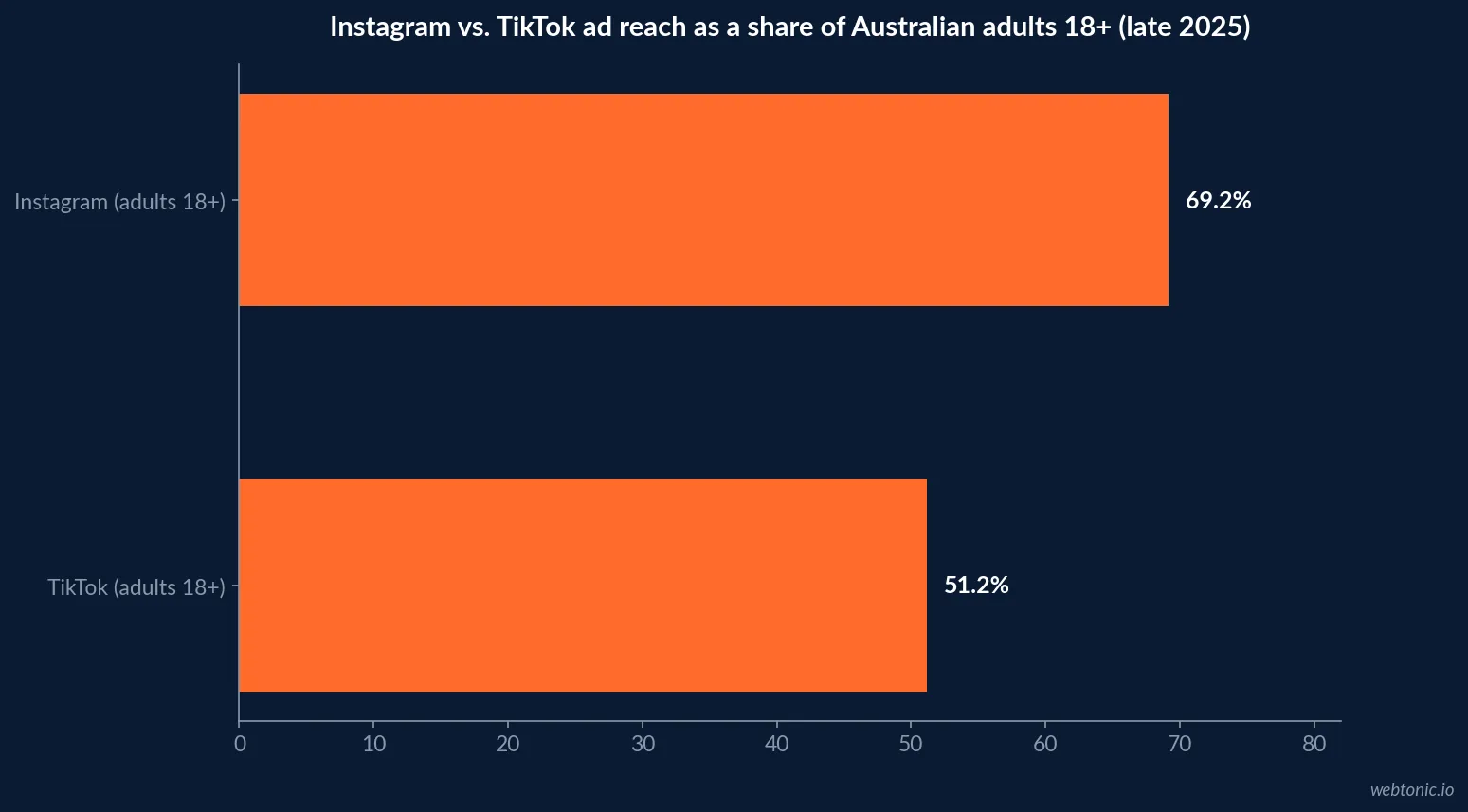
- 69.2% of Australian adults 18+ use Instagram per Meta's own ad tools.
- TikTok's ad tools count 10.9 million adult users, reaching 51.2% of adults 18+.
- LinkedIn counts 18.0 million members, equal to 66.6% of the total population.
- 50.8% of Australia's social identities are female, 49.2% male.
- TikTok's adult ad audience skews male at 53.6%, against 46.4% female.
- 80.0% of Australia's internet users use at least one social platform (Kepios, 2025).
- 87% of Australians 15+ were internet users in the ABS's last dedicated release (2016-17).
- Social networking was cited by 79.9% of internet users as a reason to go online, per the ABS.
- Entertainment (80.0%) and banking (79.5%) were the only online activities the ABS found more common than social networking.
- Social media identities grew just 0.5% year over year in Australia, a near-plateau.
- Facebook's potential ad reach grew 4.4% between October 2024 and October 2025, faster than the market overall.
The reach number to plan against
Start every Australian media plan with the ceiling, not the platform breakdown. DataReportal's Digital 2026: Australia report, built by Kepios from the ad platforms' own reporting tools, counted 21.0 million active social media identities in October 2025 - 77.7% of the total population and 87.0% of adults 18 and older. Growth has nearly stalled: identities rose by only 100,000, or 0.5%, over the prior 12 months, which means most of the reach story in 2026 is about redistribution between platforms, not net new users entering social media for the first time.
| Metric | Figure (late 2025) | Source |
|---|---|---|
| Total active social media identities | 21.0 million | Kepios / DataReportal |
| Share of total population | 77.7% | Kepios / DataReportal |
| Share of population aged 18+ | 87.0% | Kepios / DataReportal |
| Year-over-year growth | +0.5% (+100,000) | Kepios / DataReportal |
| Share of internet users on at least one platform | 80.0% | Kepios / DataReportal |
The platform breakdown to track
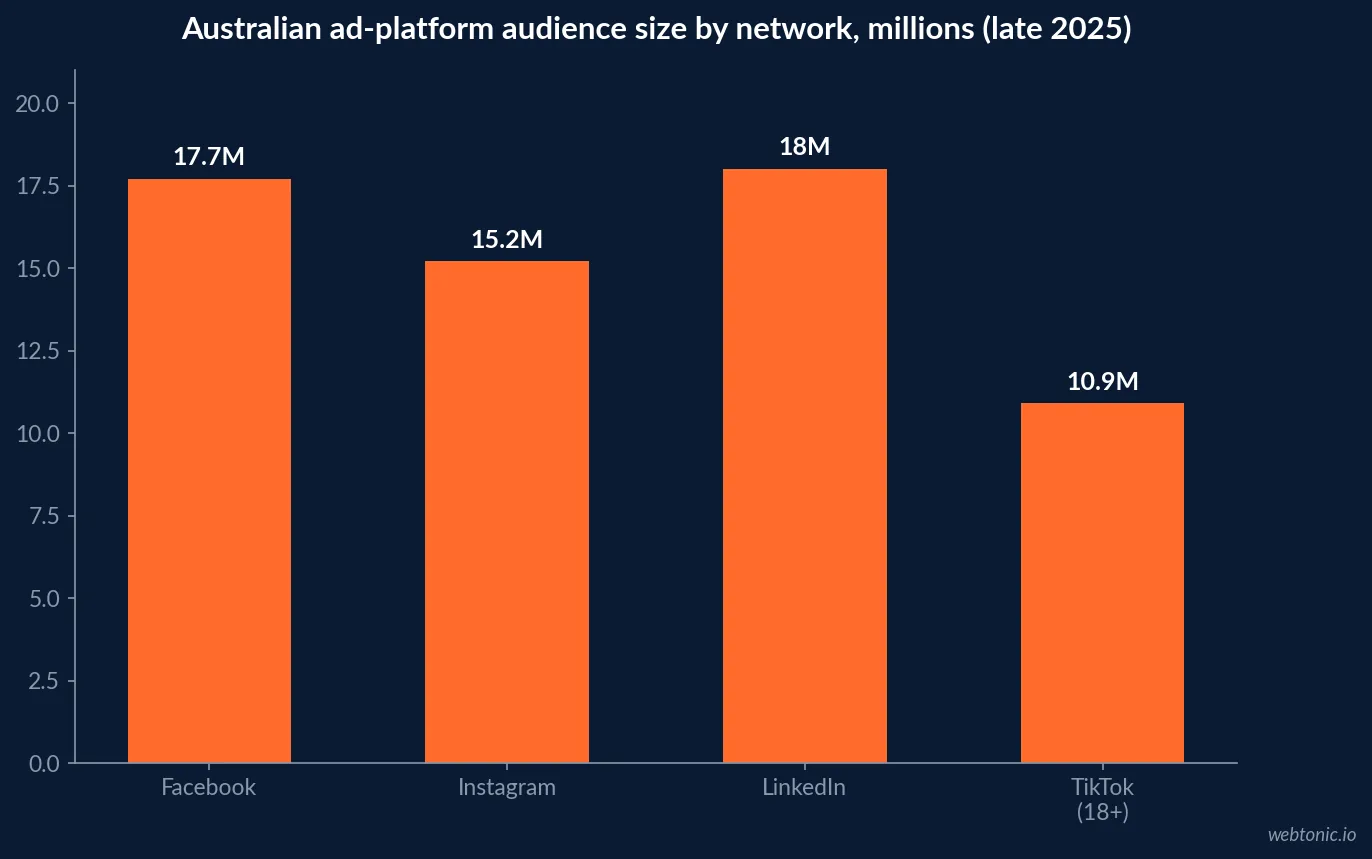
Facebook still commands the largest single-platform audience in Australia at 17.7 million users, per Meta's own advertising tools, and that audience grew a healthy 4.4% (750,000 users) between October 2024 and October 2025 - faster than the overall market. Instagram trails at 15.2 million users, reaching 56.0% of the total population and 69.2% of adults 18-plus. TikTok's ad tools report 10.9 million users aged 18 and above, translating to 51.2% of that age group, and LinkedIn counts 18.0 million members, equal to 66.6% of the population, though that figure includes lapsed accounts since LinkedIn reports total membership rather than active use.
| Platform | Ad-tool audience | Share of relevant population | YoY change | Source |
|---|---|---|---|---|
| 17.7 million users | Not separately published | +4.4% (+750K) | Meta ads via DataReportal | |
| 15.2 million users | 69.2% of adults 18+ | Growing | Meta ads via DataReportal | |
| 18.0 million members | 66.6% of total population | Includes lapsed accounts | LinkedIn ads via DataReportal | |
| TikTok | 10.9 million users (18+) | 51.2% of adults 18+ | Growing | TikTok ads via DataReportal |
The gender split worth checking before you brief creative
Overall, Australia's social media identities split almost evenly by gender - 50.8% female, 49.2% male - but that average hides platform-level reversals. TikTok's adult ad audience in Australia skews male at 53.6%, versus 46.4% female, which runs counter to the platform's typical female skew in several other developed markets and is worth confirming before assuming a TikTok campaign is reaching a female-majority audience by default.
| Platform | Female share of ad audience | Male share of ad audience | Source |
|---|---|---|---|
| All platforms (identities) | 50.8% | 49.2% | Kepios / DataReportal |
| TikTok (adult ad audience) | 46.4% | 53.6% | TikTok ads via DataReportal |
Where the official government data still matters
The Australian Bureau of Statistics has not run a dedicated household social-media-use survey since its 2016-17 Household Use of Information Technology release, but its figures still frame the baseline: 87% of Australians 15 and older were internet users, and among them, social networking was cited by 79.9% as a reason for going online - essentially tied with entertainment (80.0%) and banking (79.5%) as the three dominant internet activities. That data is nearly a decade old and should not be quoted as current usage, but it remains the last officially collected read on why Australians go online in the first place, which the ad-platform data cannot answer.
| Online activity | Share of internet users, 2014-15 | Share of internet users, 2016-17 | Source |
|---|---|---|---|
| Entertainment | 59.8% | 80.0% | ABS Household Use of IT |
| Social networking | 72.0% | 79.9% | ABS Household Use of IT |
| Banking | 72.5% | 79.5% | ABS Household Use of IT |
| Purchasing goods/services | 61.1% | 72.6% | ABS Household Use of IT |
| Health services/research | 21.8% | 46.1% | ABS Household Use of IT |
What the under-16 social media restriction changed
Australia's Social Media Minimum Age obligation came into force in December 2025, and the reach numbers above already reflect a market adjusting to it. Before the restriction, Roy Morgan's research found 624,000 Australian children aged 14 and 15 used at least one social platform in an average four weeks, with 99.96% of that age group using at least one platform and YouTube (95%), Snapchat (87%), Facebook (81%) and Instagram (78%) the most widely reached. That data, gathered in the year before the restriction took effect, is the baseline every post-restriction audience number in 2026 should be read against, since a portion of the under-16 accounts counted in ad-platform totals earlier in this page are no longer legally permitted to exist.
Practically, that means any Australian audience estimate pulled straight from an ad platform's own tools in 2026 needs a manual adjustment if the campaign has historically skewed toward under-16 users - gaming, youth fashion and school-adjacent categories most of all. The safest approach is to compare this year's platform-reported reach against the same platform's own 2025 numbers and treat any unexplained drop as a compliance effect first, before assuming organic decline. For a broader read on how these reach shifts affect paid campaign planning outside Australia, see our digital marketing statistics roundup.
| Platform | Reach among 14-15-year-olds (pre-restriction) | Source |
|---|---|---|
| YouTube | 95% | Roy Morgan, Dec 2025 |
| Snapchat | 87% | Roy Morgan, Dec 2025 |
| 81% | Roy Morgan, Dec 2025 | |
| 78% | Roy Morgan, Dec 2025 | |
| 70% | Roy Morgan, Dec 2025 | |
| TikTok | 59% | Roy Morgan, Dec 2025 |
What Australian businesses do with that reach
Reach only matters commercially if businesses convert it into spend. The Yellow Pages Social Media Report, Australia's longest-running survey of small business social media habits, found 37% of Australian small and medium businesses have paid to advertise on social media, with Facebook and Instagram cited as the platforms offering the most mature targeting and analytics tooling for that spend. That figure gives a marketer a rough ceiling on category benchmarking: if your paid social program sits well under that 37% adoption baseline for your sector, you are behind a meaningful share of Australian small business competitors, not just the large advertisers.
Where Australian usage turns into a purchase
Sprout Social's Q3 2026 Pulse Survey, which sampled social media users across the US, UK and Australia, found social media ties physical retail as the top channel for gift discovery, both cited by 46% of respondents - ahead of friend and family recommendations (34%) and TV (31%). On direct in-app purchasing, 38% of respondents have already bought something inside a social app and would do it again, and a further 19% say they would try it for the first time this year. For a Australian marketer, that means reach numbers alone understate the platforms' commercial role - a meaningful share of the audience already treats the feed as a storefront, not just a discovery channel.
| Purchase-influence metric (multi-market, incl. Australia, 2026) | Figure | Source |
|---|---|---|
| Social media as top gift-discovery channel | 46% | Sprout Social Q3 2026 Pulse |
| Have bought directly inside a social app before | 38% | Sprout Social Q3 2026 Pulse |
| Would try in-app social buying for the first time | 19% | Sprout Social Q3 2026 Pulse |
The checklist for a 2026 Australian media brief
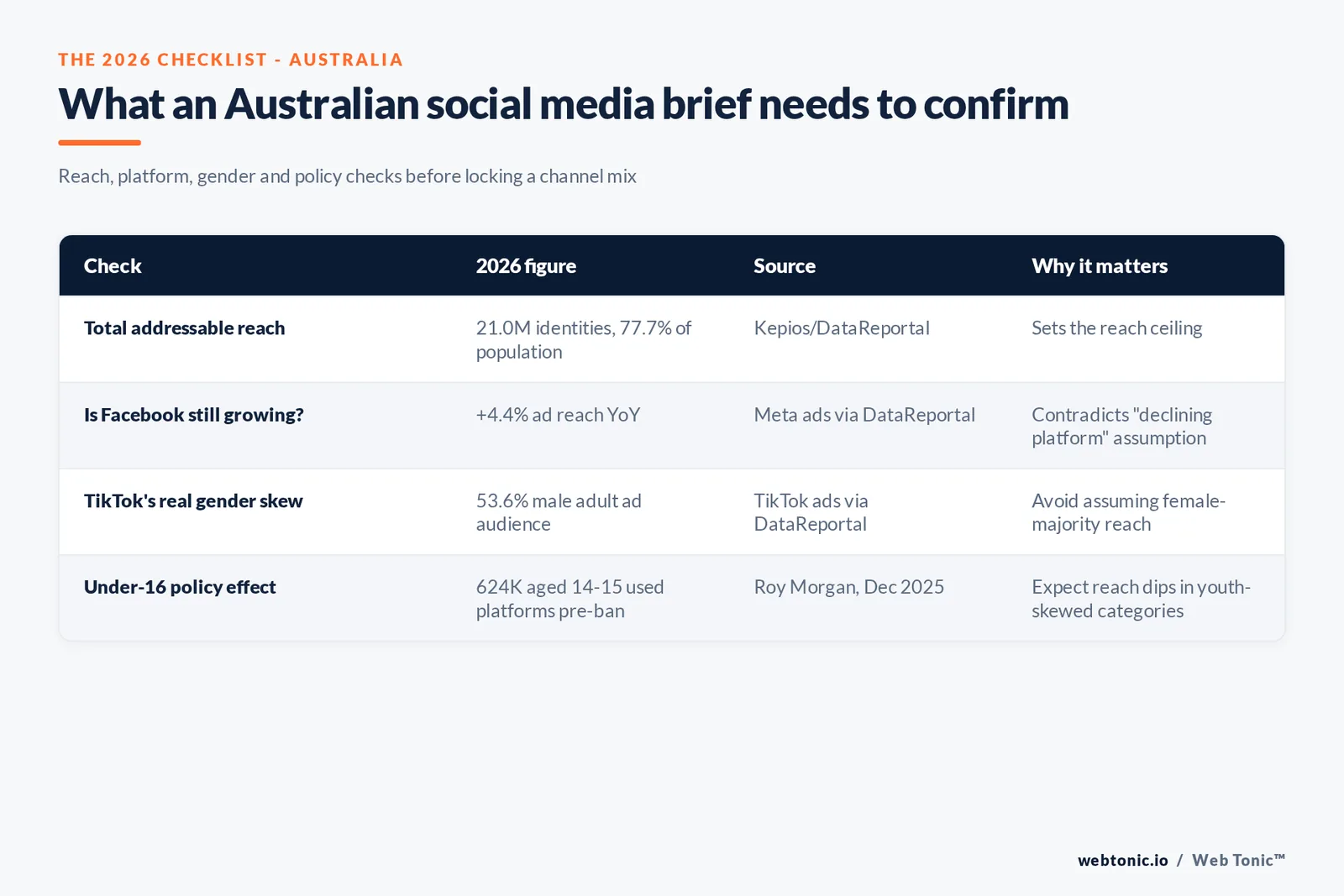
Before locking a channel mix: confirm the total addressable audience against the 21.0-million ceiling, check Facebook's continued growth against the assumption that it is a declining platform, verify TikTok's actual gender skew rather than assuming a female-majority audience, and treat the ABS's social-networking-as-online-activity figure as context rather than a current benchmark. Our performance creative practice builds Australian media plans against the live ad-platform numbers above rather than historical survey data, and our note on whether Facebook ads are still worth it is a useful next read before reallocating budget away from the platform.
Frequently Asked Questions
How many Australians use social media?
Kepios's analysis of the platforms' own advertising tools, published via DataReportal, counted 21.0 million active social media identities in Australia in October 2025, equal to 77.7% of the total population and 87.0% of the population aged 18 and above.
Which platform should an Australian marketer prioritize for reach?
By ad-tool audience size, Facebook leads with 17.7 million users, followed by Instagram at 15.2 million (56.0% of the total population) and TikTok at 10.9 million adults aged 18-plus, reaching 51.2% of that age group. LinkedIn counts 18.0 million members, though that figure includes inactive registrations.
Is TikTok's reach in Australia comparable to Facebook's yet?
Not on raw audience size - TikTok's 10.9 million adult users trail Facebook's 17.7 million total users. But TikTok's ad reach as a share of the eligible age group, 51.2% of adults 18+, is close enough to Instagram's 69.2% and Facebook's implied reach that campaign planners should not treat TikTok as a niche platform anymore.
What official Australian data exists on internet and social use?
The Australian Bureau of Statistics' last dedicated household technology-use release found 87% of people 15 and over were internet users, with social networking cited by 79.9% of internet users as a reason for going online, alongside entertainment (80.0%) and banking (79.5%). That release is dated 2016-17; more current platform-level figures now come from the ad platforms themselves via Kepios/DataReportal.
What is the gender split on Australian social platforms?
It varies by platform. Kepios's data shows Australia's overall social media identities are 50.8% female and 49.2% male, but TikTok skews male at 53.6% of its adult ad audience versus 46.4% female, a reversal of the platform's typical female skew in other markets.
Sources
DataReportal (Kepios analysis) - Digital 2026: Australia
Australian Bureau of Statistics - Household Use of Information Technology
Roy Morgan - Social media reach among 14-15-year-old Australians, December 2025
Yellow Pages - Social Media Report, business platform adoption
Sprout Social - Q3 2026 Pulse Survey Analysis