Table of contents
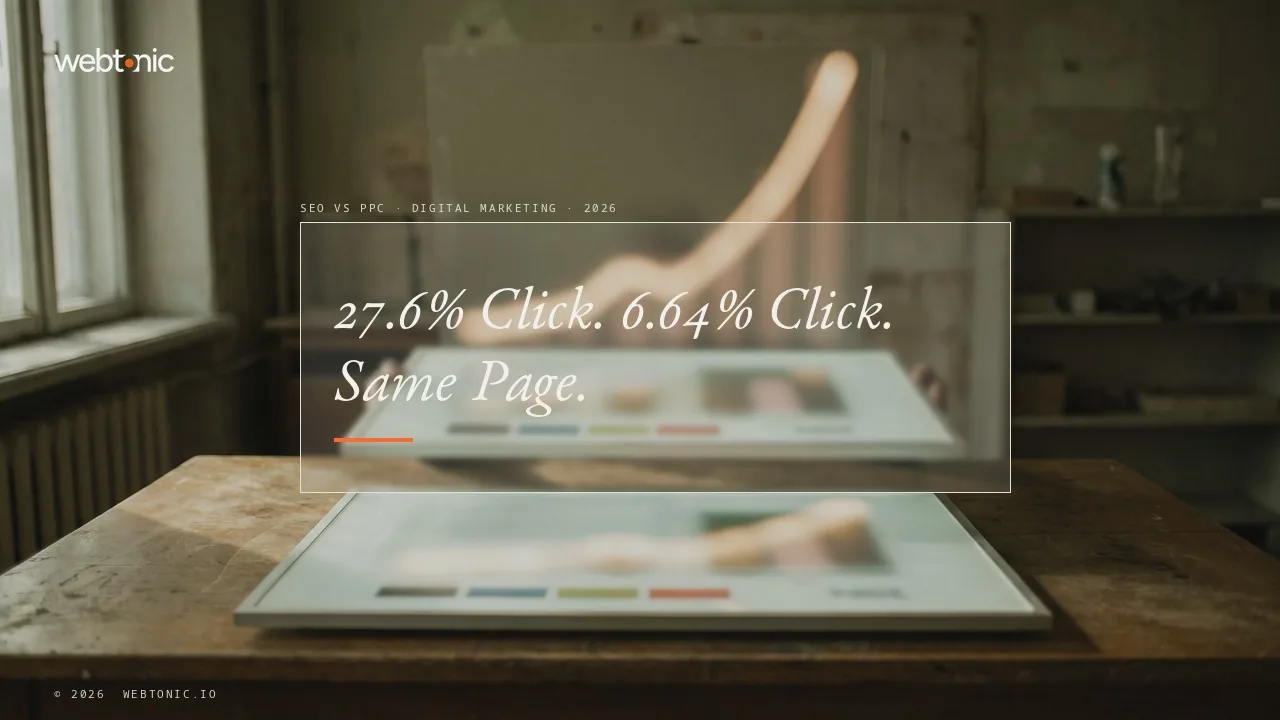
SEO wins on click-through rate at the top of the page; PPC wins on speed and control. This page puts Backlinko's organic click-through data next to WordStream's 2026 Google Ads benchmarks so the SEO-vs-PPC budget argument runs on the actual numbers instead of channel loyalty.
Key Takeaways
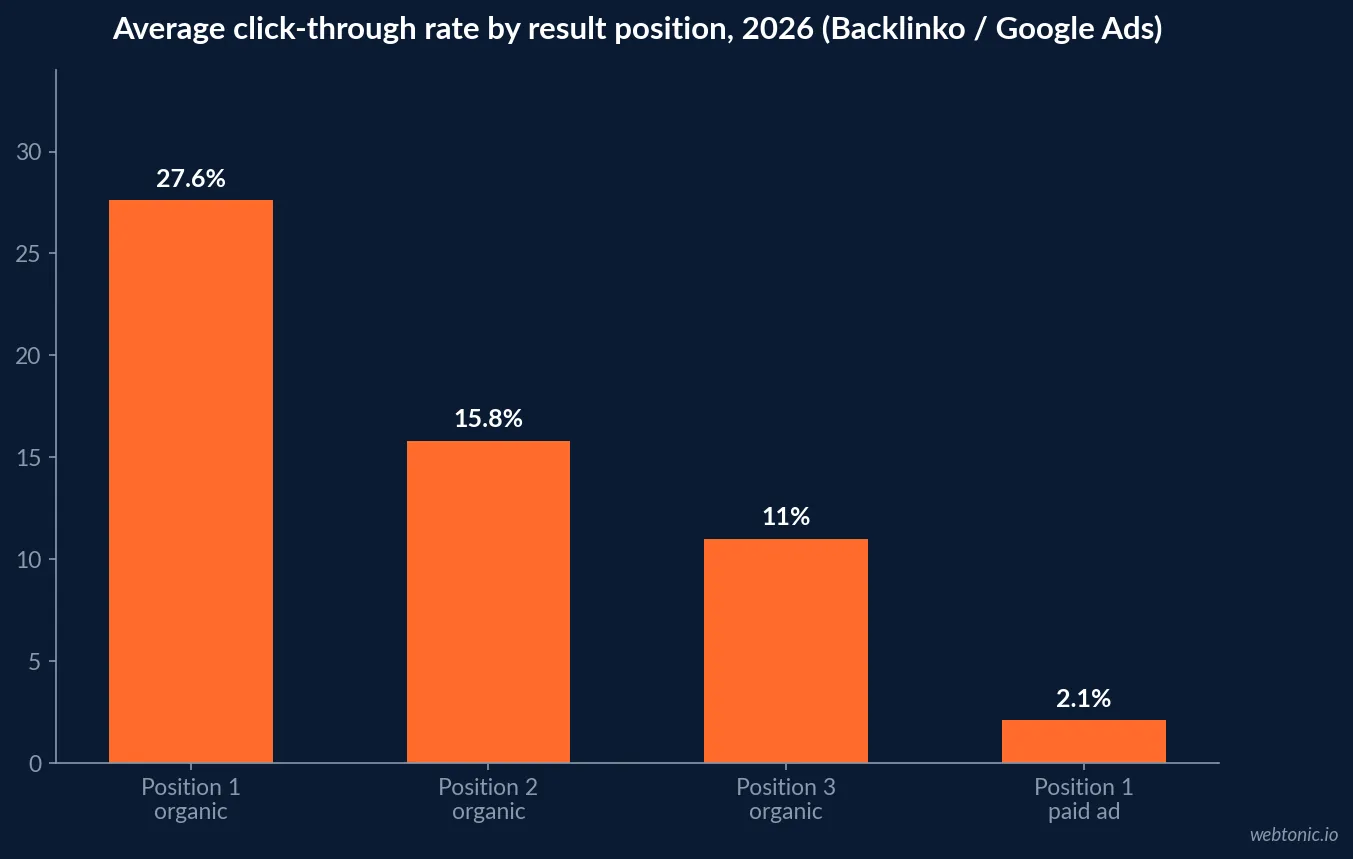
- Position 1 organic results average a 27.6% click-through rate (Backlinko, 4M results).
- Position 2 falls to about 15.8%, position 3 to 11.0%.
- The blended average Google Ads click-through rate is 6.64% across all positions.
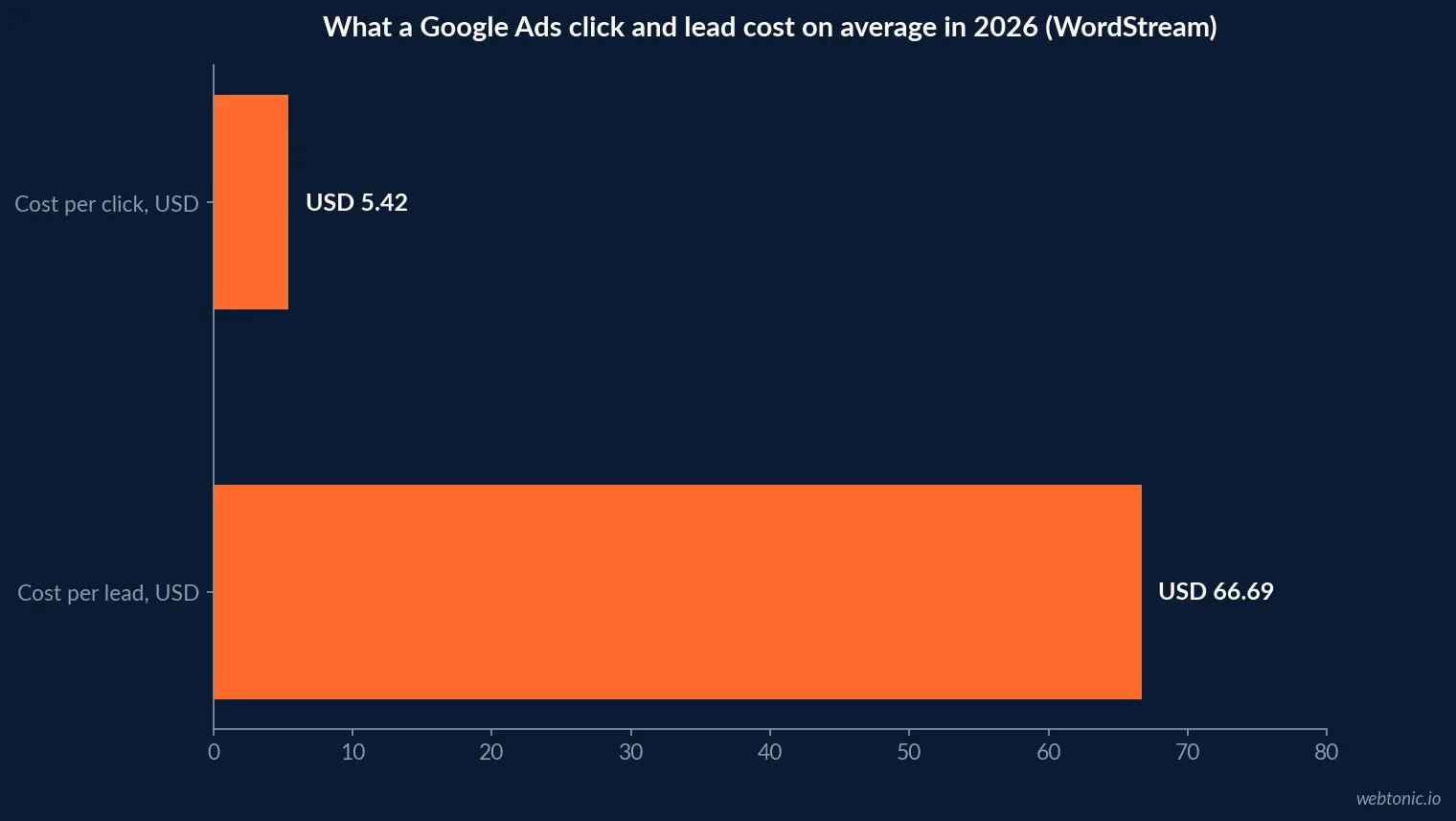
- The average Google Ads cost per click is USD 5.42 in 2026 (WordStream).
- The average Google Ads cost per lead is USD 66.69, the same benchmark set.
- Average conversion rate across Google Ads campaigns runs 8.18%.
- Cost per lead fell year over year for the first time since 2020.
- 87% of industries saw conversion-rate improvement driving that CPL decline.
- Legal & Services keyword clicks average USD 9.87, the most expensive vertical.
- Arts & Entertainment averages USD 1.63 per click, the least expensive.
- The top organic result is roughly 10 times more likely to get a click than lower ranks.
- WordStream's benchmark is drawn from over 13,000 US campaigns.
- 62% of CMOs planned to raise martech and search investment together in 2026.
- SEO usage sits at 16% of B2B tactic mix, SEM at 20% (Sagefrog 2026).
- The gap between position 1 and position 10 organic CTR is roughly 26 points.
Start with the click-through gap, not the ranking myth
Backlinko's analysis of 4 million Google search results remains the most widely cited organic CTR study in SEO, and its headline number has held up: the average click-through rate for the #1 organic position is 27.6%. That figure drops fast with rank - 15.8% at position 2, 11.0% at position 3 - which means the gap between ranking first and ranking third is not incremental, it is most of the traffic.
Paid search cannot match that top-line number on a blended basis. WordStream's 2026 Google Ads Benchmarks, built from campaigns running April 2025 through March 2026, put the average click-through rate across all ad positions and industries at 6.64%.
| Result position (organic, 2026) | Average click-through rate | Source |
|---|---|---|
| #1 | 27.6% | Backlinko, 4M search results |
| #2 | 15.8% | Backlinko, 4M search results |
| #3 | 11.0% | Backlinko, 4M search results |
| #4 | 7.2% | Backlinko, 4M search results |
| #5 | 5.1% | Backlinko, 4M search results |
| Blended paid ad average (all positions) | 6.64% | WordStream 2026 Google Ads Benchmarks |
What PPC costs once you click 'run'
WordStream's benchmark set - over 13,000 US-based campaigns - puts the average Google Ads cost per click at USD 5.42 and average cost per lead at USD 66.69. The CPL figure is notable for a specific reason: it is the first year-over-year decline since 2020, driven by conversion-rate improvement across 87% of industries - the average conversion rate across the dataset now sits at 8.18%. SEO carries no equivalent per-click invoice once a page ranks, but it also carries no guaranteed timeline to get there.
| PPC benchmark (2026, WordStream) | Figure |
|---|---|
| Average cost per click (CPC) | USD 5.42 |
| Average cost per lead (CPL) | USD 66.69 |
| Average conversion rate (CVR) | 8.18% |
| Average click-through rate (CTR) | 6.64% |
| Industries with CPL improvement | 87% |
| Most expensive vertical by CPC | Legal & Services, USD 9.87 |
| Least expensive vertical by CPC | Arts & Entertainment, USD 1.63 |
A caution on the CTR numbers: which CTR are you comparing?
Backlinko's 27.6% figure is a position-1 CTR, measured only on the keyword where a page ranks first. Ahrefs' 2026 benchmark, pulled from anonymized Google Search Console data across 422,421 real websites, measures something different: whole-site CTR, total clicks divided by total impressions across every keyword a site ranks for, including page 3 and beyond. That number lands in the low single digits for a typical site - nowhere near 27.6% - because most impressions never come from position 1. The two figures are not contradictory; they answer different questions, and quoting one against the other is the single most common CTR mistake in channel comparisons.
Google's own guidance on how click-through rate is calculated in Ads defines the paid-side metric the same way WordStream aggregates it - clicks divided by impressions per ad - so the two datasets are at least measuring PPC consistently even where the organic figures diverge by methodology.
Where each channel actually shows up in the tactic mix
Sagefrog's 2026 B2B Marketing Mix Report puts search engine marketing (the PPC leg) usage at 20% of B2B marketers and SEO usage at 16%, both ahead of most other individual tactics in that survey. Neither channel is niche; the practical question most teams face is sequencing and split, not whether to run one at all.
| Channel (2026, Sagefrog B2B Marketing Mix) | Share of B2B marketers using it |
|---|---|
| Search engine marketing (SEM/PPC) | 20% |
| Search engine optimization (SEO) | 16% |
| Paid social media campaigns | 16% |
| Marketing technology | 15% |
How the CTR gap changes by industry, not just position
WordStream's benchmark data also breaks cost per click out by industry, and the spread is wide enough to change the SEO-vs-PPC math on its own: Legal & Services keywords average USD 9.87 per click, more than six times Arts & Entertainment's USD 1.63. A business in a high-CPC vertical has a much stronger financial case for investing in SEO's compounding, no-per-click return, while a business in a low-CPC vertical can often run PPC profitably at volume without the multi-month wait for rankings.
| Vertical (2026, WordStream Google Ads benchmarks) | Average cost per click |
|---|---|
| Legal & Services | USD 9.87 |
| Employment Services | USD 7.94 |
| Home & Home Improvement | USD 6.55 |
| Health & Medical | USD 4.42 |
| Arts & Entertainment | USD 1.63 |
The variable neither benchmark captures: time to result
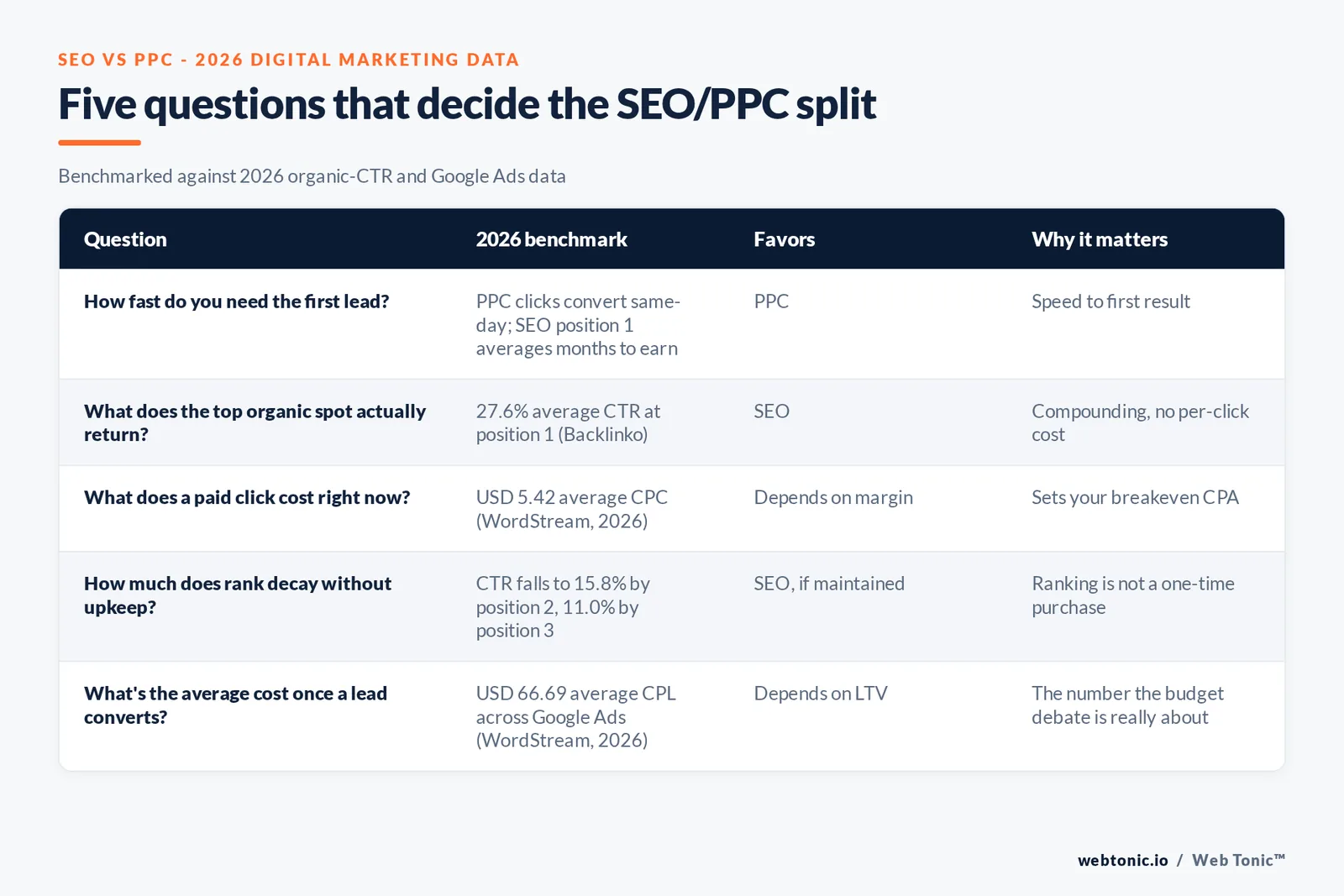
Every number above describes performance once a channel is live. PPC is live the day a campaign launches and generates clicks against the CPC and CPL figures immediately. SEO has no equivalent switch - reaching position 1 depends on competition for the target keyword and can run months, during which none of Backlinko's CTR figures apply yet. That asymmetry, not the CTR or cost numbers alone, is usually what actually decides which channel gets next quarter's first dollar.
Our performance creative practice treats this as a sequencing decision rather than a permanent either/or, running PPC to fill the gap while an SEO program builds toward the position-1 curve above.
| Decision factor | Favors SEO | Favors PPC |
|---|---|---|
| Time to first result | No - months to rank | Yes - live same day |
| Cost once ranked/running | Yes - no per-click fee | No - USD 5.42 average CPC recurs |
| Click-through rate at the top spot | Yes - 27.6% at position 1 | No - 6.64% blended average |
| Control over exact placement | No - algorithm-dependent | Yes - bid-controlled |
| Resilience if budget pauses | Yes - rankings persist | No - traffic stops with spend |
The traffic-mix picture behind the click-through numbers
Semrush's 2026 traffic-channel study, built from an analysis of billions of web visits, found organic search still delivering 16.04% of total tracked traffic and growing modestly (+2.38%) even as AI-referred traffic expanded far faster off a much smaller base. Other industry traffic-mix studies, including BrightEdge's channel performance research covered in our own SEO statistics roundup, put organic search's share of all website traffic closer to 53% when direct and branded traffic are excluded from the paid/organic comparison - the gap between studies comes down to whether direct and referral traffic are counted in the denominator. Either way, organic remains the largest single traffic source most sites have, which is the traffic-side complement to the CTR advantage above.
| Traffic-mix study (2026) | Organic search share reported | Paid search share reported | Methodology note |
|---|---|---|---|
| Semrush traffic-channel mix study | 16.04% of all tracked traffic | Not isolated separately | Includes direct, social, AI, referral in denominator |
| BrightEdge channel performance research (via industry roundups) | ~53% of website traffic | ~15% | Excludes direct/branded traffic from comparison |
HubSpot's 2026 State of Marketing survey of over 1,500 marketers puts website/blog/SEO at the top of both the usage list (48.4% of B2B marketers) and the self-reported ROI list (30.2% naming it a top-three ROI driver), with email marketing second on both. Forrester's B2B measurement research adds a caution worth pairing with that figure: many teams still lack a consistent framework for attributing revenue to organic versus paid search, which means self-reported ROI rankings like HubSpot's should be read as directional confidence, not audited attribution.
A practical split for 2026 budgets
The data supports running both, weighted by urgency: fund PPC for the pipeline gap that cannot wait, using the USD 66.69 average CPL as your planning number, and fund SEO in parallel for the keywords worth the multi-month climb, using the 27.6% top-position CTR as the payoff to model against. Cutting either one entirely trades away either speed or compounding return, and few 2026 budgets can afford to give up both.
If you want your own channel split modelled against these benchmarks, talk to us.
Frequently Asked Questions
Which gets more clicks in 2026, the top organic result or the top ad?
The top organic result, by a wide margin. Backlinko's analysis of 4 million Google search results puts the average click-through rate for the #1 organic position at 27.6%. Paid ad positions do not come close on a like-for-like basis - WordStream's 2026 Google Ads benchmark data puts the average click-through rate across roughly 13,000 US campaigns at 6.64%, blended across every position and industry, not just the top slot.
What does a PPC click and lead actually cost in 2026?
WordStream's 2026 benchmarks, drawn from campaigns running April 2025 through March 2026, put the average cost per click at USD 5.42 and the average cost per lead at USD 66.69. Both numbers vary heavily by industry - legal and other high-value verticals run several times higher - but they are the honest floor for budgeting a paid-search program.
Does SEO ranking decay if you stop maintaining it?
Position matters more than almost anything else in organic search, and it moves. Backlinko's data shows click-through rate falling from 27.6% at position 1 to 15.8% at position 2 and 11.0% at position 3 - a steep drop for even one spot lost. Rankings are not a one-time purchase; losing position to a competitor's update erases most of the click advantage within that same curve.
Is PPC just faster, or actually more expensive per result?
Both, depending on the metric. PPC delivers clicks the same day a campaign launches, which SEO cannot match - Google's own indexing and ranking timelines run to months. But per click and per lead, PPC carries an explicit, recurring cost (USD 5.42 and USD 66.69 on average) that organic traffic, once ranked, does not. The trade is speed for a running invoice against patience for a compounding asset.
So which one should get next quarter's budget?
It depends on how urgent the pipeline gap is and how competitive the target keywords already are. A team with no runway for a multi-month ranking climb should fund PPC first and treat SEO as the next quarter's build. A team with 6+ months of runway and keywords it can realistically rank for should weight SEO higher, because Backlinko's 27.6% top-position CTR compounds without a per-click invoice once it is earned.
Sources
Backlinko - Organic CTR study, 4 million Google search results
WordStream - 2026 Google Ads Benchmarks
WordStream - Digital Benchmarks by Industry: PPC
Sagefrog Marketing Group - 2026 B2B Marketing Mix Report
Ahrefs - What is a Good Organic CTR? Real Website Benchmarks (2026)
Google Ads Help - How click-through rate (CTR) is calculated
Semrush - Traffic channel mix study: how AI is reshaping traffic channels (2026)
HubSpot - The top marketing channels of 2026, according to marketers
Forrester - Measurement and Analytics Proficiency Assessment for B2B