Table of contents

Thirty-three million Canadians are counted as active social media identities, about 82.1% of the population, according to Kepios's analysis of the platforms' own advertising tools. Yet the same population is ambivalent about the product: 74% of Canadians surveyed by Angus Reid say social media companies have a net negative effect on society. This page lines up reach, self-reported use and a global engagement-rate benchmark against each other.
Key Takeaways
- 33.0 million Canadians are counted as active social media identities (82.1% of the population).
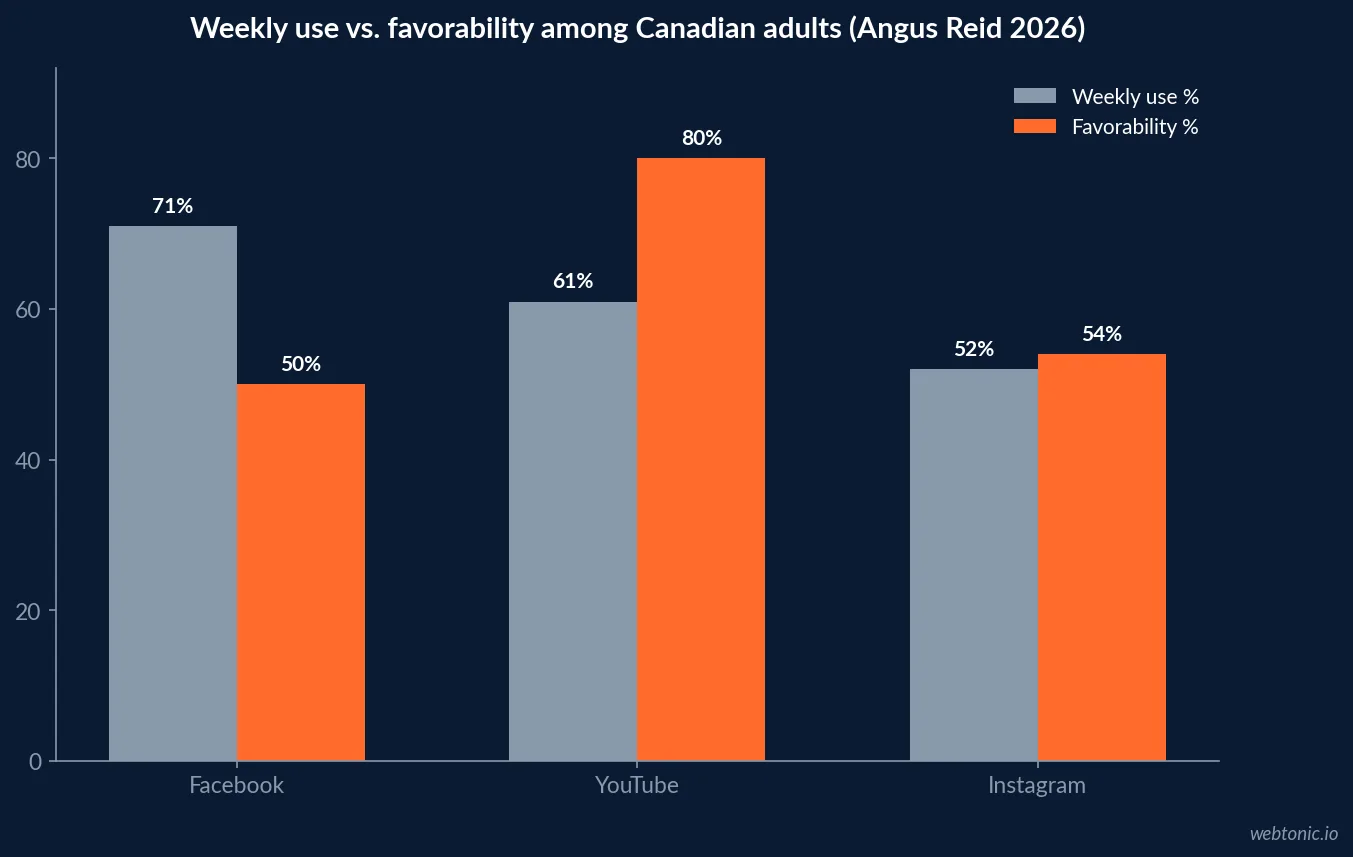
- Facebook remains the top platform for weekly use at 71%, per Angus Reid's 2026 survey.
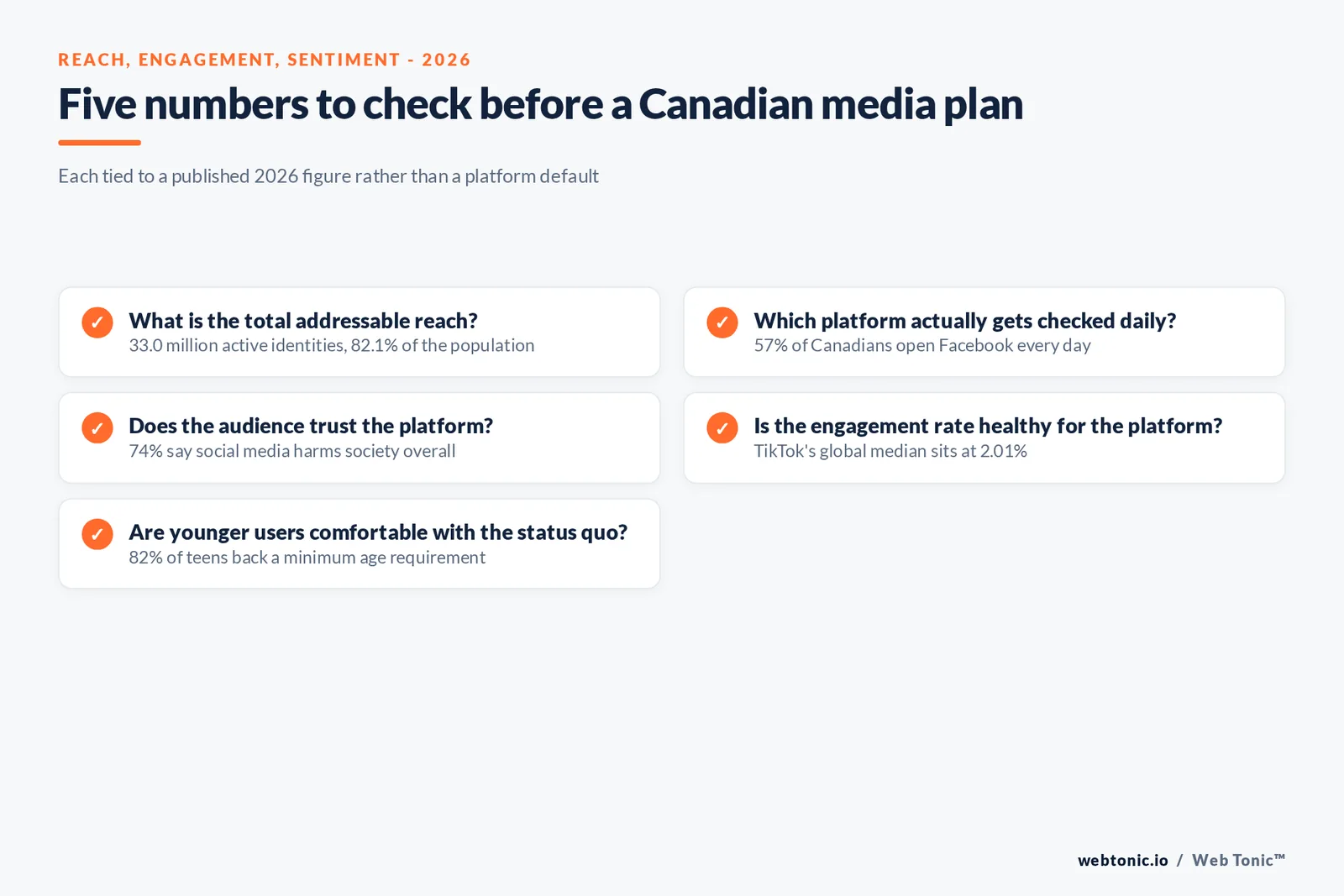
- 57% of Canadians use Facebook daily, with another 14% using it multiple times a week.
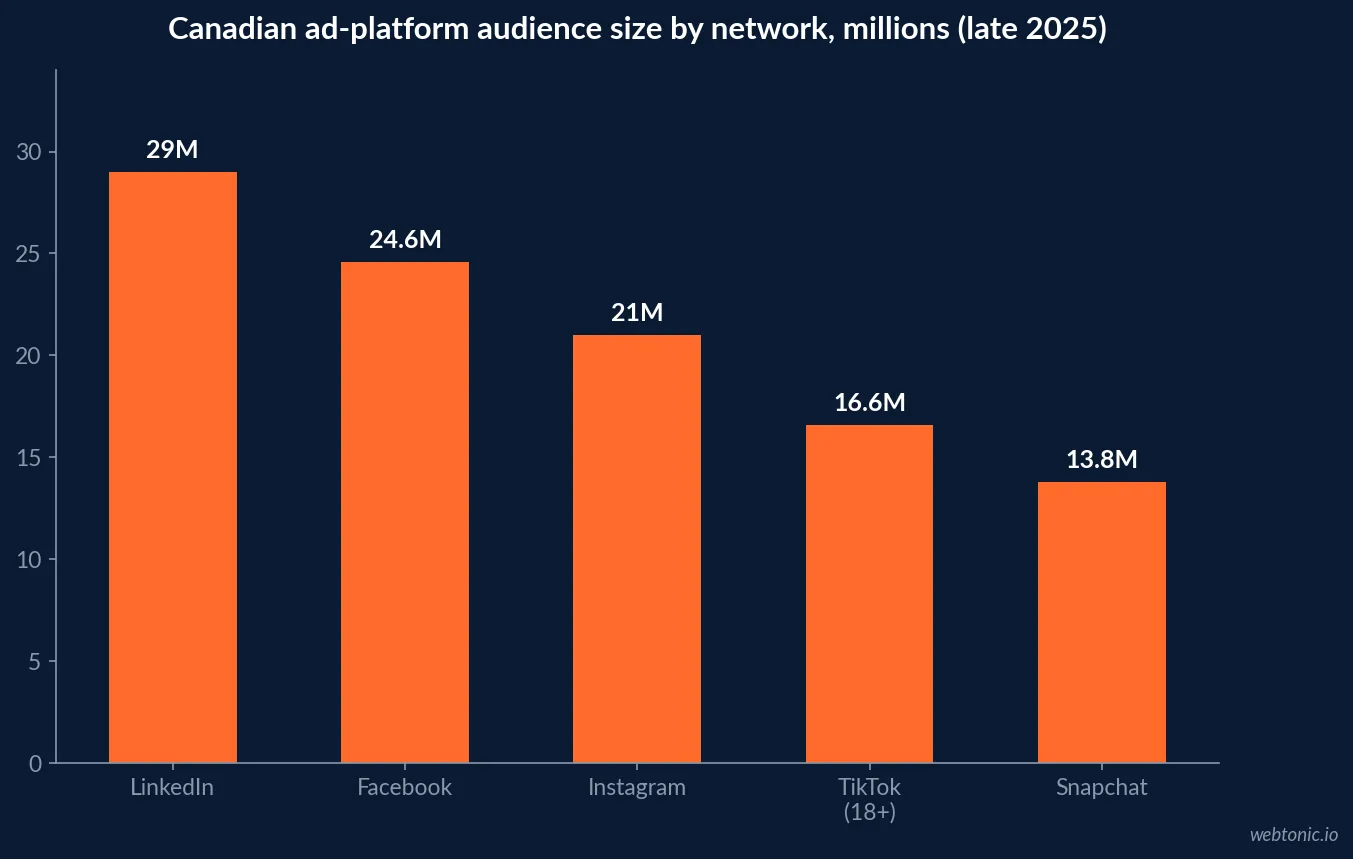
- Facebook's ad-tool audience is 24.6 million users, up 3.8% year over year.
- Instagram reaches 21.0 million users in Meta's ad tools, or 62.5% of adults 18+.
- TikTok's ad tools report 16.6 million adult users, reaching 50.6% of adults 18+.
- LinkedIn counts 29.0 million members in Canada, 72.1% of the population.
- Snapchat's ad reach covers 13.8 million users, 34.2% of the population.
- 74% of Canadians say social media harms society overall (Angus Reid, 2026).
- 28% of both Facebook and X users say they dislike using the platform they still use weekly.
- Staying connected with family and friends is the top cited benefit, at 72%.
- Misinformation is the top concern, cited by 70% of Canadians.
- YouTube draws the most positive sentiment at 80% favorable, versus 50% for Facebook.
- TikTok's global median engagement rate is 2.01%, the highest of any platform benchmarked (Rival IQ/Quid, 2026).
- Instagram's global median engagement rate fell to roughly 0.30%, down about 17% year over year.
- 22% of Canadians fall into the "Heavy and Happy" user segment, using four-plus platforms with net-positive views of all of them.
Reach: how big is the addressable audience per platform
DataReportal's analysis, built by Kepios from the platforms' own advertising dashboards, is the most current source for raw reach in Canada. It puts the total addressable social media audience at 33.0 million identities, up modestly from the year before, with Facebook, Instagram and LinkedIn each commanding double-digit-million audiences.
| Platform | Ad-tool audience (late 2025) | Share of population reached | YoY change | Source |
|---|---|---|---|---|
| 29.0 million members | 72.1% | Not separately published | LinkedIn ads via DataReportal | |
| 24.6 million users | Not separately published | +3.8% (ad reach) | Meta ads via DataReportal | |
| 21.0 million users | 62.5% of adults 18+ | Growing | Meta ads via DataReportal | |
| TikTok | 16.6 million users (18+) | 50.6% of adults 18+ | Growing | TikTok ads via DataReportal |
| Snapchat | 13.8 million users | 34.2% | Stable | Snap ads via DataReportal |
Engagement: how often Canadians actually check each platform
Reach numbers count reachable accounts; they say nothing about habit. Angus Reid Institute's April 2026 survey of 1,812 Canadian adults measured actual frequency: 57% use Facebook daily and another 14% use it multiple times a week, for a combined 71% weekly reach - still the top platform on that measure, ahead of YouTube (61%) and Instagram (52%).
| Platform | Weekly+ use (self-reported) | Favorability | Source |
|---|---|---|---|
| 71% | 50% positive | Angus Reid 2026 | |
| YouTube | 61% | 80% positive (highest) | Angus Reid 2026 |
| 52% | 54% positive | Angus Reid 2026 | |
| X (Twitter) | Lower | 24% positive / 54% negative | Angus Reid 2026 |
The sentiment gap: high use, low trust
The most striking pattern in Angus Reid's data is the split between habit and opinion. 74% of Canadians say social media companies have a net negative effect on society, and roughly three-in-10 users of both Facebook (28%) and X (28%) say they actively dislike using the platform - yet keep using it. The top cited benefit is staying connected with family and friends (72%), followed by entertainment (52%) and access to news (44%). The top concern is misinformation, at 70%, ahead of excessive screen time and addiction (43%) and mental health impact (36%).
Angus Reid's index splits Canadians into four groups: 22% are "Heavy and Happy" users of four-plus platforms with net-positive views across the board, while 19% are "Detached and Disapproving," using one or zero platforms weekly and critical of the technology overall. The largest group sits in the middle - active but ambivalent.
| Sentiment metric | Figure | Source |
|---|---|---|
| Believe social media harms society | 74% | Angus Reid 2026 |
| Top benefit: staying connected | 72% | Angus Reid 2026 |
| Top concern: misinformation | 70% | Angus Reid 2026 |
| Dislike using Facebook (but still do) | 28% | Angus Reid 2026 |
| Dislike using X (but still do) | 28% | Angus Reid 2026 |
| "Heavy and Happy" user segment | 22% of Canadians | Angus Reid 2026 |
CTR and engagement rate: no Canada-only study exists, so benchmark globally
Neither Statistics Canada, the CRTC nor Angus Reid publish a click-through-rate or per-post engagement-rate benchmark specific to Canada; that data lives inside each platform's ad manager and is not broken out by country in public reporting. The closest available proxy is the global 2026 Social Media Industry Benchmark Report from Rival IQ (now part of Quid), built from millions of brand posts across 18 industries. TikTok's median engagement rate held at 2.01%, well ahead of every other platform, while Instagram's median fell to roughly 0.30%, a drop of about 17% year over year, and Facebook stayed essentially flat.
Canadian brands should treat these as directional ceilings, not local truth: pull your own account-level CTR and engagement data from Ads Manager and compare the trend line, not the absolute number, against this global benchmark. A Canadian account posting a TikTok engagement rate meaningfully below 2.01%, or an Instagram rate meaningfully below roughly 0.30%, is underperforming its own platform's global norm regardless of how healthy the raw reach numbers above look, which is the more actionable read than comparing against a competitor's screenshot.
| Platform | Global median engagement rate (2026) | YoY trend | Source |
|---|---|---|---|
| TikTok | 2.01% | Leading, stable | Rival IQ / Quid 2026 |
| ~0.30% | Down ~17% | Rival IQ / Quid 2026 | |
| Flat vs. prior year | Stable, low | Rival IQ / Quid 2026 | |
| X | 0.03% | Up from 0.015% (first rebound in years) | Rival IQ / Quid 2026 |
Younger Canadians want more guardrails than marketers might assume
A useful counterpoint to the reach numbers above: the people inside them are not uniformly in favor of unrestricted access. Ipsos polling conducted on behalf of Raise the Age Canada found 82% of Canadian teens aged 16-19 support a minimum age requirement to open a social media account, and 84% agree platforms should do more to enforce those age requirements. The same teens are split on framing: 70% say the term "social media ban" sounds punitive, while only 61% agree it accurately describes a minimum-age policy. For brands targeting younger Canadian audiences, that ambivalence is worth building into brand-safety and platform-selection decisions, not just campaign targeting.
The practical takeaway for a Canadian brand: audience sentiment data and reach data answer different briefs. Reach data tells media planners where the impressions are; sentiment data tells brand and content teams which platforms carry reputational risk if a campaign leans too heavily on paid distribution without a credible organic presence. A platform with strong reach but weak sentiment, like X in this data set, is a reasonable paid channel for a narrow, time-bound campaign but a riskier one to build a long-term brand voice around. See our Meta ads services for how we adjust targeting and creative when a platform's youngest cohort is shrinking as a share of its total audience.
| Teen sentiment (ages 16-19) | Share agreeing | Source |
|---|---|---|
| Support a minimum age requirement for social accounts | 82% | Ipsos, July 2026 |
| Platforms should enforce age requirements more | 84% | Ipsos, July 2026 |
| "Social media ban" sounds like a punishment | 70% | Ipsos, July 2026 |
| Joined social media mainly because friends were on it | 82% | Ipsos, July 2026 |
What this means for a Canadian media plan
Reach still favors Facebook and LinkedIn on raw numbers, but engagement per post favors TikTok by a wide margin globally, and Canadian consumption patterns track closely with U.S. and broader Anglophone trends on platform preference by age. A plan built purely on reach will overweight Facebook; a plan built purely on engagement rate will overweight TikTok. Most Canadian brands need both metrics read together, plus their own first-party CTR data, before reallocating budget. The audience sentiment data adds a third filter: a platform with strong reach and rising engagement but weak favorability, as X shows here, is a reasonable channel for a short paid push but a riskier one to anchor a long-term brand presence on, since the same users who click are also the ones most likely to say they dislike being there. Our performance creative team builds that three-way comparison per account rather than relying on category averages, and you can see our broader read on digital marketing benchmarks for adjacent channels.
Frequently Asked Questions
How many Canadians use social media in 2026?
Kepios's analysis of ad-platform data for DataReportal counted 33.0 million active social media identities in Canada in October 2025, about 82.1% of the population. That figure counts accounts an algorithm considers reachable, not unique verified people, so treat it as a reach ceiling rather than a headcount.
Which platform has the largest reach in Canada?
By ad-tool audience, LinkedIn reports the most: 29.0 million registered members, though that counts total membership rather than monthly active users. By active-audience metrics, Facebook leads at 24.6 million users in Meta's own tools, and by self-reported weekly use, Angus Reid also found Facebook on top at 71%.
Do Canadians actually like using social media?
Not especially. Angus Reid's April 2026 survey of 1,812 Canadian adults found 74% believe social media companies have a net negative effect on society, and about three-in-10 users of both Facebook and X say they dislike the experience of using each platform, even while continuing to use them.
What is a good social media engagement rate to benchmark against in Canada?
No Canada-specific engagement-rate study exists publicly, so use the global benchmark as a directional target: Rival IQ/Quid's 2026 report, based on millions of brand posts, found TikTok's median engagement rate at 2.01%, well ahead of Instagram at roughly 0.30% and Facebook essentially flat year over year.
Is TikTok reach in Canada as large as Facebook's?
Not yet by raw numbers. TikTok's own ad tools report 16.6 million Canadian users aged 18 and up, reaching 50.6% of that age group, versus Facebook's 24.6 million total users. But TikTok's engagement rate per post far outpaces Facebook's, per Rival IQ/Quid's global benchmark, so reach and engagement favor different platforms depending on the campaign goal.
Sources
DataReportal (Kepios analysis) - Digital 2026: Canada
Angus Reid Institute - The State of Social Media in Canada, April 2026
Rival IQ / Quid - 2026 Social Media Industry Benchmark Report
Statistics Canada - Scrolling Through the Social Media Stats
Ipsos - Most Canadian Teens Support Social Media Age Restrictions, July 2026