Table of contents
Most small businesses spend on marketing in almost the opposite order of what actually works. Social media gets the biggest share of attention because it's the easiest to start, while SEO, the channel that consistently delivers the highest return, gets treated as an afterthought. 49% of marketers identify organic search as the top ROI-driving channel, ahead of paid ads, social media, and email. The businesses that flip that order tend to win the long game.
SEO for a small business doesn't need an enterprise budget or a six-person marketing team. It needs the right priorities, in the right order, sustained long enough for the compounding effect to kick in. This guide walks through exactly that.
Key takeaways
- Local SEO delivers $13 back for every $1 invested, the second-highest ROI of any small business marketing channel after email marketing at $42.
- The average small business SEO budget runs $500 to $5,000 a month, with 63% of companies in that exact bracket and an agency average of roughly $3,200-$3,500/month.
- SEO leads close at 14.6%, compared to just 1.7% for outbound marketing like cold calling.
- Most campaigns break even around month 6-8, with ROI climbing to 150-200% by months 7-12 and 275-500% by year two.
- 61% of small businesses still haven't invested in local SEO at all, despite it being one of the most favorable ROI channels available.
- 72% of small business marketing budgets go to digital channels, but most of that spend still skews toward social media and ads rather than the organic search work that converts best.
Why SEO is the highest-leverage channel for a small business
Paid ads stop the moment the budget stops. A Google Ads campaign paused today stops sending traffic today. SEO works differently: content and rankings built this year keep generating leads next year and the year after, without incremental spend to maintain that baseline. That compounding effect is exactly why SEO delivers a median ROI of 748%, according to First Page Sage's 2026 benchmarking as compiled by SeoProfy, and why service businesses in particular average returns exceeding 1,200% over three years.
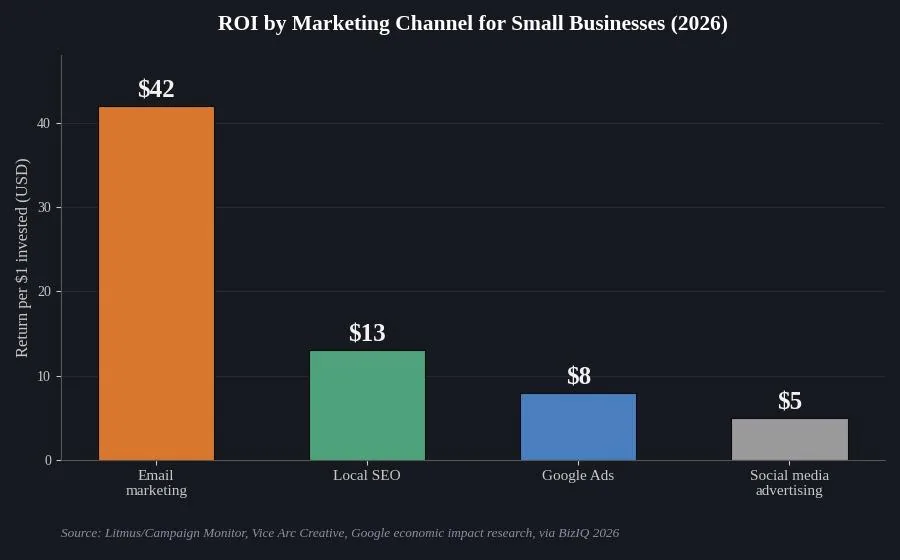
Local SEO specifically is the most accessible entry point into this. Google Business Profile optimization, citation management, and review generation produce measurable results without requiring a big content budget or competing head-on against national brands for domain authority. A business spending $500/month on local SEO ($6,000/year) can reasonably expect around $78,000 in attributable return annually at the $13:1 ratio, which for a $500,000/year business represents a 15.6% revenue lift from a single channel, per BizIQ's 2026 Small Business Marketing Statistics analysis.
Where small business marketing budgets actually go
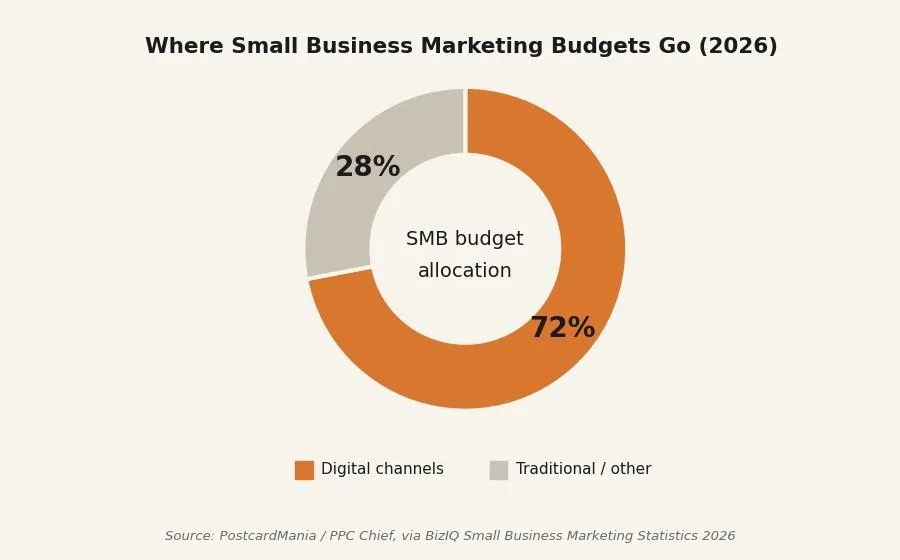
The U.S. Small Business Administration recommends allocating 7-8% of gross annual revenue to marketing, with newer businesses in competitive markets often needing 12-20%. Most small businesses fall well short of that benchmark, and even within the budget that does exist, digital channels absorb 72% of spend, but a large share of that still goes to social media and paid ads rather than the organic search work that produces the strongest long-term return. Getting the channel mix right, not just the total budget, is often the bigger lever.
What SEO actually costs for a small business
Pricing depends heavily on scope and competitiveness, but three tiers cover most small businesses:
- Local SEO: $500-$2,000/month, ideal for a single-location business competing in a moderately competitive market. This typically covers Google Business Profile optimization, 5-10 local citations monthly, review management, and location-specific page optimization.
- National or competitive-market SEO: $2,500-$10,000+/month, for businesses targeting broader or more contested search terms.
- Hourly consulting: $75-$250/hour for North American consultants, useful for a one-time audit or specific technical fix rather than ongoing management.
A useful budgeting formula: if your business could realistically generate $50,000/month from organic traffic, invest $5,000-$10,000/month in SEO to capture it. Spending under $500/month for "full-service SEO" in a competitive market typically covers overhead and automated tools, not the strategic work that actually moves rankings.
How long until SEO pays off
Small business SEO tool
SEO investment & ROI estimator
Set a monthly SEO budget and a timeframe to see a realistic return range, based on 2026 small business benchmarks.
Total invested
--
Estimated return range
--
SEO follows a predictable curve, and setting the right expectation up front prevents businesses from quitting right before the payoff, per REK Marketing & Design's 2026 SEO ROI Benchmarks. Months 1-6 are typically break-even or slightly negative, since this period covers technical fixes, foundational content, and initial authority building. Months 7-12 is where rankings start converting into real leads, with ROI typically climbing to 150-200%. By year two and beyond, once content has ranking history and accumulated backlinks, ROI commonly reaches 275-500%, and in some verticals, like real estate, returns can exceed 400% even earlier.
DIY vs. freelancer vs. agency: which fits your business
| Factor | DIY | Freelancer | Agency |
|---|---|---|---|
| Typical monthly cost | $0-$500 (tools only) | ~$1,350 average | ~$3,200-$3,500 average |
| Time commitment | 10-20+ hours/week from the owner | Managed, but usually narrower scope | Fully managed across all disciplines |
| Results timeline | Slower and less consistent without SEO expertise | 6-12 months | 6-12 months, generally more consistent |
| Best for | Very tight budgets, hands-on owners with time to learn | Single-focus projects, smaller sites, specific gaps | Full-service growth, competitive markets, multi-channel coordination |
Figures reflect 2026 U.S. market averages (Backlinko, Ahrefs, Revenue Memo); actual pricing varies by industry, market, and scope.
Where to focus first: a practical order of operations
- Google Business Profile. This is the single highest-leverage, lowest-cost move available, and it directly controls Map Pack visibility for "near me" searches.
- Technical foundations. Site speed, mobile usability, and basic indexability issues need to be resolved before content work can pay off; a fast, crawlable site is the floor, not a bonus.
- Local citations and reviews. Consistent business information across directories, paired with an active review-generation process, builds the trust signals that both Google and customers weigh heavily.
- Service pages, one per offering. Each core service or product deserves its own dedicated page targeting the specific terms customers search for, rather than one generic "Services" page trying to rank for everything.
- Blog content that answers real questions. Businesses that blog get 55% more traffic, and small businesses specifically are 23% more likely than average to see ROI from blog posts, per Revenue Memo's 2026 small business marketing data, likely because they're targeting less competitive, more specific terms than national competitors.
- Consistent monthly execution. SEO is not a one-time project. 88% of marketers maintain or increase their SEO budget year-over-year, precisely because channels that stop delivering lose budget, and SEO keeps compounding.
Common small business SEO mistakes
- Quitting before month six. The break-even window is real. Abandoning a campaign at month three means paying for the setup phase and never collecting the return.
- Chasing vanity metrics. Rankings and traffic mean nothing if they don't convert. Tie every report back to leads, calls, or revenue.
- Skipping Google Business Profile. It's free, it's fast to optimize, and it's often the very first thing a local customer sees before ever reaching your website.
- Spreading budget too thin. A tiny amount spent across five tactics usually beats nothing, but a focused budget on the two or three highest-leverage tactics (GBP, technical health, service pages) consistently outperforms a scattered approach.
- Treating SEO and paid ads as competitors instead of partners. Ads can fill the gap while SEO builds; the mistake is relying on ads indefinitely instead of letting them buy time for organic growth to mature.
Frequently asked questions
How much should a small business spend on SEO?
Most small businesses land in the $500-$5,000/month range, with local SEO alone running $500-$2,000/month. A simple rule of thumb: invest 10-20% of the monthly revenue you could realistically generate from organic traffic.
How long does SEO take to work for a small business?
Early movement in local search typically appears within 3-6 months, with most campaigns breaking even around month 6-8 and stronger returns building through year two.
Is local SEO worth it for a small business?
Yes. It delivers roughly $13 back for every $1 invested, one of the best ROI ratios of any small business marketing channel, and it's the most accessible entry point into SEO since it doesn't require competing against national brands for authority.
Should I do SEO myself or hire someone?
It depends on time and budget. DIY works for hands-on owners willing to invest 10-20+ hours a week; a freelancer suits narrower, single-focus needs; an agency fits businesses wanting full-service, consistent execution across a competitive market.
What's the single best first step for small business SEO?
Optimize your Google Business Profile. It's free, it's the fastest win available, and it directly controls visibility in the Google Maps results most local customers see first.
Turning search visibility into real growth
SEO for a small business comes down to being deliberately visible in the specific searches your actual customers make, starting with Google Business Profile, building through service pages and technical health, and compounding through consistent monthly execution. Each piece does little on its own, but together they function as ongoing infrastructure rather than a one-time sprint.
The businesses that treat SEO as a core growth channel rather than a checkbox are the ones showing up in year two with 275%+ returns, while their competitors are still deciding whether to try it.
More from Web Tonic: growth marketing services, data & analytics, performance creative.
Sources: seoprofy.com · biziq.com · rekmarketing.com · revenuememo.com