Table of contents


A small business owner needs a new accountant. They don't reach for the Yellow Pages, and more often than not, they don't ask around either. They type "small business accountant near me" into Google and call one of the first two or three firms that show up. Everyone else on that results page, including firms with better credentials and lower fees, gets nothing.
SEO for accountants is the work of making sure your firm is one of those first few results, consistently, across every version of that search. It combines local SEO, Google Business Profile management, on-page website work, and content that answers the questions potential clients are typing into Google before they ever pick up the phone. Accounting is a referral business by tradition, which is why most firms have left this digital marketing channel wide open.
Key Takeaways
- The top 3 organic results capture roughly 75.1 percent of all clicks on accounting-related searches, and 75 percent of people never scroll past page one.
- 46 percent of all Google searches carry local intent, and 88 percent of consumers who run a local search on their phone visit or call a business within a day, near-me searches convert fast.
- 40 to 60 percent of new client acquisitions for top-ranking accounting firms come directly from organic search, not referrals or paid ads.
- Agency-managed SEO services typically run USD $1,500 to USD $5,000 per month, with DIY tools starting near USD $0 to $200 per month and freelancers or AI-assisted platforms sitting in between.
- Local pack movement generally shows up in 60 to 90 days, with broader organic growth building over 6 to 12 months — this is a compounding channel, not an instant one.
- Client lifetime value makes the math work: a single small-business accounting client retained for several years can represent USD $8,000 to $40,000+ in lifetime revenue, which is why even 2 to 3 new clients a month from Google can transform a firm's growth.
What Is SEO for Accountants?
SEO for accountants is the process of optimizing a firm's website, Google Business Profile, and content so it ranks when potential clients search for accounting services, tax prep, bookkeeping, audit, or advisory help in their area. It runs on the same mechanics as SEO anywhere else: keyword research, technical health, content, and authority signals. The application looks different, though, because accounting is a trust business first and a search engine optimization exercise second. Nobody hands over their financial records to a firm that looks uncertain or outdated online.
That trust dynamic shapes the priority order. A Google business profile for an accounting firm needs to convey credentials and stability, not just an address and phone number. Reviews need to speak to professionalism and accuracy specifically, not general friendliness. And website content has to establish real expertise before a prospect ever calls, especially since Google increasingly treats accounting content as a higher-scrutiny category given the financial stakes involved. Search engines and AI assistants are both trying to answer the same underlying question: which firm can this person trust with their money?
Why Local Search Decides Who Gets the Call
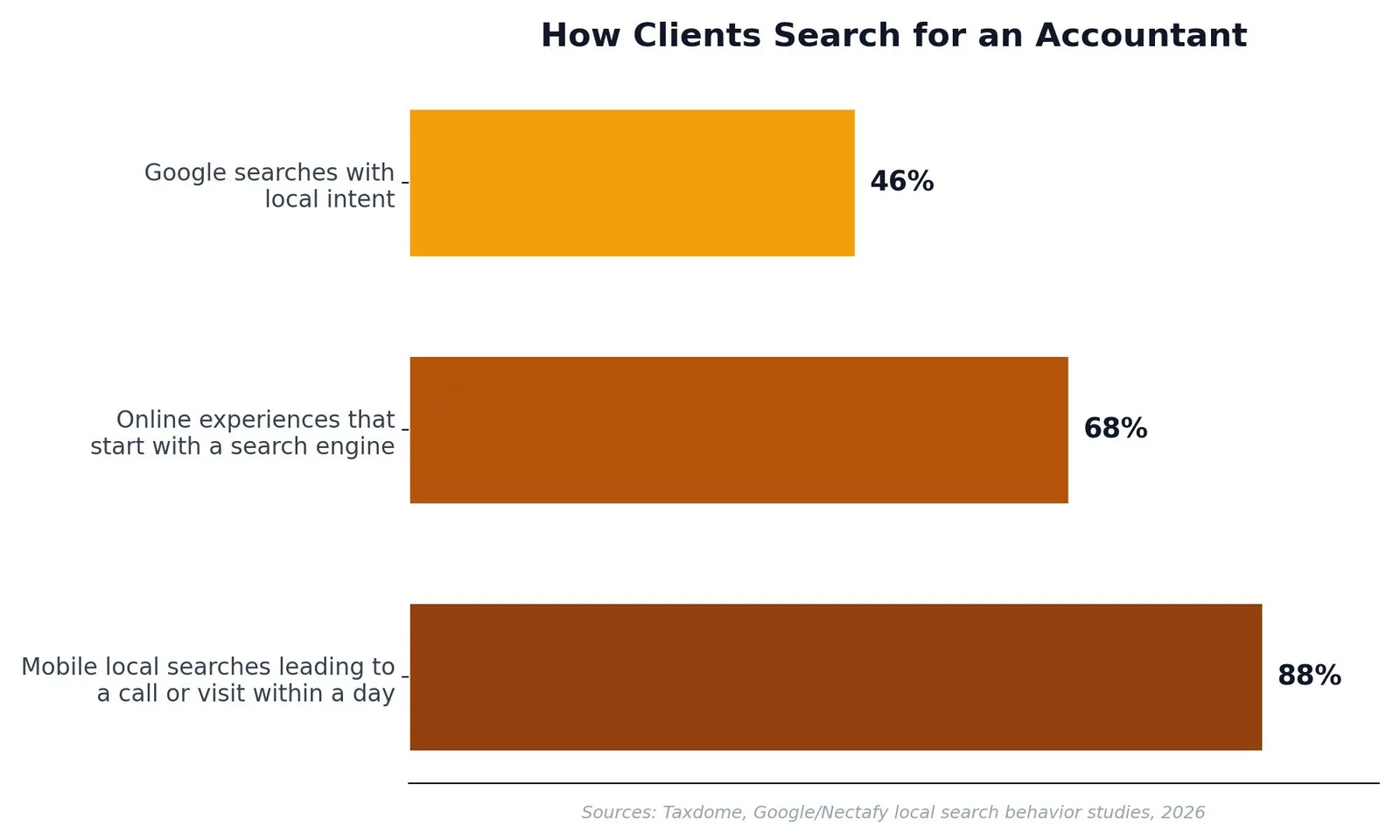
The click math here is the same brutal curve seen across every local service. Analysis from CPA Site Solutions found that the first three organic results capture roughly 75.1 percent of all clicks, while three-quarters of searchers never scroll past page one. A firm ranked eighth for its core keyword is competing for what's left over after everyone above it has already taken the call.
What drives that placement is mostly about intent and consistency. Roughly 46 percent of all Google searches carry local intent, meaning a meaningful share of the people searching for accounting help are looking for someone nearby, not a national brand. Once they find a few options, mobile behavior takes over fast: consumers who run a local search on their phone tend to visit or call a business within a day of searching. For a firm, the Google business profile is often the first real touchpoint with a new client, ahead of the homepage itself.
Local SEO vs. Google Ads for Accounting Firms
| Factor | Local SEO (organic) | Google Ads (PPC) |
|---|---|---|
| Cost model | Time investment in GBP, content, and reviews | Ongoing cost per click, no cap without one |
| Time to results | 60-90 days for local pack movement, 6-12 months for broader growth | Immediate, live same day |
| Long-term value | Compounds; content and rankings keep working after publication | Stops the moment ad spend stops |
| Best seasonal fit | Strong year-round, especially outside peak filing season | Strongest during Jan-April individual tax season |
| Where clients land | Map Pack, organic results, AI Overviews | Paid search ads above organic results |
| Typical monthly cost | USD $1,500 to USD $5,000 for full-service agency management | Scales directly with ad spend and market competitiveness |
Many firms run both, weighted by season: Google Ads for the individual tax-prep rush in the first quarter, and local SEO as the channel that keeps generating business clients the other nine months of the year without a recurring per-click bill.
The Accounting Firm Local SEO Roadmap
The SEO strategy that works for accounting firms follows a fairly consistent order.
Step 1: Claim and fully build out your Google Business Profile
Every field matters, but for an accounting firm specifically: list credentials, certifications, and every service offered (tax prep, bookkeeping, payroll, audit, advisory) explicitly. Google's own guidance confirms that complete, accurate profiles are more likely to surface in local search results, which makes a thin or generic GBP (still called GMB, or Google My Business, on some older directories) a signal of low trust in a category where trust is the entire sale.
Step 2: Build a review cadence that speaks to accuracy and professionalism
Generic five-star reviews help less here than reviews that mention specific outcomes: a smooth audit, a caught deduction, a responsive tax season. These are the details a prospect actually reads before trusting someone with their books.
Step 3: Fix technical and on-page fundamentals
Fast load times, mobile-first design, and schema markup for local business and FAQ content form the base. More than half of local service searches now happen on mobile, and a slow or clunky site undercuts even strong content.
Fast load times, mobile-first design, and schema markup for local business and FAQ content form the base. Google's own Search Central documentation confirms that loading speed, responsiveness, and visual stability are metrics its core ranking systems use to reward strong page experience. More than half of local service searches now happen on mobile, and a slow or clunky site undercuts even strong content.
Step 4: Build dedicated pages for each core service and niche

A single "our services" page competes poorly against dedicated pages for tax preparation, bookkeeping, payroll, or advisory work. The same logic applies to industry niches: a page built around "accountant for real estate agents" or "CPA for e-commerce businesses" captures long term search intent a generic page never will.
Step 5: Earn local citations and relevant mentions
Consistent name, address, and phone data across directories, local chambers of commerce, and industry associations supports both traditional rankings and how AI systems verify a firm's legitimacy. Whitespark's 2026 Local Search Ranking Factors survey of local SEO experts still counts citation consistency as a real ranking signal, even as its relative weight has declined compared to reviews and Google Business Profile signals. Buying bulk links or citations in volume is far more likely to trigger a Google penalty than to help in 2026.
Step 6: Structure content for AI search, not just organic rankings
Over half of searches now end without a click, with the answer served directly in an AI Overview or assistant response. SparkToro's 2026 zero-click search study found that 68 percent of U.S. Google searches ended without any click in early 2026, up from roughly 60 percent just two years earlier, which is exactly why being the clear, correctly-answered source matters even when it doesn't win the click. Clear, direct answers to real client questions ("What's the difference between a CPA and an accountant?") are what get pulled into those answers.
Is Your Accounting Firm's Website SEO-Ready?
Accounting firm SEO tool
Is your firm's website SEO-ready?
Check off what's already true for your firm. Your score updates as you go.
0 of 5
Check off items above to see how ready your firm is.
What to Expect: SEO Timeline for Accounting Firms
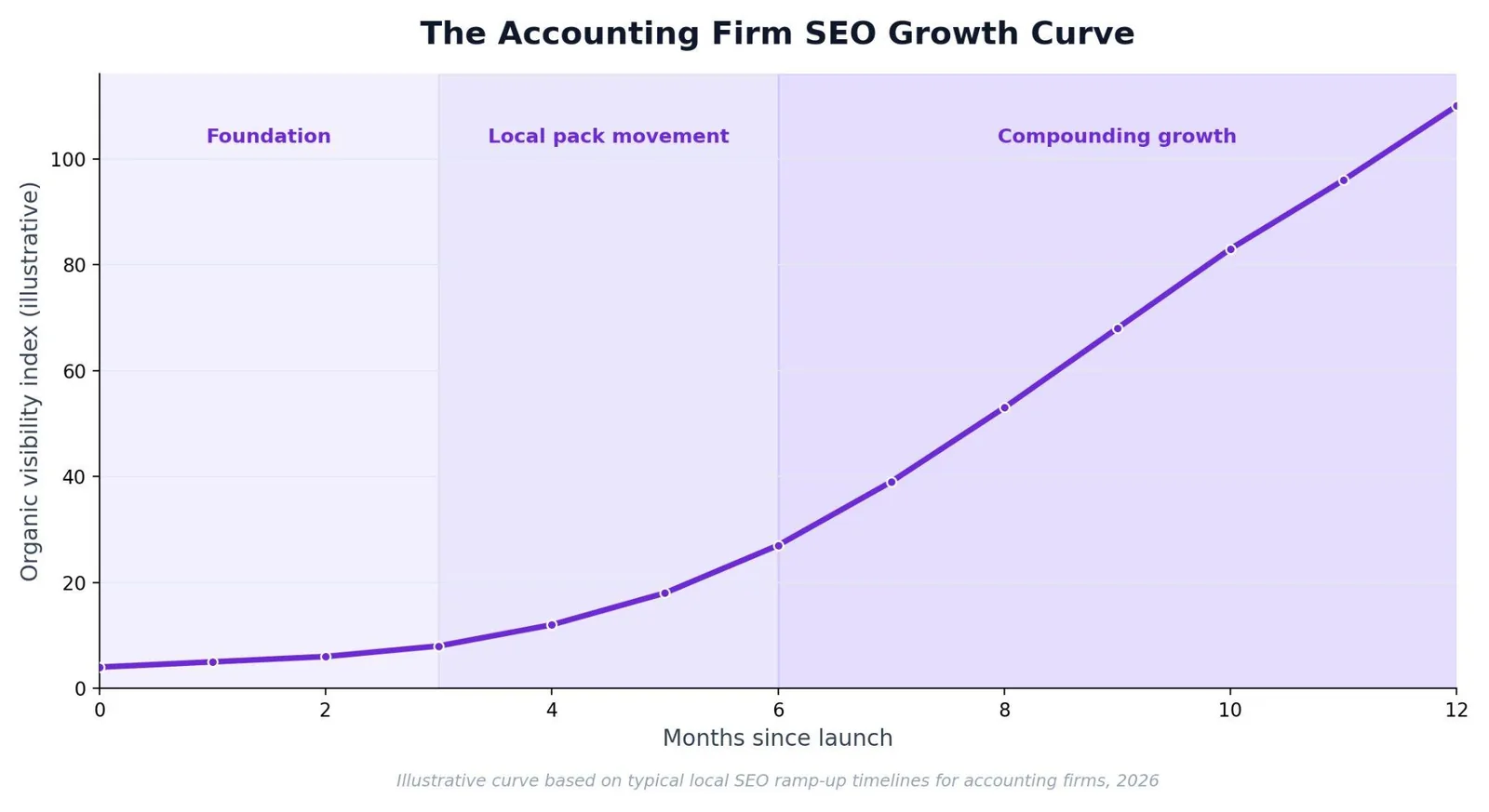
The first three months mostly go into Google business profile optimization, technical fixes, and initial review building, with little visible movement yet. Local pack shifts tend to show up in the 60- to 90-day range, particularly outside the busiest filing season. Broader guidance on accounting SEO timelines puts full organic growth at 6 to 12 months, longer in dense metros like New York, Los Angeles, Houston, or Dallas — and the pattern holds in competitive markets across the United States more broadly.
Firms that abandon the effort around month four, right before the local pack starts to move, are the single most common way this channel gets written off as "not worth it."
SEO Tools Every Accounting Firm Should Use
Google Search Console and Google Analytics are free and essential for seeing which searches already bring website traffic and where technical issues are quietly blocking visibility. Google Maps and Google Business Profile management tools keep listing data accurate across locations. Ahrefs or a similar paid platform adds visibility into what's already ranking for nearby competing firms, which is useful before committing content resources to a keyword someone else already owns. These tools also help you benchmark different SEO strategies against what's already working in your market.
Common SEO Mistakes Accounting Firms Make
The most common one is treating the Google business profile as a formality rather than a trust asset, filled out once and never touched again. In a category built on trust, a stale profile reads as a genuine red flag.
Publishing generic "about our services" content instead of dedicated pages for tax prep, bookkeeping, payroll, and advisory work is a close second. Each of those has different search intent, and a single blended page satisfies none of them well.
Relying entirely on referrals while ignoring local SEO is the quieter mistake. Referrals still convert, but a prospect almost always searches the recommended firm's name afterward, and a thin or outdated online presence can turn a warm referral into a coin toss against a better-optimized competitor.
And chasing broad national keywords instead of local, service-specific ones wastes budget in a category where almost every real prospect searches with geographic intent anyway.
Frequently Asked Questions
How much does SEO cost for an accounting firm?
Full-service agency management for local SEO typically runs USD $1,500 to USD $5,000 per month, while DIY tool subscriptions run closer to USD $0 to $200 per month, with freelancers and AI-assisted platforms in between. The right tier depends on how competitive your market is and how quickly you need results.
How long does it take to see results?
Local pack movement generally appears in 60 to 90 days, with broader organic growth building over 6 to 12 months. Firms in less competitive markets tend to see movement faster than those in dense metro areas.
Is Google Business Profile really that important for an accounting firm?
Yes. It's often the first real touchpoint a prospect has with a firm, ahead of the website itself, especially for mobile searches with local intent. A complete, credential-forward profile does real work here.
Do I need separate pages for tax prep, bookkeeping, and advisory services?
Yes, if you offer more than one distinct service. Each has different search intent, and a single blended services page tends to rank for none of them as well as dedicated pages would.
Should I run Google Ads or focus on SEO?
They fit different moments. Google Ads makes sense for the individual tax-filing rush in the first quarter, when demand spikes fast and short-term visibility matters. Local SEO delivers better ROI the rest of the year, when the goal is a steady, compounding stream of business and advisory clients rather than a seasonal spike.
The Bottom Line on SEO for Accountants
Accounting is still a trust business, but the search bar has become the first place that trust gets tested. Firms that treat their Google Business Profile, reviews, and service-specific content as seriously as their client work consistently outrank larger, better-resourced competitors who are still running on referrals alone.
Start with a full Google Business Profile audit and a short list of the tax, bookkeeping, or advisory searches your firm can realistically win in your market. That's a workable starting point regardless of firm size.
Ready to Turn Local Search Into a Real Client Pipeline?
Coordinating GBP optimization, technical fixes, service-page content, and review growth all at once is where most firms lose months they don't have. Web Tonic's growth marketing team handles the technical SEO, local content, and reputation work covered in this playbook as part of a full-funnel approach that also connects to paid acquisition for tax season, so nothing runs in a silo while you stay focused on client work.
More from Web Tonic: growth marketing services, data & analytics.
Sources: cited.so · insidea.com · support.google.com · developers.google.com · whitespark.ca · sparktoro.com