Table of contents
Key Takeaways
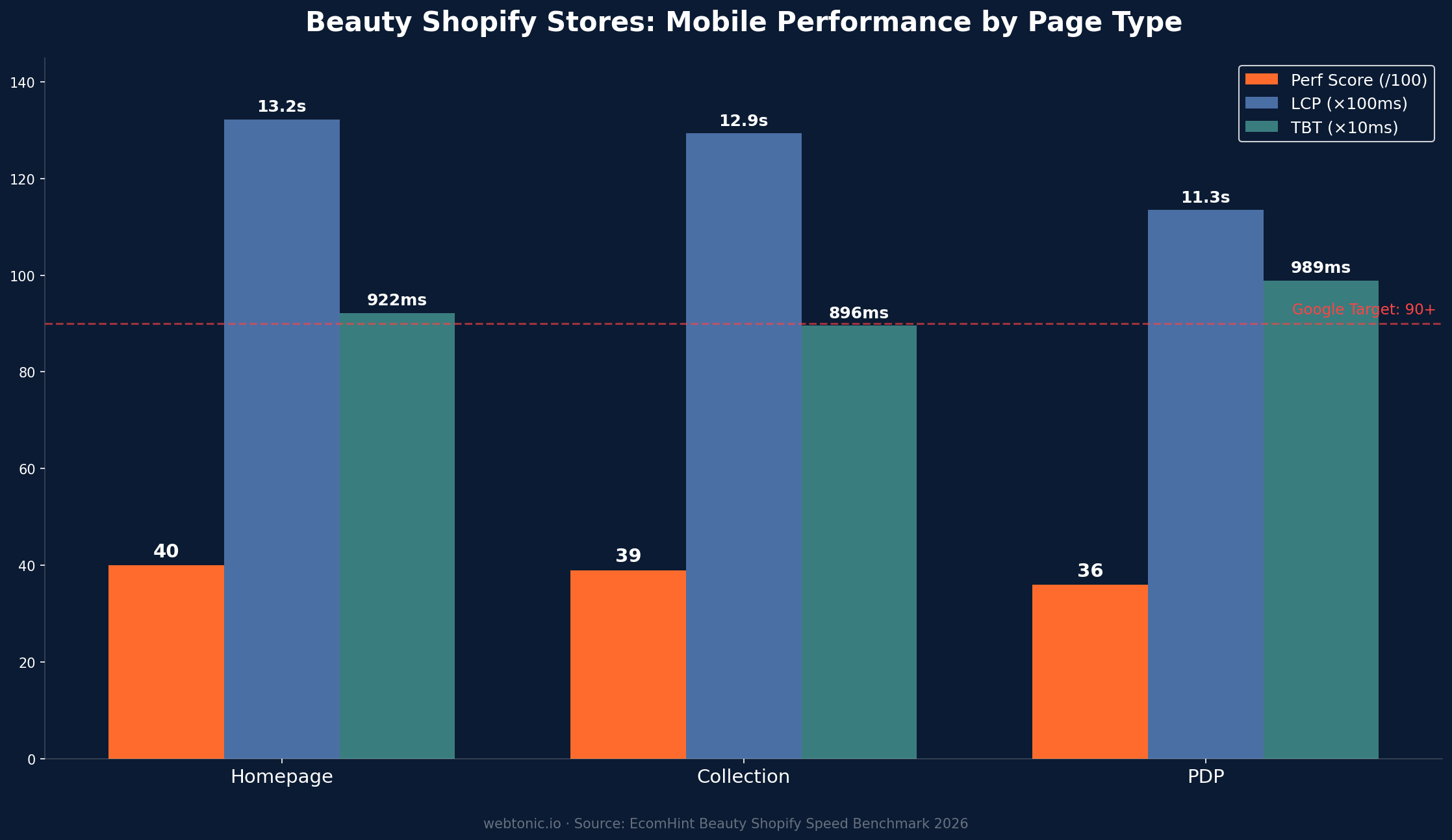
- Beauty Shopify stores average a Lighthouse performance score of just 36–40 on mobile, with LCP times exceeding 11–13 seconds across page types.
- A beauty brand reduced page load time from 5.2s to 1.9s and saw a 34% increase in conversion rate, plus a 42% improvement in mobile sales.
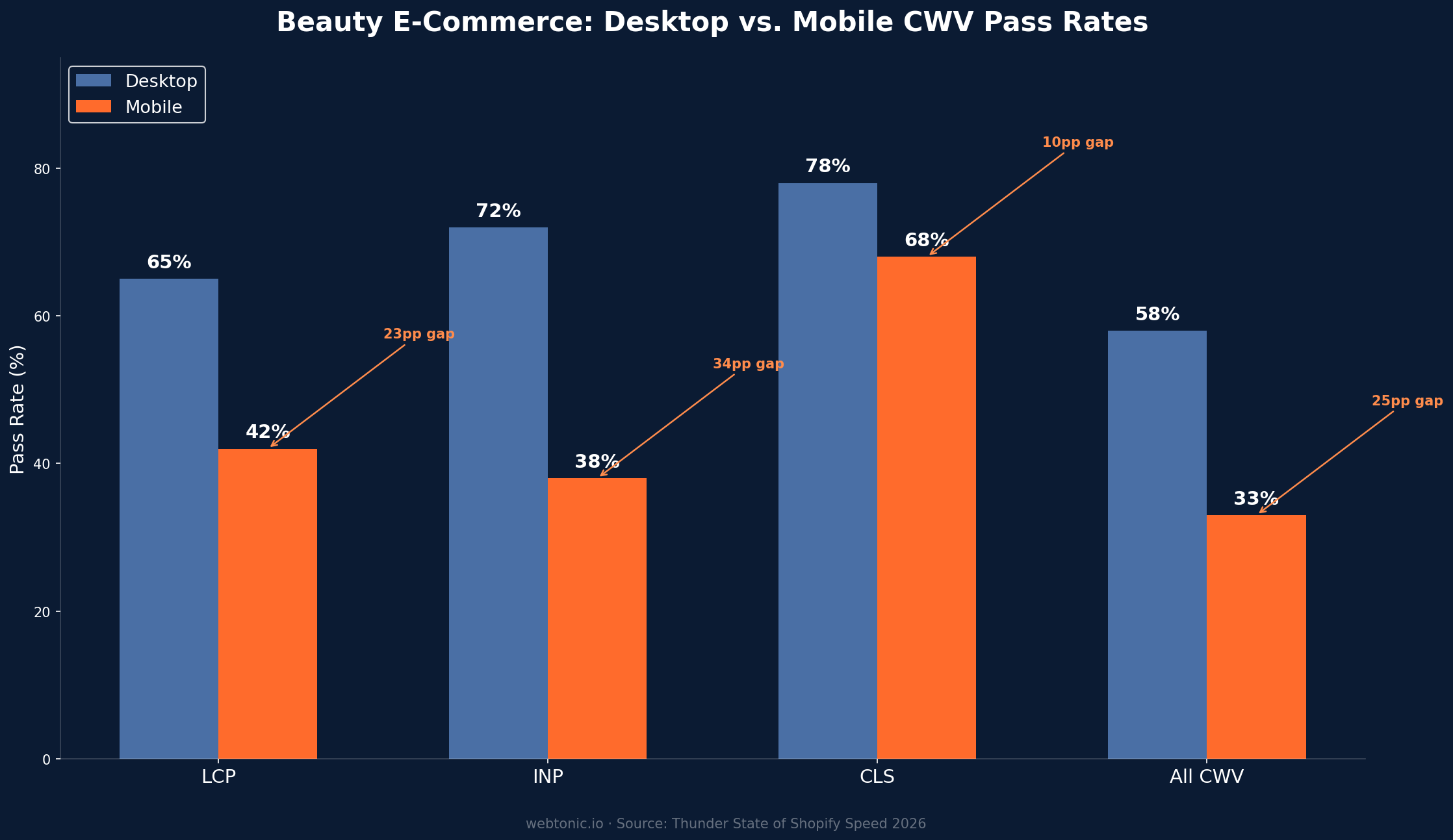
- Only 33% of Shopify beauty stores pass all Core Web Vitals on mobile, versus 58% on desktop — a 25-percentage-point gap.
- One beauty brand's technical SEO overhaul grew organic traffic from near-zero to 23,000 monthly visits in 11 months by fixing crawl issues and indexing gaps.
- Fewer than 40% of eligible e-commerce pages carry correctly implemented structured data despite schema being a confirmed rich result eligibility signal.
- Beauty e-commerce sites with proper Product schema see up to a 58% increase in rich result impressions and measurable CTR improvements.
- The beauty and personal care sector saw 66.1% YoY organic traffic growth while accessibility scores held flat at 86.8/100.
- Health and beauty Shopify stores are the slowest e-commerce vertical due to image-heavy layouts and extensive app usage, averaging ~2.4s LCP.
Beauty & Skincare Technical SEO Benchmarks at a Glance
| Metric | Beauty Average | Google Threshold | Status |
|---|---|---|---|
| Mobile LCP (Homepage) | 13,224 ms | ≤ 2,500 ms | 5.3× over limit |
| Mobile LCP (PDP) | 11,348 ms | ≤ 2,500 ms | 4.5× over limit |
| Total Blocking Time | 896–989 ms | ≤ 200 ms | 4–5× over limit |
| CLS (PDP) | 0.020 | ≤ 0.1 | Passing |
| Mobile CWV Pass Rate | 33% | 100% | 67% failing |
| Desktop CWV Pass Rate | 58% | 100% | 42% failing |
| Performance Score (Mobile) | 36–40/100 | ≥ 90/100 | Critical |
| Median Page Weight | 3,547 KB | ≤ 1,500 KB | 2.4× over target |
Core Web Vitals Performance for Beauty Websites
Beauty and personal care websites face a severe Core Web Vitals challenge. EcomHint's 2026 Shopify speed benchmark across 33 beauty stores found mobile Lighthouse performance scores averaging just 36–40 out of 100, depending on page type. Product detail pages (PDPs) scored the lowest at 36, with LCP times of 11,348 ms — more than 4.5× Google's 2,500 ms threshold.
Thunder's State of Shopify Speed 2026 report confirms that health and beauty stores are the slowest e-commerce vertical, averaging ~2.4s LCP with often 10+ apps installed per store. The industry's mobile CWV pass rate sits at just 33%, compared to 58% on desktop — a 25-percentage-point gap that directly impacts mobile search rankings.
CLS remains the one bright spot: beauty stores average 0.001–0.020 across page types, well within Google's 0.1 threshold. The primary CWV bottlenecks are LCP and Total Blocking Time (TBT), driven by image-heavy layouts, unoptimized hero images, and excessive third-party script loading.
Site Speed Impact on Beauty E-Commerce Conversions
The revenue impact of technical SEO improvements in beauty is substantial and well-documented. 1Center's beauty e-commerce analysis found that one brand that reduced page load time from 5.2s to 1.9s saw a 34% increase in conversion rate, a 42% improvement in mobile sales, and a 28% decrease in bounce rate.
RevenueFlows' 2026 data study found that jewelry, home decor, and beauty products show stronger conversion rate correlation with speed than supplements and kitchen gear, suggesting that beauty shoppers are particularly speed-sensitive. The study shows mid-tier stores averaging 2.3s mobile LCP and 4.0s desktop, with a 1.7s gap between the two.
For growth-focused beauty brands, each second of LCP improvement translates to measurable revenue gains. The compounding effect on paid media landing pages is particularly significant — faster pages improve Quality Score, lower CPC, and increase conversion rates simultaneously.
Schema Markup and Structured Data for Beauty Sites
Structured data implementation remains a major missed opportunity for beauty e-commerce. Technical SEO News' 2026 analysis of 12.67 million domains found that fewer than 40% of eligible e-commerce pages carry correctly implemented structured data. The "deployed-but-broken" segment is the largest category in the data.
For beauty brands, the key schema types include Product (ratings, price, availability), FAQPage (ingredient questions, shade guidance), and HowTo (application tutorials). Higglo's LolaLee Beauty case study documented a site with zero schema markup, inconsistent metadata, 47 crawl errors, and flat internal linking — fixing these issues drove a 228% surge in organic impressions.
AI search engines including Google AI Overviews, Perplexity, and ChatGPT search preferentially cite sources with proper structured data, according to Digital Applied's 5,000-site audit. Beauty brands without schema risk losing visibility in both traditional and AI-powered search results.
Crawlability and Indexation Challenges in Beauty E-Commerce
Beauty websites with large product catalogs face unique crawl budget challenges. UpCut Studio's beauty brand case study documented how a neglected site accumulated crawl issues, indexing gaps, and structural problems that prevented Google from understanding the site's content hierarchy. A systematic technical overhaul grew organic traffic from near-zero to 23,000 monthly visits in 11 months.
Common crawl budget drains for beauty sites include faceted navigation generating thousands of parameter URLs (shade, size, skin type combinations), duplicate product pages across collections, and pagination beyond page 3. Multi-attribute filter combinations in beauty — where a single product page might exist under moisturizers, anti-aging, dry skin, and sensitive skin categories — create exponential URL bloat.
Internal linking structure is equally critical. The LolaLee Beauty site had a flat internal linking structure that gave Google no clear signals about content hierarchy. After implementing proper siloing and cross-linking between related products, ingredients, and how-to content, the site saw both improved crawl efficiency and the 228% impression surge noted above.
Beauty Technical SEO vs. Other E-Commerce Verticals
| Vertical | Mobile Perf. Score | Mobile CWV Pass | Avg. LCP | Apps Installed |
|---|---|---|---|---|
| Beauty & Personal Care | 36–40 | 33% | ~2.4s (field) / 11–13s (lab) | 10+ |
| Fashion & Apparel | 38–42 | 35% | ~2.2s (field) | 8–12 |
| Food & Grocery | 48–55 | 45% | ~1.8s (field) | 4–6 |
| Electronics | 40–45 | 38% | ~2.0s (field) | 6–8 |
| Home & Garden | 42–48 | 40% | ~1.9s (field) | 5–7 |
Technical SEO Best Practices for Beauty Brands
- Compress and lazy-load hero images. Beauty product imagery is the primary LCP bottleneck. Convert to WebP/AVIF, serve responsive sizes, and use
loading="lazy"on below-fold images to reduce initial payload. - Audit and reduce third-party scripts. Beauty stores average 10+ apps, each injecting JavaScript. Remove unused apps and defer non-critical scripts to cut Total Blocking Time from 900+ ms to under 200 ms.
- Implement Product schema on every PDP. Include price, availability, aggregate ratings, and shade/variant information. Fewer than 40% of e-commerce pages have correct schema — proper implementation is a competitive advantage.
- Manage faceted navigation crawl budget. Use canonical tags, noindex on low-value filter combinations, and robots.txt rules to prevent Googlebot from wasting crawl budget on shade × size × skin type URL permutations.
- Build topical internal linking. Connect products to ingredient guides, how-to tutorials, and routine builders. Sites with flat internal linking miss both crawl signals and topical authority.
- Monitor field data, not just lab scores. Lighthouse lab scores (36–40) paint a worse picture than real-user data. Track field CWV metrics in Google Search Console and CrUX to understand actual user experience.
- Prioritize mobile. With a 25-point gap between desktop and mobile CWV pass rates, mobile optimization delivers the largest SEO uplift per engineering hour spent.
Mobile vs. Desktop Performance Gap in Beauty E-Commerce
The performance gap between mobile and desktop experiences on beauty sites is among the widest in e-commerce. Thunder's 2026 Shopify speed report shows the gap across all CWV metrics:
| Core Web Vital | Desktop Pass Rate | Mobile Pass Rate | Gap |
|---|---|---|---|
| LCP | 65% | 42% | 23 pp |
| INP | 72% | 38% | 34 pp |
| CLS | 78% | 68% | 10 pp |
| All CWV Combined | 58% | 33% | 25 pp |
INP (Interaction to Next Paint) presents the biggest mobile challenge with a 34-percentage-point desktop-to-mobile gap. This metric measures responsiveness to user interaction — critical for beauty sites where shoppers tap shade swatches, filter by skin type, and expand ingredient lists. Heavy JavaScript from review widgets, shade-matching tools, and loyalty program overlays contribute to sluggish interactivity.
Raygun's analysis of leading beauty retailers found that even major brands show wide variance. Sephora achieved 75.12% LCP pass rate on desktop, while Beautycounter led the pack at 25.41% (lower is better for LCP percentile). The gap between best and worst performers within the beauty vertical is larger than the gap between beauty and other verticals.
Traffic Growth and Accessibility in Beauty E-Commerce
Despite technical challenges, the beauty sector is experiencing strong organic growth. GetEcommerceLeads' 2026 beauty report documented 66.1% year-over-year organic traffic growth across the beauty vertical, suggesting that even with poor CWV scores, beauty content demand is surging.
Accessibility scores for beauty e-commerce averaged 86.8 out of 100 in June 2026, essentially unchanged month-over-month. This stability represents a silent opportunity: brands that invest in accessibility improvements (alt text for product images, proper heading structure, keyboard-navigable shade selectors) can differentiate while competitors ignore this dimension entirely.
The combination of strong traffic growth and poor technical performance means beauty brands are leaving significant revenue on the table. A site that captures 66% more organic traffic but converts poorly due to slow page speed wastes much of that growth. Brands investing in technical SEO stand to capture both the traffic growth and the conversion improvement simultaneously.
Frequently Asked Questions
What are the biggest technical SEO issues for beauty websites?
The three most common technical SEO problems for beauty sites are slow Core Web Vitals (only 33% pass on mobile), missing or broken structured data (fewer than 40% of eligible pages have correct schema), and crawl budget waste from faceted navigation generating thousands of unnecessary URLs from shade, size, and skin type filters.
How much does site speed affect beauty e-commerce conversion rates?
Site speed has a significant impact. One beauty brand that reduced load time from 5.2s to 1.9s saw a 34% conversion rate increase and 42% mobile sales improvement. RevenueFlows' research shows beauty products have a stronger speed-to-conversion correlation than most other e-commerce verticals.
Is schema markup important for beauty product pages?
Yes. Beauty sites with proper Product schema see up to 58% more rich result impressions. AI search engines like Google AI Overviews and Perplexity preferentially cite sources with structured data. Yet fewer than 40% of eligible e-commerce pages implement schema correctly.
What is a good Core Web Vitals score for a beauty website?
Google's thresholds are: LCP under 2,500 ms, CLS under 0.1, and INP under 200 ms. The beauty industry averages 11,000–13,000 ms LCP on mobile in lab tests, so most brands have substantial room for improvement. Aim for a Lighthouse performance score above 60 as an initial target.
How can beauty brands improve their crawl efficiency?
Start by auditing faceted navigation URLs and blocking low-value filter combinations from crawling. Fix internal linking structure to create clear content hierarchies. One beauty brand grew from zero to 23,000 monthly organic visits in 11 months primarily through technical fixes before any content changes.
Sources
ecomhint.com — Beauty & Personal Care Shopify Speed Benchmark 2026
thunderpagespeed.com — State of Shopify Speed 2026
1center.co — Site Speed and Beauty eCommerce Sales
technicalseonews.com — Schema ROI 2026
upcutstudio.com — Beauty Brand SEO Case Study
higglo.io — LolaLee Beauty Case Study
getecommerceleads.com — Beauty Ecommerce Report 2026
revenueflows.ai — Shopify Page Speed Conversion Study 2026
digitalapplied.com — Schema Markup Adoption Audit 2026
raygun.com — Core Web Vitals E-Commerce Analysis