Table of contents
Most SaaS companies approach SEO — search engine optimization, if you want the full term — the same way an eCommerce store or a local business would: chase traffic, publish blog posts, hope some of it converts. That misses what makes SEO for SaaS genuinely different. You're not selling a one-time purchase. You're selling recurring revenue to a buyer who might take weeks to decide, involves two or three other people in the decision, and needs to be convinced you'll still be a good fit a year after signing.
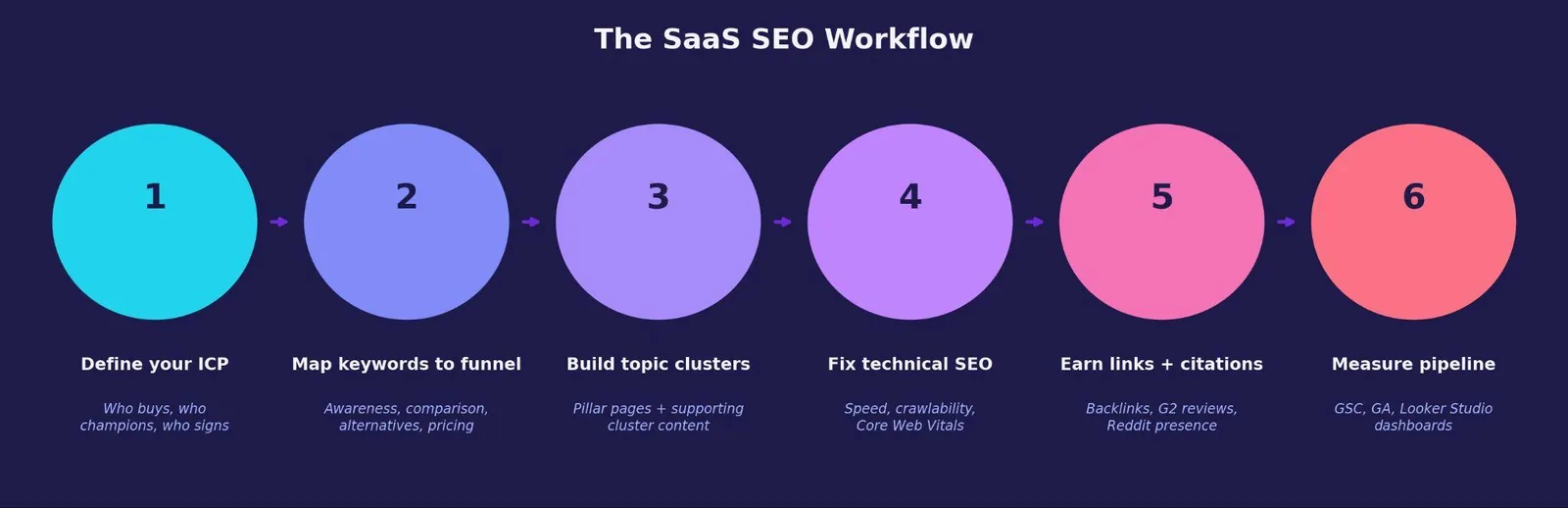
SEO for SaaS means building an organic growth funnel that reflects that reality: content mapped to each stage a buyer moves through, technical SEO that keeps a fast-shipping product's website crawlable, and a measurement approach tied to trial signups and revenue instead of raw traffic. Unlike PPC, where visibility disappears the day you stop paying, organic content keeps compounding long after it's published. Done well, this is one of the highest-leverage channels a SaaS company has. Copy-paste it from retail SEO strategy, and it just produces a blog nobody in the buying committee ever reads.
Key Takeaways
- SEO for SaaS differs from traditional SEO because it optimizes for Monthly Recurring Revenue and retention, not one-time transactions; content strategy has to serve awareness, comparison, and decision-stage buyers at once.
- Bottom-of-funnel terms, like "alternatives," "vs," and pricing-related searches, are reported by at least one SaaS SEO analysis to drive 40-60 percent of organic conversions for SaaS websites, though this figure comes from a single source and hasn't been independently verified.
- Customer-led SEO — building content marketing and keyword targeting around your actual customer segments rather than generic volume — is the named approach one SaaS-focused agency uses in place of pure traditional SEO, and the underlying idea (segment first, then target) is gaining traction elsewhere too.
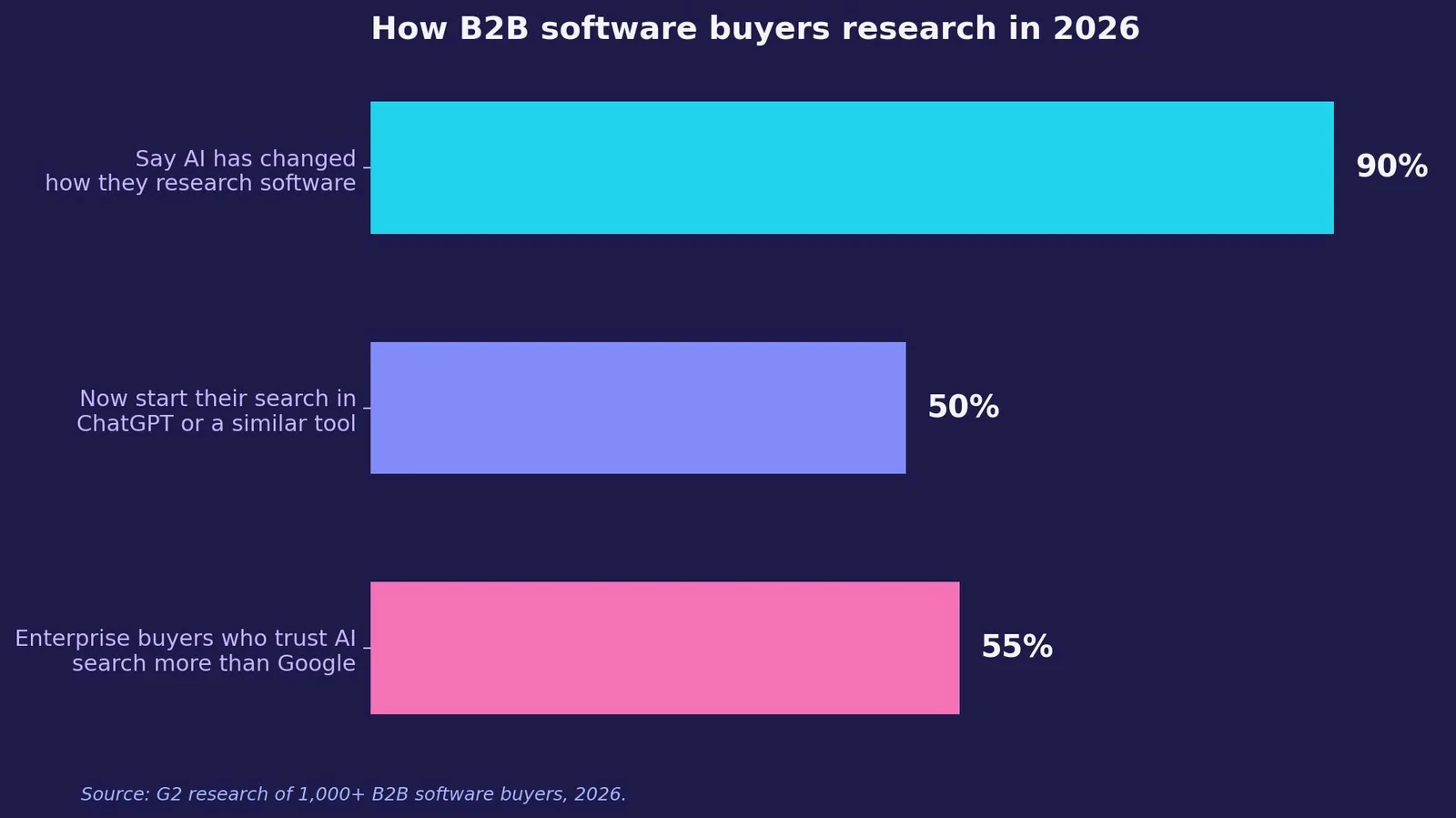
- Roughly 9 in 10 B2B buyers say AI has already changed how they research software, and about half now start that research inside a ChatGPT-style tool instead of Google, according to G2's 2026 AI Search Insight Report. AEO (answer engine optimization) is no longer optional for a SaaS SEO strategy.
- G2 reviews have become one of the most-cited sources inside AI-generated software answers, and Reddit threads now regularly rank alongside, and often above, branded pages and comparison sites for commercial software searches.
- Report SEO performance against pipeline, not vanity metrics: track it through Google Search Console, Google Analytics, and a Looker Studio dashboard tied to trials, demos, and revenue.
Why SEO for SaaS Is Different From Traditional SEO
Traditional SEO measures success in clicks and rankings. SEO for SaaS companies has to measure success in Monthly Recurring Revenue and Customer Lifetime Value, because the business model behind it is entirely different. A shoe store wants a purchase. A SaaS company wants a subscriber who renews for years, upgrades tiers, and refers colleagues. That difference changes almost everything about how the SEO strategy gets built. It's also a large part of why a generalist SEO agency without SaaS experience often struggles to move the metrics that actually matter to the business.
The sales cycle is longer, often involving multiple stakeholders: an individual contributor testing the product, a manager who owns the budget, sometimes a security or procurement reviewer who never touches the product itself. Each of those personas searches differently and needs different content. A fintech SaaS company's ICP, for instance, often includes a compliance reviewer who won't even appear in the buyer journey for a simpler project-management tool. A generic blog post optimized for one keyword rarely serves all of them.
This is where customer-led SEO comes in. One SaaS-focused agency, Directive Consulting, built its practice around this exact idea: instead of chasing keyword volume, start from actual customer segments and their ICP (ideal customer profile), then work backward to the content and terms that specific segment searches for. Whether or not a team uses that specific label, the underlying shift, lower search volume per page in exchange for a much higher conversion rate, is one most SaaS companies end up making eventually.
Building the Funnel: Keyword Strategy by Buyer Stage
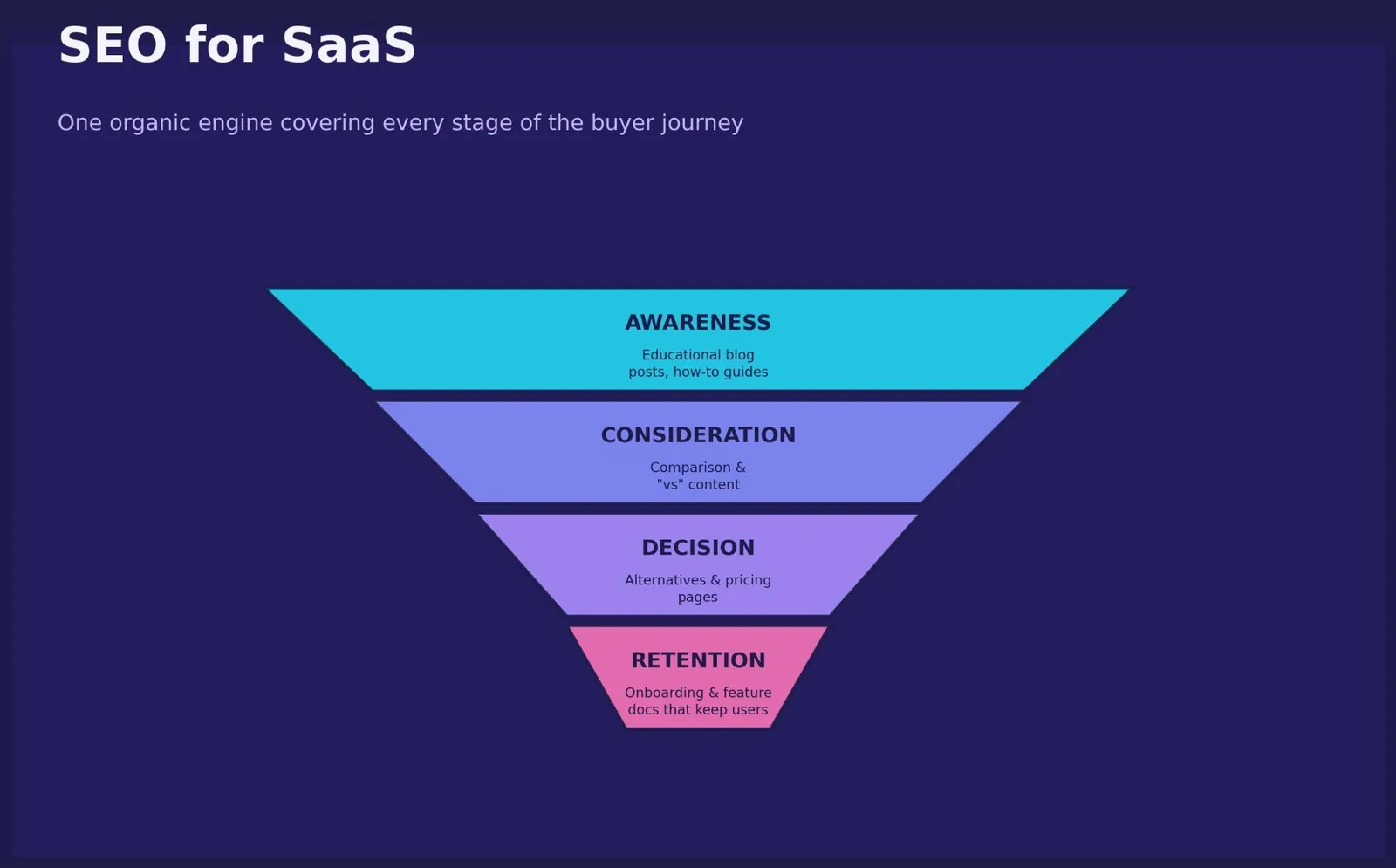
A SaaS SEO strategy that ignores funnel stage will overinvest in awareness content that never converts. Mapping keywords to where a buyer actually is in their decision matters more than raw search volume:
- Awareness stage: Educational content, how-to guides, and industry-trend pieces that establish your company as a knowledge source. Broad, informational keyword targets.
- Consideration stage: Comparison content and "X vs Y" pages where buyers actively evaluate options against each other. Lower volume, but far higher buying intent.
- Decision stage: Alternatives pages, pricing pages, and "best [category] tool" content. This is where bottom-of-funnel terms live, and where one SaaS SEO analysis puts as much as 40-60% of organic conversions, though that figure comes from a single source and hasn't been independently verified..
- Retention stage: Onboarding guides, feature documentation, and FAQ content that keeps existing customers subscribed and expands their usage. Often overlooked in an SEO content strategy, even though it directly supports the recurring-revenue metrics that matter most.
The most effective content architecture for tying these stages together is hub-and-spoke: a pillar page targets a broad topic, with supporting cluster articles (commonly cited ranges run from 10 to 30) linking back to it, building the kind of topical depth search engines reward with stronger rankings across the whole cluster, not just one page.
On-Page SEO Fundamentals Still Matter
None of the funnel or technical work pays off if the basics of on-page optimization are missing. Every page in a SaaS content marketing program needs, at minimum:
- Title tags that include the primary keyword close to the front and stay under roughly 60 characters, so search engines don't truncate them in results.
- Meta descriptions written to earn the click, not just describe the page. This is the one place on a search results page where a SaaS brand gets to make a direct pitch before the visitor arrives.
- A single, descriptive H1 per page, with H2s and H3s that follow a logical hierarchy search engines (and increasingly AI crawlers) use to understand structure.
- Internal links from established pages toward newer ones, which is what actually moves a new pillar or cluster page up in rankings faster than waiting for external links alone.
It's an unglamorous list next to AI visibility and topic clusters. But title tags and meta descriptions remain some of the highest-leverage, lowest-effort fixes on most SaaS websites, and they're often the first thing a technical SEO audit finds neglected.
Technical SEO: The Foundation Fast-Moving Products Keep Breaking
SaaS websites ship features constantly, and every deploy is a chance to break something Google depends on. Technical SEO for a SaaS company means making sure none of that speed comes at the cost of crawlability:
- Core Web Vitals and site speed, especially on product and pricing pages where a slow load costs conversions directly, not just rankings.
- Clean information architecture, so new feature pages and integration pages get indexed instead of orphaned.
- Structured data and schema markup, which increasingly feeds AI answer engines as well as classic rich results.
- A crawlable website during rapid iteration, particularly for single-page apps and JavaScript-heavy product marketing sites where content can be invisible to crawlers if rendering isn't handled correctly.
Neglecting this layer is one of the most common mistakes in SaaS SEO strategies. Strong content on a site search engines can't properly process wastes the content investment entirely.
AEO and the New Discovery Surfaces: G2, Reddit, and AI Answers
Something structural changed in how software buyers discover products, and a SaaS SEO strategy that ignores it is already behind. According to G2's 2026 AI Search Insight Report, based on a survey of 1,076 B2B software buyers, roughly 9 in 10 say AI has changed how they research, about half now start that research inside an AI chat tool like ChatGPT rather than Google, and 55% of enterprise buyers say they rely on AI search more than a traditional Google search.
Two sources deserve specific attention because of how heavily AI systems draw on them.
G2 reviews have become part of the trust layer AI models rely on to decide which products to name in an answer. Structured review data, star ratings, and category comparisons are exactly the format large language models prefer to cite, and research tracking AI-generated software answers consistently finds G2 among the most-cited sources, ahead of many vendor sites and technology publications. Worth noting: this research comes largely from G2 itself, which has a clear incentive to publish flattering numbers about its own platform, so treat the magnitude with some caution even if the direction is credible. For a SaaS company, the practical takeaway is that review volume and G2 profile completeness now function as a discoverability lever, not just a trust signal for humans landing on the page.
Reddit is consistently among the most visible domains in Google's own results in 2026, frequently cited as second only to Wikipedia, though tracking varies and it has occasionally slipped to third or fourth depending on the source and time window, per Semrush's own tracking of the most-cited domains across AI platforms. Threads now appear on page one for commercial software searches often enough that they routinely rank alongside, and sometimes above, comparison sites and branded pages.
Reddit links carry no direct link equity, since they're nofollow by default. But a genuine, non-promotional presence in the right subreddits drives branded search volume, referral traffic, and indirect citation from bloggers and journalists who discover a product through the discussion. Brands that treat Reddit as a place to broadcast tend to get flagged and ignored; the approach that works is contributing real answers in relevant threads long before ever mentioning a product.
This combination is what AEO (answer engine optimization) actually means in practice for SaaS in 2026. It isn't a separate discipline from SEO so much as an extension of it, built on the same foundation of genuine authority and clear, structured content.
SaaS SEO tool
Roughly, when does SEO pay for itself?
A back-of-envelope estimate, not a forecast. Use it to sanity-check assumptions before you commit a budget.
Adjust the sliders above
Your estimated new MRR and payback window will appear here.
Measuring What Actually Matters: Pipeline, Not Traffic
Traffic is a leading indicator, not the goal. A SaaS SEO strategy should report against pipeline metrics first, with traffic and rankings as secondary signals underneath:
| Layer | What it tracks | Primary tool | Reports to |
|---|---|---|---|
| Primary | Pipeline from organic: trials, demos, MQLs, SQLs, revenue | CRM + Google Analytics | Revenue and sales leadership |
| Secondary | Organic traffic, conversion rate, AI visibility / citation frequency | Google Search Console, G2 analytics | Marketing leadership |
| Leading indicators | Page-one keyword rankings, referring domains, content production velocity | Google Search Console, a rank tracker | SEO / content team |
| Reporting layer | Unified dashboard blending the above across every source | Looker Studio | Everyone, on a recurring cadence |
The tools themselves aren't complicated. Google Search Console shows what's ranking and what's earning impressions. Google Analytics connects that traffic to on-site behavior and, with the right setup, to trial signups. Looker Studio pulls both into a single dashboard that doesn't require anyone to log into three different platforms to understand whether SEO is working. The discipline that matters is reporting against the same benchmarks every month, so a trend is visible instead of guessed at — whether that reporting is done by an internal team or an outside SEO agency.
Link Building for SaaS: What Actually Earns Links in 2026
Backlinks remain one of the strongest ranking signals for competitive SaaS keywords, and a handful of tactics reliably outperform generic outreach for software companies specifically. Original research and data top the list: publishing a study, survey, or benchmark report gives other writers something worth citing, and it's the most sustainable form of link building because links arrive without a cold email for each one.
Free tools and calculators work almost as well. A simple, genuinely useful tool related to your product tends to earn organic backlinks when other sites embed or reference it — some well-known SaaS companies have built substantial link profiles this way. Integration partnerships are a quieter but reliable source: getting listed in partner directories, app marketplaces, and integration pages is a contextual backlink from a relevant, often high-authority domain, though it usually requires a partnership conversation rather than an outreach pitch.
Comparison and "alternative to" content rounds out the list, and it serves double duty. It targets decision-stage keywords directly, and well-researched comparison pages are exactly the kind of resource other sites and Reddit threads link to naturally.
Frequently Asked Questions
How long does SEO take to work for a SaaS company? Estimates vary by source: some put initial ranking movement at 1-2 months, others at 3-6 months, depending on competition and starting technical debt. What's more consistent across sources is that pipeline impact, the metric that actually matters, usually isn't measurable until somewhere between month 2 and month 6.
What's the difference between SEO and AEO for SaaS? SEO optimizes for ranking in traditional search results. AEO optimizes for being named and cited inside AI-generated answers from tools like ChatGPT, Perplexity, or Google's AI Overviews. In 2026, the two overlap heavily. The same signals, structured content, genuine authority, third-party validation, feed both.
Is SEO or PPC a better first investment for an early-stage SaaS company? They serve different timelines. PPC can generate leads within days but stops the moment you stop paying. SEO takes longer to produce meaningful volume but keeps compounding afterward at close to zero marginal cost per visit. Most SaaS companies with any runway benefit from running both, using PPC for immediate pipeline while SEO builds.
Does Reddit help SEO even though the links are nofollow? Indirectly, yes. Reddit mentions drive branded search volume, referral traffic, and can lead to natural backlinks from writers who discover a product through a thread. They shouldn't be treated as a replacement for a link building strategy, but ignoring Reddit entirely means ceding a growing share of commercial search visibility.
What SEO metrics should actually go in an executive report? Pipeline metrics first: trials, demos, MQLs, SQLs, and revenue attributable to organic. Traffic, rankings, and referring domains are useful as leading indicators for the SEO team, but they shouldn't be the headline number in a report to revenue leadership.
Turning Organic Search Into a Revenue Channel
SEO for SaaS works when it's built around the same thing the rest of the business is built around: recurring revenue, not one-time clicks. That means mapping content to every stage a buyer actually moves through, getting the on-page and technical basics right, and treating G2 and Reddit as real discovery surfaces instead of side projects.
None of it replaces a product worth subscribing to. What a strong SaaS SEO strategy does is make sure the right buyer, at the right stage of their decision, finds that product before a competitor's does.
Ready to Build an Organic Engine That Drives Recurring Revenue?
A SaaS SEO strategy only works if it's built for how SaaS actually sells: longer cycles, multiple stakeholders, and a subscription business model where retention matters as much as acquisition. Web Tonic's growth marketing team combines content SEO, technical SEO, and AI/LLM visibility work into a single strategy, so your organic pipeline is measured against revenue from day one, not just traffic.
More from Web Tonic: growth marketing services, data & analytics.
Sources: designrevision.com · directiveconsulting.com · learn.g2.com · g2.com · reddit.com · semrush.com · marketingplatform.google.com · search.google.com · lookerstudio.google.com