



Table of contents

No published survey tracks where software companies' international SEO budgets are headed, so this page answers the question with what is published: 2026 spend shares, buyer language data and dated list prices. The direction those sources point to is clear enough: more spend on content and AI, a growing share on AI-search visibility, and buyers who still expect to read and buy in their own language. What none of them shows is a measured international SEO line item, and we say so wherever it matters.
Key Takeaways
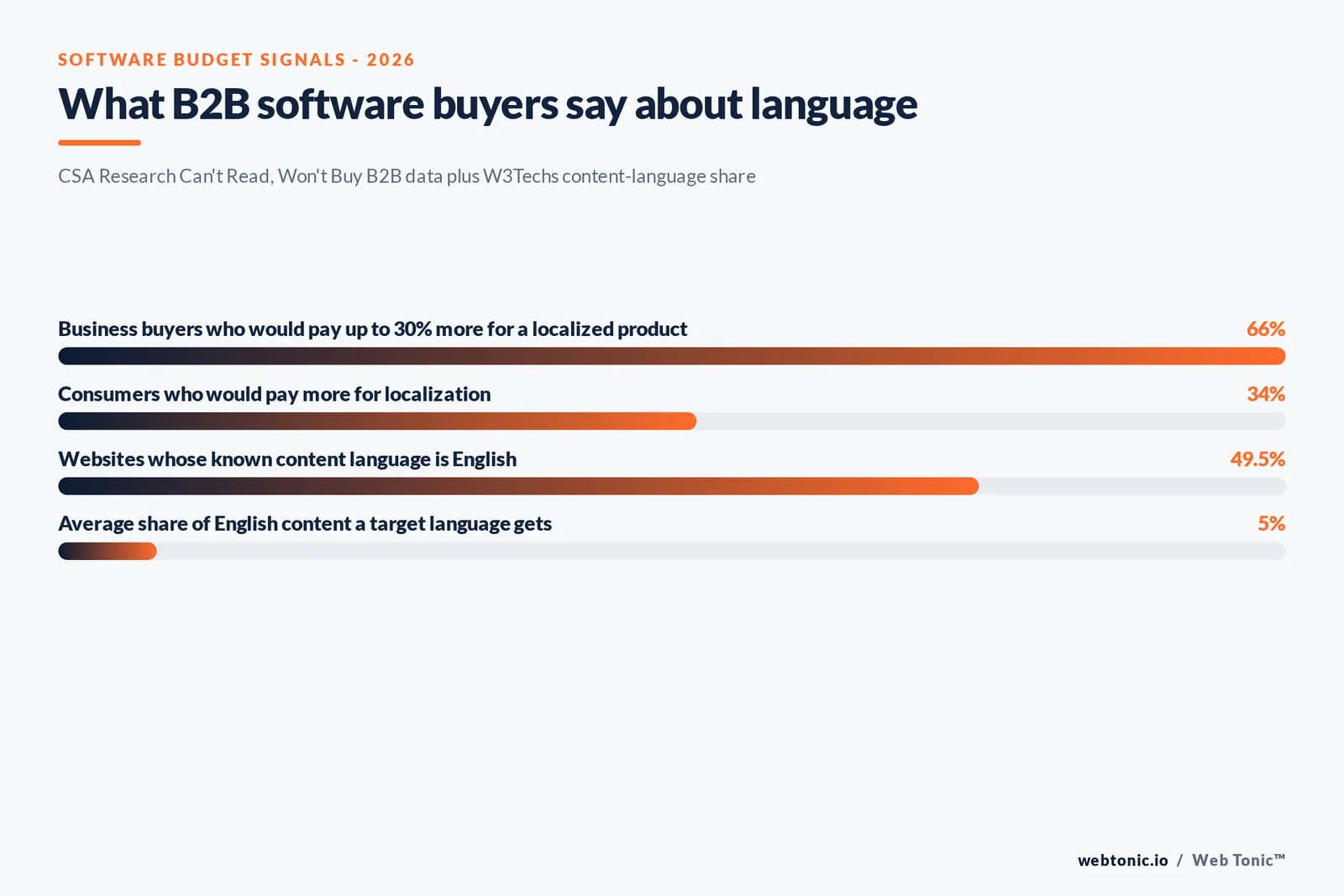
- 66% of business buyers would pay up to 30% more for a localized product (CSA Research).
- Only 34% of consumers said the same, so the B2B case is stronger.
- The B2B dataset covers 1,116 business buyers in 33 countries.
- The average target language gets just 5% of the original site's content.
- 49.5% of websites with a known content language are in English (W3Techs, October 2026).
- 41.5% of companies already use generative engine optimization (The CMO Survey 2026).
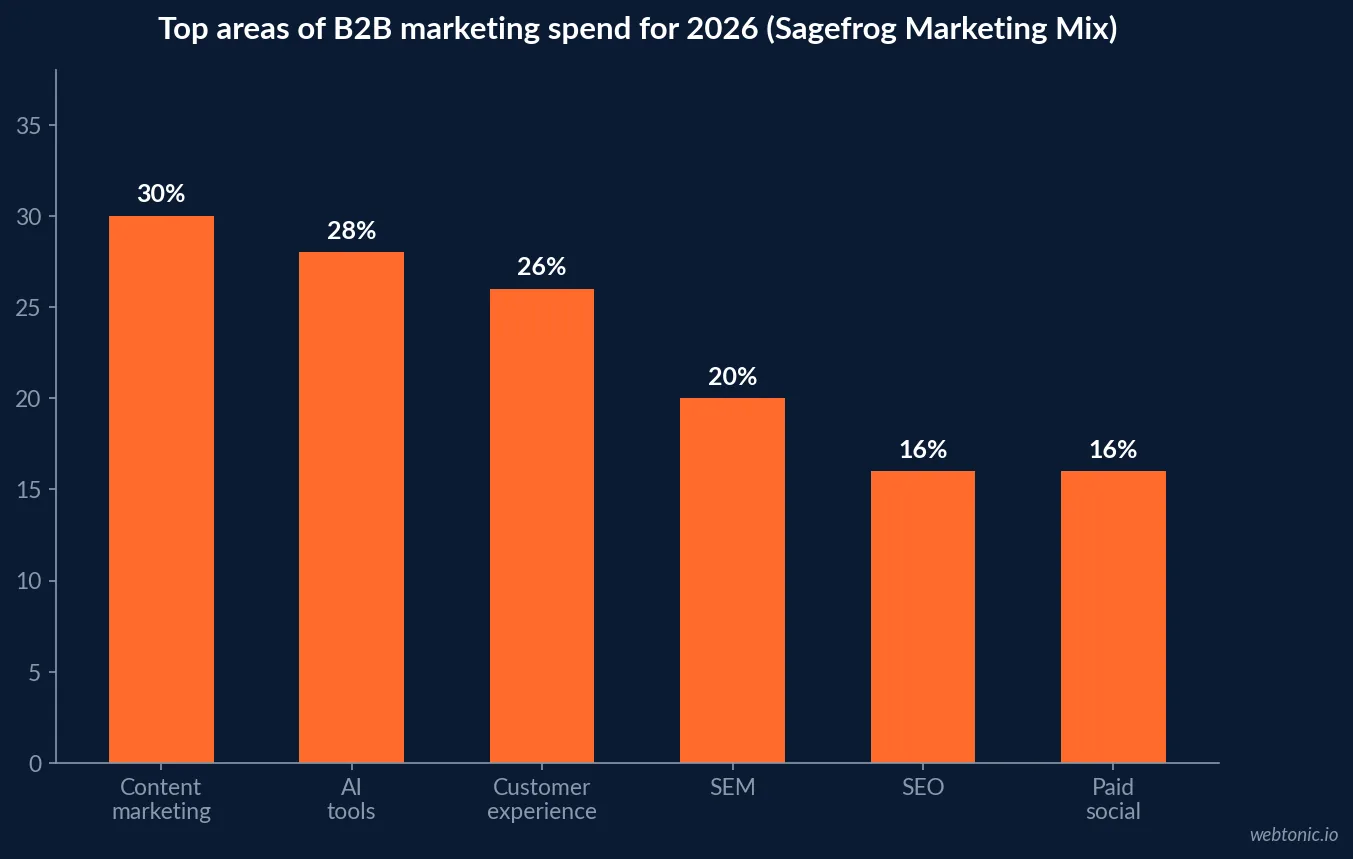
- Content marketing is a top spend area for 30% of B2B marketers, SEO for 16% (Sagefrog 2026).
- Weglot lists USD 87 a month for five translated languages and USD 769 for twenty.
- Bing holds 31.41% of search in Japan and Naver 43.06% in South Korea (Statcounter, September 2026).
B2B SaaS international SEO at a glance
The table pulls the budget-relevant figures into one place. Every row is a third-party figure with its date; none is a Web Tonic estimate.
| Signal | Figure | Source and date | What it tells a SaaS budget owner |
|---|---|---|---|
| Buyers who would pay more for localization | 66% (up to 30% more) | CSA Research, B2B dataset | Localized buying paths can carry a price premium |
| Consumers who would pay more | 34% | CSA Research, B2C dataset | B2B is the stronger localization case |
| Companies using GEO | 41.5% | The CMO Survey 2026 | AI-answer visibility is already budgeted |
| Generative AI share of marketing activity | 22.4% (from 7.0% in 2024) | The CMO Survey 2026 | Translation and drafting costs are falling |
| SEO as a top spend area | 16% | Sagefrog 2026 Marketing Mix | SEO is a mid-table line, not a leader |
| English share of web content | 49.5% | W3Techs, October 2026 | Half the web is written in other languages |
Why no one publishes an international SEO budget benchmark
Budget surveys ask about channels, not markets. Sagefrog's 2026 B2B Marketing Mix lists search engine optimization as a top area of spend for 16% of respondents, behind content marketing at 30%, AI tools at 28% and customer experience at 26%. It does not split SEO by country or language. The CMO Survey 2026 tracks AI use and spending growth but not localization. So the honest answer to "where are budgets headed" is a reading of adjacent lines: content, AI, and search visibility, plus the price of the tools that turn one English site into many.
That matters for planning. A software firm that copies a "percent of budget for international SEO" from a blog round-up is copying a number nobody measured. A better input is the cost of each locale you actually plan to open, which is what the rest of this page prices.
Where B2B spend is moving in 2026
The Sagefrog list shows the shape of the year. Content and AI sit at the top, which is where localized pages are produced. SEM at 20% sits above SEO, and SEO is cited as a leading lead source by only 11% of respondents in the same report. Sagefrog also reports 34% of B2B marketers using AI for SEO optimization. For a SaaS team, the read-through is that international SEO work is likely to be funded from content and AI lines rather than from a dedicated SEO budget.
| Spend area (Sagefrog 2026) | Share naming it a top area | Link to international SEO | Budget question to ask |
|---|---|---|---|
| Content marketing | 30% | Localized pages and documentation | How many locales does the content plan cover? |
| AI tools and applications | 28% | Machine translation and drafting | Who reviews AI output before it ships? |
| Customer experience and journey | 26% | Localized onboarding and checkout | Is billing localized as well as copy? |
| Search engine marketing | 20% | Paid tests before organic investment | Which markets prove demand first? |
| Search engine optimization | 16% | hreflang, locale URLs, local links | Is technical SEO staffed per market? |
| Paid social | 16% | Market seeding | Does it feed the same locale pages? |
The AI-search line is already in the budget
The CMO Survey 2026 reports that generative engine optimization, getting content to appear in AI-generated search results, "is already being used by 41.5% of companies". The same survey puts generative AI at 22.4% of marketing activities in 2026, up from 7.0% in 2024, and companies project AI will account for 55.9% of marketing activities within three years. For international SEO this cuts both ways: translation gets cheaper, while AI summaries reduce clicks in every language.
The click side is measured. Ahrefs found AI Overviews cut the top result's click-through rate by 34.5% in its April 2025 study and by 58% in its February 2026 update on December 2025 data. Pew Research Center saw users click a result on 8% of visits with an AI summary against 15% without one (March 2025 browsing data). Both studies are US and English-language, so treat them as directional for other markets.
Buyer language data for software
CSA Research sourced 1,116 business-buyer respondents through Kantar from 8,498 candidates for its B2B "Can't Read, Won't Buy" analysis, a survey of technology-product buyers. Nearly two-thirds, 66%, said they would pay up to 30% more for a localized product, against 34% of consumers. CSA adds that buyers in countries with high English proficiency, such as Sweden and Germany, were among the most committed to content in their own language. Its B2C press release from July 2020 found 76% of online shoppers prefer to buy products with information in their native language and 40% will never buy from websites in other languages.
| CSA Research finding | Figure | Sample | Implication for a SaaS site |
|---|---|---|---|
| B2B buyers who would pay up to 30% more for localization | 66% | 1,116 business buyers | Localize pricing and trial pages first |
| Consumers who would pay more | 34% | 9,909 consumers | Self-serve, low-ticket products have a weaker case |
| Shoppers preferring native-language information | 76% | 8,709 consumers, 29 countries (2020) | Product pages, not just the homepage |
| Shoppers who never buy from sites in other languages | 40% | 8,709 consumers, 29 countries (2020) | An English-only checkout loses part of the market |
| Content an average target language receives | 5% of the English site | CSA site analysis | Most locales are thin and rank accordingly |
The content gap behind most SaaS locales
CSA's interactive tools page states that "only seven languages receive more than 10% of the content available in English" and that "the average target language gets just 5% of the original site's content". For a software company this is the real budget issue: a German or Japanese subdirectory with a translated homepage and pricing page, but none of the documentation, comparison pages or blog, has little to rank with. The same page says more than 80% of buyers are unlikely to purchase without a localized user interface.
Content supply is the other side. W3Techs reports English is used by 49.5% of websites whose content language it knows, followed by Spanish at 6.0%, German at 5.9%, Japanese at 4.9% and French at 4.5% (October 2026). Half the competitive set in any non-English market is local content you will not see from an English-only keyword tool.
What localization tools list in 2026
Translation proxies are the cheapest way to open a locale, and their prices are public. These are list prices from the vendors' own pages as fetched in October 2026; Weglot states that its USD figures are an estimate based on the euro price.
| Weglot plan | Monthly list price | Translated languages | Word allowance |
|---|---|---|---|
| Starter | USD 17 (EUR 15) | 1 | 10,000 words |
| Business | USD 32 (EUR 29) | 3 | 50,000 words |
| Pro | USD 87 (EUR 79) | 5 | 200,000 words |
| Advanced | USD 329 (EUR 299) | 10 | 1,000,000 words |
| Extended | USD 769 (EUR 699) | 20 | 5,000,000 words |
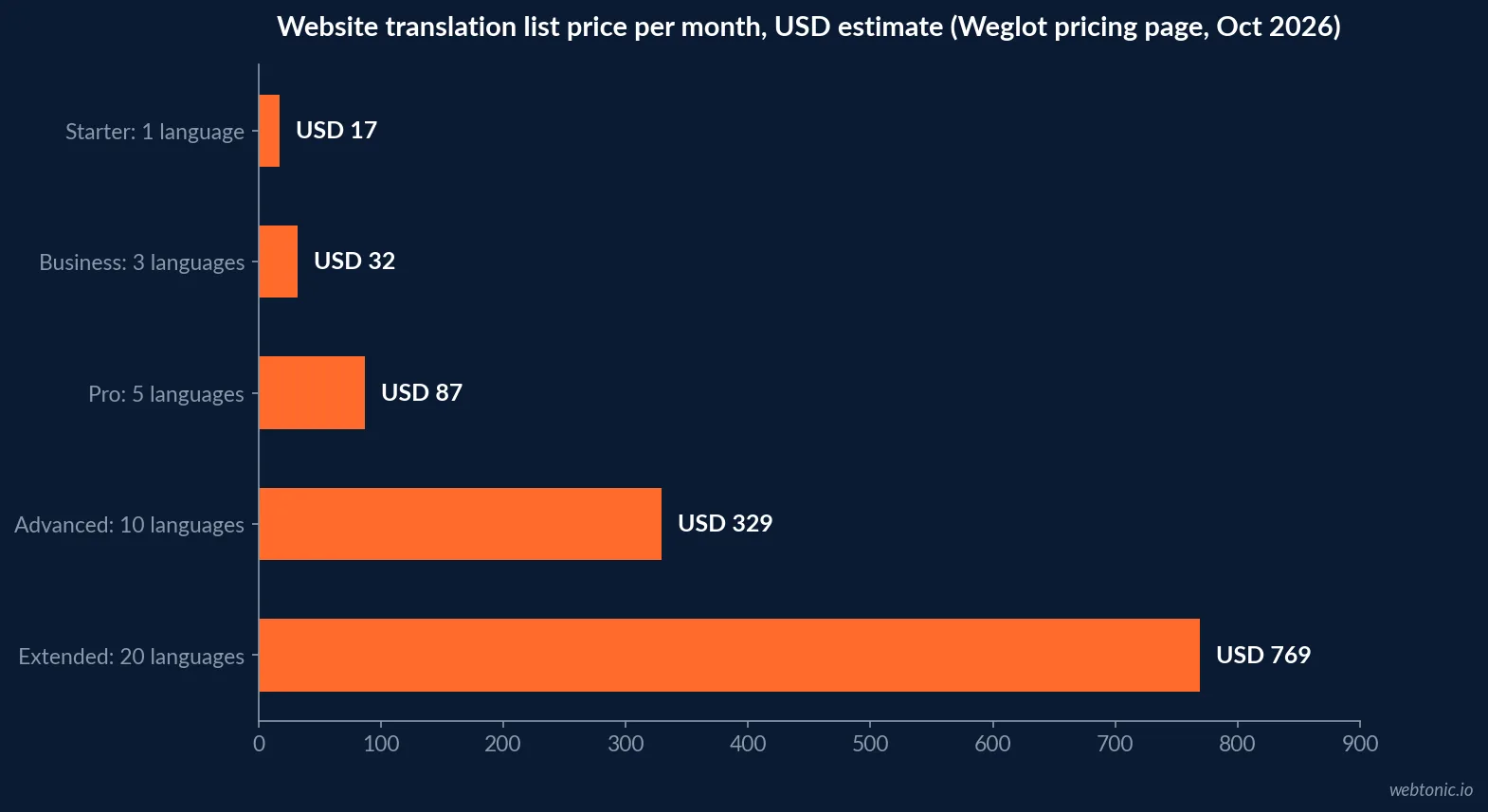
Weglot's pricing page shows the cost curve is driven by words and languages together: the jump from five to ten languages is USD 87 to USD 329 a month because the word allowance rises fivefold. A SaaS site with a large docs section hits word limits before language limits. DeepL Pro lists EUR 7.49 per user a month billed annually for its Individual plan with 300,000 characters, EUR 24.99 for Team and EUR 49.99 for Business with unlimited characters (prices shown for Germany).
SEO tool line items for a multi-market team
Rank tracking in several countries is the second recurring cost. List prices on the vendors' pages (October 2026) are below; both sell annual discounts.
| Tool and plan | Monthly list price | Included tracking | Note |
|---|---|---|---|
| Ahrefs Lite | USD 129 | 750 tracked keywords, 5 projects | 1 user included |
| Ahrefs Standard | USD 249 | 2,000 tracked keywords, 20 projects | Extra users USD 60 each |
| Ahrefs Advanced | USD 449 | 5,000 tracked keywords, 50 projects | Extra users USD 80 each |
| Semrush SEO | USD 139 (USD 117.33 billed annually) | 500 keywords tracked daily | 5 websites to monitor |
A five-locale launch tracking 150 keywords per locale already needs 750 tracked keywords, the full allowance of Ahrefs Lite; a ten-locale plan moves to Standard. Semrush's SEO plan tracks 500 keywords daily. These are the figures to put in a budget request, rather than an unsourced percentage of revenue.
Search engines SaaS teams meet abroad
Most markets are Google markets. Statcounter puts Google at 87.84% in Germany and 85.3% in Canada for September 2026, against 86.1% in the US in August 2026. Three exceptions change the budget: Japan, where Bing holds 31.41%; South Korea, where Naver holds 43.06% against Google's 47.97%; and China, where Baidu holds 46.65% and Google 1.46%.
| Market (Statcounter, Sept 2026) | Main alternative | Planning note | |
|---|---|---|---|
| Germany | 87.84% | Bing 6.49% | Google-first; German-language content gap is the issue |
| Canada | 85.3% | Bing 10.06% | English and French versions for Quebec |
| Japan | 59.27% | Bing 31.41% | Bing Webmaster Tools belongs in the plan |
| South Korea | 47.97% | Naver 43.06% | Naver needs its own presence |
| China | 1.46% | Baidu 46.65% | Separate hosting and engine strategy |
What Google's documentation requires before you spend
Google Search Central recommends "using different URLs for each language version of a page rather than using cookies or browser settings", because Googlebot usually crawls from the USA without an Accept-Language header. Its localized versions guide defines x-default as the value "to match any language not explicitly listed", and asks that newly expanded language pages be linked bidirectionally to the originating language. The Search Console International Targeting report is deprecated; Google says it "will continue to support and use hreflang tags". None of this costs tool money, but all of it costs engineering time, which is the budget line SaaS teams most often forget.
- One URL per locale, no IP or cookie switching.
- hreflang on every version, with return links and an x-default for the selector page.
- One language per page; Google uses visible content, not the lang attribute, to detect language.
- Hyperlinks between language versions instead of automatic redirects.
How to read the direction for your own budget
Put the sources together and the direction is modest but consistent. Spend is moving toward content and AI (30% and 28% top-area shares), AI-search work is already used by 41.5% of companies, and business buyers say localization is worth a premium. Clicks per ranking are falling in AI-heavy result pages. The practical plan is fewer locales done properly rather than many thin ones: CSA's 5% average coverage figure is the warning. Our B2B SaaS enterprise SEO data covers the domestic side, and the enterprise SEO overview covers scale. Teams that want to test demand in a new market before committing content can start with paid search or a growth marketing plan.
Frequently Asked Questions
Is there a benchmark for how much SaaS companies spend on international SEO?
No. None of the 2026 budget surveys we reviewed breaks out international or multilingual SEO as a line. The closest signals are Sagefrog's 2026 B2B Marketing Mix, where SEO is a top spend area for 16% of respondents and content marketing for 30%, and The CMO Survey 2026, where 41.5% of companies already use generative engine optimization. Anything more precise is a guess.
What does it cost to translate a SaaS marketing site?
Machine-plus-editor tools publish list prices. Weglot's pricing page (October 2026) lists USD 17 a month for one language and 10,000 words, USD 87 for five languages and 200,000 words, USD 329 for ten languages and USD 769 for twenty, with USD shown as an estimate of the euro price. DeepL Pro starts at EUR 7.49 per user a month billed annually for 300,000 characters. Human review and in-market content are extra.
Do business buyers really care about language if they read English?
CSA Research says yes. In its Can't Read, Won't Buy B2B dataset of 1,116 business buyers, 66% said they would pay up to 30% more for a localized product, against 34% of consumers. CSA also notes that buyers in high English-proficiency countries such as Sweden and Germany were among the most attached to content in their own language.
Which search engines matter outside the US for software?
Mostly Google, with three big exceptions. Statcounter's September 2026 data shows Bing at 31.41% in Japan, Naver at 43.06% in South Korea and Baidu at 46.65% in China, where Google holds 1.46%. A Korean or Japanese launch therefore needs a second engine in the plan, not just translated pages.
Should a SaaS company use ccTLDs, subdomains or subdirectories?
Google's multi-regional guidance lists trade-offs rather than a winner: country domains give clear geotargeting but are expensive and can only target one country; subdirectories are easy to set up and low maintenance on the same host. Most SaaS sites with one product and one billing system pick subdirectories plus hreflang, but that is an operational choice, not a ranking rule.
Sources
CSA Research - Do B2B buyers value localized experiences?
CSA Research - Consumers prefer their own language (2020)
Sagefrog - 2026 B2B Marketing Mix Report
The CMO Survey - 2026 Highlights and Insights
W3Techs - Content languages
Weglot - Pricing
DeepL - Pro plans
Ahrefs - Pricing
Statcounter - Search engine share
Google Search Central - Multi-regional and multilingual sites
Pew Research Center - AI summaries and clicks


