Table of contents
Only 35% of SMBs have a claimed Google Business Profile, and B2B software buyers are now more likely to open an AI chatbot than Google Maps to research a vendor. Local SEO is not one question for "B2B SaaS and tech" - it is two different answers depending on whether the sale ever touches a physical address.
Key Takeaways
- Only 35% of SMBs have a claimed Google Business Profile (BrightLocal, cross-industry).
- Primary GBP Category is the #1 local ranking factor, scoring 227 of a possible top score (Whitespark 2026).
- Proximity to the searcher ranks second at a score of 225.
- Keywords in the GBP Business Title rank third at 223.
- B2B service companies see 10-12% website-click rates from their profile, against 4-7% all-industry (WebFX).
- B2B services also see 10-15% click-to-call rates, against 5-8% all-industry.
- 51% of B2B software buyers now start research in an AI chatbot more than Google (G2).
- 71% of B2B software buyers use AI chatbots for software research, up from about 60% seven months prior (G2).
- 75% of B2B buyers prefer a rep-free purchase experience (Gartner).
- 97% of consumers read reviews before choosing a business (BrightLocal).
- 41% now say they "always" read reviews, up from 29% a year earlier.
- Google's share of recommendation sources fell from 83% to 71% in one year.
- AI tools rose from 6% to 45% as a recommendation source in the same period.
- Self-service-only buyers are 1.65x more likely to regret a purchase than rep-led buyers (Gartner).
- A rep-plus-digital path is 1.8x more likely to close a high-quality deal than either alone.
Two different "tech" businesses, two different answers
"B2B SaaS and tech" collapses two very different buying journeys into one label. A company selling a pure-play, self-service SaaS product has no storefront, no service van and no address a searcher would ever type "near me" after. A company selling through a regional reseller, a managed service provider, a computer repair counter or a data center with a physical rack room absolutely does. Local SEO answers apply cleanly to the second group and barely apply to the first.
The ranking-factor data below explains why: every signal that decides a Maps result depends on an address existing at all.
| Business shape | Does a Maps result apply? | What decides visibility instead |
|---|---|---|
| Pure-play, self-service SaaS | No - no address to rank | AI-chatbot citation, review sites, organic content |
| SaaS sold via regional field sales | Partially - office location may rank | Combination of digital content and local presence |
| IT reseller / value-added reseller | Yes | Primary GBP category, proximity, reviews |
| Managed service provider (MSP) | Yes | Primary GBP category, proximity, reviews |
| Computer / electronics repair | Yes | Primary GBP category, proximity, reviews |
| Data center / colocation facility | Yes, for the physical site search | Proximity, category, industry citations |
What actually decides a Maps ranking in 2026
Whitespark's 2026 Local Search Ranking Factors report, built from a survey of 47 local SEO experts scoring 187 individual ranking factors, puts Primary GBP Category first at a score of 227, ahead of Proximity of the business address to the point of search at 225 and Keywords in the GBP Business Title at 223. Additional GBP categories and the recency and volume of native Google reviews follow closely behind.
None of the top three factors exist for a business with no physical location to categorize or be near. That is the mechanical reason local SEO underperforms for pure SaaS - not a strategy failure, a missing input.
| Rank | Local pack ranking factor | Whitespark 2026 score | Requires a physical address? |
|---|---|---|---|
| 1 | Primary GBP Category | 227 | Yes |
| 2 | Proximity of Address to Point of Search | 225 | Yes |
| 3 | Keywords in GBP Business Title | 223 | No, but pairs with the above |
| 8 | Additional GBP Categories | 173 | Yes |
| 9 | Quantity of Native Google Reviews (with text) | 170 | No |
| 10 | Proper Placement of the Map Pin | 165 | Yes |
When it does apply, B2B local outperforms the average
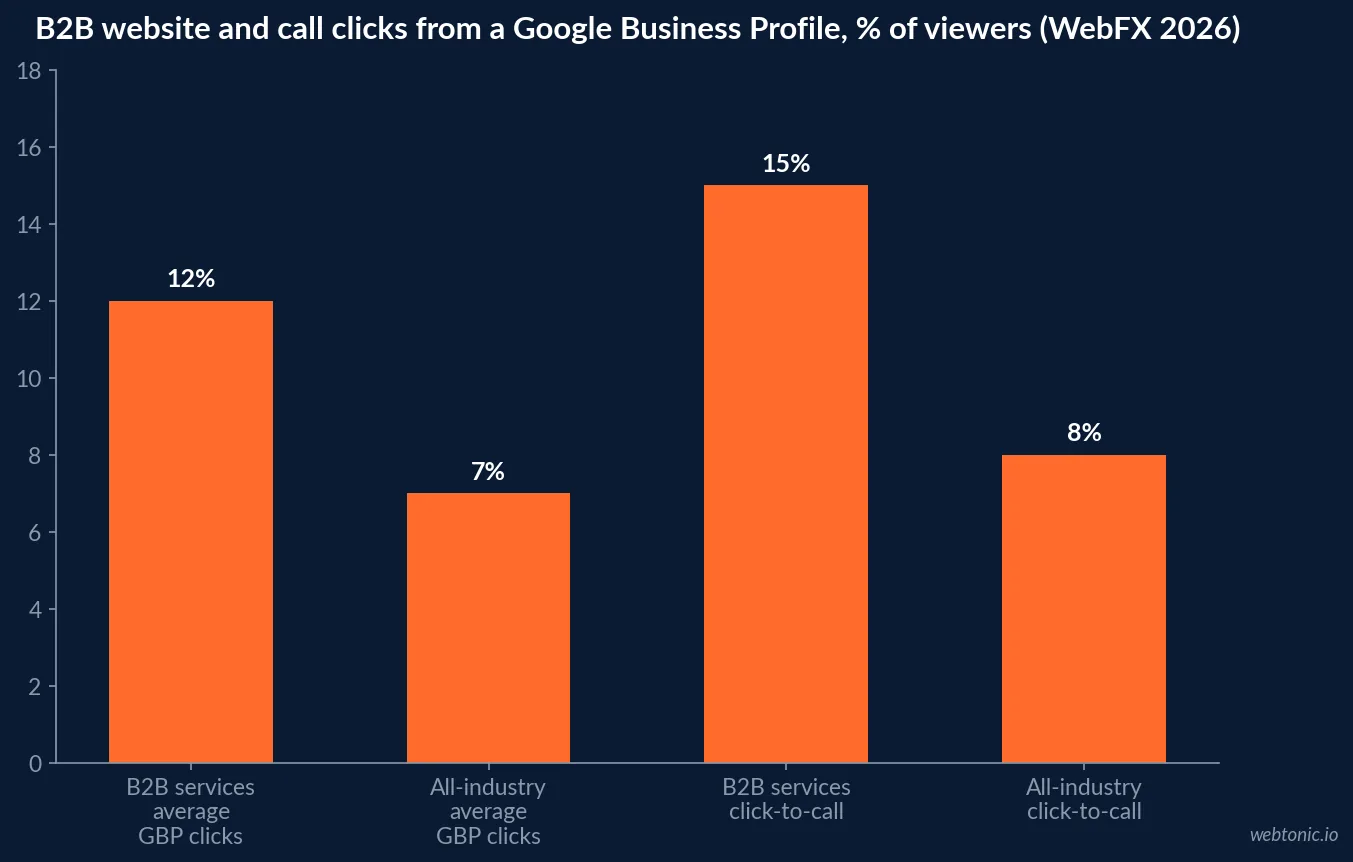
For the tech businesses where a physical presence is genuinely part of the sale, local signals convert unusually well. WebFX's 2026 Google Business Profile benchmarks report that B2B service companies convert 10-12% of profile views into website clicks, against a 4-7% all-industry average, and see 10-15% click-to-call rates against 5-8% generally. A completed, well-categorized profile is doing real acquisition work for an MSP or reseller, not just maintaining a directory listing.
Yet BrightLocal's 2026 research finds only 35% of SMBs have a claimed Google Business Profile at all - a cross-industry figure, but one that leaves an obvious, low-effort gap for any tech company with a real address that has not yet claimed and completed its listing.
| Metric (B2B services vs. all-industry) | B2B services | All-industry average | Source |
|---|---|---|---|
| Website clicks per profile view | 10-12% | 4-7% | WebFX 2026 |
| Click-to-call per profile view | 10-15% | 5-8% | WebFX 2026 |
| SMBs with a claimed GBP listing | n/a | 35% | BrightLocal 2026 (cross-industry) |
| Local 3-pack visibility, average business | n/a | 20-40% of relevant searches | WebFX 2026 (cross-industry) |
Why the pure-SaaS side is moving away from Maps entirely
G2's 2026 AI Search Insight Report finds 51% of B2B software buyers now start vendor research in an AI chatbot more often than in Google, and 71% use AI chatbots for software research at all, up from roughly 60% just seven months earlier. Separately, the Gartner B2B Buying Report puts the share of buyers who prefer a rep-free purchase path at 75%.
Neither behavior routes through a local pack. A SaaS buyer researching in a chatbot or self-serving a trial signup never types a city name, which is exactly why a pure-play SaaS company's local SEO effort is better spent on the citation-and-review signals AI answer engines actually draw from than on Maps-pack mechanics built for a different kind of business.
Reviews are the signal both sides still share
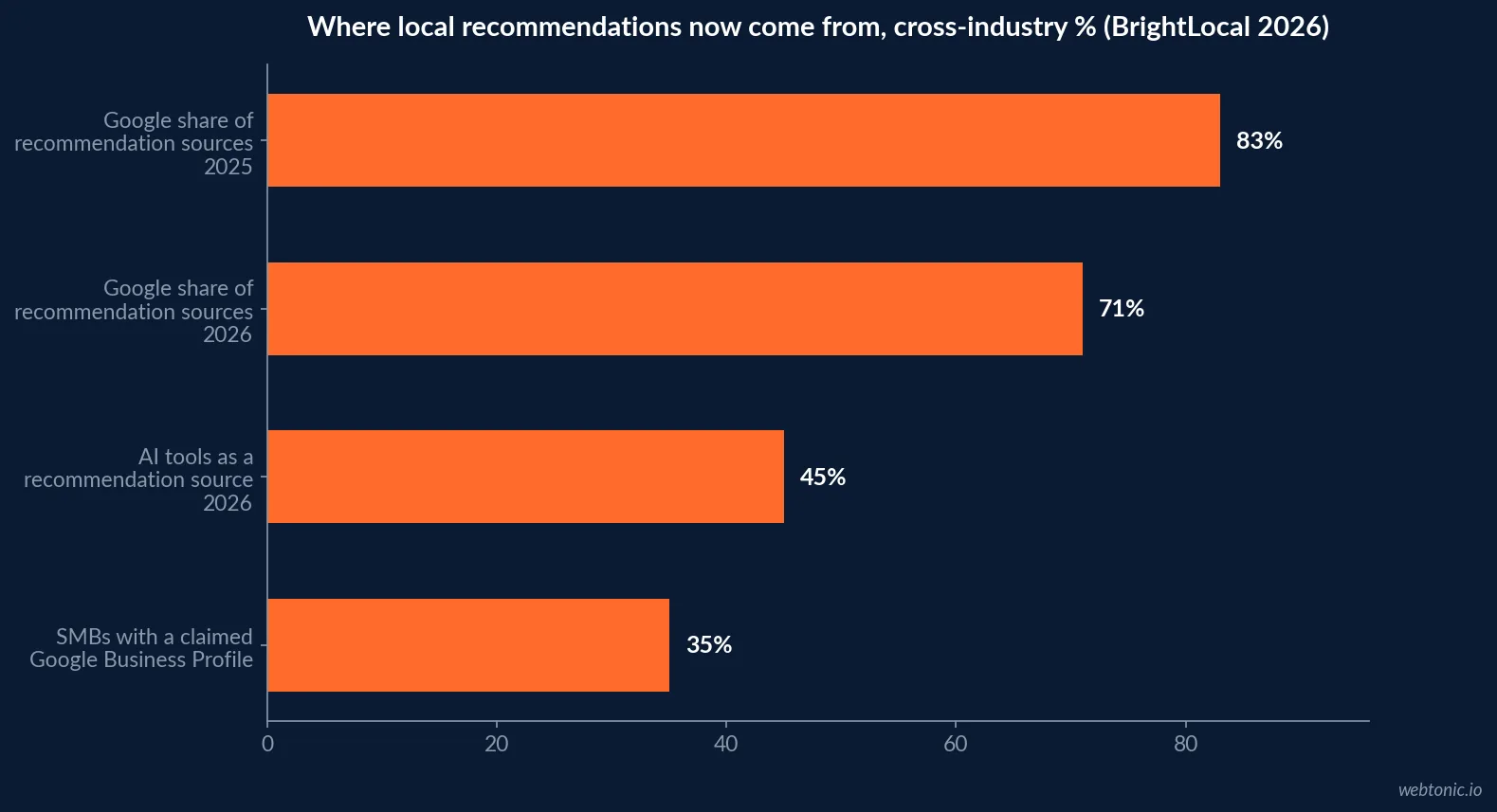
Whether or not a Maps result applies, review signals do not disappear. BrightLocal's 2026 Local Consumer Review Survey found 97% of consumers read reviews before choosing a business and 41% now say they "always" do, up sharply from 29% a year prior. Google's share of where people actually find those reviews fell from 83% to 71% across the same window, while AI tools rose from 6% to 45% as a source - both cross-industry figures, but directionally consistent with what G2 measured specifically among B2B software buyers.
For a tech company with a real address, that means the review strategy has to feed both Google and the AI answer engines now citing review content directly. For a pure SaaS company, it means the G2/Capterra/TrustRadius review layer is doing the trust-signal work a local review profile would do for a business with a storefront.
| Review signal | 2026 figure | Business type it applies to most |
|---|---|---|
| Consumers who read reviews before choosing a business | 97% | Tech businesses with a local footprint |
| Consumers who now 'always' read reviews | 41%, up from 29% | All local B2B/B2C service businesses |
| Software review sites shaping a shortlist | 38%, ahead of AI chatbots' 37% | Pure-play SaaS |
| AI tools as a local recommendation source | 45%, up from 6% | Cross-industry, rising fast |
The cost side of the decision
Local SEO for a multi-location tech reseller or MSP competes against the same budget line as every other lead-generation channel, so it has to be judged on cost per lead, not visibility alone. Our own cross-industry cost-per-lead benchmarks are a useful anchor for that comparison before committing a local budget - a channel that ranks well but produces leads at a worse cost than the alternative is not actually the cheaper option it looks like on a rankings report.
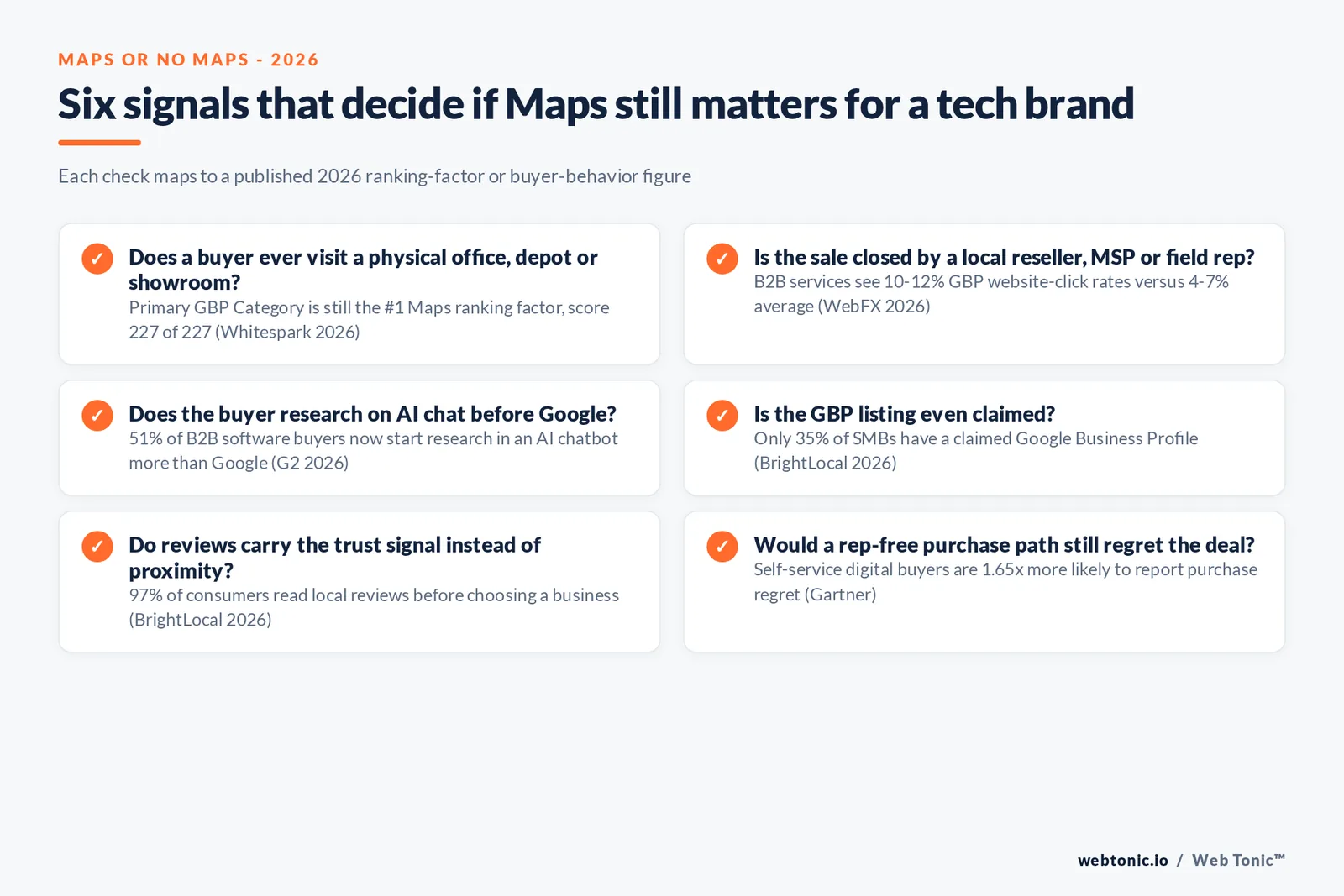
The practical filter is simple: if the sale never requires a buyer to be physically near anything, that budget almost certainly belongs in the citation-and-review layer instead, not in Maps-pack mechanics.
| Question to ask before funding local SEO | If yes | If no |
|---|---|---|
| Does a buyer ever visit, call, or get served by a local address? | Fund GBP, citations, reviews | Skip - redirect budget to organic content |
| Is the GBP profile currently claimed and complete? | Optimize category and reviews next | Claim it first - 65% of SMBs have not |
| Do competitors in the same category rank in the 3-pack? | Local SEO has room to compete | Category may be too thin to matter |
| Are buyers citing AI chatbots over Google for this decision? | Prioritize citation-friendly content | Maps-pack mechanics still apply |
Where the local budget line sits inside the wider marketing mix
Sagefrog's 2026 B2B Marketing Mix Report finds bandwidth (22%) and speed (18%) are the top reasons B2B teams reach outside for marketing work, ahead of cost efficiency at 13% - a pattern that fits local SEO well, since claiming and maintaining dozens of reseller or branch listings is a bandwidth problem long before it is a strategy problem. The CMO Survey 2026 puts overall marketing budgets at 9.0% of revenue with spend growth of only 1.7% - meaning a local program for a multi-location tech business has to compete for a genuinely flat budget, which is another reason to spend it only where the ranking factors above say it will actually move a result.
What this means for a B2B SaaS or tech local strategy
Do not run a Maps-first playbook for a company with no address to be near - the top three ranking factors literally cannot apply. Do run one, and claim the profile today, if any part of the sale touches a physical reseller, service technician or data center rack room; the 10-12% click rate WebFX measured for B2B services is real money left unclaimed by the 65% of SMBs without even a completed listing. Our performance creative team and SEO practice can help decide which side of that line your business actually sits on before you spend a budget on the wrong signal.
Frequently Asked Questions
Does local SEO matter for a pure-play SaaS company?
Rarely as a primary channel. G2's 2026 AI Search Insight Report finds 51% of B2B software buyers now start vendor research in an AI chatbot more often than Google, and Gartner's B2B Buyer Survey puts the share who prefer a rep-free, self-service purchase path at 75%. A SaaS product sold and delivered entirely online has no address for a searcher to be 'near', which is the signal Google Business Profile ranking factors are built around.
Which tech businesses should still invest in local SEO?
Any tech business a buyer visits, calls, or is served by locally: IT resellers and value-added resellers, managed service providers, computer and electronics repair shops, and data center or colocation facilities with a physical address. WebFX's 2026 Google Business Profile benchmarks show B2B service companies converting profile views to website clicks at 10-12%, nearly double the 4-7% all-industry average - proof the channel still performs when a local relationship is actually part of the sale.
What actually decides local Maps rankings in 2026?
Whitespark's 2026 Local Search Ranking Factors survey, compiled from 47 local SEO experts scoring 187 ranking factors, ranks Primary GBP Category first (score 227), Proximity of the business address to the searcher second (225), and Keywords in the GBP Business Title third (223). None of those three factors exist for a company with no address a buyer would search near.
How complete are most small tech businesses' Google listings?
Not very. BrightLocal's 2026 research found only 35% of SMBs have a claimed Google Business Profile at all, a cross-industry figure that almost certainly runs lower still for software-only companies that have never needed one. That leaves a real, low-competition opportunity for the tech businesses that do have a physical service area to claim and complete theirs.
Are reviews replacing proximity as the trust signal for tech buyers?
They are gaining ground. BrightLocal's 2026 Local Consumer Review Survey found 97% of consumers read reviews before choosing a business, with 41% now saying they 'always' check reviews, up from 29% a year earlier. Google's share of where people find those reviews slipped from 83% to 71% in the same period, while AI tools rose from 6% to 45% as a recommendation source - a cross-industry shift, but one B2B tech buyers are following.
Sources
Whitespark - 2026 Local Search Ranking Factors
WebFX - Google Business Profile Benchmarks 2026
BrightLocal - Local Consumer Review Survey 2026
G2 - The Answer Economy: 2026 AI Search Insight Report
G2 - 2026 Buyer Behavior Report: The Evaluation Maze
Gartner - B2B Buying Report
Sagefrog - 2026 B2B Marketing Mix Report
The CMO Survey - Highlights and Insights Report 2026