Table of contents
Median monthly organic traffic across 50 leading SaaS companies sits at 881,000 visits, and the gap between the best- and worst-ranked platforms in the same category runs into the tens of thousands times. This page benchmarks B2B SaaS and tech SEO against real 2026 ranking and funnel data rather than a single blended industry average.
Key Takeaways
- Median monthly organic traffic is 881,000 visits across 50 top SaaS companies, excluding Google and Microsoft.
- The mean is 8.5 million, skewed upward by a handful of massive outliers.
- OpenAI leads at 151.2 million monthly organic visits; MicroStrategy sits at 8,700.
- Median Domain Rating across the cohort is 87, with 21 of 50 companies at DR 90-plus.
- Median ranked-keyword footprint is 32,400 keywords.
- Adobe ranks for 4.3 million keywords, the largest footprint in the cohort.
- OpenAI generates about 650 visits per ranked keyword, the most efficient in the set.
- 45 of 50 companies still run paid search alongside organic.
- LinkedIn converts visitors to leads at 2.20%, the top channel in 2025 data.
- SEO converts at 2.10% visitor-to-lead, just behind LinkedIn.
- Paid search trails at 0.70% visitor-to-lead for B2B SaaS.
- Chemical/Pharmaceutical SaaS converts visitors to leads at 2.3%, the top SaaS vertical measured.
- Telecom SaaS converts at just 0.9%, the lowest vertical measured.
- Free-trial-to-paid conversion ranges from 5.5% to 12.6% depending on vertical.
- 75% of B2B buyers prefer a rep-free purchase experience (Gartner).
- 51% of B2B software buyers now start research in an AI chatbot more than Google (G2).
- 71% of B2B software buyers use AI chatbots for software research, up from roughly 60% (G2).
- Website/blog/SEO is the #1 B2B marketing channel by usage at 48.4% (HubSpot).
What "good" organic traffic looks like for a real SaaS company
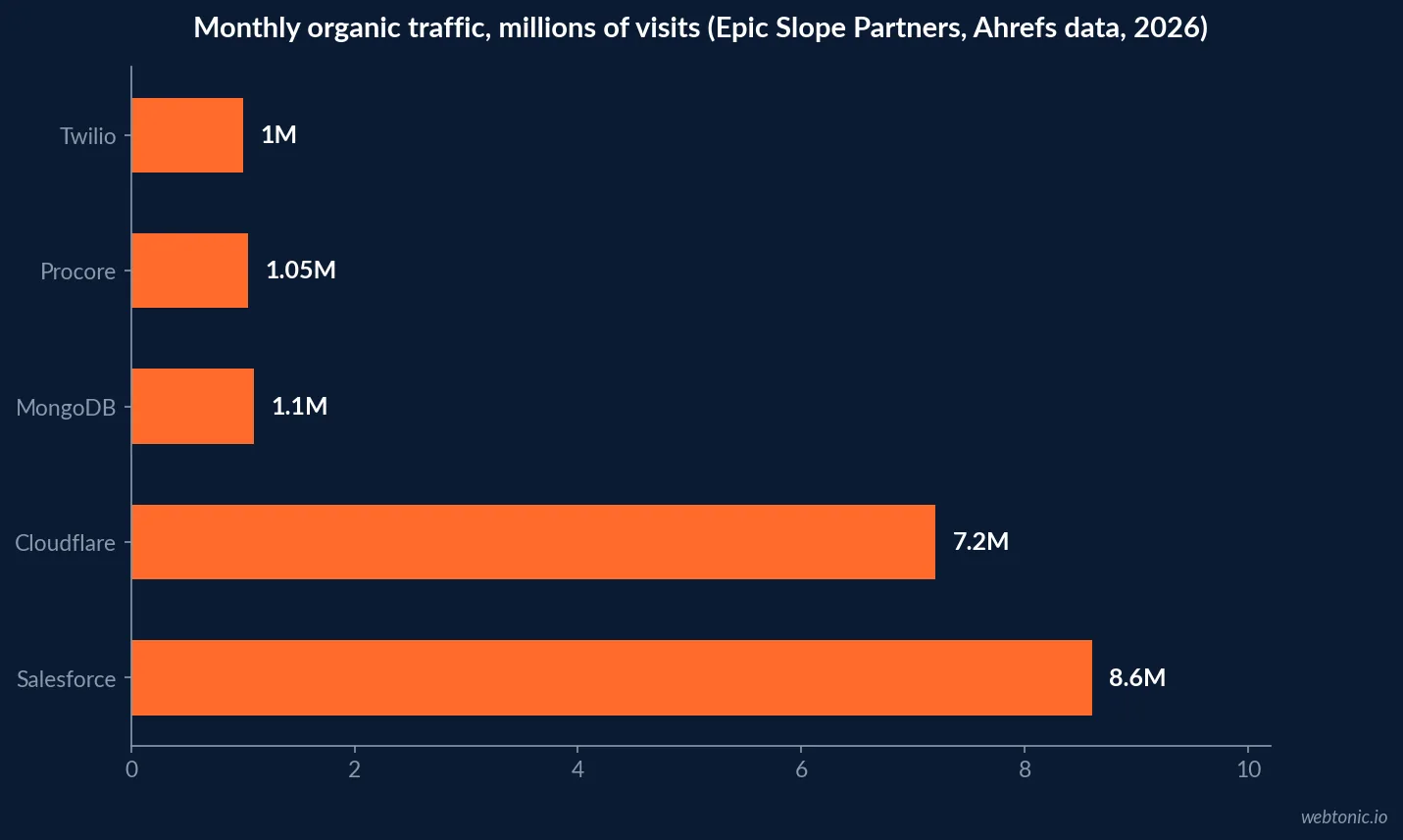
Most SaaS SEO benchmarks quote an average that a handful of category-defining platforms distort beyond usefulness. Epic Slope Partners pulled Ahrefs ranking data for 50 leading SaaS companies in February 2026 and reported the more honest number: excluding Google and Microsoft, median monthly organic traffic is 881,000 visits, against a mean of 8.5 million pulled upward by outliers like OpenAI at 151.2 million monthly visits and Adobe at 126.0 million.
At the other end of the same 50-company set, MicroStrategy draws roughly 8,700 organic visits a month, SS&C Technologies about 14,000, and FICO around 36,700 - all large, well-known B2B tech companies that simply have not treated organic search as a primary acquisition channel.
| Company | Organic traffic / month | Ranked keywords | Domain Rating |
|---|---|---|---|
| OpenAI | 151.2M | 232.7K | 93 |
| Salesforce | 8.6M | 276.5K | 92 |
| Cloudflare | 7.2M | 159.1K | 93 |
| MongoDB | 1.1M | 24.0K | 90 |
| Procore | 1.05M | 88.9K | 82 |
| MicroStrategy | 8.7K | 3.5K | 80 |
Domain authority buys a ceiling, not a result
The 50-company cohort's median Domain Rating is 87, and 21 of 50 companies carry a DR of 90 or higher - authority is not where this group differs. Traffic outcomes still span three orders of magnitude. F5, at DR 93, generates about 306,000 monthly visits while MicroStrategy, at DR 80, generates roughly 8,700. Authority sets the range of what is reachable; keyword coverage and content investment decide what a company actually claims inside it.
Keyword footprint tells the more useful story. The cohort's median ranked-keyword count is 32,400, with Adobe ranking for 4.3 million keywords at the high end and several companies, including FICO, ranking for fewer than 5,000.
| Efficiency metric | Leader | Figure | What it signals |
|---|---|---|---|
| Traffic per ranked keyword | OpenAI | ~650 visits/keyword | Brand-demand concentration, not breadth |
| Traffic per ranked keyword | Zoom | ~157 visits/keyword | Strong topical relevance at scale |
| Keyword breadth | Adobe | 4.3M keywords | Covers the widest topic surface in the cohort |
| Keyword breadth (low end) | Several cos. incl. FICO | Under 5,000 keywords | SEO is not a stated priority channel |
| Paid search overlap | 45 of 50 companies | 90% run paid search | Organic rarely stands entirely alone |
Which channel actually opens the funnel
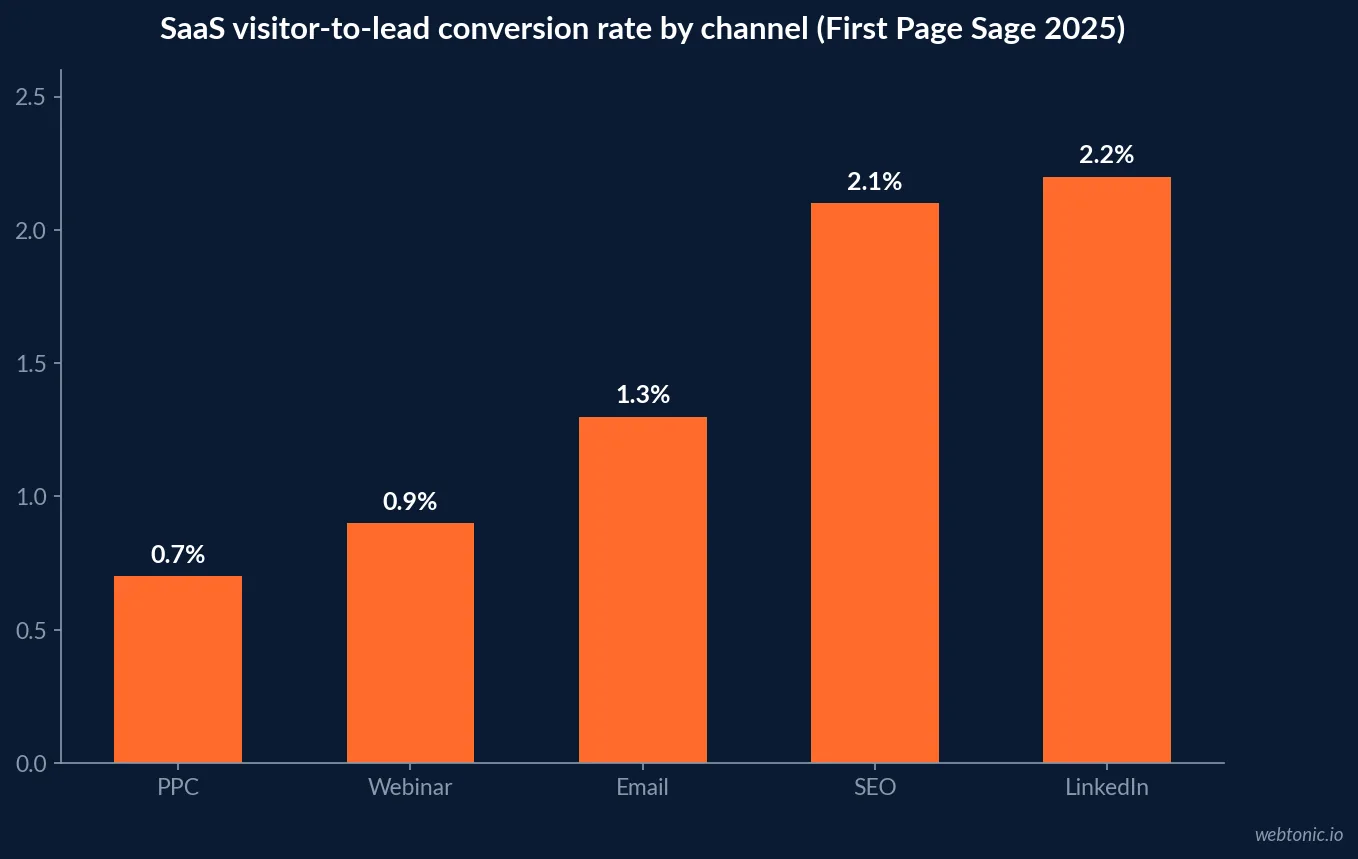
First Page Sage's 2025 benchmark, drawn from anonymized client data collected between 2017 and 2025, puts LinkedIn first for visitor-to-lead conversion at 2.20%, with SEO close behind at 2.10%. Email holds 1.30% and webinar traffic converts at 0.90%, while PPC trails the group at 0.70%.
Deeper in the funnel the ranking shifts: email leads convert lead-to-MQL at 43%, ahead of every other channel measured, which is why the two channels are usually paired rather than pitted against each other.
| Channel | Visitor to lead | Lead to MQL | MQL to SQL | Opportunity to close |
|---|---|---|---|---|
| 2.20% | 38% | 30% | 39% | |
| SEO | 2.10% | 41% | 51% | 36% |
| 1.30% | 43% | 46% | 32% | |
| Webinar | 0.90% | 44% | 39% | 40% |
| PPC | 0.70% | 36% | 26% | 35% |
Full-funnel conversion varies sharply by SaaS vertical
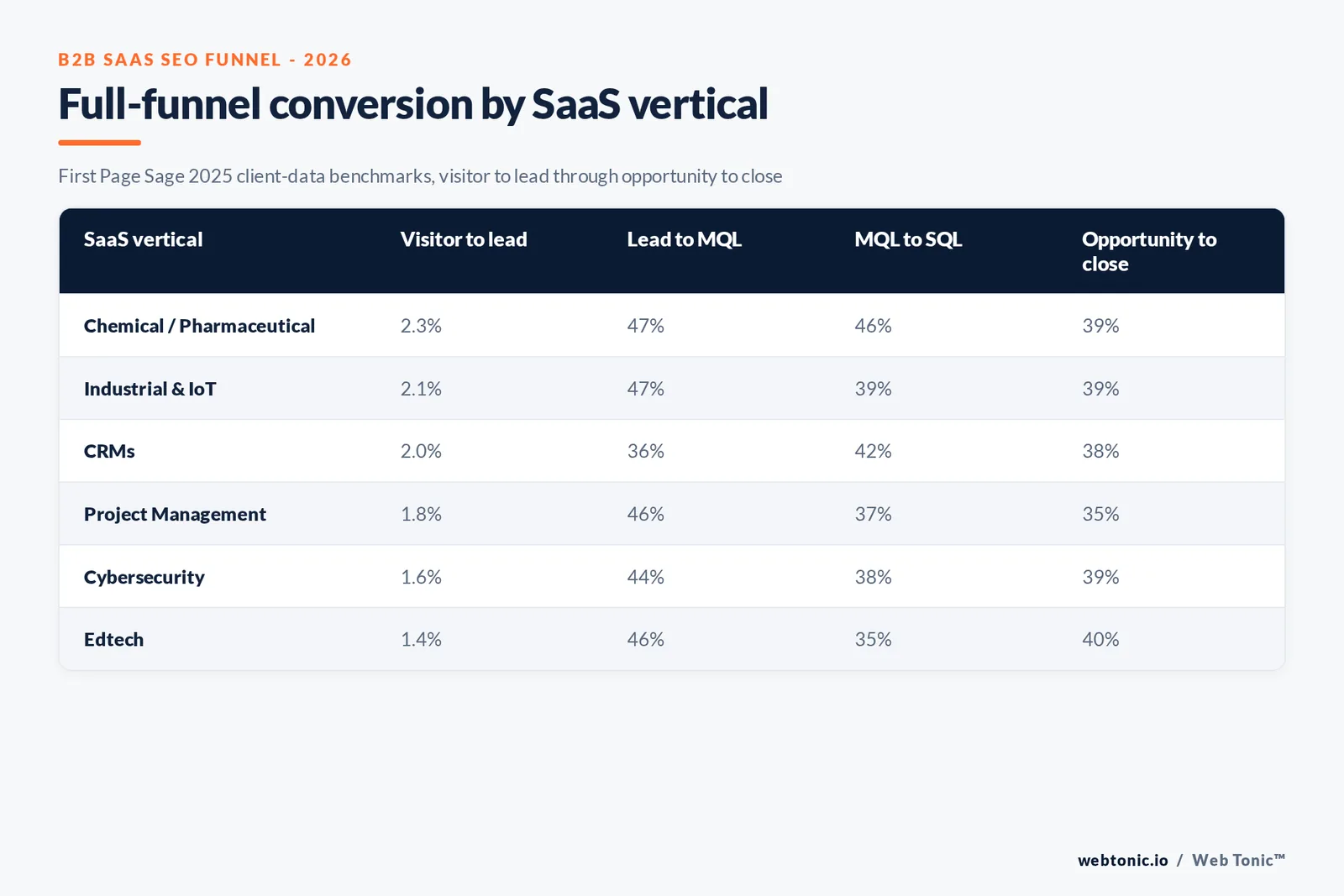
Blending every SaaS vertical into one benchmark hides more than it reveals. First Page Sage's full-funnel breakdown shows Chemical/Pharmaceutical SaaS converting visitors to leads at 2.3%, the strongest vertical in the set, against Telecom SaaS at just 0.9% and Design SaaS at 0.9% - a spread wide enough to make a single "SaaS average" close to meaningless for planning a content program.
| SaaS vertical | Visitor to lead | Lead to MQL | MQL to SQL | Opportunity to close |
|---|---|---|---|---|
| Chemical / Pharmaceutical | 2.3% | 47% | 46% | 39% |
| Industrial & IoT | 2.1% | 47% | 39% | 39% |
| CRMs | 2.0% | 36% | 42% | 38% |
| Retail / eCommerce (SaaS) | 2.1% | 41% | 36% | 39% |
| Edtech | 1.4% | 46% | 35% | 40% |
| Telecom | 0.9% | 46% | 35% | 36% |
Free trial and freemium conversion follow their own pattern
Below the visitor-to-lead line, First Page Sage's freemium and free-trial data shows the widest spread of any funnel stage measured. Environmental/CleanTech SaaS converts free trials to paid at 11.1% and IoT at 12.6%, while Enterprise SaaS converts at only 5.5% - a function of deal size and procurement complexity rather than product quality.
| SaaS category | Free trial to paid | Visitor to freemium | Freemium to paid |
|---|---|---|---|
| IoT | 12.6% | 25.2% | 15.5% |
| Healthcare / Medtech | 12.3% | 21.5% | 15.3% |
| Environmental / CleanTech | 11.1% | 22.9% | 12.9% |
| CRM | 9.7% | 29.0% | 12.8% |
| Enterprise | 5.5% | 18.6% | 11.8% |
Why SEO's weight is rising as reps get skipped
The Gartner B2B Buyer Survey puts the share of B2B buyers who say they prefer a rep-free purchase experience at 75%. Separately, G2's 2026 AI Search Insight Report finds 71% of B2B software buyers now rely on AI chatbots for software research, up from roughly 60% seven months earlier, and 51% start that research in an AI chatbot more often than in Google.
Both findings route the buyer to indexed, ranked, citable content before any rep enters the deal - which is precisely the material a SEO program builds and the material generative engines pull answers from. G2's 2026 Buyer Behavior Report adds that review sites now edge out AI chatbots for shaping a shortlist, at 38% versus 37%, meaning organic visibility and third-party proof are converging into one channel rather than splitting into two.
Where B2B SaaS SEO sits in the wider channel mix
HubSpot's 2026 State of Marketing data confirms the pattern: website/blog/SEO is the top B2B marketing channel by usage at 48.4% of B2B marketers, ahead of email marketing at 39.3% and organic social at 38.6%. By reported ROI, SEO again ranks first at 30.2%, ahead of email marketing at 23.6%.
Read alongside Benchmarkit's CY-2025 benchmarks - median B2B SaaS growth has compressed from 30% to 20% year over year - the case for compounding, low-marginal-cost organic traffic only strengthens as paid acquisition gets more expensive relative to the growth it buys.
The paid-search overlap most SaaS teams don't expect
A common assumption is that companies with strong organic SEO drop paid search once rankings mature. Epic Slope Partners' data says otherwise: 45 of the 50 companies studied still run paid search alongside organic, even at massive organic scale. Google itself runs ads on over 28,100 paid keywords, and Adobe appears on roughly 45,700 paid keywords despite ranking organically for 4.3 million terms. The pattern holds across the cohort: organic and paid are treated as complementary coverage for different query intents, not as a sequence where one replaces the other once it "works."
For a B2B SaaS team budgeting a first serious SEO investment, that overlap is a useful expectation to set early - a mature organic program does not mean a shrinking paid budget, it means a paid budget that can get more selective about which terms it still needs to buy.
| Paid/organic overlap signal | Figure | What it implies |
|---|---|---|
| Companies in the cohort still running paid search | 45 of 50 | Organic maturity doesn't retire paid spend |
| Google's own paid keyword count | 28,100+ | Even the dominant organic player still buys terms |
| Adobe's paid keyword count | ~45,700 | Paid fills gaps a 4.3M-keyword organic footprint leaves open |
| Microsoft's paid keyword count | ~6,700 | Smaller paid footprint, still present |
What this means for a B2B SaaS SEO program
Benchmark against the 440,000 to 1.8 million monthly-visit middle of the cohort, not the headline average pulled up by category-defining platforms. Build keyword breadth deliberately rather than trusting domain authority alone to carry traffic, and size funnel expectations against your own vertical's published range rather than a blended SaaS number. Our growth marketing practice builds that vertical-specific benchmarking before a content plan is written, and our guide to what paid search actually costs is a useful companion when deciding how much of the mix organic should carry.
If AI-chatbot and review-site discovery keep compounding at the rate G2 measured this year, a SaaS SEO program increasingly has to write for the citation, not only the click. Talk to us about auditing where your content already ranks and where it is invisible to both.
Frequently Asked Questions
What is a good organic traffic benchmark for a B2B SaaS company?
Epic Slope Partners' 2026 Ahrefs-based analysis of 50 leading SaaS companies puts median monthly organic traffic at 881,000 visits once Google and Microsoft are excluded as outliers. The mean is far higher, 8.5 million, because a handful of platforms drive most of the volume - OpenAI alone pulls 151.2 million. A mid-market B2B SaaS company should benchmark against the 440,000 to 1.8 million range, not the headline average.
Does domain authority guarantee SaaS organic traffic?
No. The median Domain Rating across the 50-company cohort is 87, and 21 of 50 carry a DR of 90 or higher, yet traffic outcomes still vary by orders of magnitude. MicroStrategy holds a DR of 80 and draws roughly 8,700 visits a month; F5, at DR 93, draws about 306,000. Epic Slope Partners' data shows authority sets a ceiling, not a floor - keyword coverage and content investment decide what happens inside it.
Which acquisition channel converts best for B2B SaaS?
First Page Sage's 2025 client-data benchmarks put LinkedIn first for visitor-to-lead conversion at 2.20%, with SEO close behind at 2.10%. Email converts leads deeper into the funnel more reliably (43% lead-to-MQL), while paid search trails both at 0.70% visitor-to-lead. SEO's advantage is compounding reach at a cost that doesn't scale with volume, which is why it usually anchors the channel mix rather than replacing it.
Do full-funnel conversion rates vary by SaaS vertical?
Substantially. First Page Sage's full-funnel data across SaaS verticals shows Chemical/Pharmaceutical SaaS converting visitors to leads at 2.3% against Telecom SaaS at 0.9% - a 2.5x spread inside the same broad category. Free-trial-to-paid conversion swings even more: Environmental/CleanTech SaaS converts at 11.1% against Enterprise SaaS at 5.5%. Benchmark against your own vertical, not a blended SaaS average.
Why does SEO matter more when buyers avoid sales reps?
Gartner's B2B Buyer Survey puts the share of B2B buyers who prefer a rep-free purchase experience at 75%, and G2's 2026 AI Search Insight Report finds 51% of B2B software buyers now start vendor research in an AI chatbot more often than Google. Both trends route buyers to ranked, indexed content before a rep ever enters the deal - which is exactly the content SEO produces and generative engines cite.
Sources
Epic Slope Partners - SaaS SEO Benchmark Report 2026 (Ahrefs data)
First Page Sage - Sales Funnel Conversion Rate Benchmarks Report 2025
First Page Sage - Average SaaS Conversion Rates 2026 Report
G2 - The Answer Economy: 2026 AI Search Insight Report
G2 - 2026 Buyer Behavior Report: The Evaluation Maze
Gartner - B2B Buying Report
HubSpot - Top Marketing Channels of 2026
Benchmarkit - CY-2025 B2B SaaS Performance Metrics Benchmarks