Table of contents

A buyer relocating to Miami or New York doesn't start with a phone call. They start with a search: "best real estate agent in [neighborhood]," "homes for sale near me," or increasingly, a question typed straight into an AI assistant. Whoever shows up in that moment gets the lead. Everyone else is competing for whatever's left.
SEO for real estate is the work of making sure your name, your listings, and your website are the ones that show up. It combines local SEO, a fully built-out Google Business Profile, neighborhood-specific content, and increasingly, visibility inside AI-generated answers. Real estate is one of the most searched-for categories online, and one of the least optimized, which is exactly why the opportunity is still wide open.
Key Takeaways
- Organic SEO leads close at roughly 14.6 percent, compared to just 1.7 percent for outbound leads (Sierra Interactive, citing NAR's 2025 Profile of Home Buyers and Sellers), a gap that compounds significantly the longer a site has been ranking.
- Local search drives over 70 percent of leads for real estate agents (Designing It, 2026), and your Google Business Profile alone accounts for more than 30 percent of map pack visibility.
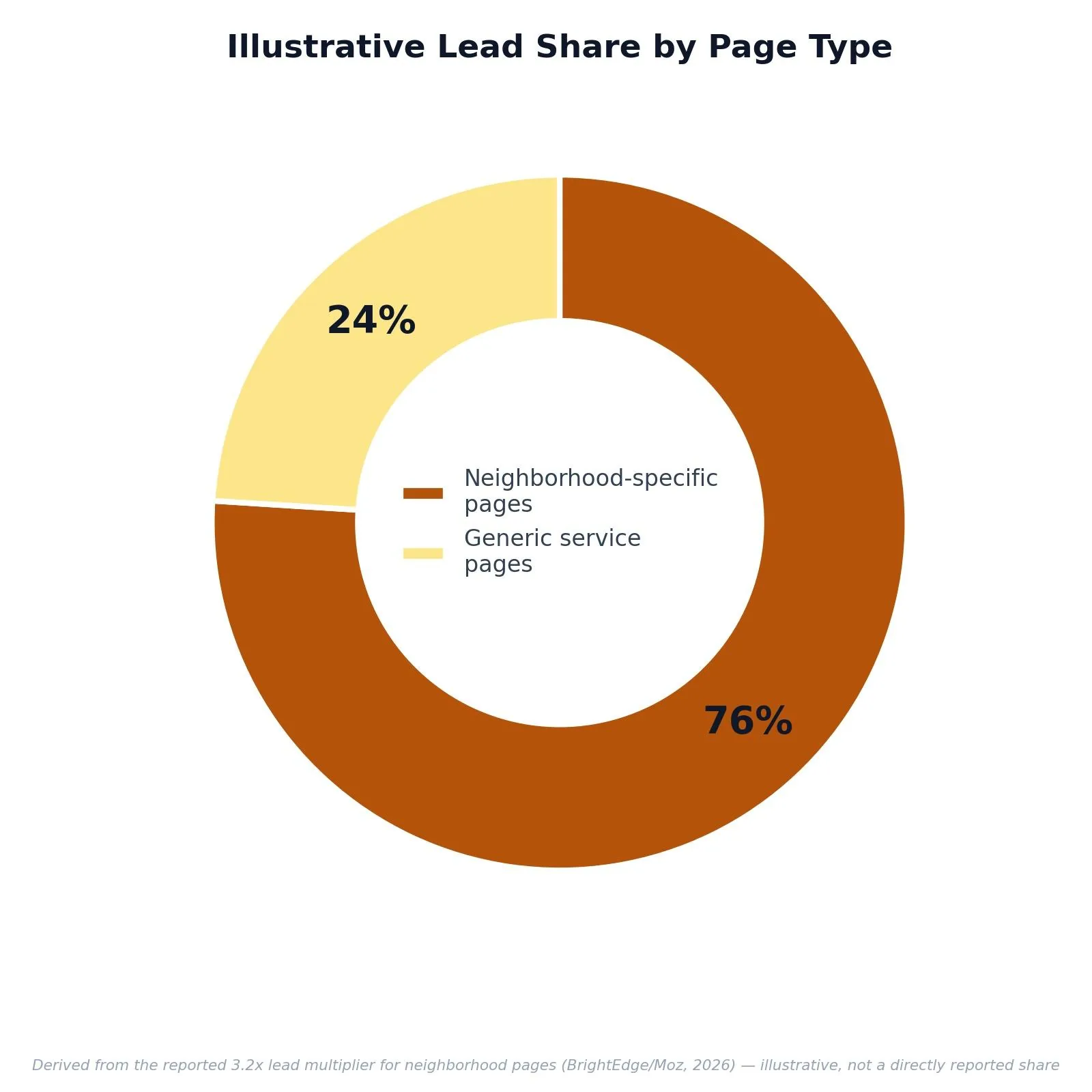
- Neighborhood-specific pages generate roughly 3.2 times more leads than generic "areas we serve" pages, and rank an estimated 28 percent higher (BrightEdge/Moz, via Deal Machine OS 2026). Agents with 20 or more Google reviews get 2.7 times more leads than agents with fewer than 5 (BrightLocal 2026).
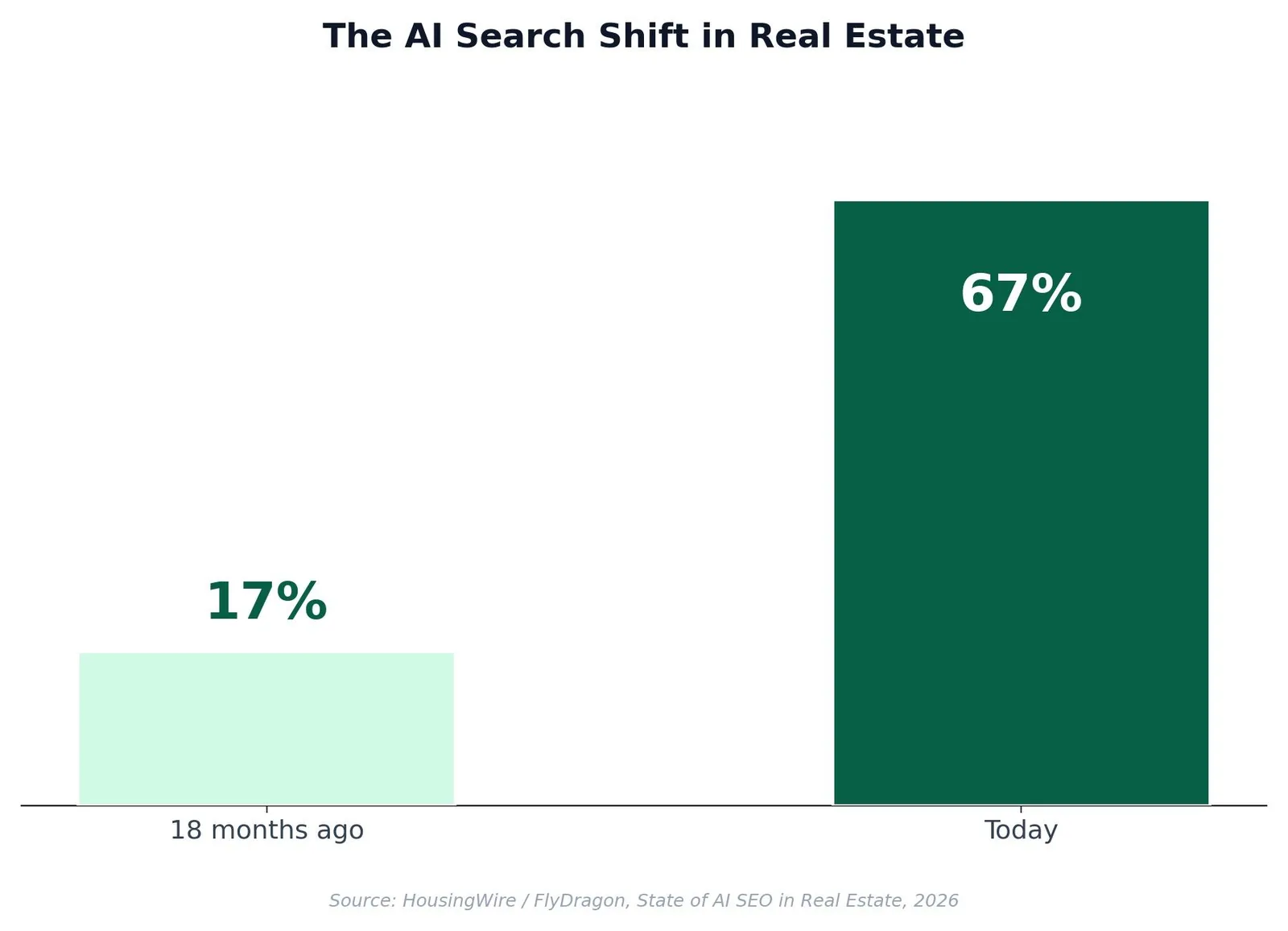
- AI tools are reshaping the top of the funnel fast: 67 percent of homebuyers now use an AI tool as a primary research method, up from just 17 percent about 18 months ago, though only 8.4 percent of agents currently appear in AI-generated search responses (HousingWire/FlyDragon, State of AI SEO in Real Estate, 2026).
- Combining SEO with paid search produces the strongest results: agents running both together see roughly a 3.1x return on investment, higher than either channel alone.
What Is SEO for Real Estate?
SEO for real estate, short for search engine optimization, is the process of optimizing an agent, broker, or agency's website and online presence so it ranks when buyers and sellers search for homes, agents, or market information in a specific area. Almost every real estate search carries local intent, "homes for sale in [city]," "best realtor near me," which means a national ranking strategy misses the point entirely. What matters is dominating a specific market, not the word "real estate" nationwide. The same logic applies to real estate investors and property managers targeting deal-sourcing searches like "sell my house fast," not just traditional buyer- and seller-side agents.
That local-first structure shapes where the effort goes. A fully built-out Google Business Profile, consistent name-address-phone (NAP) data, neighborhood-level content, and a steady stream of client reviews all matter more than chasing broad, high-volume keywords that a national portal like Zillow or Realtor.com already dominates.
Why Local Search Decides Who Gets the Listing
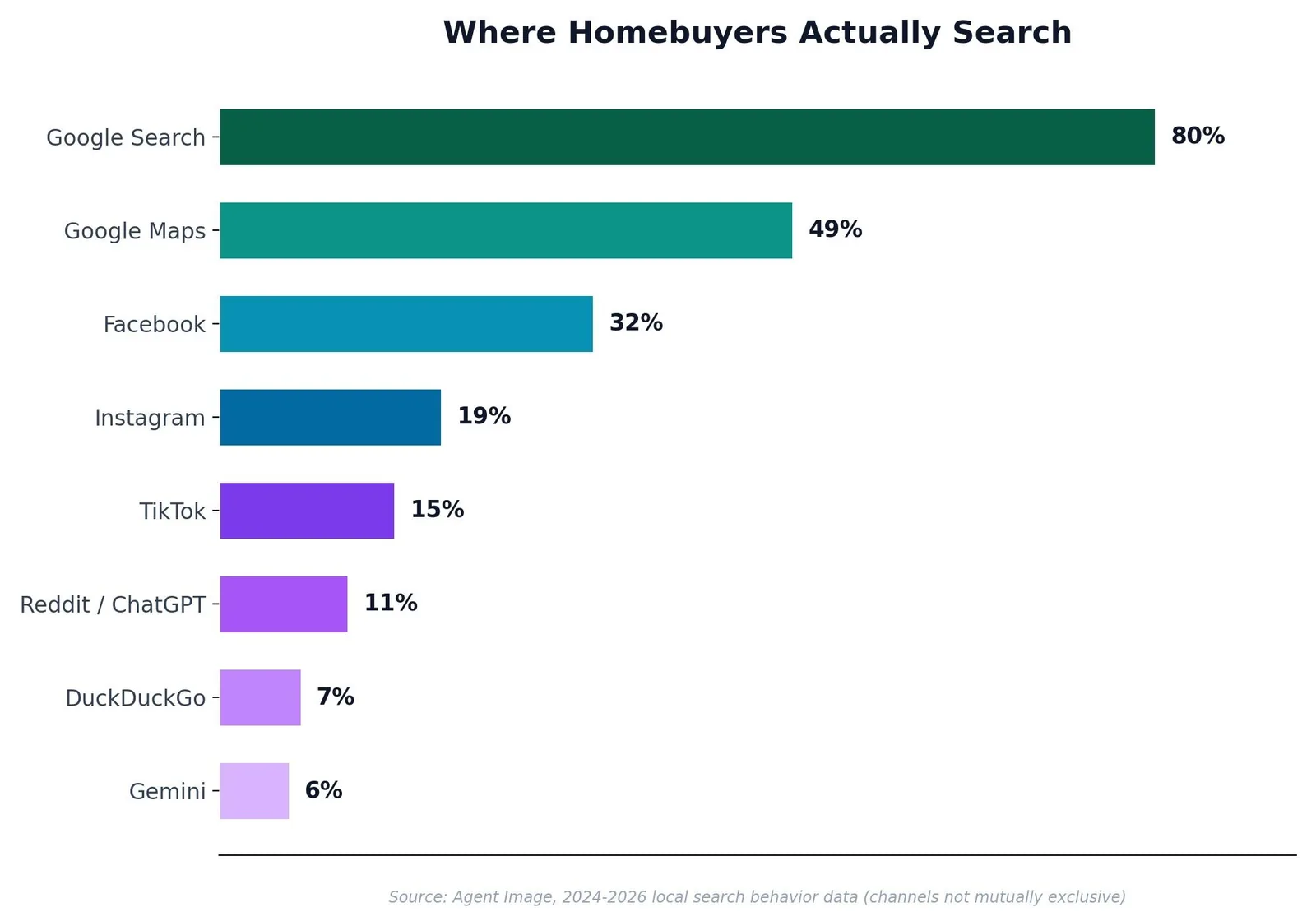
Google still leads the way homebuyers search, but it's not the whole picture anymore. Roughly 80 percent of people use Google Search to find local businesses, and 49 percent rely on Google Maps, according to recent local-search behavior data. Social platforms play a real supporting role too: Facebook sits at 32 percent, Instagram at 19 percent, and TikTok at 15 percent, while Reddit and ChatGPT are now tied at 11 percent as buyers turn to forums and AI tools for recommendations.
That spread puts real weight on the Google Business Profile: it's often the first real touchpoint a prospective client has with an agent, ahead of the website itself. Profiles with complete information, accurate categories, and active posting consistently outperform ones set up once and forgotten, and the same social media presence that builds local trust also supports a stronger overall user experience across every channel a prospect touches.
SEO vs. Google Ads for Real Estate Lead Generation
| Factor | SEO (organic) | Google Ads (PPC) |
|---|---|---|
| Cost model | Time investment in content, GBP, and reviews | Cost-per-lead (CPL), billed per click |
| Typical cost | Time-based; no direct per-lead cost | USD $150 to $400 CPL for seller-intent keywords in mid-sized markets |
| Lead close rate | ~14.6% for organic SEO leads | Varies by campaign quality and keyword intent |
| Time to results | Weeks to months; compounds over time | Immediate, live same day |
| Longevity | Content and rankings keep working after publication | Stops the moment ad spend stops |
| Best fit | Long-term, compounding lead flow in a specific market | Filling pipeline gaps or targeting high-intent seller keywords fast |
Given that the average gross commission on a single closed listing runs USD $10,000 to $18,000, even a USD $400 cost-per-lead on Google Ads can pencil out, especially paired with organic SEO working in parallel. That combined approach is where the 3.1x ROI figure in the Key Takeaways comes from.
The Real Estate Local SEO Roadmap
Step 1: Claim and fully optimize your Google Business Profile
Complete every field, verify your address, choose "Real Estate Agent" or "Real Estate Agency" as your primary category, and post regularly. Your Google business profile is the single largest local ranking signal available to an individual agent.
Step 2: Build dedicated neighborhood pages, not one generic "areas we serve" page
A page built around "[Neighborhood] Real Estate Market Report 2026" or "Moving to [City]: What You Need to Know" captures long tail keywords a blended page never will, and the data shows it converts substantially better.
Step 3: Build a consistent, genuine review cadence
Request a review from every closed client within a week of closing, while the experience is still fresh. Never offer incentives for reviews or request specific star ratings; both violate Google's guidelines and can trigger profile penalties.
Step 4: Publish long-form, hyper-local content
Market reports, buyer and seller guides, and neighborhood breakdowns of 2,000-plus words tend to outperform short, generic posts. This is also the content format that AI tools pull from most reliably when answering local real estate questions.
Step 5: Fix the technical basics
Fast load times, mobile-first design, a valid SSL certificate, and clean IDX integration (the system that pulls live listings onto your site) are all part of the technical SEO foundation. A slow or broken IDX feed undercuts even strong content.
Step 6: Earn local citations and start showing up in AI answers
Consistent NAP data across Zillow, Realtor.com, Trulia, and your local chamber of commerce supports traditional rankings. With only 8.4 percent of agents currently appearing in AI-generated responses, structuring FAQ-style content that directly answers real buyer and seller questions is a wide-open opportunity right now.
Is Your Real Estate Website SEO-Ready?
Real estate SEO tool
Is your website SEO-ready?
Check off what's already true for your site. Your score updates as you go.
0 of 5
Check off items above to see how ready your site is.
The AI Search Opportunity Nobody's Capturing Yet
The shift toward AI-assisted search is happening faster than most agents have adjusted to. Homebuyers using an AI tool as a primary research method jumped from roughly 17 percent to 67 percent in about 18 months, according to a 2026 State of AI SEO in Real Estate report. Meanwhile, Zillow's own agent-discovery traffic fell from 41.2 percent to 33.8 percent year-over-year, a 17.5 percent relative decline, with that lost traffic moving toward AI tools rather than competing portals.
Despite that shift, only 8.4 percent of agents currently appear in AI-generated search responses, and the top 1 percent of those agents capture nearly half of all AI citation share across metros. Structured, genuinely useful local content, the same content that wins featured snippets and knowledge panels, is what gets pulled into those answers. Right now, most of the category simply hasn't shown up to compete for it.
SEO Tools Every Real Estate Professional Should Use
Google Search Console and Google Analytics are free and show exactly which searches bring traffic and where technical issues are costing visibility. Google Keyword Planner helps identify realistic, winnable local search terms beyond the broad, portal-dominated ones. For markets like California or Florida with heavy competition, a paid tool that tracks competitor rankings adds real visibility into what's already working for nearby agents.
Common SEO Mistakes Real Estate Agents Make
The most common one is treating the website like a digital business card instead of a lead-generation asset, a homepage, a listings feed, and little else. Generic "areas we serve" pages instead of dedicated neighborhood content is a close second, leaving real search intent unanswered.
Relying entirely on portal traffic from Zillow, Realtor.com, and Trulia while ignoring an agent's own website is the quieter mistake. Portals convert well, but they're also crowded with competing agents on the same listing. A strong personal or brokerage SEO presence is the one channel that isn't shared with every other agent in the market.
And treating Google Business Profile as a one-time setup, rather than an active asset with regular posts and prompt review responses, is a common way agents lose ground to competitors who show up consistently.
Frequently Asked Questions
How much does real estate SEO cost?
Costs vary widely by market competitiveness and scope; there's no single number that applies everywhere. Paid search for comparison runs USD $150 to $400 per lead (CPL) for seller-intent keywords in mid-sized markets, which gives a useful benchmark, but organic SEO pricing depends heavily on your specific market and goals. Get a quote specific to your area.
How long does it take to see results from real estate SEO?
Most agents start seeing noticeable improvement in 3 to 6 months, with consistent content, local optimization, and technical fixes compounding over time.
Should I focus on my own website or rely on Zillow and Realtor.com?
Both have a role. Portals like Zillow, Realtor.com, and Trulia capture buyers already browsing listings, but they put you in direct competition with every other agent on the same page. Your own site is the only channel where you're not sharing the lead.
Is Google Business Profile really that important for real estate?
Yes. It accounts for more than 30 percent of map pack visibility on its own, and it's often the first real touchpoint a prospective client has with an agent, ahead of the website itself.
Does AI search change real estate SEO strategy?
It's starting to. With two-thirds of buyers now using AI tools as a primary research method, and less than 9 percent of agents currently showing up in AI-generated answers, structuring content to directly answer real buyer and seller questions is quickly becoming as important as traditional ranking.
The Bottom Line on SEO for Real Estate
Real estate SEO in 2026 rewards agents who treat their Google Business Profile, neighborhood content, and reviews as core infrastructure sitting ahead of the listings feed, not behind it. The category is heavily searched and, outside a handful of top producers, still under-optimized, especially for AI search, which is exactly why the opportunity remains open.
Start with a full Google Business Profile audit and one dedicated neighborhood page for your strongest market. That's a workable starting point regardless of team size.
Ready to Turn Local Search Into Signed Listings?
Coordinating GBP optimization, neighborhood content, technical fixes, and AI search visibility all at once is where most agents run out of bandwidth. Web Tonic's growth marketing team handles the technical SEO, local content, and reputation work covered in this playbook as part of a full-funnel approach that also connects to paid acquisition, so nothing runs in a silo while you stay focused on clients and closings.
More from Web Tonic: growth marketing services, data & analytics.
Sources: sierrainteractive.com · nar.realtor · designingit.com · dealmachineos.com · agentimage.com · leadsuitenow.com